
In an era where artificial intelligence is fully integrated into content production, the boundaries of creation are being redefined. Algorithm models, datasets, prompts, and even reasoning results have become new forms of content and economic elements. However, the existing digital content system remains at the level of "output results," lacking a mechanism for recognizing and measuring the value of underlying production processes such as models, algorithms, and data contributions. This means that while content is experiencing explosive growth, it cannot form a real asset representation within the economic structure. The widespread adoption of AI has made "generation" extremely easy, but true scarcity is shifting from "output" to "ownership and circulation rights." How are models priced? How is algorithm usage tracked? How can creators obtain continuous revenue when their data is used? These questions expose the limitations of the current centralized platform structure—computing power and models are encapsulated as black boxes, data contributions and content output cannot be transparently identified and settled, and the value of innovation is ultimately intercepted by the platform. The emergence of CodexField is improving this situation. The platform attempts to reconstruct "general content" such as content, models, and algorithms in an asset-based manner, giving them the characteristics of measurability, programmability, and tradability. This transforms content from merely a production result into a governable, profit-sharing, and sustainably evolving economic unit. Based on this system, CodexField aims to establish a true "value layer" for the AI-driven content economy—a decentralized foundation connecting creation, access, ownership, and incentives. CodexField: The Underlying Infrastructure for Content Assetization. CodexField's core concept is "transforming creation into productivity and content into assets." Through its underlying on-chain ownership confirmation and smart settlement mechanisms, the platform establishes a unified economic interface for developers, creators, and model providers. Whether it's model inference, content generation, code distribution, or data access, all can be identified as verifiable production activities within this system, and automated revenue distribution is achieved through contracts. This means that content is no longer just a static expression, but a dynamic asset unit embedded with economic logic. CodexField itself incorporates generation, ownership confirmation, trading, profit sharing, and governance into a unified system, ensuring that different types of content and models have the same economic identity and settlement standards on the blockchain. Through modular design, the platform streamlines the entire process from creation to revenue, creating a closed loop for the generation, circulation, and incentives of content assets. This structure not only provides a new way to capture value in the AI economy but also brings unprecedented transparency and collaborative efficiency to the content industry. Based on this system, CodexField, building upon Quest & Rank, further constructs a complete value cycle system—a decentralized economic framework that enables the continuous creation, circulation, and rewarding of contributors of content, models, and algorithms. Quest & Rank ownership verification gives content verifiable ownership, while the incentive mechanism determines whether the ecosystem can continue to grow. After completing on-chain ownership verification of content and models, CodexField abstracts the issues of growth and governance into a computable behavioral structure, and uses this to construct the Quest & Rank system. As a task tool or points system, it further constructs a fundamental mechanism that incorporates user behavior into the economic cycle, creating a closed loop for value distribution and ecosystem collaboration.
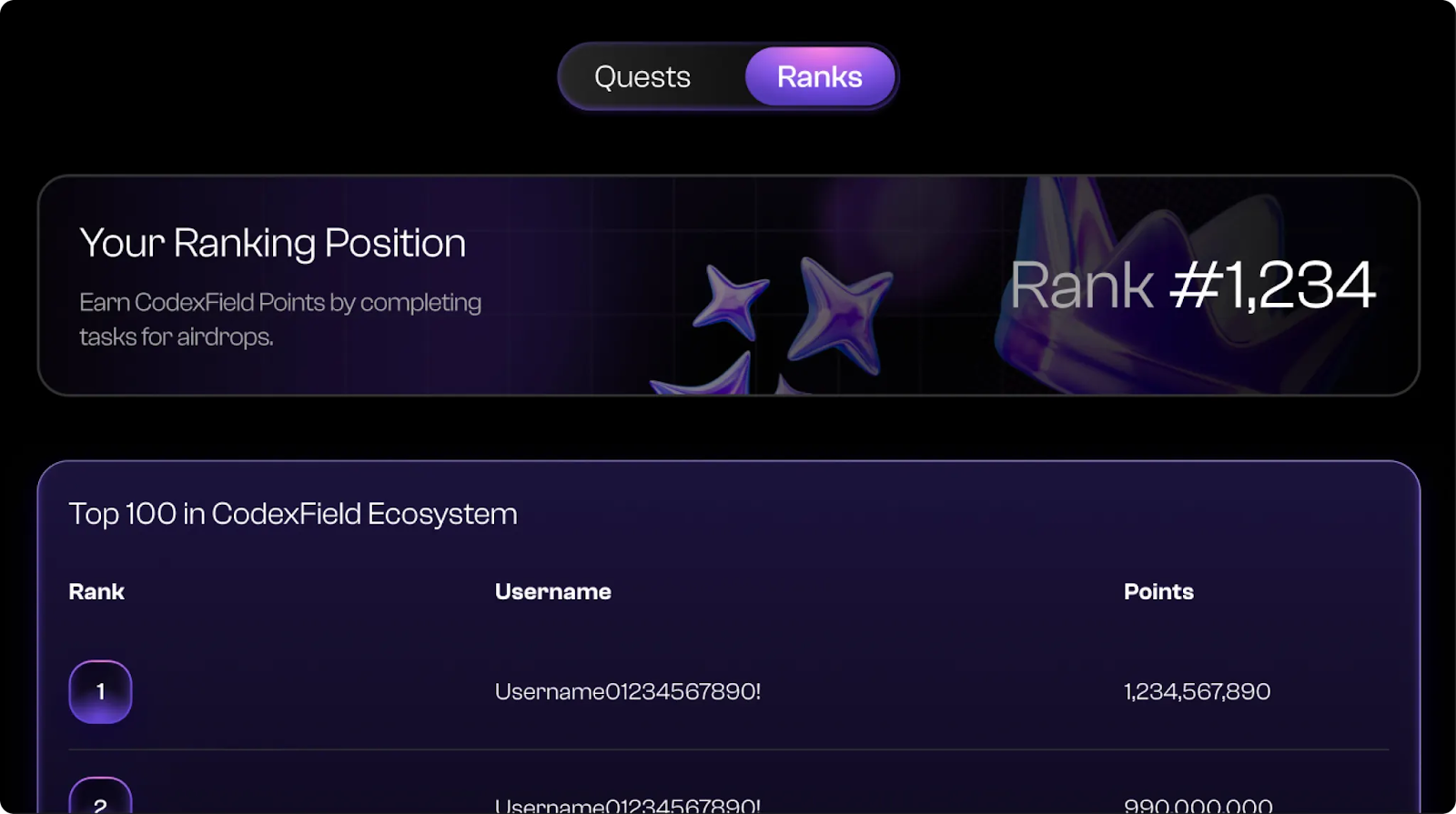
In CodexField's design, Quests serve as the entry point for incentives and the organizational unit for ecosystem activities. The system maps various behaviors both inside and outside the platform into traceable tasks, including on-chain operations (staking, trading, asset issuance), content creation (model invocation, work generation), and off-chain interactions (social dissemination, community building). Task completion is recorded as verifiable on-chain events, becoming the basis for allocating incentives and governance weights. Thus, every participation behavior on the platform acquires a clearly defined economic meaning—not just scattered interactions, but a link in the system's growth. Rank is the measurement layer for behavioral outcomes, used to measure a user's long-term contribution to the ecosystem. The system integrates multi-dimensional indicators such as task completion, activity frequency, asset performance, and interaction depth to generate a dynamic reputation and ranking structure. Rank scores not only reflect a participant's reputation position within the ecosystem but also directly affect the proportion of rewards, resource allocation, and governance weight. Through this hierarchical points system, CodexField incorporates "incentives" and "governance" into the same weighting system, allowing the ecosystem's self-governance capabilities to evolve naturally with the depth of participation. More structurally significant is that Quest & Rank permeates the entire CodexField ecosystem. Creators can complete tasks and generate content in the AI Playground, then publish and earn revenue on the Marketplace; developers upload code and maintain versions via Gitd; users engage in PoA staking or asset interaction on Wallet. Data from these activities is automatically captured and written back to the Rank model, forming a unified contribution and incentive ledger. This entire mechanism creates a continuous flow of "ownership—behavior—incentives—governance," making ecosystem growth an endogenous result of the system, rather than a short-term feedback from external stimuli. Simultaneously, CodexField's incentive system remains open and scalable. The platform provides programmable task templates, allowing third-party projects to define task logic and interoperate with CodexField's incentive mechanism. This open structure enables Quest & Rank to extend to the entire AI × Web3 ecosystem, becoming the underlying interface for external projects to introduce users, allocate rewards, and verify contributions. In other words, CodexField not only achieves structured and sustainable incentives within its own ecosystem but also provides a standardized growth protocol for external networks. Through this system, CodexField extends the "static value of ownership" to the "dynamic value of behavior," enabling the economic lifecycle of content, models, and algorithms to evolve sustainably. Incentives here are no longer merely an outcome, but become the inherent logic of system operation; growth no longer depends on external input, but originates from the participation and collaboration of the ecosystem itself. This value cycle mechanism from ownership to incentives enables CodexField to form a self-driven, verifiable, and sustainably scalable content asset network. From Incentive Mechanisms to Ecosystem Self-Evolution: After CodexField incorporates ownership, behavior, and incentives into a unified structure, ecosystem growth no longer depends on external stimuli, but forms a sustainable feedback loop within the system. When incentives become a logical component of network operation, every act of creation, invocation, transaction, and governance accumulates calculable reputation and value for the system. With the continuous accumulation of participation data, CodexField forms a self-regulating and self-driven growth structure. This structure is giving birth to a new form of order—behavior is governance, and incentives are structure. In the CodexField network, the actions of participants become a continuous process of shaping the rules. The system directly maps contributions to governance influence through quantification and weighting, enabling the ecosystem to maintain orderly expansion without centralized coordination. Incentives and governance are thus integrated into a single process: governance stems from behavior, and behavior, in turn, fuels incentives. At a deeper level, this mechanism is establishing a new organizational logic for the AI-driven content economy. Traditional platforms rely on centralized distribution to maintain order, while CodexField, through its algorithmic collaborative structure, allows "creation, use, revenue sharing, and governance" to occur continuously within the same network. Each call refines the economic profile of the model and content, and each revenue settlement strengthens the system's internal coordination, making value distribution transparent and traceable. This makes CodexField not only a platform for content assetization but also a decentralized production system. It replaces institutional friction with algorithms and centralized control with structural transparency, allowing the economic order to evolve and self-generate. Such a system no longer relies on external traffic and subsidies but achieves long-term growth through internal collaboration and behavioral consensus. Overall, CodexField is building a new life form for the content economy—an open system capable of self-growth, automatic adjustment, and continuous value creation. When incentives become the order, growth becomes a natural result, and collaboration itself is the process of value generation.