From its inception, DeFi has carried an incredibly grand vision: to build an open, permissionless, and censorship-resistant global financial system. Its ultimate promise is "Bank the Unbanked"—to provide equitable financial services to the billions of people excluded from traditional finance.
This is a revolutionary ideal capable of upending the world.
However, fast forward to today. DeFi has evolved into a thriving ecosystem with a TVL of tens of billions of dollars and a constant stream of innovation. We have DEXs, lending protocols, derivatives, stablecoins... We have built magnificent financial edifices with code.
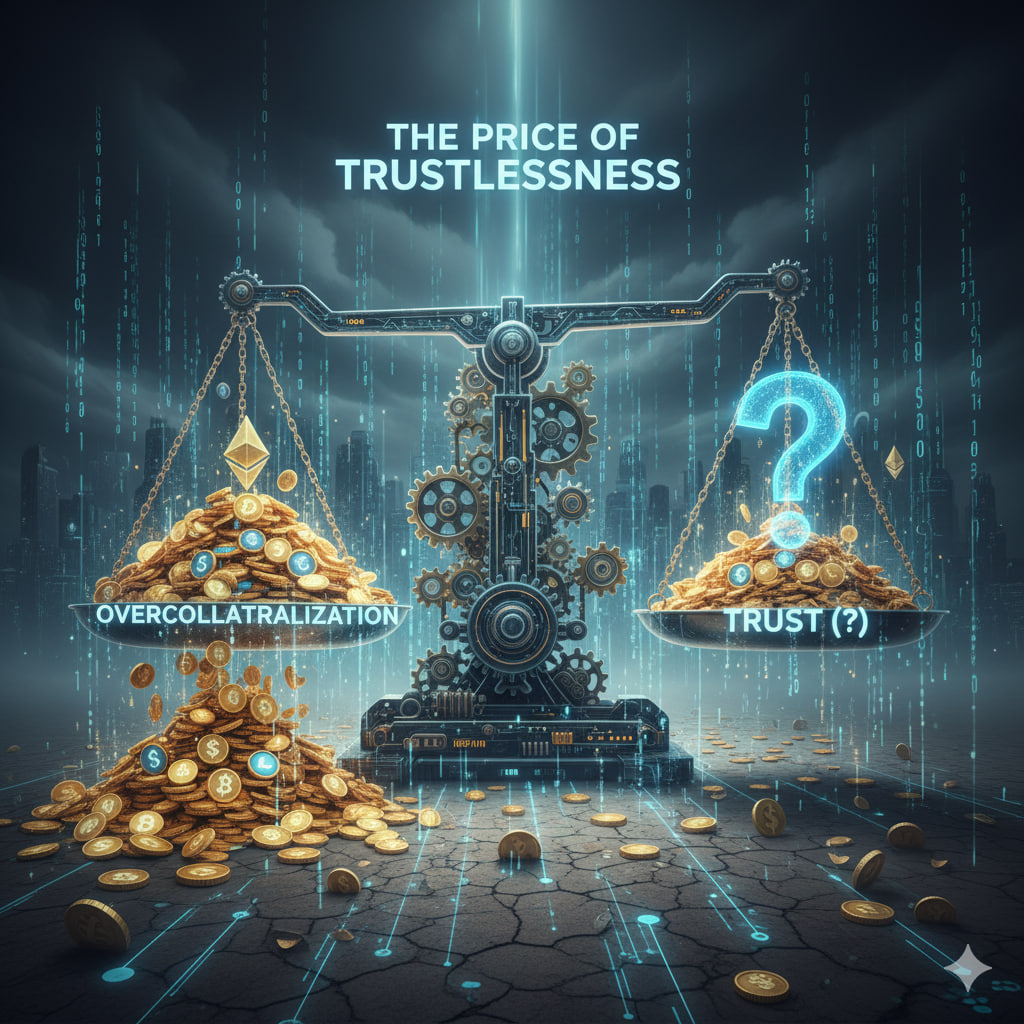
But we must honestly confront a paradox: this edifice is not truly open to those "billions of people." This wall is DeFi's "original sin" and its biggest current limitation: its systemic reliance on "over-collateralization."

I. The Original Sin of DeFi: The High Price Paid for "Trustlessness"
To understand this wall, we must go back to the first principles of DeFi.
DeFi emerged to address the core flaw of TradeFi: trust. Traditional finance relies on centralized institutions (banks, governments, clearinghouses) as intermediaries of trust. These intermediaries are expensive, inefficient, opaque, and can arbitrarily revoke your access.
Therefore, the pioneers of DeFi chose a radical and ingenious path: instead of "optimizing" trust, they "removed" trust.
By leveraging the principles of "code is law" and the transparency of blockchain, DeFi has built a "trustless" system. In this system, you don't need to trust that your counterparty will repay you; you only need to trust that the code will execute.
This brings unparalleled freedom—anyone, wherever they are, can participate anonymously. But it also brings the most expensive "debt" in DeFi history: in the world of finance, risk is always present. If you remove trust in "people," you must find another way to manage risk.
This method is called "over-collateralization".
Take DeFi's core—lending protocols (such as Aave or Compound)—as an example. In traditional banks, you can leverage your credit history (salary, property, reputation) to potentially borrow 700,000 or more by mortgaging assets worth 1 million. However, in DeFi, because the protocol doesn't know or trust you—it can't distinguish between an honest builder and a malicious anonymous wallet—it only recognizes one thing: capital.
You must deposit $150 worth of ETH in order to borrow $100 worth of USDC.
This design is "reasonable," even "unique," in a "trustless" anonymous environment. It ensures that even if you default, the protocol can remain solvent by liquidating your collateral. But this also draws a huge chasm between DeFi's grand vision and its cold reality. It inadvertently creates a paradox: a system designed to serve "the unbanked" requires you to have "excessive" bank deposits to receive services.
This is the "capital wall" of DeFi. It's not a bug, but a core characteristic stemming from its "trustless" DNA.
II. Beyond the walls: A massive group of billions with "invisible credit"
Who exactly is being kept out by this "capital wall"?
When we talk about “unbanked people,” we often mistakenly assume they are “people who have nothing.” This is a fatal misconception. These billions of “credit-invisible” people do not lack “value”; they lack “collateral recognized by TradeFi or DeFi.”
What they possess is another, more important asset that cannot currently be quantified by DeFi: reputation.
Let's clearly outline the profile of this group:
● A small e-commerce business owner in Manila: She doesn't have cryptocurrency as collateral, but she boasts three consecutive years of steadily growing store cash flow and extremely high customer satisfaction. Her "business reputation" is excellent, but DeFi doesn't recognize it.
● A brilliant developer from Buenos Aires: He is a core contributor to several well-known open-source projects, and his GitHub record is solid proof of his "technical reputation." He needs a loan to start his project, but he doesn't have enough ETH to pledge.
● A KOL with millions of followers: His "influence and reputation" are enough to make him command a large following, but he cannot use this influence as collateral to borrow a single penny in DeFi.
● A postdoctoral researcher at a top university: His "academic reputation" is highly regarded in the industry, but DeFi protocols cannot read his academic papers, let alone quantify them into credit limits.
These "credit-invisible" entities are among the most dynamic and capital-leveraged groups in the global economy. They possess skills, influence, and verifiable social capital. Ironically, DeFi, as a product of an "information" technology revolution, lives entirely in an "information" blind spot. It only understands the language of "capital."
DeFi's "overcollateralization" model essentially ignores these "reputation assets." It tells billions of people: "All your past achievements, all the reputation you've built, and all your future potential are worthless in my world. Unless you buy an expensive 'ticket' (crypto assets) first, you have no right to enter."
This systemic rejection is not only a betrayal of DeFi's promise of "financial inclusion," but also a huge constraint on its own development. It has self-castrated a value internet that should serve the world into a niche, inefficient, and capital-inefficient "Lego club for the rich."
III. Breaking Down Barriers: From "Capital Finance" to "Information Finance" (InfoFi)
We have clearly seen the "symptoms" of DeFi (over-collateralization) and the "consequences" it has caused (systemic exclusion). So, where does the future of DeFi lie? And what is its "cure"?
It is obvious that the next trillion-dollar narrative for DeFi will inevitably be "uncollateralized" or "low-collateralized" finance. Only by breaking down this capital barrier can DeFi truly move from being "Lego for the rich" to "bank for the poor," unleashing the economic potential of billions of people with "invisible credit."
But this raises a more fundamental and intractable ultimate problem. To achieve "low collateral," we must address the issue that DeFi intentionally avoided from day one: trust. We cannot remain forever in the comfort zone of "trustlessness"; we must evolve to "verifiable trust."
This means we must build a completely new infrastructure, a system capable of answering the following questions:
1. How is "reputation" verified? (Privacy and authenticity issues)
2. How is "reputation" quantified? (Standardization and pricing issues)
3. How can "reputation" be protected against attacks? (The issue of witch attacks and manipulation)
These issues represent the final hurdle for DeFi to reach the mainstream. To systematically solve them, we must introduce a new paradigm that transcends DeFi itself.

The DeFi revolution is about making "capital" programmable. But it exposes a fact: programmable capital alone is not enough; we also need "programmable trust."
This marks the beginning of the third wave of finance: InfoFi.
InfoFi's core mission is no longer to simply financialize "capital" like DeFi, but to financialize those long-neglected, most core intangible assets: information, attention, and what we have been searching for—reputation.
It's no longer simply asking "How much collateral do you have?", but has begun to systematically answer "What is the value of your reputation?". This is no longer a simple DeFi problem, but an InfoFi problem. Whoever can build the infrastructure of InfoFi will be able to break down the "capital walls" of DeFi and open up a blue ocean several orders of magnitude larger than the existing market.