
Driven by large-scale models and generative technologies, the production speed of code, content, and applications is growing at an unprecedented pace. However, whether in the traditional internet environment or the crypto ecosystem, these products still lack a standardized market for ownership verification, circulation, and reuse. Web2 content systems focus on distribution but struggle to support fine-grained licensing, access, and revenue sharing. While Web3's ownership verification mechanisms solve the ownership issue, they haven't yet established a structure for the rights to use, access, and generate revenue for models and creative assets. As a result, a large amount of AI-generated or user-created resources remain at the "displayable" level, failing to form a sustainable and measurable value path. This gap is particularly pronounced for creators and developers. Creators struggle to convert content, models, or applications into long-term revenue, while developers lack an environment that allows them to directly access others' assets for combinatorial innovation. The industry as a whole lacks a truly meaningful market—an infrastructure that allows models, code, multimodal content, and AI applications to enter a standardized circulation system. Against this backdrop, CodexField chooses to build its content asset lifecycle as a holistic project. From underlying storage and ownership confirmation to model invocation and generation, CodexField has established the foundation for creative and technical capabilities through Gitd and AI Playground. However, to give assets real value, a mere entry point for creation is insufficient. For any ecosystem to scale, a market structure capable of supporting the circulation of content, models, and applications is needed, allowing creative results not only to be generated and preserved but also to be invoked, traded, and reused. CodexField therefore considers the Marketplace a key component of its content economy. It plays the role of enabling on-chain assets to "enter the market," transforming code, models, and applications from technological products into tradable economic units, and building a fundamental channel for value exchange and collaboration throughout the ecosystem.
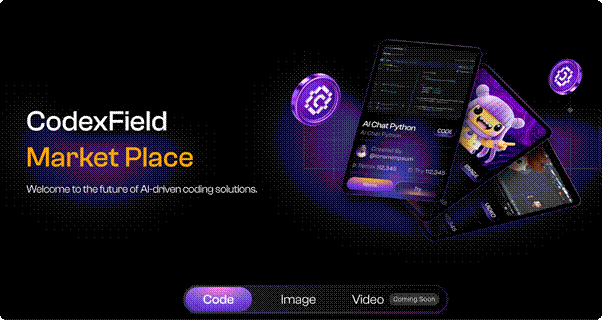
CodexField Marketplace: An On-Chain Hub for Content and Smart Assets. CodexField is a systematic ecosystem centered around content assets and intelligent computing. Unlike traditional content platforms or single AI tools, CodexField focuses on how to create reusable, composable, and accumulative production relationships for code, models, and creative outputs on-chain. To this end, multiple modules within the ecosystem continuously evolve around the same goal, deeply integrating creative activities with the on-chain economic structure, ensuring that every generation, call, or collaboration can be recorded, measured, and participate in value flow. In the CodexField system, the production, management, and execution of content and models are connected by a structured on-chain environment. Gitd provides verifiable storage and version management for code, enabling developers to have on-chain ownership and traceability of their work; AI Playground provides a modular structure for model calls, content generation, and application building, allowing the creation process itself to be reused and combined; Wallet serves as the ecosystem's identity, asset, and billing framework, ensuring that any call, transaction, or authorization can be completed within the same account system. As these activities continue to occur within the ecosystem, CodexField gradually incorporates creative outputs into a unified assetization process. Code, models, multimodal content, and application components can be recorded as assets with verifiable ownership, traceability, and measurability, and bound to attributes such as usage rights, access rights, and revenue rights. Based on this, the CodexField Marketplace plays a crucial role in enabling content and smart assets to enter the value circulation stage. It provides a unified market entry point for different types of assets, allowing creators' models, code, applications, and multimodal works to be displayed, accessed, traded, and reused. The Marketplace introduces these assetized creative outputs into the on-chain economic network, giving them true market significance and making them composable, licensable, and profit-sharing economic units, thus jointly constructing a complete content economic structure with the ecosystem's internal production and incentive systems. Through the Marketplace, production activities within the CodexField ecosystem are drawn into a larger collaborative network: assets can be accessed, combined, and used to build new applications; creators can obtain continuous revenue; developers can reuse existing components to quickly iterate products; and model providers can also allow their technology to participate in more downstream scenarios. The Marketplace thus becomes a crucial node for content and models to move from "production" to "circulation," and is also the foundation for CodexField's ability to form a systemic network effect. The role of the CodexField Marketplace as a systematic entry point for content assets into the economic network is not limited to providing a browsable interface; it is more like a "structured engine" for content and model assets to enter the economic network. Here, creative achievements within the ecosystem are transformed, organized, and incorporated into a sustainable circulation system, giving CodexField's content economy true scalability.
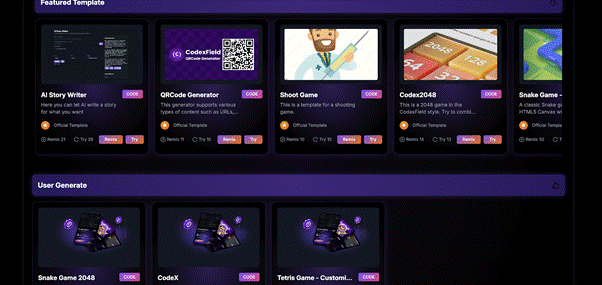
The Marketplace's first capability stems from the standardized processing of assets. Within the CodexField ecosystem, creators and developers produce diverse content: code, models, AI applications, multimodal content, plugin components, and more. These resources, originally of vastly different formats, are abstracted into describable, callable, and measurable asset units within the Marketplace. This standardized structure allows them to be displayed, reused, or combined in a unified manner, and also provides a consistent logic for subsequent licensing, revenue sharing, and invocation. Once assets have a structured form, the Marketplace undertakes the second crucial function: building pathways for content to be used, licensed, and combined. Creators' models can be directly integrated into applications by developers, code snippets can support secondary development by others, and AI applications can be disassembled and recombined into new production tools. The Marketplace organizes these actions into executable on-chain logic, making "reuse" the most fundamental collaborative method within the ecosystem, rather than fragmented individual behaviors. The third capability is reflected in the routing of revenue. By integrating with Wallet, Marketplace establishes a complete billing and revenue-sharing structure for model invocation, content usage, asset portfolio creation, and secondary creation. Whether it's a one-time license, per-use invocation, secondary release, or a multi-party collaborative creation chain, a clear revenue path can be found in Marketplace, allowing the value of creative achievements to be naturally accumulated. Ultimately, Marketplace becomes the interaction hub between various modules within CodexField. Code assets from Gitd, models and applications generated in the AI Playground, participation and contributions recorded via PoA, and user behavior organized by Quest & Rank will all find corresponding use cases in Marketplace. It provides a foothold for all production activities within the ecosystem and gives all value circulation processes a traceable, composable, and sustainable logical structure. In this sense, Marketplace is playing the role of the systemic foundation for CodexField's content asset system to achieve large-scale collaboration, circulation, and growth. Overall, the emergence of CodexField Marketplace is enabling creation to move beyond mere publishing, models to transcend simple calls, and content to transcend just the work itself. It opens a gateway to a value system for creators, provides developers with a resource pool for combinatorial innovation, and establishes a sustainable circulation layer for the entire ecosystem. As the Marketplace continues to expand, CodexField will gradually form an open network capable of supporting large-scale collaboration and an intelligent content economy.