Hi everyone, these past two days, every time I checked my phone, I saw an outrageous message:
Even Michael Burry , the legendary tycoon in the movie "The Big Short" who went against everyone else and short subprime mortgages, has started a paid group!
I:???
No, what happened to the "I'm the only one who's sober when everyone else is drunk" attitude? What happened to the dislike of the media and the disdain for exploiting retail investors?
How did this rebellious individual with thick eyebrows and big eyes manage to have his persona collapse so suddenly?
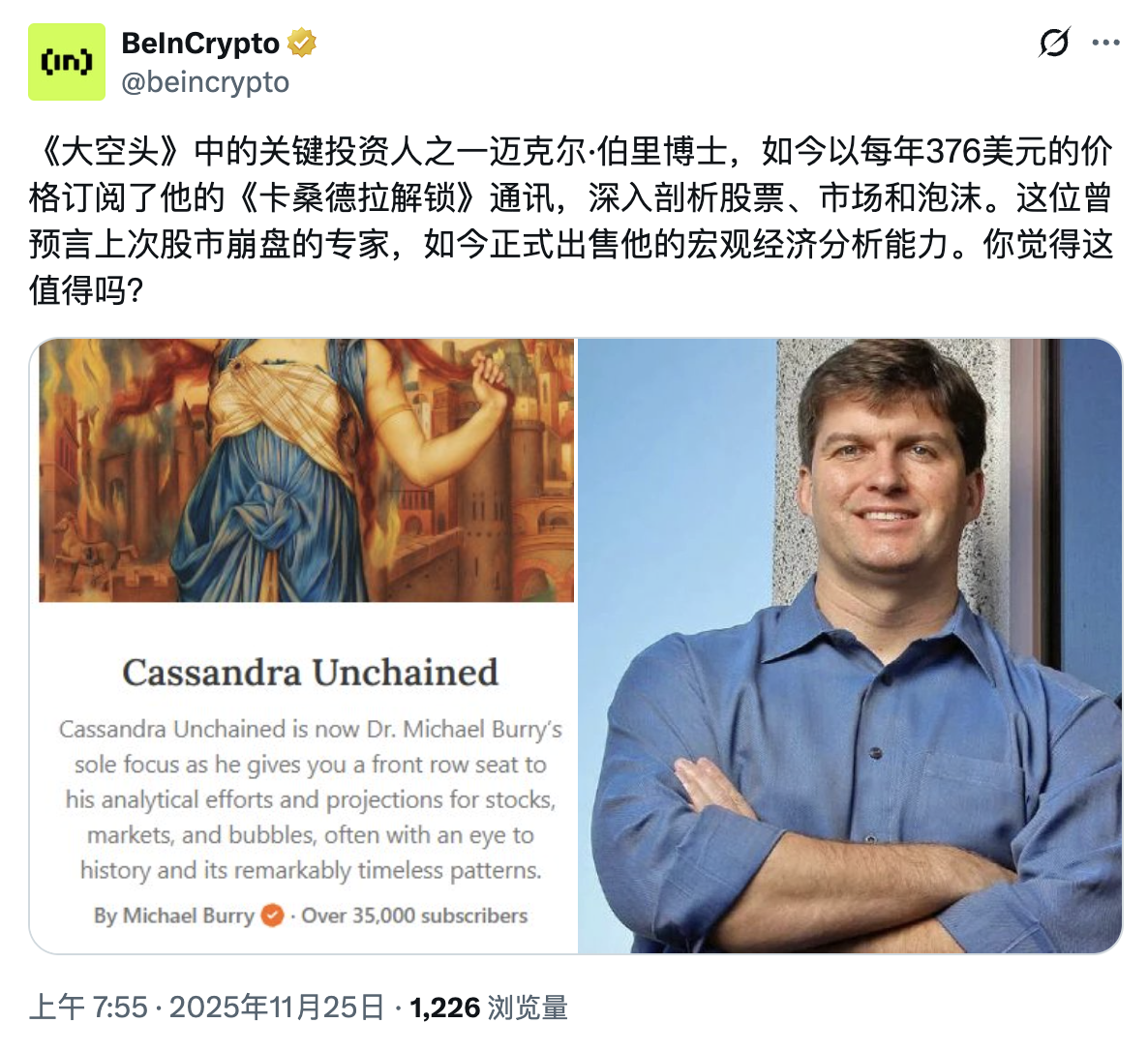
Upon closer inspection of the details, I was even more bewildered.
His paid channel, Cassandra Unchained
It currently has over 60,000 subscribers and has generated over $22.74 million in revenue. The annual fee is $376 , which is approximately 2,700 RMB .
Despite its high price, over 60,000 people have already paid for it, generating a whopping $22 million .
Coincidentally, not long ago, Donald Trump Jr., the eldest son of Trump, also launched an elite club with an outrageous membership fee of $500,000 .
I'm wondering, what's wrong with this world? From the stock and cryptocurrency trading groups around us to Wall Street and the White House, is the whole world just one giant paid group?

But here's the problem.
These big shots should have been financially independent long ago, with more money than they could spend in several lifetimes, right? Why would they "condescend" to earn this "small change"?
Upon closer examination, I realized that things were not so simple.
The answer lies in the most basic business logic: cash flow.
Think about it, investing is essentially a high-stakes gamble. Even someone as successful as Burley Ginsburg has lost a lot of money with his fund by short tech stocks. The market can make you a legend today, but it can wipe you out tomorrow.
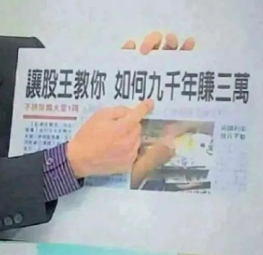
But paid groups are a sure-fire way to make money.
It provides a stable, predictable, and virtually zero-cost positive cash flow .
To give an analogy, it's like why Warren Buffett loves running insurance companies so much: because insurance can generate a continuous flow of "float," providing him with a constant source of investment ammunition.
Now, paid knowledge services have become the "personal insurance business" for business leaders .
When the market is good, this money is icing on the cake; when the market is bad, this steady income is their lifeline and the confidence to weather bull and bear markets.
To put it bluntly, smart people are turning their influence into a private money-printing machine.
But the story doesn't end there.
Behind this money lies an even more sophisticated "art of selection".
Paying is not just about making money, but also about "screening people".
Just think, Donald Trump Jr.'s $500,000 club, that price alone automatically filters out those who are just there for the spectacle and those who don't have the financial means.
What kind of people can afford to pay this much to get in? They are either very rich or very powerful, and their values and wealth levels are similar.
This creates a highly homogenized "circle" .
Paying has become the most efficient filter. There's a psychological phenomenon called the "sunk cost effect"—the more you invest in something, the more you value it, and the higher your loyalty becomes.
Within this circle, people are more likely to resonate with each other, build trust, and even form a community of shared interests.
So you see, even if the "group leader" fails in his investment one day, as long as this paid circle built with real money still exists, his core influence and base will not collapse.

This, in turn, raises a trend that deserves our even greater vigilance: the end of information democratization.
For the past decade, we naively believed that Twitter and Weibo had brought us in sync with the world and democratized information.
But now it seems that it may have just been an illusion.
The big shots either choose to remain silent or hide the real valuable insights and key information behind the paywall.
Public social media platforms are increasingly resembling noisy "showgrounds" and "billboards" .
A brutal "Matthew effect" of information is taking shape:
The wealthy not only have more money, but they can also pay to enter a closed circle with earlier access to higher-quality information and a wider network of connections.
And what about ordinary investors? We are left behind on the ruins of public information, spinning around every day in a deluge of slogans and second-hand and third-hand information, hoping to make key decisions using these distorted fragments.

Ultimately, we are not ushering in a more open world, but rather an increasingly rigid "information feudal era."
So when Bury and Donald Trump Jr. started creating groups, we lost far more than just a free opportunity to watch big shots speak.
What we are witnessing is a complete shift in an era: that seemingly flat, free utopia is slowly closing its doors before our eyes.
And each of us has to think about this question:
In this new era, are you content to forever scavenge for information at the bottom of the supply chain, or are you starting to think of ways to build yourself an information "life preserver"?
🎉Let 's explore everything about beraBTC, BVT, and BearChain together .
Welcome to follow ⭐️ Batoshi