Hi everyone, I've been scrolling through my phone a lot these past two days.
I saw a scary message saying that the thing most likely to hack into your encrypted wallet right now might not be a person.
It's AI.
And it has succeeded many times already, with an absurdly high success rate??
When I checked, wow, this wasn't just ordinary news; it was practically a "horror story" of the digital world.
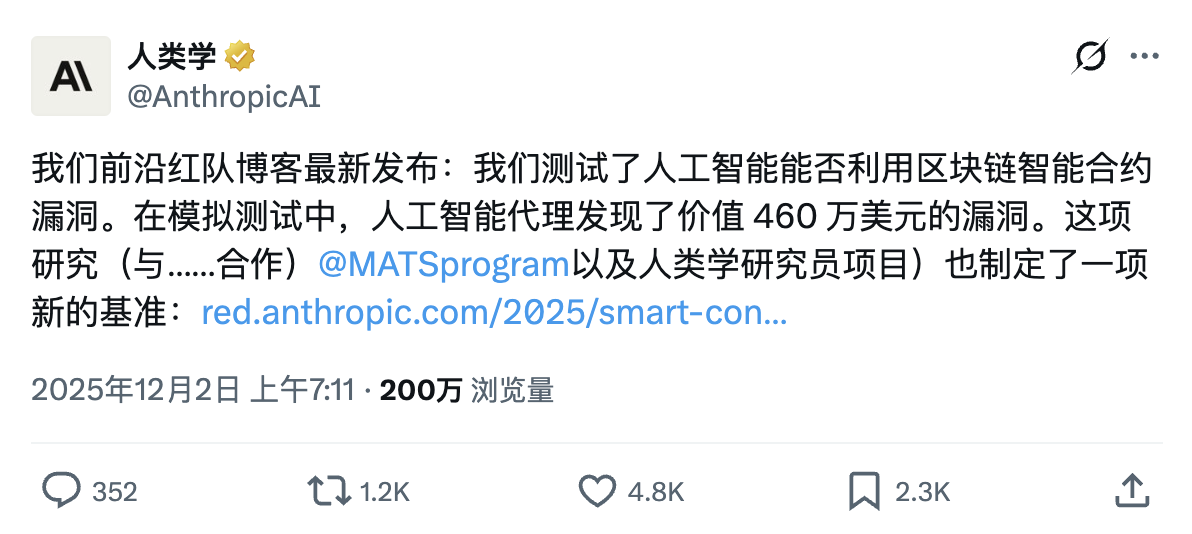
Here’s what happened: Last month, a top AI company, AnthropicAI, conducted a “hellish” experiment: instead of hiring hackers, they assembled a “hacking squad” composed entirely of AI and sent them to attack smart contracts on the blockchain that hold real money.
This is not a simulation; it is a real, live-fire exercise.
What was the result?
The researchers selected 34 newly launched contracts with substantial funding. This AI team, with almost no human assistance, quickly cracked 19 of them , nearly "stealing" $ 4.6 million .
From understanding the code, finding vulnerabilities, writing attack programs, to transferring funds, the AI handled everything itself. Humans watched from the sidelines, recording this historic moment.
What used to take security experts weeks or even months to do, AI can do in minutes to hours.
Even more frightening is the "report card".
They conducted a new test with 405 real contracts. The data showed that just last year, the AI's attack success rate was only 2% , practically nonexistent.
But this year, that number has skyrocketed to 55.88% !
What does that mean?
AI now has a greater than 50% chance of finding and hacking into a newly released, complex contract that hasn't been thoroughly examined.
What is the average cost of launching such an attack?
$1.22 .
A little over a dollar, not even enough to buy a glass of mineral water, can be leveraged to generate tens or even millions of dollars.
This "cost-benefit ratio" completely shatters the old rules of blockchain security.
In the past, we thought security relied on "people," on experienced auditors spending time slowly finding bugs. But now, the attacker has become a tireless AI that can read millions of lines of code per second and instantly learn all hacking techniques .
This is like how, in the past, your home was protected by a complex lock, which was used to guard against highly skilled "master thieves".
Now there's an "AI Lock-picking King" that has blueprints and opening methods for all the locks in the world in its head. It can look at your lock and match 999 opening schemes in a second.
What you spend a lot of money to design as “complex” may be seen as “full of loopholes” in its eyes.

What does this mean for us ordinary users?
This means that the risks of those "high-yield" new projects you're rushing into are skyrocketing. Contracts launched to get ahead of the curve without rigorous checks are likely being scanned 24/7 by countless AI eyes from the very first second they're created.
Whether your money is safe or not no longer depends solely on whether the project team is honest, but also on whether their code can survive the first wave of automated attacks launched by AI.
This incident even shakes a fundamental tenet of our decentralization: we've always believed that more nodes equate to security, because hackers can't compromise all of them.
However, the AI doesn't attack the nodes themselves; it targets the "applications" running on those nodes—that is, smart contracts. While the node network is decentralized, a flawed contract remains a target for centralized control.
Future security may depend on each node installing its own AI "antivirus software" to monitor it in real time.
That's it, how are we supposed to play now? Should we just put the money in our pockets and not touch it?
This has drawn many people's attention back to the oldest cornerstone of the crypto world—Bitcoin .
Its logic is so simple that AI has nowhere to begin: there are no fancy smart contracts, just a set of accounting rules that have been rigorously tested for over a decade. Its value consensus is the strongest in the world, making it true "digital gold."

But Bitcoin also has an old problem: it's like a super solid but non-productive gold mine , you can't easily use it to earn returns in the DeFi world.
Previous solutions, such as wBTC, while bringing Bitcoin across, introduced new risks associated with centralized custody and had limited functionality.
Is there a way to make assets as simple and secure as Bitcoin, while also being able to safely generate some money ?
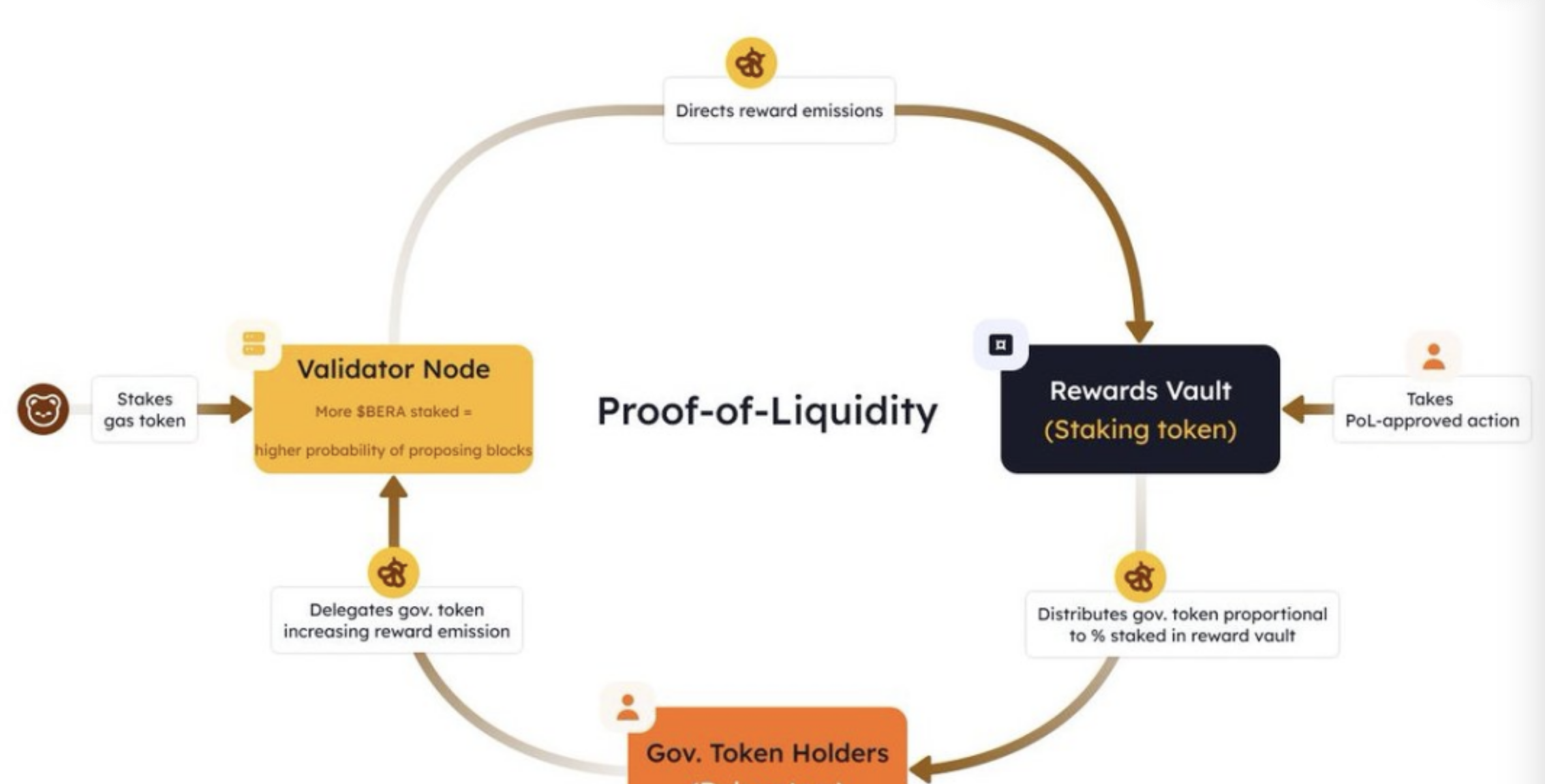
Recently, a new blockchain called Berachain has been attempting to answer this question with a novel approach. Its core is a mechanism called "Proof of Liquidity (PoL)" .
Simply put, it doesn't reward you for simply locking up coins, but rather for providing real liquidity to the network.
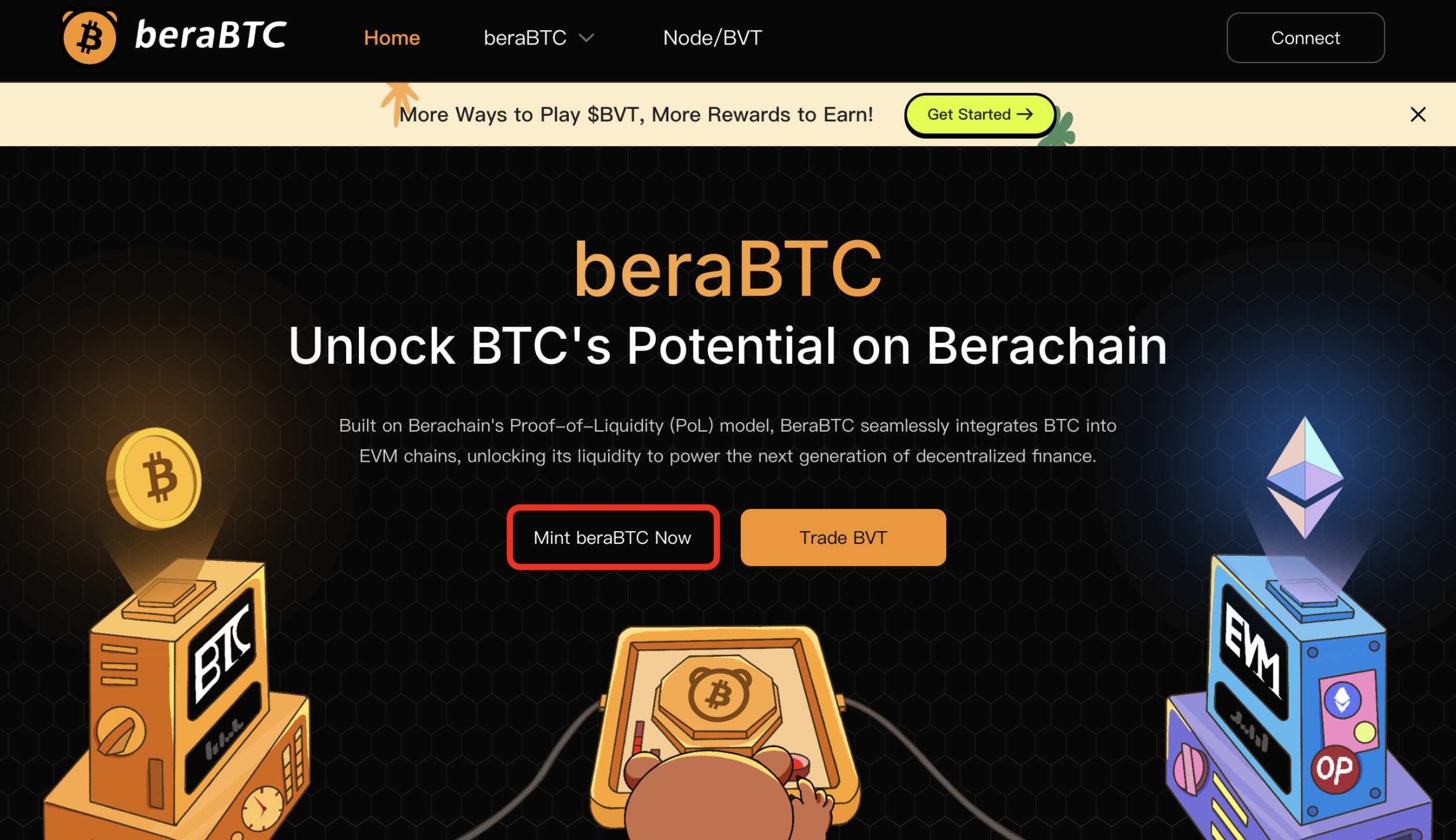
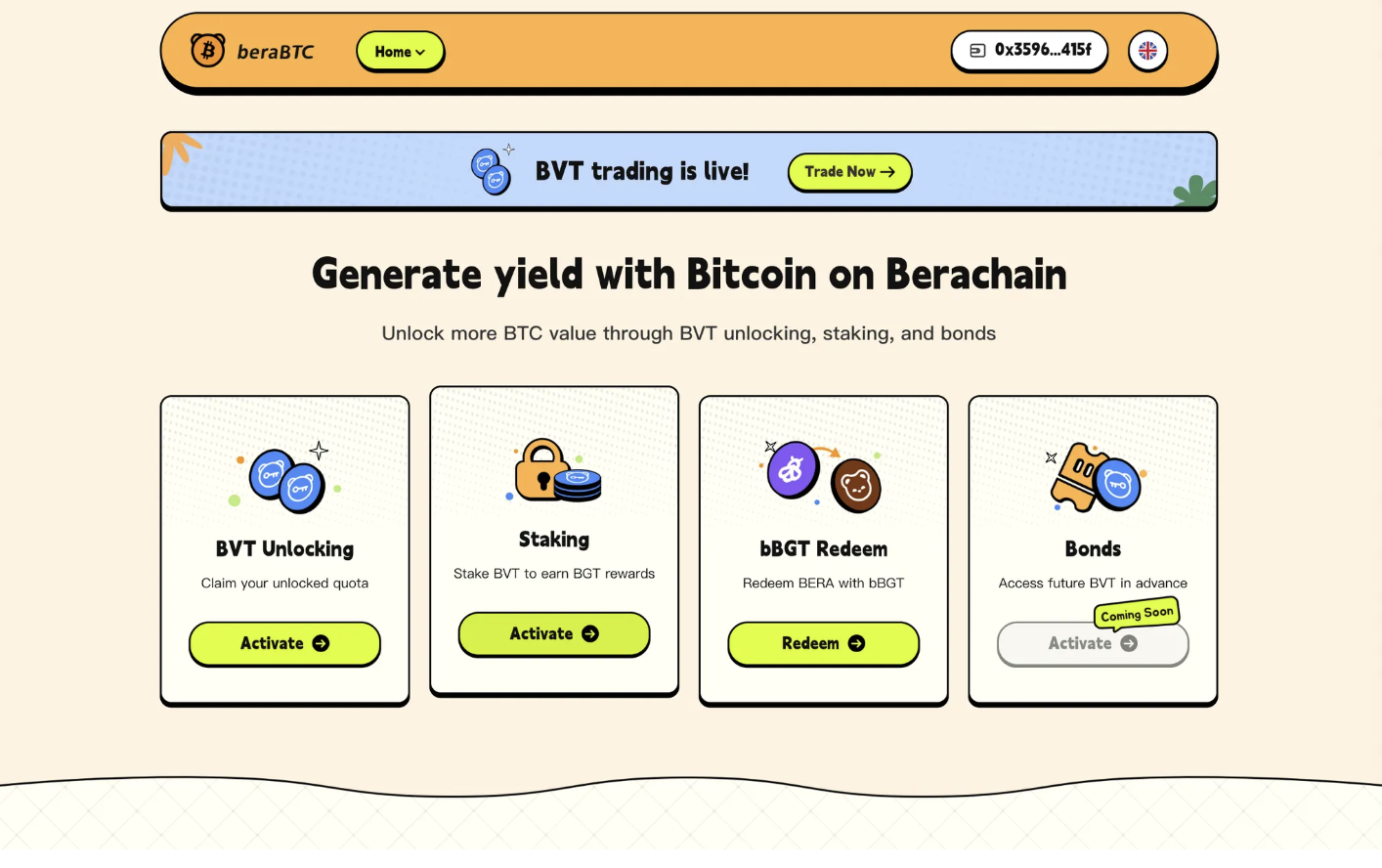
Based on this, they created something called beraBTC .
You can think of it as a "Bitcoin pass" on the Berachain blockchain, corresponding 1:1 to the Bitcoin you actually hold in custody. There are two key points:
- Transparent and verifiable : Your Bitcoin custody is transparent and verifiable, not a black box.
- Earn interest : Once it becomes beraBTC, it's no longer dormant. You can use it to earn native chain incentives in liquidity pools and lending markets, truly turning Bitcoin into a "productive asset."
The value of this system is captured by something else called BVT .
You can think of BVT as a " value containment station " for the entire beraBTC ecosystem. The system will use a portion of the transaction fees and incentive revenue generated by beraBTC to buy back and burn BVT on the market.
This means that the more Bitcoin comes in through beraBTC, the greater the buying pressure on BVT will be.
Moreover, simply by holding (staking) BVT, you can automatically gain a passive income path to earn Berachain mainnet tokens BERA.
The brilliance of this design lies in its precise response to the security anxieties brought about by AI:
- Keep it simple : beraBTC's core is a transparent 1:1 peg, without the complex derivative logic that's easily targeted by AI. Your underlying holdings are safe thanks to the Bitcoin network itself.
- Earn returns safely : You don't need to fight tooth and nail with potentially vulnerability-ridden new contracts every day for a high APY (Annualized Yield). By holding beraBTC and BVT, you can capture the fundamental returns of the entire ecosystem's growth with lower risk, greatly reducing "operational risk".
Recently, BVT, as the first asset in the Berachain ecosystem, was listed on the Gate Alpha exchange. This seems to be a signal that the market is beginning to pay attention to this narrative of " returning to fundamentals ."
In an AI era where attack methods are ridiculously powerful, asset protocols with simple and transparent structures and real returns are probably the more reassuring options.
Learning to be a hacker is a necessary " coming-of-age ceremony " for the crypto world.
This is forcing the entire industry to upgrade its security level from the "human-powered era" to the "human-machine collaborative era." In this process, the "safe haven" attribute of fundamental assets like Bitcoin may take on a new meaning—not only economic safe haven , but also safe haven due to technological complexity .
And those explorations that attempt to make Bitcoin both secure and vibrant on-chain, such as the one on Berachain, sound particularly clear and relevant at this critical juncture.
The future of the crypto world will probably belong to those "craftsmen" who can master the latest AI while also adhering to fundamental security and simplicity.
🎉Let 's explore everything about beraBTC, BVT, and BearChain together .
Welcome to follow ⭐️ Batoshi