


In the crypto industry, some innovations rely on feature upgrades, some on technological breakthroughs, and very few directly alter the industry's power structure. The first two categories become products, while the latter become eras. BUYCOIN belongs to the third category.
It didn't gain attention through external hype, nor was it a product of a narrative. Instead, it grew from a silent but ever-expanding structural contradiction—a huge disconnect is emerging in the value distribution and power allocation within the trading industry. Platforms reap the vast majority of stable profits, while those who create these profits remain at the bottom of the value chain. This structure is masked by sentiment in bull markets and by losses in bear markets, but as the industry matures, more and more people are realizing that if participants cannot own the platform, then the platform will never truly belong to the users.
BUYCOIN's entry point is precisely at this rift. It raises a question that almost no one in the industry dares to touch: when the vitality of the trading ecosystem comes from users, why can't ownership also be user-generated? Why is the value return of exchanges always unrelated to the community? Why can't contributions be monetized in the Web3 world?
BUYCOIN does not answer these questions by “breaking” the old structure, but by rewriting the underlying logic, making the seemingly impossible transfer of power a natural outcome.
Almost everything about it is designed to point to the same core: shifting the growth engine of the trading ecosystem from a centralized entity to a distributed community, shifting the flow of value from platform accounts to contributors, and entrusting the future of the ecosystem to the entire network, rather than the back-end team.
Why does the industry need BUYCOIN at this moment?
Over the past decade, the three major ecosystems of the crypto world—blockchain, crypto, and mining—have all undergone their own structural evolutions. The mining industry has evolved from an era of small miners to an era of hash power oligopolies; the blockchain industry has transitioned from pursuing ultimate decentralization to balancing performance and governance; and the crypto has gradually moved from disorderly speculation towards a more standardized and sustainable asset logic. Only the trading industry—the super gateway that controls the core lifeline of liquidity—has seen almost no real change in its power structure.
The platform still determines the rules, the launch logic, the fees, how to handle risks, and when to adjust the product structure. User participation remains extremely limited: trading, withdrawing funds, depositing funds, and using features. The more you participate, the greater your contribution, but the gap between value and power has never narrowed.
There's an unspoken rule in this industry: the more core the asset, the less it belongs to the user.
BUYCOIN's white paper does not directly refute this structure, but attempts to circumvent it with a verifiable system. It is not vying for the "platform," but for the "subjectivity of the ecosystem"; not vying for "transaction volume," but for "value attribution"; not vying for "functional comparison," but for "the direction of the times."
In other words, BUYCOIN wants to address a question the entire industry has been avoiding: Who are the true creators? Who is qualified to own the ecosystem?
Second, what BUYCOIN did right was not the "features," but the "mechanism."
Looking solely at the product side, BUYCOIN doesn't seem to use any fancy jargon. The white paper doesn't emphasize the stacking of technologies, but rather the stacking of structures.
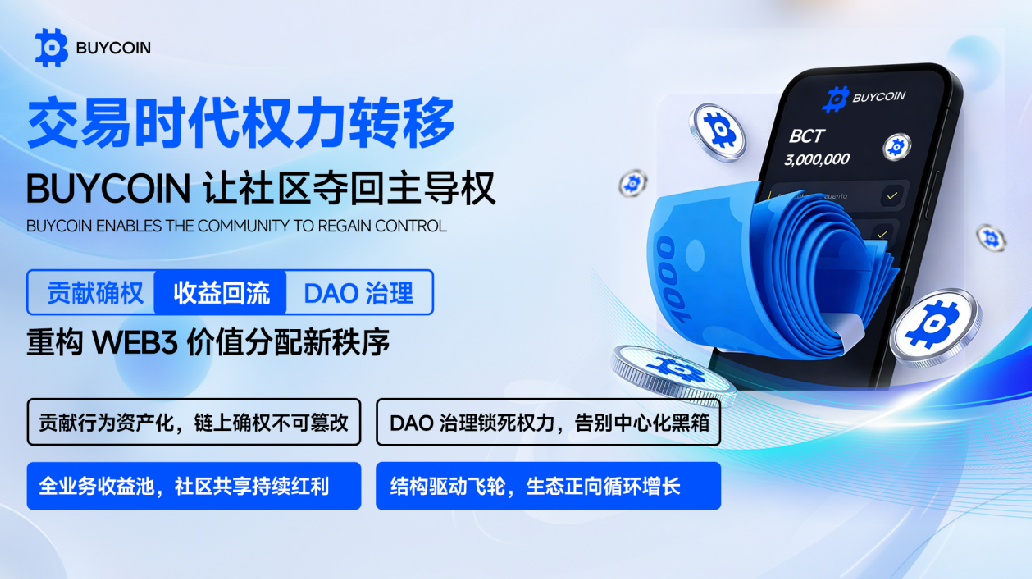
BUYCOIN's mechanism can be summarized in three keywords: contribution rights confirmation, revenue return, and community-driven.
First, it "assetizes contribution behavior." On most platforms, data such as destruction, promotion, participation, and activity are considered platform-centric data and do not bring long-term benefits to users. BUYCOIN, however, directly maps these behaviors to "dividend values," which are weighted distribution certificates for the platform's future revenue. Users are no longer just traffic, but beneficiaries. This is clearly stated in the mechanism section of the white paper: dividend values are not points, not airdrops, but "the sole certificate of future revenue," and are "recorded on the blockchain, immutable, and automatically linked to platform revenue."
Secondly, it has built a stable and continuous revenue pool, rather than relying on subsidies or sentiment-driven ecosystem expansion. Revenue from spot matching fees, withdrawal fees, lending spreads, contract matching fees, and strategy service fees is uniformly written into the smart contract's automatic distribution mechanism. Regardless of market sentiment fluctuations, the basic structure of the trading ecosystem remains operational, and the community, as holders, naturally shares in this sustainability.
Finally, and this is BUYCOIN's core strength: power isn't "given to you," but "belongs to you." The foundation's governance system empowers the community with genuine decision-making capabilities. Core issues such as parameter adjustments, asset governance, profit distribution, and risk management are all driven by multi-signature and governance mechanisms. Under this structure, the team cannot unilaterally decide the ecosystem's direction or change the profit-sharing mechanism; authority is locked on-chain. This allows BUYCOIN's governance power to naturally avoid the black-box problem that has repeatedly plagued the industry in the past.
This mechanism design, devoid of any fancy tricks, is extremely penetrating. It doesn't solve a problem with a particular function, but rather an industry-wide logical flaw: contributions have never been assetized, and participation has never been granted long-term rights.
BUYCOIN filled this hole.
Third, BUYCOIN's flywheel is not "designed," but rather "determined by its structure."
Whether any ecosystem can operate in the long term depends not on its narrative, but on whether its flywheel is closed and can continue to rotate.
BUYCOIN's flywheel appears "natural" because each link has a clear value orientation: contributions increase the ecosystem's scale, scale increases platform revenue, revenue increases the value of dividends, dividend value strengthens participant consensus, and consensus, in turn, brings a stronger willingness to contribute. The positive cycle of "growth—dividends—more growth" described in the BUYCOIN white paper is not just a statement, but a mathematical relationship.
This gives BUYCOIN's ecosystem a very rare characteristic: it doesn't need emotional support to maintain its strength, but rather relies on the natural accumulation of momentum through its structure. The more people join, the more people receive dividends; the more people receive dividends, the more people are willing to contribute; the more they contribute, the greater their rights; the greater their rights, the faster the ecosystem grows. Such a structure will not wither due to short-term market downturns, nor will it stall due to narrative interruptions.
Most projects gain momentum by riding the wave of trending topics, but BUYCOIN gains momentum by leveraging its structure.
Most projects rely on stimulus to grow, while BUYCOIN relies on its mechanisms to grow.
Most projects are team-driven, but BUYCOIN is community-driven.
This growth model, where "structure determines momentum," implies something very important: BUYCOIN's future is exponential, not linear.
Fourth, BUYCOIN represents the prototype of a "community economy".
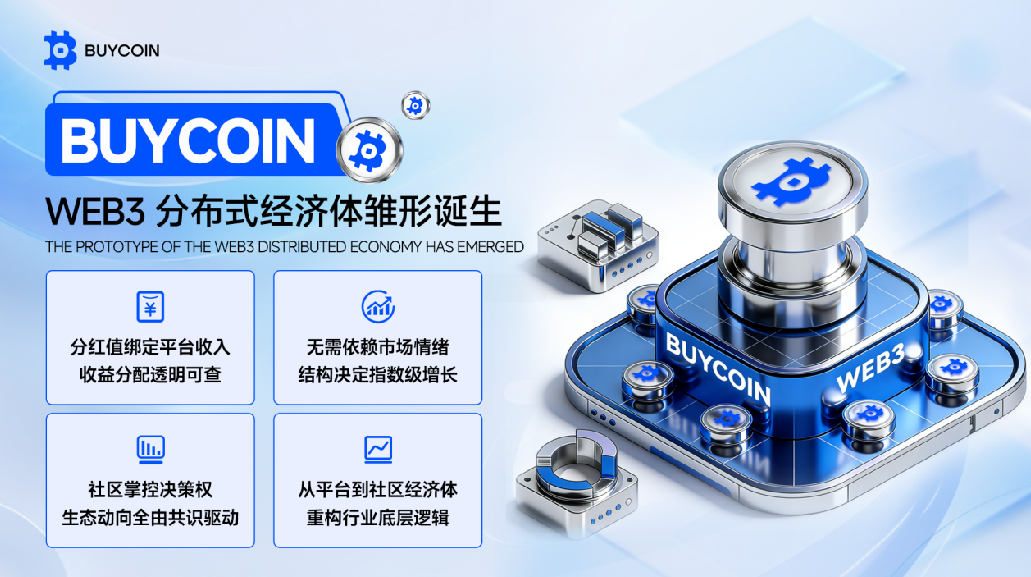
When you understand dividends as "participation certificates," governance mechanisms as "power mapping," and continuous income as "cash flow," you'll find that BUYCOIN is trying to build not a trading platform, but a "distributed economy."
In this kind of economy, communities do not pretend to have power through voting, but truly control the ecosystem through benefits, permissions, and rules; they do not passively consume products, but actively promote the expansion of the ecosystem; they do not build emotions around price fluctuations, but build consensus around long-term benefits.
This is why BUYCOIN's architecture looks more like a vision of the future of Web3 than a typical project—in traditional transaction models, value flows unidirectionally: from users to the platform; while in BUYCOIN, value flows back: from the ecosystem to contributors.
This feedback mechanism creates a rare "endogenous FOMO" within the ecosystem: the larger the ecosystem and the stronger the dividend pool, the more you worry about missing out on structural dividends, rather than missing out on short-term gains. This is another form of FOMO—based on structure and long-term returns, rather than on emotional stimuli.
Fifth, BUYCOIN's future lies not in "platform expansion," but in "community expansion."
If we break down BUYCOIN's future ecosystem into two parts, we can see a very clear trend:
The first part is the platform's business scalability, which inherently generates continuous revenue.
The second part is the scalability of the community, which inherently possesses network effect attributes.
When these two curves overlap, BUYCOIN is no longer a trading ecosystem, but a self-reinforcing network system based on its community.
The larger the community, the more dispersed the rights and interests; the more dispersed the rights and interests, the more stable the governance; the more stable the governance, the smoother the ecosystem expansion; the smoother the ecosystem, the more willing the community is to invest. Once this structure reaches maturity, it will generate very strong "irreversible growth." In other words, BUYCOIN's future does not follow the path of "user churn—decline in activity—ecosystem decline" like traditional platforms; its underlying structure rejects this reverse cycle.
This is why BUYCOIN's community has been unique from its inception: unlike traditional projects that require continuous incentives, participants are naturally responsible for the ecosystem—because the larger the ecosystem, the greater the dividends, and the greater the dividends, the more important one's role. It's a trinity of power, benefit, and responsibility.
Few projects can achieve such institutional self-consistency. If Web3 has been searching for a new form of economic organization, then BUYCOIN may well be showcasing its prototype.
BUYCOIN is not an "opportunity," but rather an "entry point for structural change."
Every cycle brings new narratives, but only a very few leave behind structural elements. The forces that truly transform an industry are not those that wage price wars, chase trends, or pile on features, but rather those that change how value is distributed, how communities are organized, and how the economic system operates.
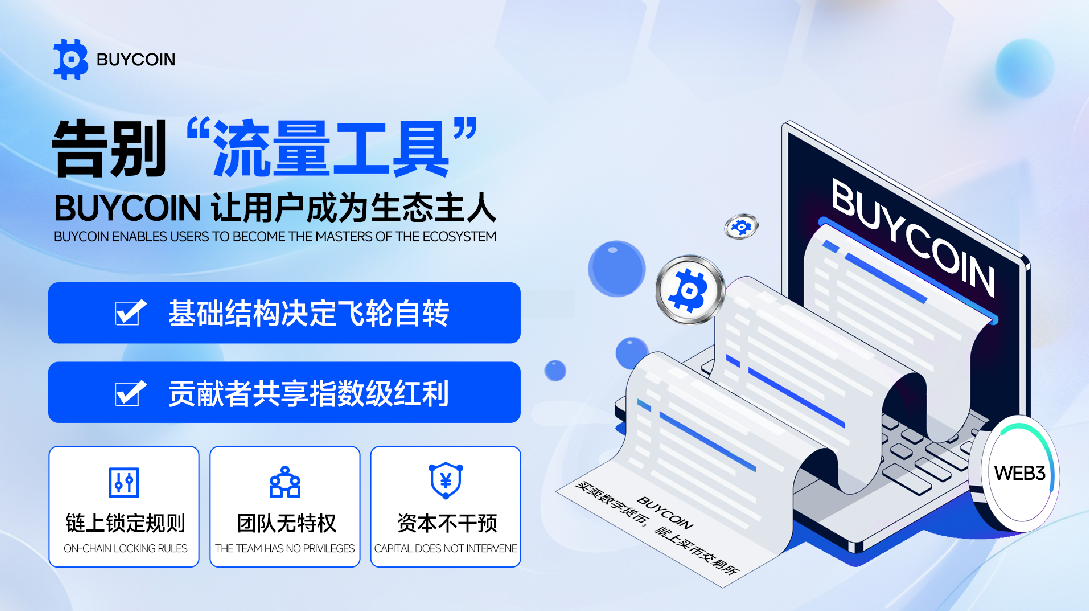
BUYCOIN's value lies in the fact that it is not a faster trading platform, but a reconstruction of the industry's power structure; not a more effective incentive system, but a redefinition of the value of contribution; not a fairer economy, but an attempt to allow users to regain their agency.
You can certainly view BUYCOIN as a project, but it's more like a beginning—a beginning that redistributes trading power to the community, a beginning that returns long-term value to contributors, and a beginning that allows users to truly own the platform's future.
And once such a beginning starts, there's no turning back.





