The reason for ChatGPT's strange writing style (commonly known as having a strong AI flavor) has been found!
Kenyan writer: They all learned from us.
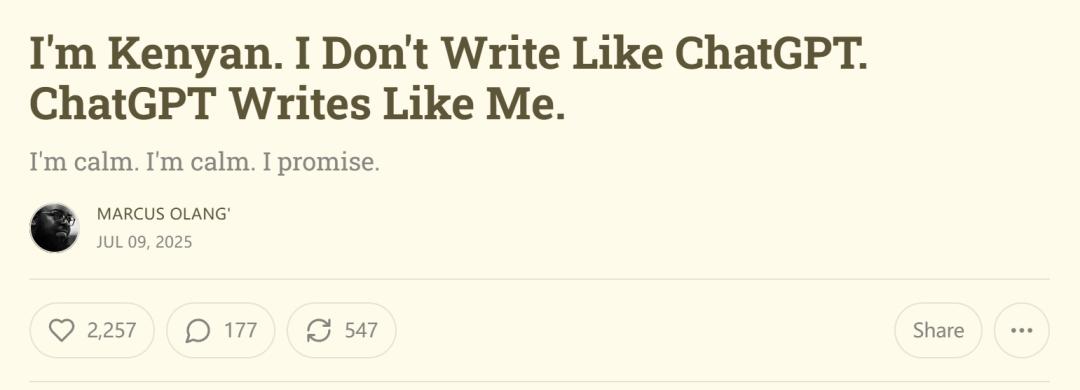
Just recently, a Kenyan writer's "accusation post" topped the Hacker News trending list—
I am Kenyan. It's not that my writing style is the same as ChatGPT's, but rather that ChatGPT's writing style is the same as mine.

Upon clicking, I discovered that several of my friend's meticulously crafted articles had been rejected, all for the reason that they were "too similar to ChatGPT."
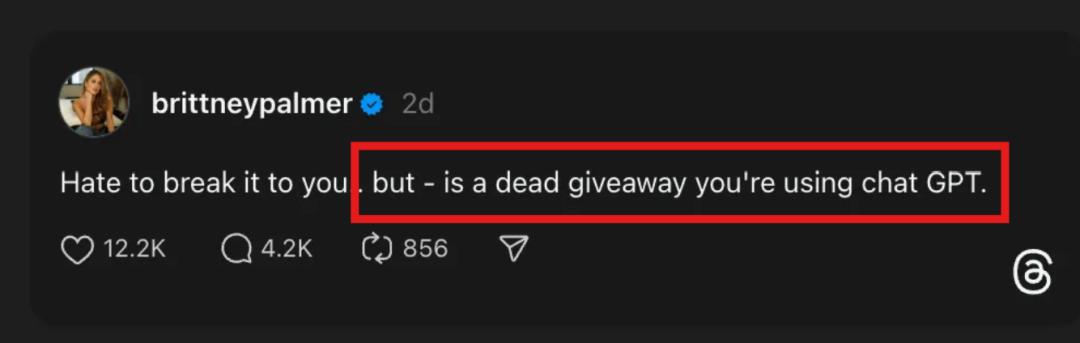
Hmm... Considering that he was taught from childhood that "an article must be like a perfect building" and "you must demonstrate a rich vocabulary," and now he's being mistaken for writing by AI, this friend couldn't help but roar in anger:
To those detectives who are keen on uncovering digital fraud, I say: Friends, welcome to a typical Tuesday in a Kenyan classroom, meeting room, or internal Teams chat room. What you perceive as machine fingerprints are actually the fossil record of our education .
Moreover, it has been reported for a long time that in order to save on labor costs, many AI model manufacturers will outsource tasks such as RLHF to Africans, so many of the models' terminology will also be biased towards Africa.
Therefore, we have reason to suspect that ChatGPT may have actually "stole" writing techniques from Kenya.
Let's take a quick look!
"ChatGPT is unintentionally imitating us."
Here's what happened.
Marcus Olang' (hereinafter referred to as Marcus), from Kenya, recently posted an article complaining that since receiving the first reply at the beginning of the year, he has been caught in a dilemma of needing to "prove he is not AI." The client's reply at the time was:
Your writing is quite good, and the logic is solid, but... could you rewrite it in a more "human" way? Right now, it feels a bit too much like what ChatGPT writes.
Moreover, it wasn't just him; many of his writer friends also received similar feedback.
After carefully comparing his own writing with ChatGPT's, Xiao Ma finally realized with a sigh— you know what, our writing style really is very similar to ChatGPT's .
In a sense, the accuser is not entirely wrong. My writing style does indeed bear some resemblance to the output of the large language model.
We all tend to use well-structured, balanced sentences. We all like to use transition words to ensure logical flow. We all occasionally use (which now seems like incriminating evidence) hyphens, semicolons, or dashes to connect related ideas, making them more elegant than a simple period.

However, in Xiao Ma's opinion:
The irony is that this irony might have brought a knowing smile to our ancestors' faces.
He stated that it wasn't that his writing resembled ChatGPT's, but rather that ChatGPT unintentionally imitated them —imitating their generation, and previous generations, of people "forged" by a rigorous education system in the Global South, especially in places like Kenya.
From childhood, Xiao Ma's writing instruction emphasized standards and careful word choice and sentence structure (whose DNA has changed again?).
From a young age, we are taught that an article must be like a perfect edifice . The introduction is the foundation, the main body is the load-bearing walls, and the conclusion is the roof; it must be solid, symmetrical, and impeccable. We are to use "firstly, secondly, and finally" to construct logic, "in addition, however, and therefore" to make precise transitions, and "good words" such as "brilliant" and "exhausted" to demonstrate our vocabulary.
This kind of writing is our stepping stone , a survival skill we must master in the forty minutes of the KCPE (Primary School Graduation Exam) that determine our fate, and a ladder for us to climb higher. It is rigorous, clear, and persuasive, but because of this, it sounds "lacking in human warmth" to some people today.
And this very system has been learned by AI.
The irony is that large AI models (like ChatGPT) learn to write from massive amounts of books, papers, and reports. These text repositories are filled with historically accumulated, classic, and formal written language—the very style we are trained to imitate. So when AI outputs content to appear "authoritative" and "credible," its writing style naturally creates a strange "twin" effect with my own education.
Therefore, when faced with accusations that his writing style is "like AI," Xiao Ma angrily retorted:
In an attempt to project an air of authority, the machine ended up sounding like a Kenyan primary school graduation exam (KCPE) graduate who had gotten an A on their English essay. It inadvertently replicated the linguistic specter of the British Empire.
He also mentioned that some existing AI detectors tend to label fluent, logically rigorous, and well-structured text as AI-generated, which is precisely the writing characteristic of many non-native English speakers (especially those who have received rigorous formal writing training), making them more susceptible to misjudgment.
In short, Xiao Ma uses his own experience to tell everyone—
Due to historical reasons, the writings of some non-native English speakers were originally the "textbook" for existing AI models, but now they have become "victims" of the widespread adoption of AI .
This viewpoint has also gained widespread approval from netizens:
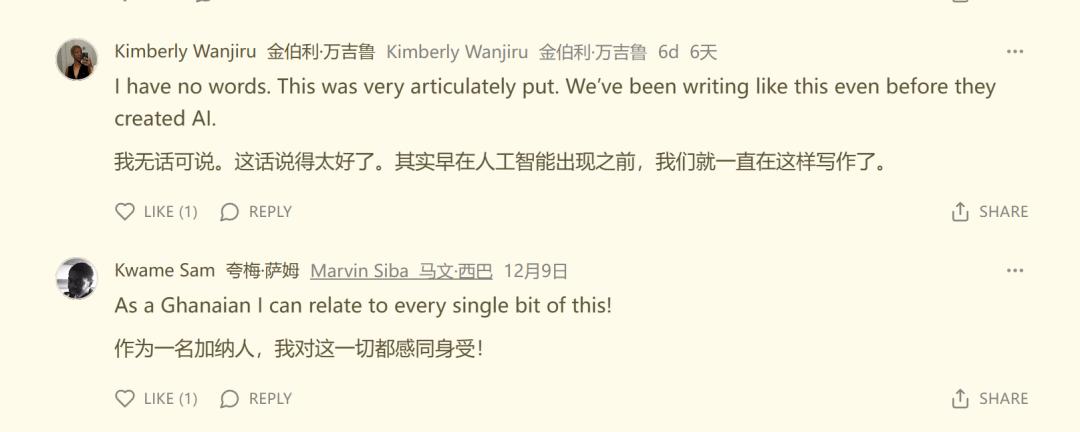
Ironically, despite being full of emotion and feeling very real, Xiao Ma's post was still judged by the Pangram website to be 100% AI-generated.
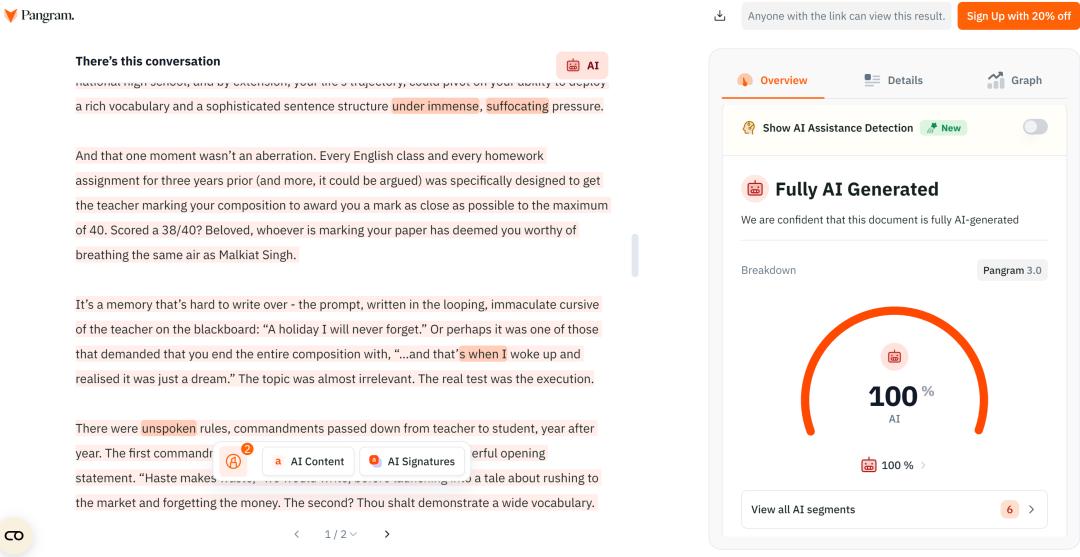
Ah... Little Horse remained silent, he was just so angry he was spitting blood (doge).
Because Africans use RLHF, ChatGPT also likes to use the word "delve".
For similar reasons, it has been found that ChatGPT seems to have a particular fondness for the word "delve" (to dig deep, to explore).
An article in The Guardian pointed out that Jeremy Nguyen, an AI expert from Swinburne University of Technology in Melbourne, discovered—
On professional academic websites like PubMed, the frequency of the word "delve" has increased by 10 to 100 times in recent years .
(PubMed primarily indexes over 5200 biomedical journals from more than 80 countries, totaling over 39 million articles.)
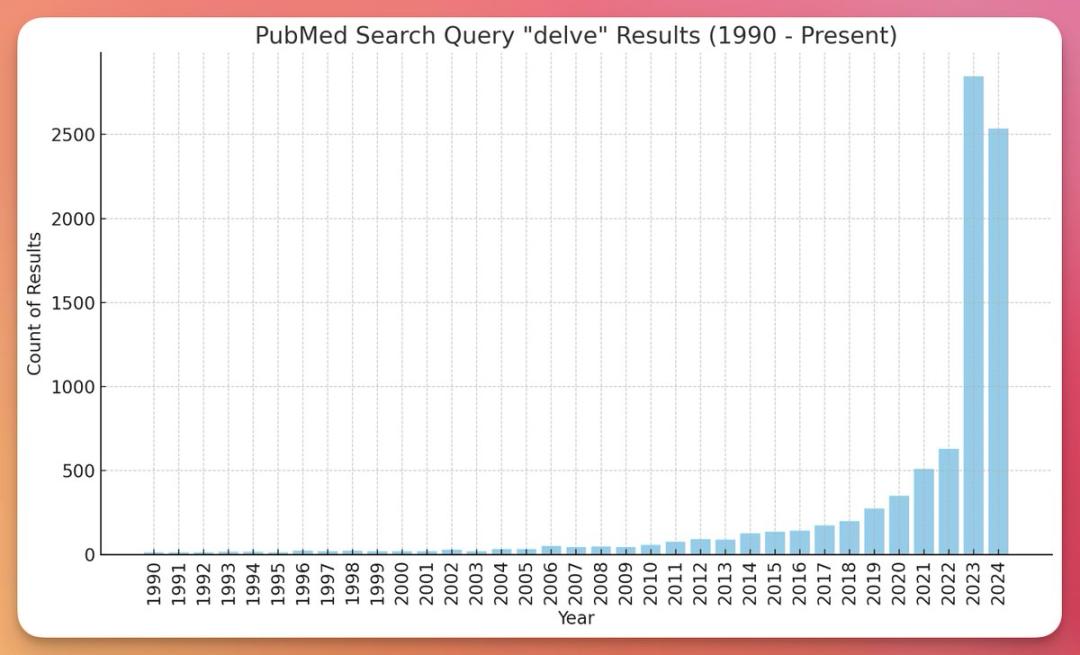
This suggests that a large number of researchers may be using ChatGPT to aid their writing and incorporating their preferred vocabulary into formal academic texts.
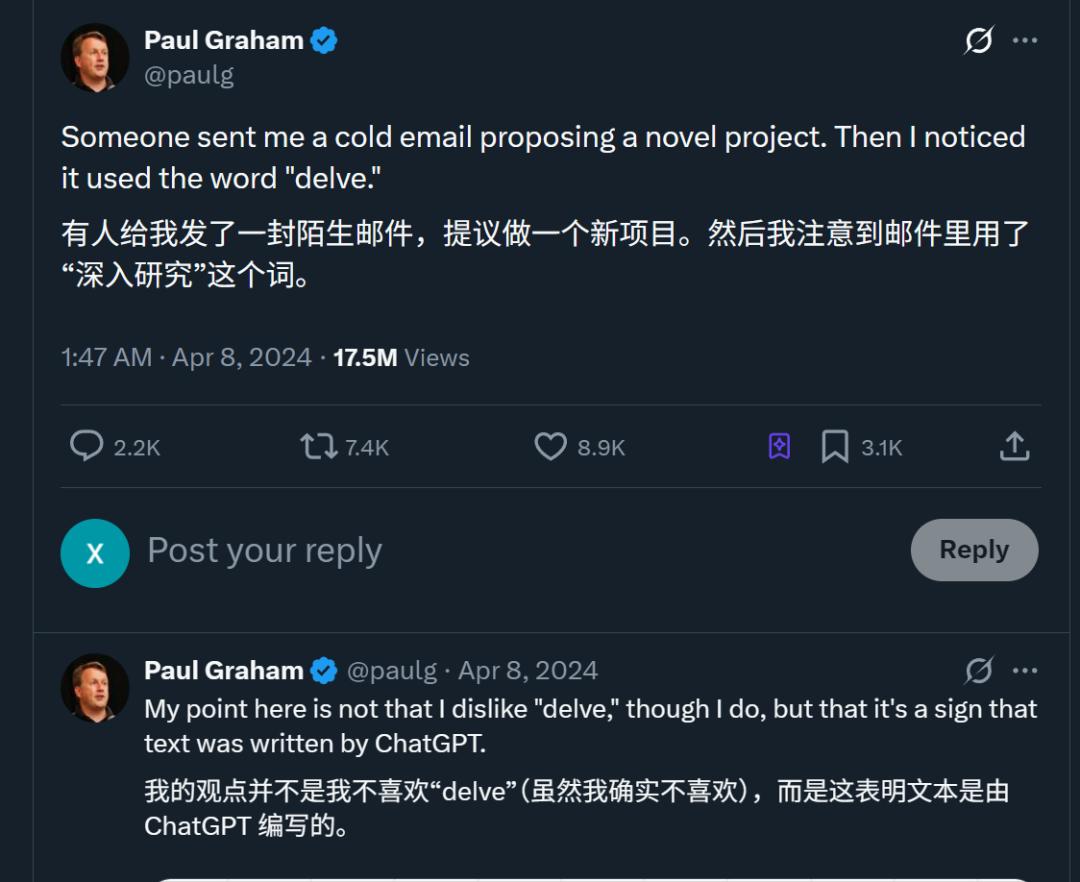
This phenomenon also attracted the attention of Elon Musk and Y Combinator co-founder Paul Graham, with the latter posting:
Someone sent me an email with the word "delve," which suggests the text was likely generated by AI (implying the sender used AI to write a project proposal and wanted to invest in it, haha).
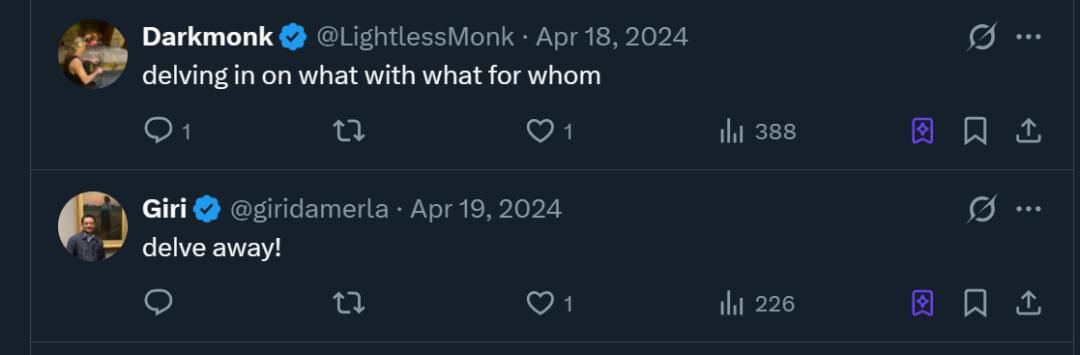
And right after Graham posted, the official ChatGPT account used the term in a public prank, which then attracted countless netizens to follow suit.


However, further data analysis shows that "delve" is far from an isolated case—
Words like “explore,” “tapestry,” “testament,” and “leverage” also appear unusually frequently in the text generated by ChatGPT.
The Guardian revealed the mystery behind this in detail in its article—
In order to "domesticate" large language models into safe, useful, and controllable chatbots, companies typically hire a large number of human testers to interact with the models and provide feedback (such as likes/dislikes, or writing ideal replies).
The model learns from these massive amounts of human preference data to adjust its behavior, which is known as RLHF (Reinforcement Learning Based on Human Feedback).
Due to labor cost considerations, the labor-intensive work of RLHF has been largely outsourced to English-speaking African countries such as Kenya and Nigeria.
For these countries, words like “delve” are natural and standard business or academic English in their daily lives, and therefore are used frequently.
Therefore, these words naturally appear frequently in ChatGPT.
By the way, what other tips do you have for identifying whether content was created by AI?
Some netizens have already set an example for everyone:
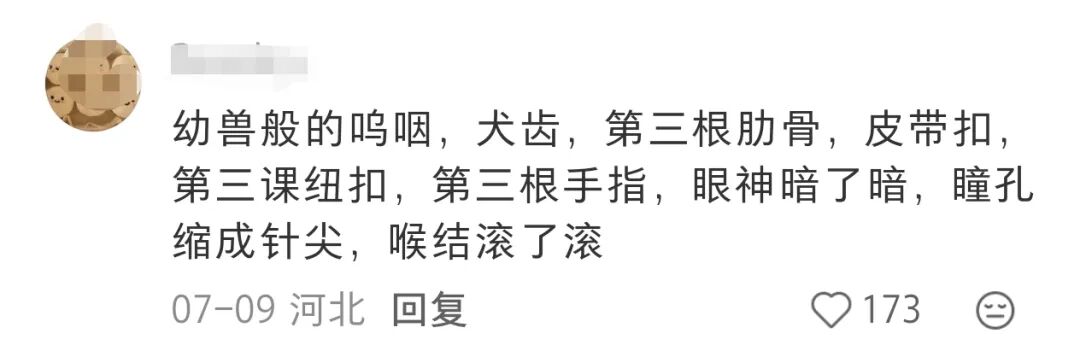
"A whimper like a cub", "pupils shrinking to pinpoints"... well, most people really wouldn't have thought of that (doge).
Reference link:
[1]https://marcusolang.substack.com/p/im-kenyan-i-dont-write-like-chatgpt
[2]https://news.ycombinator.com/item?id=46273466
[3]https://x.com/JeremyNguyenPhD/status/1780580567215681644
[4]https://x.com/ChatGPTapp/status/1780721920322781447
This article is from the WeChat public account "Quantum Bit" , author: Yishui, and published with authorization from 36Kr.