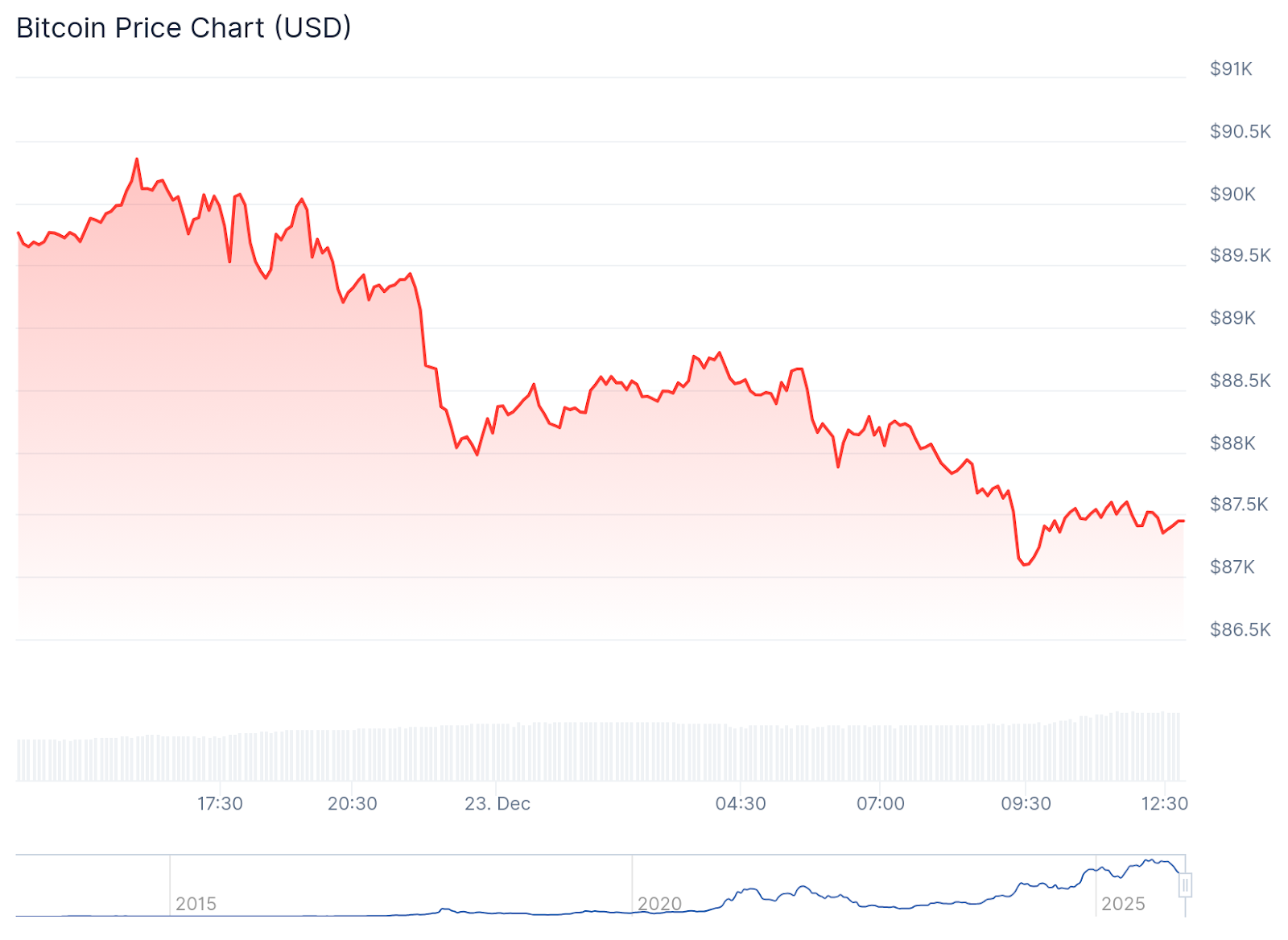
Cryptocurrency markets fell sharply on Tuesday, with Bitcoin sliding back below $88,000 after briefly trading above $90,000 on Monday. Most major digital assets are trading lower, with the total cryptocurrency market capitalization standing at about $3.04 trillion, down 2.4% over the past 24 hours.
Bitcoin (BTC) is trading around $87,383, down about 2.4% on the day, while Ethereum (ETH) is holding near $2,957, down roughly 2.7%.
The other Top 10 altcoins are also down, with losses of 1.4% to 2.4% today.
Traders Bet on Santa
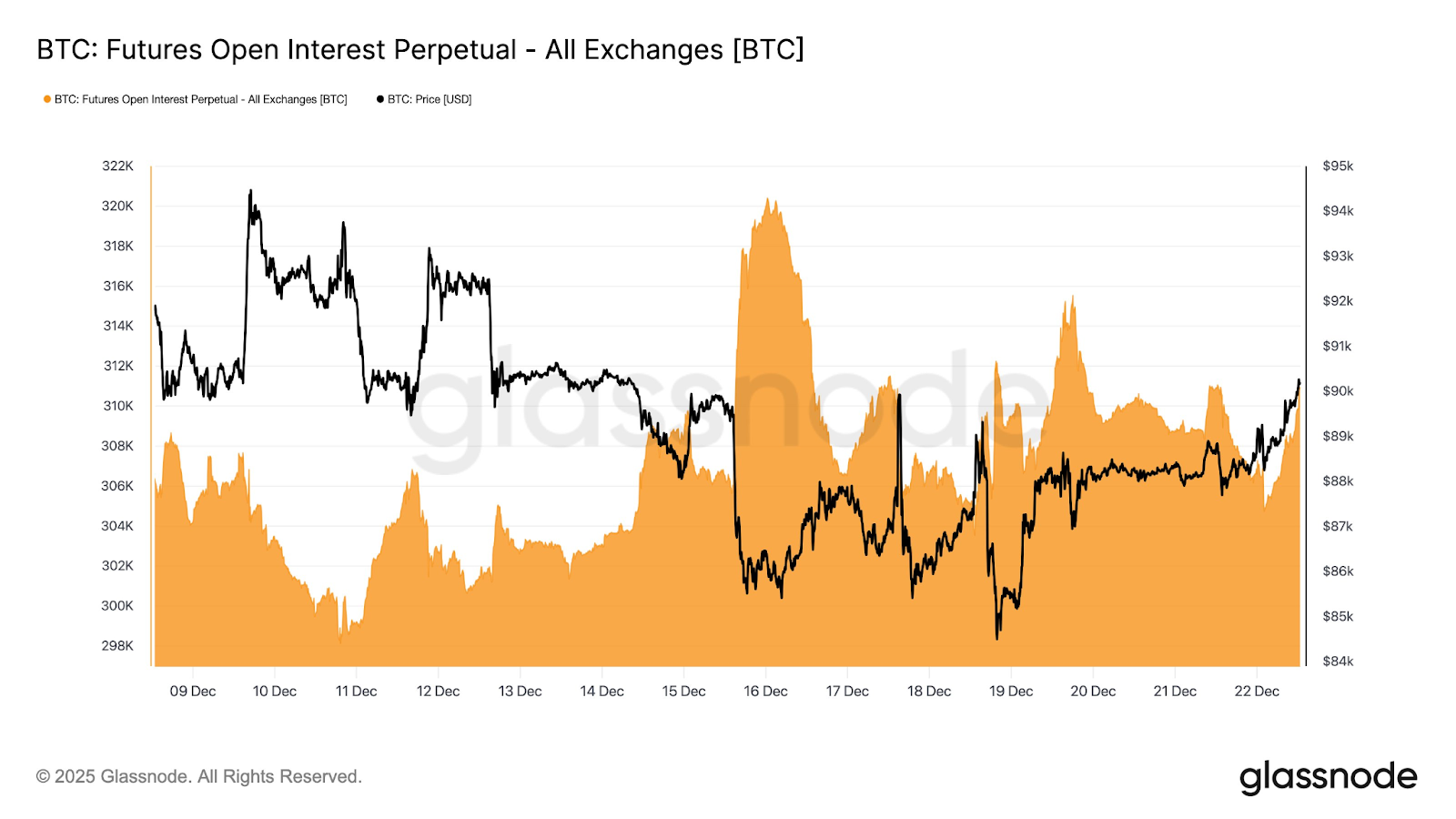
Analysts at glassnode noted in an X post on Dec. 22 that perpetual open interest in BTC has risen about 2% from 304,000 BTC to 310,000 BTC, while funding rates increased from 0.04% to 0.09%, signaling renewed long positioning among traders.
“This combination signals a renewed buildup in leveraged long positioning, as perpetual traders position for a potential year-end move,” the analysts wrote.
Among the Top 100 assets by market cap, Rain (RAIN) led gainers with a 4.7% rise to $0.0079, while Tether Gold (XAUT) gained 1.9%.
On the downside, Midnight (NIGHT) fell 17.5% and pumpfun (PUMP) declined 12.3% after Burwick Law filed a notice on Dec. 22 in the Aguilar v. Baton Corp. case, documenting harassment, identity misuse, and threats by pumpfun, Baton Corp., and founder Alon Cohen against plaintiffs and their lawyers.
Over the past 24 hours, liquidations totaled roughly $258 million, dominated by long positions at $193 million, with Bitcoin and Ethereum leading at $104 million and $62 million, respectively, according to Coinglass data.
ETFs and Macro Conditions
Spot Ethereum ETFs recorded net inflows of $84.6 million on Monday, raising total net assets to $18.2 billion. Spot Bitcoin ETFs saw outflows of $142 million, leaving assets at about $115 billion, per data from SoSoValue.
U.S. Treasury yields rose slightly ahead of the holiday-shortened week, with the 10-year at 4.165%, the 2-year at 3.507%, and the 30-year at 4.838%, CNBC reports.
QCP Capital analysts suggested in a Tuesday update that holiday liquidity and tax-loss harvesting may amplify short-term volatility. Historically, such moves tend to retrace once markets reopen fully in January.
“[...] crypto is likely to remain range-bound, caught between waning leverage, mechanical flows, and a growing chorus of conflicting narratives,” they said.