In the past two years, it's hard to ignore a change: blockchains are no longer "asset-intensive projects for a few teams," but increasingly resemble a product form. For many applications, public blockchains are like storefronts in a shopping mall—popular but expensive, with rules beyond your control; while dedicated rollups are more like self-built online stores, where design, user flow, settlement, and membership systems can all be tailored to the business. Thus, Rollup-as-a-Service (RaaS) has taken off: encapsulating the technical complexity of "launching a blockchain," allowing teams to focus their energy on growth, user experience, and business models.
The prosperity is genuine. More and more chains are emerging, and more and more "on-chain experiences" are beginning to resemble internet products rather than technology demos: lower gas fees, smoother interactions, and more business-oriented modular configurations. However, when you put these new chains on a map from a macro perspective, the problems begin to become clear—the more chains there are, the more fragmented the world becomes; the more specialized a chain is, the more painful cross-chain communication becomes. The most common frustration in the multi-chain era is not insufficient throughput, but rather, "I'm clearly using the same ecosystem, but it feels like I'm exchanging currency, getting visas, and buying phone cards in different countries."
The dilemma behind prosperity
Fragmentation first appears at the asset layer. A token on different networks becomes several "versions": the original, the packaged, and the "credential version" from the bridge. For ordinary users, this means immediately having to make choices—which one is genuine, why are the prices of assets with the same name different, which pool is deeper, and whether it can be sold smoothly; often, you may just want to transfer money to use, but you have to learn to recognize the contract, the bridge, and the routing. It's even more troublesome for applications: the same deposit portal may need to be compatible with multiple asset forms, the same withdrawal process needs to handle cross-chain delays and failure rollbacks, and customer service and risk control must constantly explain, "This is not that version, so you can't use it directly." These problems seem trivial, but they can directly shut out new users.
Next comes the break in the liquidity layer: each chain has its own pool, incentive system, market making, and routing mechanism, often resulting in a lack of depth across all areas. You'll see some common, minor inconveniences: the same transaction has almost no slippage on chain A, but is significantly more expensive on chain B; the price difference for the same coin widens across different chains; users are forced to switch networks repeatedly to find the optimal path to save a little money. Worse still is the cross-chain experience itself: numerous steps, long wait times, and high failure costs. If any step gets stuck, it transforms from "I want to experience an application" into "I'm dealing with a bunch of processes." These seemingly disparate problems are essentially all hindering progress in the same way: more and more chains can be launched, but as long as the process of depositing funds, exchanging tokens, and navigating the chain remains cumbersome, growth will be eaten up by user friction. It is precisely because this obstacle is so real that the next step for multi-chain development is not "accelerating the launch of new chains," but rather making cross-chain functionality and onboarding a smooth, default process.
The solution is not to create more chains, but rather a "connection layer".
The ultimate outcome of multi-chain technology is likely not a single "super chain" swallowing all scenarios, but rather an interconnected ecosystem composed of numerous specialized chains, yet offering a unified user experience. The reason is straightforward: users, project teams, and even institutions are often more willing to pay for "smoothly moving funds to where they need to be" than for "more blockchain space." Whoever can make cross-chain transactions, asset arrivals, and liquidity absorption resemble the default capabilities of the internet will be more likely to capture greater value in the multi-chain era.
Therefore, what's truly scarce in the multi-chain world isn't "adding another chain," but rather a connection layer that allows multiple chains to be used like a single chain: minimizing choices for users—avoiding repeated asset version confirmations, network switching, and route research; minimizing repetitive work for applications—avoiding writing separate adaptations for each chain, maintaining multiple asset mappings and liquidity guidance. Ultimately, it aims to reduce the most common losses in the multi-chain era: trust costs due to information inconsistency, transaction friction caused by fragmented liquidity, and churn due to excessive cross-chain steps. There can be many chains, but users' minds can only accommodate one "default usage." The connection layer's role is to push complexity to the backend, keeping the frontend experience simple, predictable, and straightforward. Caldera does just that; this "connection layer" corresponds to the Metalayer: allowing new chains to naturally connect to a larger network of funds and users from the outset, rather than being isolated islands.
From "being able to open many chains" to "being used as if on a single chain"
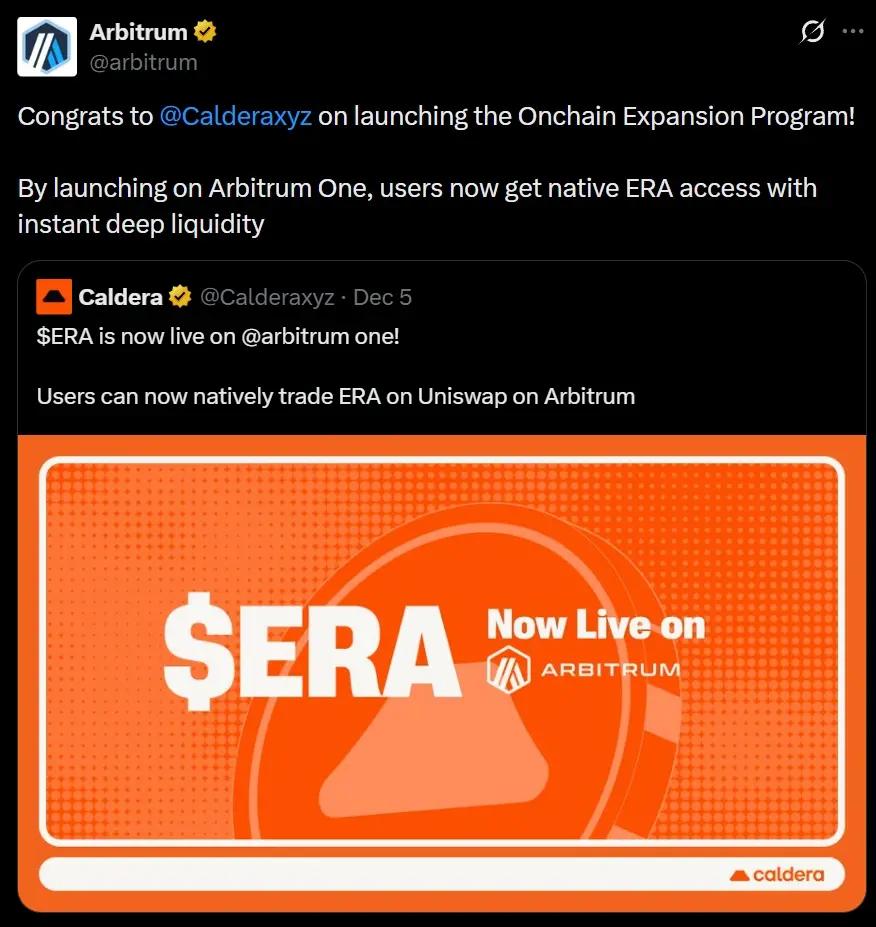
Abstractly speaking, the concept of a "connection layer" is easy to grasp, but the challenge lies in its practical implementation: With each new chain added, has the user path become shorter? Has liquidity been absorbed? Are participants clearly incentivized and expected to benefit? The on-chain expansion plan surrounding $ERA is a typical example of "expansion based on user experience." Its goal isn't simply to "put the token in more places," but rather to align the user experience across ecosystems, minimizing user hassle. On December 4th, $ERA first launched on Arbitrum: placing the trading and acquisition path directly in the places users are most familiar with and where transactions are most easily completed (such as mainstream Uniswap trading pairs), allowing immediate buying, exchanging, and participation upon "launch." On December 14th, $ERA further expanded to Base: entering a faster-growing, more application-intensive incremental ecosystem, while simultaneously completing the "how to use, where to use" path in local core liquidity venues (such as Aerodrome). Looking at the two steps together, the focus isn't on the technical details, but on the expansion itself: first, establish usability on networks with large user bases and mature transactions, then expand reach to larger ecosystems. With each new chain, strive to align with established user habits, thus truly transforming "multi-chain existence" into "multi-chain usability." The reason this type of expansion can roll out so quickly is that Metalayer's goal is clear: reduce the "switching costs" between different networks, allowing for smoother flow of assets and users within the ecosystem.
The incentives for ecosystem integration are also being increased simultaneously, further transforming "expansion" into a "reason for participation." For example, the Espresso Foundation publicly stated that it will allocate more than 2% of its total supply of TGE tokens to the Caldera ecosystem community, with holders and stakers of TGE tokens being among the key recipients. At the same time, Espresso also disclosed that several Caldera-supported chains have been integrated, including ApeChain and Molten. For users, you don't need to delve into the underlying implementation details; just know one signal: the collaborative network is growing, the reach of assets and applications is expanding, and incentives and application scenarios are more likely to become dynamic.
As dedicated blockchains proliferate, "capabilities" also need to be connected.
Once assets and liquidity can flow more smoothly across ecosystems, the next step will naturally be the "capabilities" themselves: can the specializations of different chains also be more easily integrated and utilized? Connecting multiple chains into a network, on the surface, makes assets and liquidity flow more smoothly, but in essence, it addresses a longer-term issue: future chains will become increasingly "specialized." As the barrier to chain creation is lowered, new chains will no longer prove their existence by simply saying "I also have a chain," but by what unique capabilities they can provide—better suited for trading, gaming, social interaction, or handling scenarios with requirements for data confidentiality, auditing, and compliance. The more specialized chains there are, the higher the risk of fragmentation; therefore, the value of the connection layer will also be amplified: it must not only allow assets to cross over, but also enable these capabilities to be accessed and reused within the network with lower friction; otherwise, each specialized chain will become an island that is "powerful in function but isolated in use."
Following this logic, Horizen's joining the Caldera ecosystem and promoting a privacy-first dedicated chain on Base is like adding a scarce piece of the puzzle to this network. It targets financial scenarios such as confidential transactions and DeFi, making "privacy + compliance friendliness" a prerequisite for its applications; simultaneously, it leverages Caldera's blockchain network system to place these capabilities into a network context that is easier for other chains and applications to connect to and access—not creating a standalone, closed privacy chain, but a privacy-focused app chain that can be integrated into ecosystem collaboration. In other words, this kind of collaboration brings not just "another chain," but "another capability that can be amplified by the network," allowing multi-chain development to move beyond simply expanding quantity to expanding usability and possibilities.
The end of multi-chain technology is not "more chains," but "a better-usable network."
Looking back at this wave of RaaS prosperity, it solved the problem of "difficulty in launching a chain," but it also brought the problem of "difficulty in using a chain" to the forefront: asset versions, fragmented liquidity, and lengthy cross-chain processes all ultimately consume growth. Caldera's approach is actually quite clear: on one hand, it uses Rollup Engine to continue lowering the barriers to chain launch and operation, enabling more teams to create dedicated chains; on the other hand, it uses Metalayer to connect these chains into the same interconnected network from day one, trying to push cross-ecosystem friction to the background; and then, through ecosystem assets and expansion actions like $ERA, it amplifies participation, incentives, and network effects.
As more and more "capability-specific blockchains" join the fray (whether in gaming, trading, social networking, or privacy- and compliance-oriented financial scenarios like Horizen), the real dividing line will not be who has more blockchains, but who can make these capabilities more easily accessible, combinable, and reusable. The winner in the multi-chain era may not be the one that builds the fastest blockchain, but more likely the one that transforms multiple blockchains into a network and transforms complexity into a seamless experience.