Throughout the long evolution of the digital economy, incentive mechanisms have always been the core driving force behind ecosystem prosperity. From Web2's points system to Web3's token economy, we have been trying to answer a fundamental question: how to ensure that true value creators receive their due share? However, the current Web3 incentive paradigm is caught in an unprecedented "incentive paradox." Airdrops, points, and token rewards—tools originally intended to "allocate sovereignty"—are being distorted by capital and scripted strategies, becoming cash cows for speculators and a form of slow suicide for project teams.
To break this deadlock, we need a new economic language that can penetrate the fog of speculation. This is the core of the InfoFi engine introduced by Commons— View Token . It is not a financial toy created to cater to market speculation, but rather a means to reconstruct the value chain between "contribution" and "return," providing a sovereign economic metric for the most valuable intangible assets of the digital age—attention and wisdom.
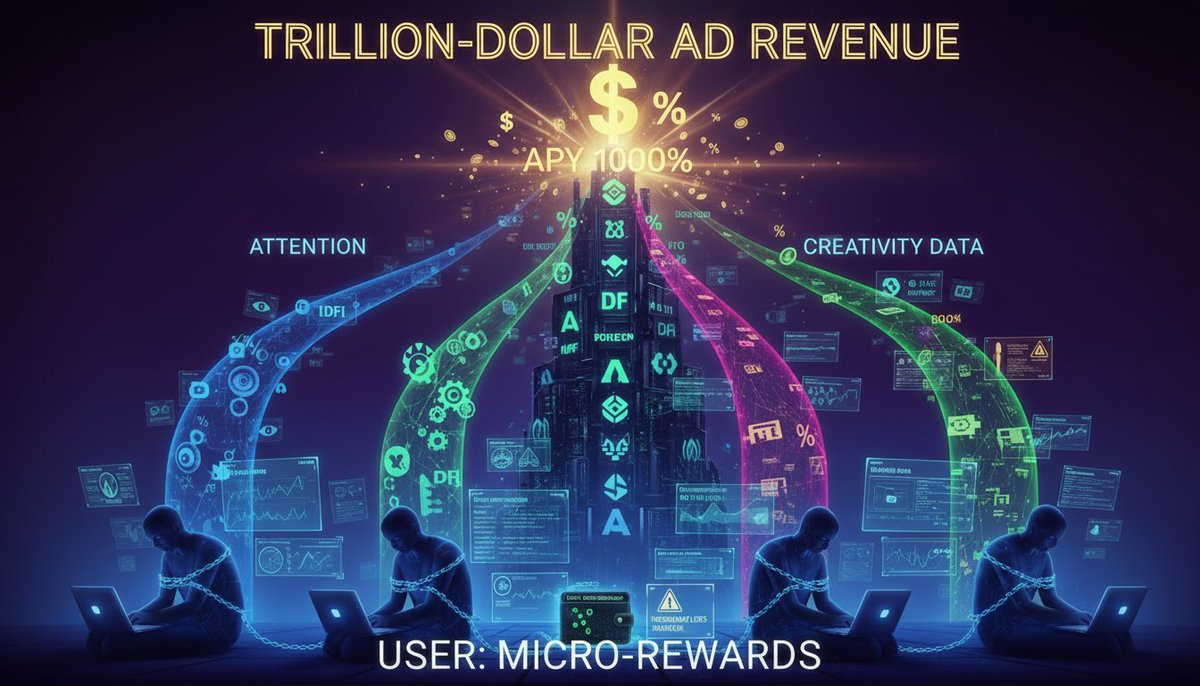
I. The "Liquidity Trap" of Incentives: Why Traditional "Points-Based Systems" Are Doomed to Fail
To understand the revolutionary nature of View Token, we must first conduct a thorough overhaul of the currently popular Web3 "points system" or "token mining." In traditional thinking, liquidity is considered the highest virtue in finance. However, in the early stages of ecosystem building, premature and excessive liquidity often corrodes consensus.
Most current airdrop points or early token rewards are essentially "shadow tokens." From their inception, they have been driven by a strong expectation of monetization. This expectation leads users to pursue "quantity" rather than "quality," and "coverage" rather than "depth." When all interactions can be completed in batches via scripts, and the "points" generated by these interactions have a potential market premium, a large-scale "Syllabic attack" becomes inevitable.
This is a classic "liquidity trap": project teams hope to gain growth through incentives, but instead capture speculative capital with no loyalty. This capital will quickly withdraw after receiving the incentives, leaving the ecosystem with an empty activity metric. In this environment, "builders" who truly invest time in thinking, creating, and governing will never be able to compete with bots that have thousands of wallets in terms of return on unit cost.
This imbalance leads to a severe "incentive mismatch." When speculators' actions are mispriced as high-value, while genuine human wisdom is seen as redundant noise, the economic foundation of the ecosystem begins to collapse. Therefore, we must acknowledge a harsh reality: if incentive tools themselves are easily transferable and speculative, they can never accurately identify and anchor "genuine contributions." We must establish an incentive mechanism completely insulated from "speculation," allowing value to return to the behavior itself, rather than the arbitrage expectations behind it.
II. Definition of View Token: A contribution credential based on "soul binding"
To address these challenges, Commons proposed View Token as the core expression of its economic sovereignty. In our architecture, View Token is strictly defined as a "contribution credential," not a "speculative token." It is a digital reflection of an individual's attention, wisdom, reputation, and multi-dimensional contributions to the ecosystem.
Unlike tokens designed for secondary market trading, View Token's core and most unshakeable characteristic is its "non-tradable and non-transferable" nature. This design is not a step backward for liquidity, but rather a way to protect the ecosystem from the erosion of Gresham's Law (bad money drives out good).
From InfoFi's perspective, View Token is closer to a kind of "soul-bound" economic energy. It is part of an individual's DID (decentralized identity) sovereignty, marking the degree of a person's contribution in a specific context. Because it is non-transferable, it cannot be "bought," only "won." This simple setting instantly cuts off the power to all speculators and bot scripts—if the incentives obtained through scripts cannot circulate on the black market or be directly exchanged for liquidity tokens, then the economic motivation for "brushing" disappears at its root.
This means that View Token captures pure, non-synthetic value. It's like a "logobook" continuously verified and recorded on a distributed ledger by an AI-powered system. Each View Token generated corresponds to a genuine action deeply identified by the AI value engine, whether it's in-depth content creation, high-value community feedback, or precise governance voting. It establishes a protective barrier, isolating speculative funds seeking only short-term gains and ensuring that ecosystem resources and influence continue to concentrate on long-term, genuine participants. This is not merely a technological constraint, but also a form of economic honesty.
III. The Alchemy of Value Transformation: The Ultimate Exchange Based on "Quality and Reputation"
If View Token is a non-tradable certificate, how does it translate into ultimate economic value? This involves Commons' core "value conversion engine." In Commons' long-term development roadmap, View Token will be the sole and crucial threshold for acquiring the native token in the future. However, this conversion is by no means a simple, linear, 1:1 mapping based on "score accumulation," but rather a complex alchemy based on "contribution quality" and "sovereign reputation."
In this conversion mechanism, we introduced an AI value brain and a DID reputation anchor. When a user attempts to exchange accumulated View Tokens for $COMMS, the system not only checks the balance in your account, but also traces the "historical path" that generated these balances through an AI engine.
If a user's View Tokens come from thousands of meaningless, mechanical interactions, then in the final conversion formula, the weight of these scores will approach zero. Conversely, if a user's View Tokens, though few in number, are generated from consistent contributions of original content, deep insights widely recognized by high-reputation groups, and cross-platform DID verification achievements, then each of their View Tokens will receive an extremely high conversion rate.
This is InfoFi's concrete implementation of "pricing reputation." We use algorithms to convert users' "digital reputation" into "computing power" for token allocation. This design ensures that the allocation rights ultimately reside in the hands of individuals who truly understand and love the ecosystem and possess genuine influence. This "reputation-weighted" conversion mechanism makes View Token a long-term trust funnel, filtering out speculators and retaining true core builders through dynamic game theory.
In this way, Commons constructs a closed-loop, sustainable economic system: View Token is responsible for capturing real behavior at the micro level and filtering out external noise; while $COMMS rewards genuine contributions that have stood the test of time and possess sovereign reputation at the macro level. This "slow is fast" economic philosophy is the technological foundation that allows InfoFi to truly navigate bull and bear market cycles and anchor real value in the ocean of AI-polluted information.
In short, amidst the rapid advancement of Web3, we often become obsessed with the illusion of liquidity, forgetting that the essence of finance is the objective mapping of value. The launch of View Token is not only an extension of the Commons technical architecture, but also a profound reflection on "what constitutes contribution".
This is not only an economic experiment, but also a civilizational expedition about the "return to value". From "mining by racking up points" to "establishing benchmarks through contributions", View Token is the first roar of the InfoFi engine, announcing the official start of an era where only real value is paid for.