


This article is machine translated
Show original
Today, a friend in a group asked me how to use support/resistance levels and various technical indicators. I think it's a topic worth sharing because technical indicators are the most common blind spot for trading beginners, and also the easiest tool for trading mentors to use to mislead people (drawing a line and telling you where to place an order). I'll treat this as my first practical post of the new year.
In my own trading system, all my "technical analysis" serves to discover "trends." To put it more directly, a trend is: "higher high and higher low are upward trends (higher price highs and lows), and lower high and lower low are downward trends (lower price highs and lows)."
"Identify the trend, then be a friend of the trend, until the trend changes." This method works across all timeframes, and is more effective the longer the timeframe.
Furthermore, regarding how to use these technical indicators, the most common mistake I've seen beginners make in secondary trading is: "Draw a line and then use these 'lines' as the sole reference for opening and closing orders."
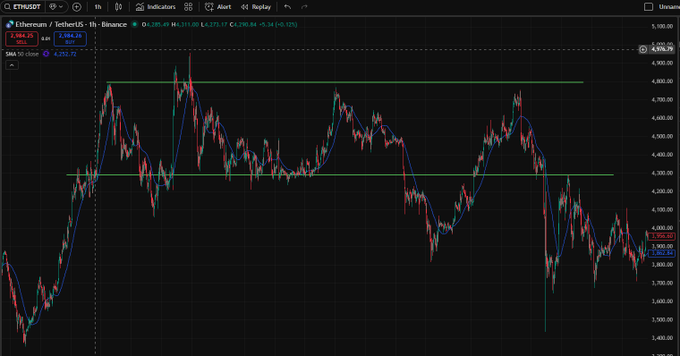
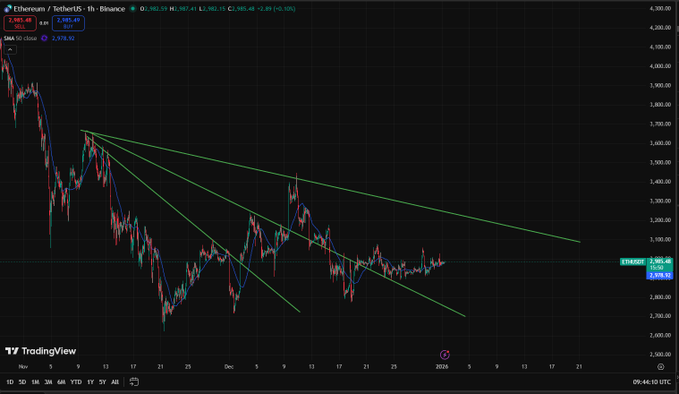
Let's take the chart below as an example. You draw a line at the support level and another at the resistance level. You buy when it falls to the support and sell when it rises to the resistance. Then you'll find that the market keeps hitting your stop-loss. It breaks the support and then pulls back, breaks the resistance and then makes a false break and falls again. If you strictly follow your two lines, you'll end up losing everything. More commonly, many people keep adjusting their lines to prove they're right, eventually becoming obsessed with them. If you understand this, you'll understand why these technical indicators can't be used as a reference for opening trades. Because the buy points drawn by those technical indicators are precisely the buy points that other retail investors agree on. You're thinking of buying at the support level, and other retail investors are thinking the same thing. Millions of retail investors are opening trades here, which ironically reveals that this is where liquidity is most abundant.
If you were a major player (market maker/large investor) and wanted to unload your shares, you would do it by consolidating at this level; if you wanted to shake out weak hands, you would do it by breaking below this level. Therefore, the way major players use support and resistance levels is completely opposite to yours; the technical indicators you use are tools to provide liquidity to others.
But are technical indicators like support and resistance levels completely useless? Not at all. Support and resistance levels are used to observe "market trends." For example, when a stock reaches a support level, does it quickly rebound (buy the dips strong buying pressure)? Or does it linger at the support level with weak buying (indicating that someone is selling at the support level)? Or does it experience a large-volume sell-off (panic selling/margin calls)?
Observing the market's reaction to these key "technical positions" tells you its "attitude" towards them, and the market's attitude tells you about the trend (is the trend still there? Or has it ended?).
For example, when I buy the dips in major cryptocurrencies in the past, why did I keep waiting even when the price reached a support level? I wasn't waiting for the price to reach a certain line that I subjectively drew, but rather for it to reach a large support range. I would observe the trading volume and price to see if there was panic selling/mass liquidation, in order to determine whether the selling pressure/panic had been exhausted.
If you are doing discretionary trading at level two, draw fewer lines and consciously observe the trends and "market reactions" of multiple time intervals and key price ranges. Simplify your technical indicators; support and resistance levels combined with price and trading volume are sufficient.
Also, don't use technical analysis on Altcoin 😅
Happy New Year, friends! Binance red packet code: POVDSGZ (plus an H)
Not going out for New Year's Day?
I'm going to lie on the beach tomorrow.
Take care of your body

From Twitter
Disclaimer: The content above is only the author's opinion which does not represent any position of Followin, and is not intended as, and shall not be understood or construed as, investment advice from Followin.
Like
Add to Favorites
Comments
Share
Relevant content





