Written by Frank, PANews
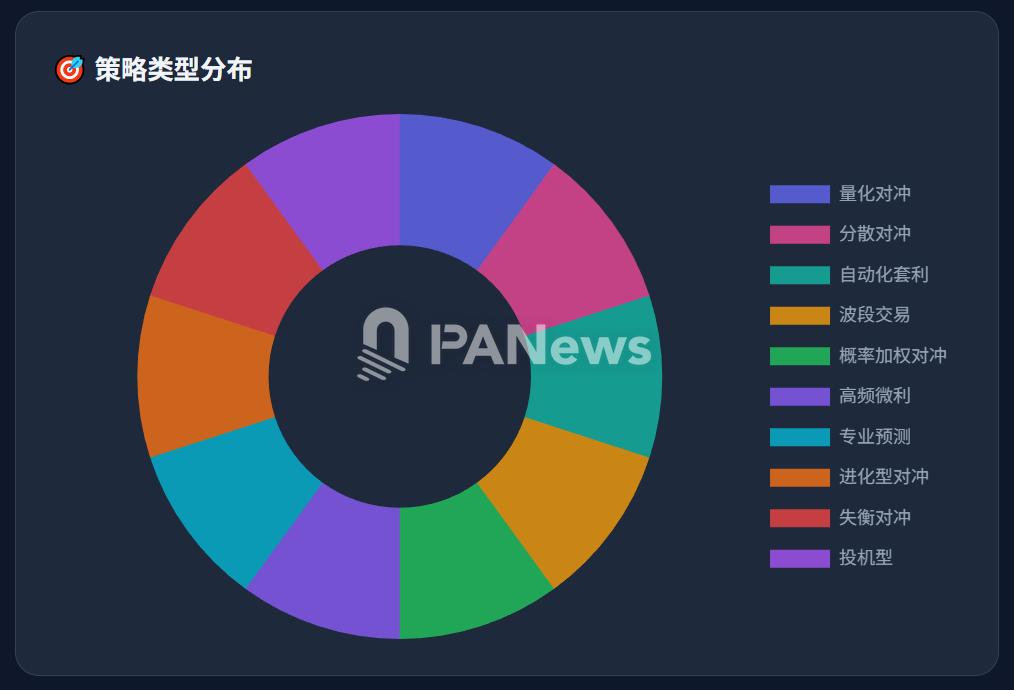
Recently, the market prediction industry has seen a surge in popularity, especially with smart money arbitrage strategies being touted as the gold standard. Many have begun to imitate and try these strategies, seemingly signaling the start of a new gold rush.
But behind the hype, what are the actual effects of these seemingly clever and reasonable strategies? And how are they actually implemented? PANews conducted an in-depth analysis of 27,000 transactions by the top ten most profitable whale on Polymarket in December to explore the truth behind their profitability.
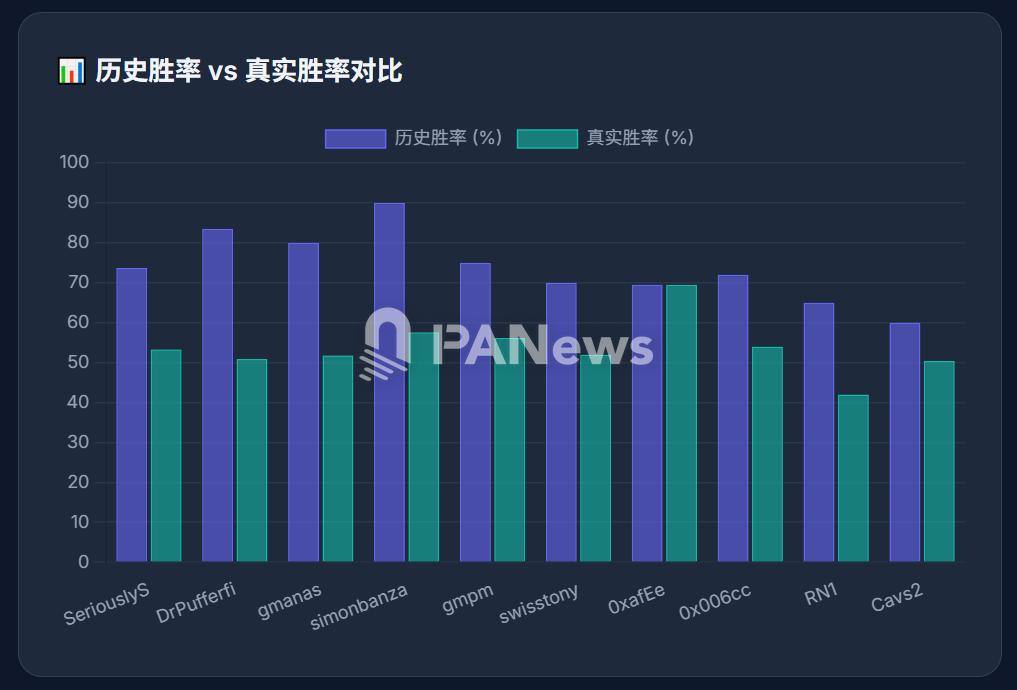
After analysis, PANews found that while many of these "smart money" investors did employ hedging and arbitrage strategies, this hedging differed significantly from the simple hedging portrayed on social media. The actual strategies were far more complex, not simply "yes" or "no" combinations, but rather involved fully utilizing rules such as "over/under" and "win/loss" in sports events to create combined hedging strategies. Another important finding was that behind the remarkably high historical win rates of these whale lay a large number of unclosed "zombie orders," masking the true win rates, which were far lower than the historical win rates.

Next, PANews will use real-world examples to reveal the true operations of this "smart money".
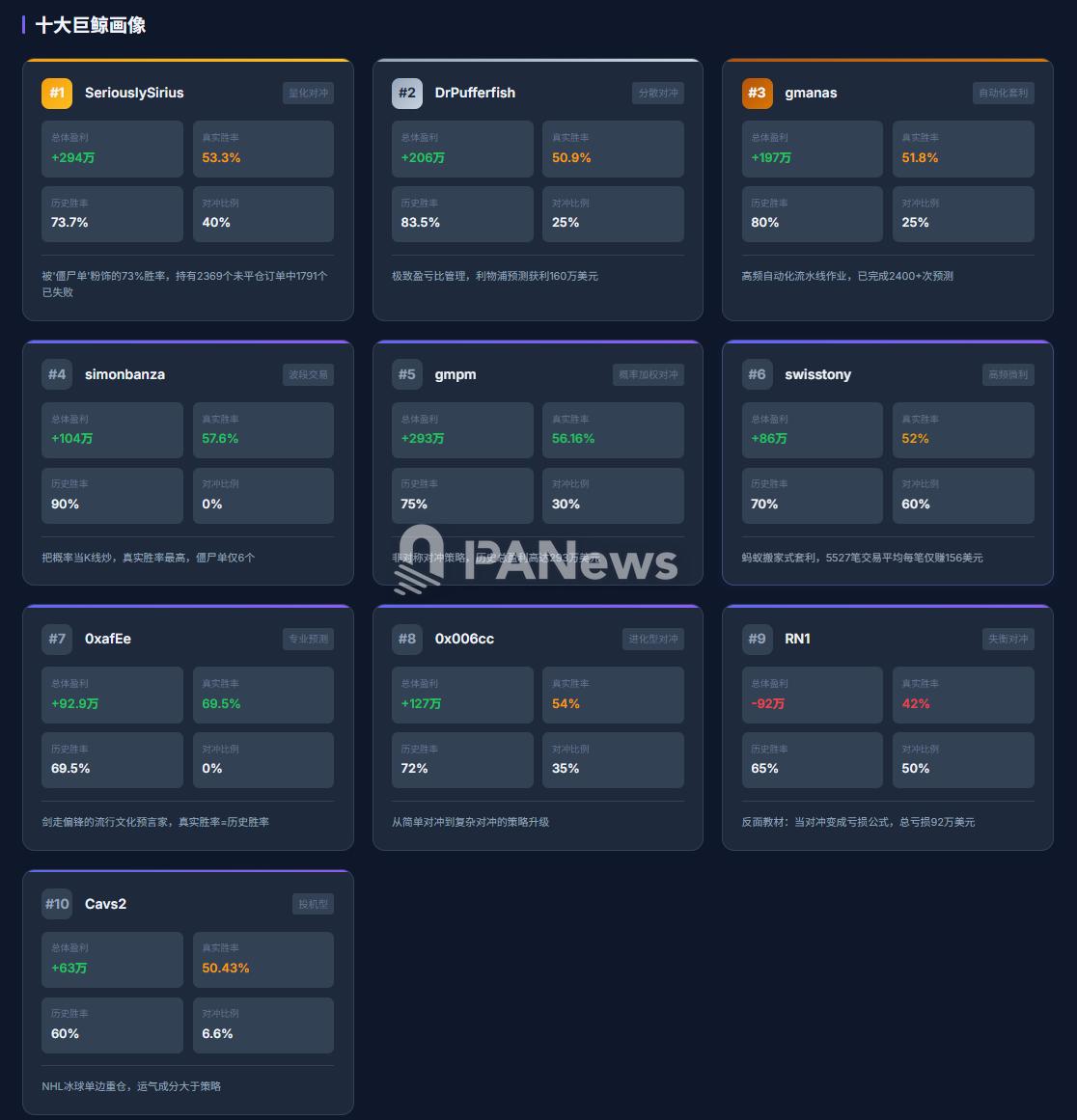
1. SeriouslySirius: A 73% win rate embellished by "zombie trades," and a complex quantitative hedging network.
SeriouslySirius was the top-ranked address in December, with profits of approximately $3.29 million and a total historical profit of $2.94 million. Looking only at its completed order history, its win rate appears as high as 73.7%. However, the reality is that this address currently holds 2,369 open orders, with 4,690 orders already settled. Of these, 1,791 are actually completely failed orders that the user hasn't closed. On one hand, this saves significant time and transaction fees. On the other hand, because it typically closes profitable orders, its historical settled order data shows an extremely high win rate. However, if these unclosed "zombie orders" are taken into account, the address's true win rate drops to 53.3%, only slightly higher than a random coin toss.
In his actual trading, about 40% of his orders were hedging orders betting on multiple directions for the same event. However, this hedging wasn't a simple "YES" + "NO". For example, in the NBA game 76ers vs. Mavericks, he simultaneously bet on 11 directions, including Under (under), Over (over), 76ers (home team), and Mavericks (away team), ultimately profiting $1,611. In this process, he did indeed employ an arbitrage strategy with insufficient probability; for instance, the probability of betting on the 76ers winning was 56.8%, while the probability of betting on the Mavericks was 39.37%, with a total cost of approximately 0.962, achieving a profit regardless of the outcome. Ultimately, he profited $17,000 in this game.
However, this strategy is not always profitable. For example, in the Celtics vs. Kings game, he participated in nine different betting directions and ultimately lost $2,900.
Furthermore, many orders show severely unbalanced capital allocation ratios. For example, although orders were placed in both directions, the proportion of capital invested differed by more than tenfold. This outcome is likely due to insufficient market liquidity. This illustrates that while arbitrage strategies seem attractive, liquidity can be the biggest problem in actual operation . In other words, even if an opportunity arises, it doesn't necessarily guarantee the hedging effect of equal positions on both sides.
Moreover, because the process is automated, buying and selling in this situation could very likely result in significant losses.
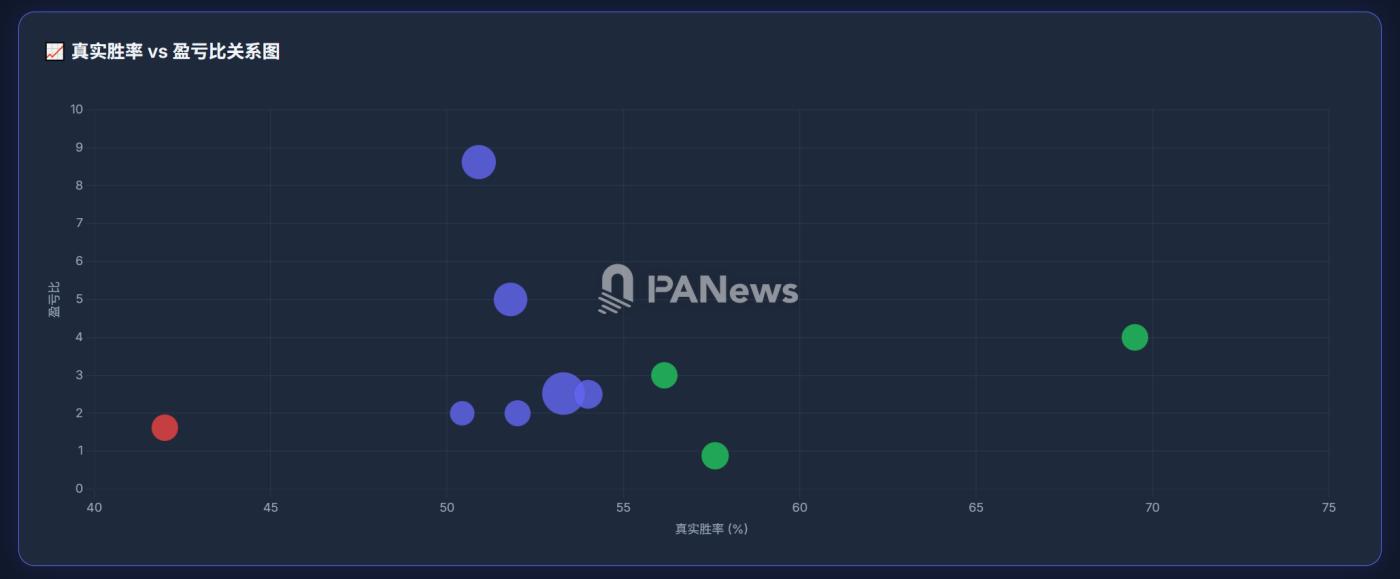
However, the core reason SeriouslySirius was able to achieve substantial profits using this strategy was his effective position management, resulting in a profit/loss ratio of approximately 2.52. This is the main reason why, despite a low actual win rate, he was ultimately able to make a profit.
Furthermore, this strategy isn't always profitable. Before December, the address's profit and loss situation was not optimistic, remaining below the break-even point for a long period, with the largest loss even reaching $1.8 million. Now that the strategy has matured, it's uncertain whether it will maintain this level of profitability.
2. DrPufferfish: Turning low-probability bets into high-probability ones – the ultimate art of managing the "risk/reward ratio".
DrPufferfish was the second most profitable address in December, with monthly profits of approximately $2.06 million. Its historical win rate was even more impressive, reaching 83.5%. However, considering the large number of "zombie orders" it held, its win rate dropped to 50.9%. However, this address's strategy differs significantly from SeriouslySirius's trading strategy. While it also had nearly 25% of its orders as hedging orders, this hedging wasn't reverse hedging, but rather diversified betting. For example, regarding the MLS baseball championship, it simultaneously bet on 27 teams with lower probabilities, whose combined probability exceeded 54%. Through this strategy, it transformed low-probability events into high-probability events.
Furthermore, a major reason for his enormous profits was his ability to control the profit-loss ratio. For example, Liverpool, a Premier League team, was one of his favorites. He predicted the team's outcome 123 times, ultimately earning approximately $1.6 million. Of the profitable predictions, the average profit was about $37,200, while the average loss from the unsuccessful predictions was about $11,000. He also sold most of the losing orders early to control position losses.
This operational approach resulted in an overall profit/loss ratio of 8.62, indicating a high potential for profit. However, overall, his strategy was not simply arbitrage hedging, but rather a massive return achieved through professional forecasting and analysis, and a rigorous position management plan. Another point is that most of his hedging trades were in a losing position, with a total loss of $2.09 million for these orders. Therefore, it seems that this whale's hedging trades were primarily used as a form of insurance.
3. gmanas: High-frequency automated assembly line operations
The third-ranked address, gmanas, has a similar style to DrPufferfish, achieving a total profit of $1.97 million in December. Its true win rate of 51.8% is close to DrPufferfish's. However, it trades more frequently, having completed over 2400 predictions, clearly indicating that its strategy is the result of automated execution. Its betting style is similar to the previous address, so further details will not be provided.
4. Hunter simonbanza: A swing trader who treats probability prediction like "candlestick charts".
The fourth-ranked address, simonbanza, is a professional prediction hunter. Unlike the previous addresses, his strategy contains no hedging orders. His realized profits are approximately $1.04 million, while his "zombie" positions have a loss of only $130,000. Compared to the previous addresses, his capital and trading volume are not high, but his actual win rate is the highest, at approximately 57.6%. Furthermore, among his settled orders, his average profit is approximately $32,000, and his average loss is $36,500. While the profit/loss ratio isn't high, his high win rate ultimately resulted in excellent returns.
Furthermore, this address has very few "zombie orders," only six. This is because it typically doesn't wait until the event ends to settle accounts, but instead profits from probability fluctuations. Simply put, it takes profits as soon as they appear and doesn't linger on the final outcome.
This is also a unique approach to market prediction and investment. In his logic, these changes in probability are more like the rise and fall of financial investments. Of course, we don't know the specific logic behind his high win rate; it's his exclusive survival secret.
5. Whale GMPM: An asymmetric hedging strategy that uses "large positions" to seek certainty.
The address ranked fifth, gmpm, while only fifth in profit and loss rankings in December, boasts a higher historical total profit of $2.93 million compared to the addresses ranked ahead. Furthermore, its true win rate of approximately 56.16% is also quite high. Its trading strategy is similar to that of the fourth-ranked address, but it possesses unique and proprietary tactics.
For example, you might see this address frequently placing bets on both sides of the same match, but its strategy doesn't seem to be to profit from the arbitrage opportunities in either direction. Instead, it seems to invest more capital in the side with a higher probability of winning and less in the side with a lower probability. This achieves a hedging effect where the position size is larger when the probability of winning is high, but the losses are not too high when a low-probability event occurs.
In terms of actual results, this is a more advanced hedging strategy that does not rely solely on mathematical arbitrage based on "yes" + "no" < 1, but rather combines a comprehensive judgment of events with hedging and loss reduction strategies.
6. Swisstony, the model worker: "Ant-like" high-frequency arbitrage
The sixth address, Swisstony, is an ultra-high frequency arbitrage address. It had the highest trading frequency among these addresses, conducting a total of 5,527 trades. Although it accumulated over $860,000 in profits, the average profit per trade was only $156. Strategically, this address employs a "small-scale, incremental" approach. Similar to other arbitrage addresses, this address typically bets on all odds for a single game; for example, in the Jazz vs. Clippers game, it bet on 23 different odds. Furthermore, because the investment amounts are relatively small, the allocation of funds is relatively balanced, achieving a certain degree of hedging effect.
However, this strategy seems to heavily rely on the details of the buy-in process. For example, the sum of "yes" and "no" must be less than 1. For some reason, his hedging orders often have a total buy-in volume greater than 1, which means that the order will ultimately result in a loss no matter what. Nevertheless, thanks to a reasonable profit-loss ratio and win rate data, his profit is still expected to be positive.
7. 0xafEe, an unconventional "pop culture prophet":
The seventh address, 0xafEe, is a classic example of a low-frequency, high-win-rate trader. His trading frequency is extremely low, averaging only 0.4 trades per day, with a true win rate of 69.5%.
Of the orders he completed, he earned approximately $929,000 thanks to his exceptionally high win rate, with very few "zombie orders" and only about $8,800 in unrealized losses. Furthermore, he never engages in hedging orders, focusing instead on predictions. His predictions primarily target Google search indexes and popular culture-related content, such as "Will Pope Leo XIV be the most searched person on Google this year?" or "Will Gemini 3.0 be released before October 31st?" He seems to possess a unique analytical method in these areas, resulting in an exceptionally high win rate. Among the top-ranking whale, he stands out as a "unconventional" approach, being the only address outside of sports-related categories.
8. Manual Hedging Player 0x006cc: Strategy Upgrade from Simple Hedging to Complex Hedging
The eighth-ranked address, 0x006cc, is similar to the aforementioned complex hedging addresses, with an overall net profit of approximately $1.27 million and a true win rate of about 54%. However, compared to other addresses executed by automated programs, its operation frequency is very low, averaging only 0.7 transactions per day. Furthermore, based on early operations, this address may have been an early example of a manually operated address employing a "simple hedging strategy."
However, after entering December, this simple hedging strategy was upgraded to a more complex one. Judging from his operational experience, the market is gradually evolving as more and more people understand hedging strategies.
9. Negative Example RN1: When "Hedging" Becomes a "Loss Formula"
Address RN1, ranked ninth, is among the top ten most profitable addresses in December, but it is currently experiencing an overall loss. Its realized profit is approximately $1.76 million, but its unrealized loss reaches $2.68 million, for a total loss of $920,000. As a cautionary tale, there are many things to consider regarding RN1.
First, his true win rate is only 42%, the lowest among these addresses, and his profit/loss ratio is only 1.62. Considering these two factors, his expected profit is negative, meaning this strategy is unlikely to be profitable overall.
A closer look at the details reveals that this address is also a clear arbitrage strategy address. However, in many of his hedging transactions, although the condition of "yes" + "no" < 1 is met, he often invests more in the side with a lower probability and buys less in the side with a higher probability. This leads to an imbalance in the actual position, which ultimately results in real losses when the high-probability event occurs.
10. Gambler Cavs2: One-sided heavy betting on the ice hockey rink, where luck outweighs strategy.
The tenth-ranked address, Cavs2, is also a bettor who likes to place large bets on one side of the betting odds, specializing in NHL hockey games. However, looking at the overall data, his actual total profit is approximately $630,000, with a true win rate of about 50.43% and a relatively low risk hedging ratio of 6.6%. The data is fairly average, and there is a significant element of luck involved. He correctly predicted the results of a few high-profit individual games, so his actual strategy is not very applicable.
Five harsh truths after demystifying "smart money"
After conducting an in-depth analysis of these "smart money" transactions, PANews summarized the reality behind the "wealth stories" in the prediction market.
1. "Hedge arbitrage strategy" is not as simple as the fulfillment of probability conditions. Under the intense competition in the market and the limitation of liquidity, it is very likely to become a losing formula that backfires. Blindly imitating it is not advisable.
2. Copy trading also seems ineffective in prediction markets, primarily for several reasons. First, the rankings or win rates we see are distorted data derived from historically settled profit figures. Behind such data, a large amount of "smart money" isn't actually that "smart," and true win rates exceeding 70% are extremely rare; most win rates are roughly equivalent to a coin toss. Furthermore, the trading depth in prediction markets is currently relatively poor; the same arbitrage opportunity may only accommodate a small amount of capital, potentially squeezing out copy traders.
3. Managing the profit/loss ratio and position size is more important than pursuing a high win rate. Among the addresses with excellent strategy performance, they all share the common characteristic of being very good at managing the profit/loss ratio. Addresses like gmpm and DrPufferfish even exit at any time based on probability changes to reduce losses and improve the profit/loss ratio.
4. The real secret lies beyond the "mathematical formula." Currently, social media offers many interpretations of "arbitrage formulas," and at first glance, these strategies seem quite reasonable. However, in actual operation, the true abilities of these "smart money" traders appear to lie outside these "mathematical formulas." They either possess exceptional judgment regarding certain events or have unique analytical models for popular culture. These invisible decision-making algorithms are the key to their success. For users without such "decision-making algorithms," predicting the market is equally a cold and ruthless "dark forest."
5. The profit scale of the prediction market is still small. Looking at the returns of these top smart money accounts in December, the address with the largest total return has only earned around $3 million. Compared to the cryptocurrency derivatives market, the profit potential of this market seems to have a clear ceiling. For those who enter the market dreaming of getting rich overnight, the market size is clearly not large enough. Such a market, full of unique specialization and small scale, is unlikely to attract institutions in the short term, which may be a significant reason limiting the growth of the prediction market.

In Polymarket, a prediction market that seems to be paved with gold, the so-called "god-level whale" are mostly just surviving gamblers or hardworking laborers. The real secret to wealth is not hidden in those inflated win rate lists, but in the algorithms that a few top players bet real money on after filtering out the noise.