Following the arrest of Venezuelan President Nicolás Maduro by US forces on January 3, 2026, market predictions suggest that María Corina Machado is emerging as a leading candidate for the transition period—with the potential to promote Bitcoin-friendly policies.
Washington's declaration that it will "temporarily govern" Venezuela until a new leader is appointed makes the short-term future even more unpredictable, while the Venezuelan Supreme Court has appointed Vice President Delcy Rodríguez as interim president.
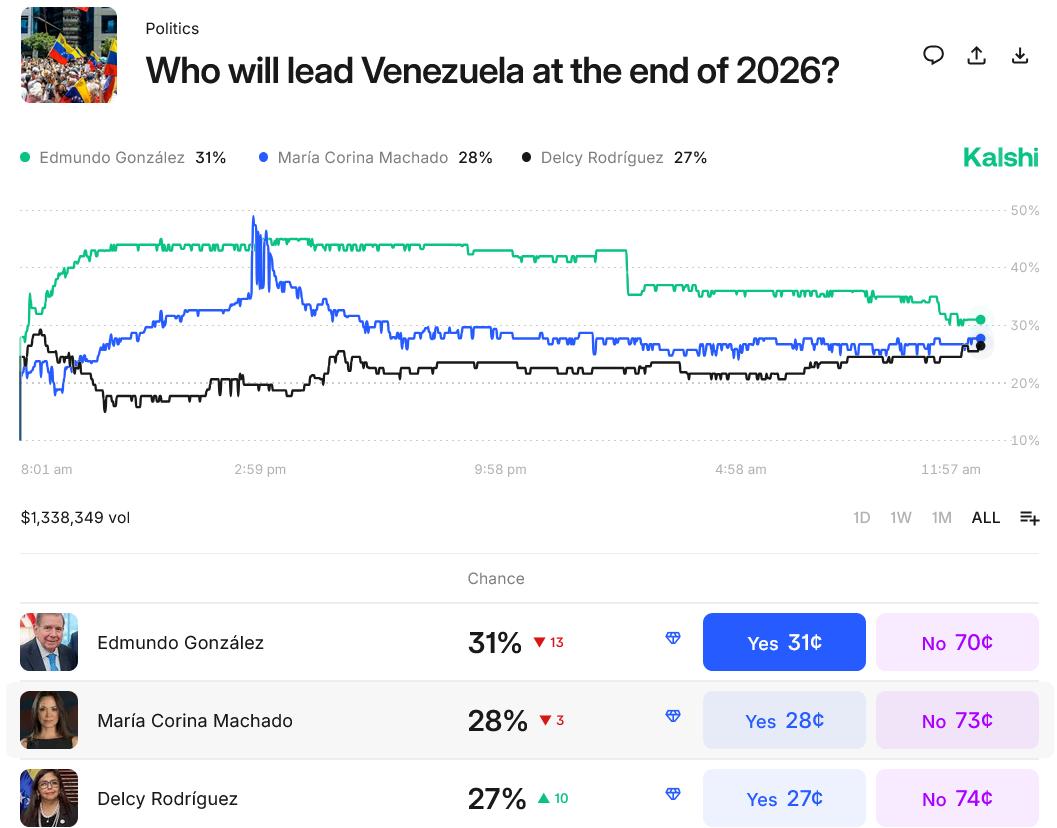
- Kalshi noted that the race for Venezuelan leadership until the end of 2026 is very close between González, Machado, and Rodríguez.
- Machado once called Bitcoin a "lifeline" and suggested including BTC in national reserves and expanding payments.
- The legacy of tight restrictions on Bitcoin mining under Maduro could continue to pose a significant risk to miners and crypto businesses.
Kalshi's statement indicates that the race for Venezuela's leadership by the end of 2026 is very close.
According to data from the Kalshi forecasting market, the lead over Venezuela by the end of 2026 is evenly Chia among three names: Edmundo González Urrutia, María Corina Machado, and Delcy Rodríguez.
Data shows Machado at 28%, behind Unitary Platform candidate Edmundo González Urrutia (32%). Delcy Rodríguez is third with 27%, amid her appointment as interim president by the Supreme Court following Maduro's arrest.
González Urrutia is widely believed to have won the Venezuelan elections in May 2025, but is being prevented from taking office by Maduro's ruling party. This makes the "legitimacy" and "feasibility" of the power transition a hotly contested issue in 2026.
Machado XEM Bitcoin as a "lifeline" and wants to include BTC in his reserves.
Machado has publicly advocated for Bitcoin as a tool to protect assets and support people during crises, suggesting that BTC be made a national reserve asset and that its use for payments be expanded.
In a late 2024 exchange with Alex Gladstein (Human Rights Foundation), Machado outlined a vision of considering Bitcoin as a national reserve asset and promoting its use as a widespread means of payment.
"Venezuelas have found a lifeline in Bitcoin during times of hyperinflation—using it to protect assets and finance their departure."
– María Corina Machado, in interview with Alex Gladstein (2024)
“Bitcoin has evolved from a humanitarian tool into an essential means of resistance. We are grateful for the ‘lifeline’ Bitcoin has provided and look forward to embracing it in a democratic Venezuela.”
– María Corina Machado, speech (2024)
The core economic issue is that the bolivar has been described as having lost over 99.99% of its purchasing power since Maduro came to power in 2013. In a free-market reform scenario, Bitcoin could be XEM as an alternative to reduce dependence on a weak domestic currency and open up more payment options.
Trump's comments have altered expectations regarding Machado's leadership potential.
Kalshi noted that Machado's approval ratings briefly surpassed González's on January 3, 2026, but declined after U.S. President Donald Trump publicly questioned her domestic support.
Trump said he thought it would be “very difficult” for Machado to lead Venezuela away from Maduro’s legacy, because she “does not have enough support or respect” in the country.
"I think it would be very difficult for her to become a leader… she doesn't have domestic support or respect."
– Donald Trump, speaking (2026)
Many analysts disagree with this view. Liz Rebecca Alarcón, founder and CEO of Project Pulso, Chia that the opposition movement has strong backing and that the "will" of Venezuelans both inside and outside the country should be respected.
“We want the will of Venezuelans at home and abroad to be respected—and that will is for María Corina Machado and Edmundo González Urrutia to ultimately take power.”
– Liz Rebecca Alarcón, CEO of Project Pulso, in an interview with ABC (2026)
Machado was once considered a strong contender to defeat Maduro in the 2025 election, but was barred from running by the Supreme Court due to allegations of administrative misconduct and violations of election laws.
The legacy of repression against Bitcoin mining means that policy risks remain significant.
The Maduro government and law enforcement have a history of seizing Bitcoin Mining Rig and shutting down mining facilities, often citing reasons such as illegal electricity use or lack of permits.
During the United Socialist Party's term, the seizure of equipment and closure of Bitcoin mining sites were often justified by accusations of "unauthorized" operations or "illegal use of electricity." One example cited by the community is Pierre Rochard 's post summarizing cases related to cracking down on mining activities.
Politically, the Trump administration stated that it had spoken with Rodríguez on January 3, 2026: initially, she signaled cooperation, but later called Maduro's arrest an "illegal kidnapping" and considered the US operation a violation of Venezuela's sovereignty.
Trump also warned of a “very high price” if Rodríguez didn’t “do the right thing,” according to an interview with The Atlantic. In this context, any expectations for a crypto-friendly legal framework remain heavily dependent on the post-Maduro power structure.
Why is crypto still a survival tool for many Venezuelan families?
With persistent high inflation and a massive wave of migration, crypto is being used as one of the tools for transferring money, saving, and making cross-border payments for Venezuelans.
An estimated more than 8 million Venezuelans have left the country since 2013. In this remittance flow, crypto is one of many options helping those abroad send money back to their families, especially when traditional financial infrastructure is limited or expensive.
The key lies in belief in value: when the domestic currency weakens, consumers tend to seek alternative assets to reduce the risk of losing purchasing power. However, the level of "legitimacy" of crypto in the economy still depends on the direction of the new administration and how they strike a balance between managing risk and opening up to innovation.
Frequently Asked Questions
Kalshi is predicting who is likely to lead Venezuela by the end of 2026?
According to Kalshi data, Edmundo González Urrutia leads with 32%, María Corina Machado with 28%, and Delcy Rodríguez with 27% for the end of 2026.
What did Machado say about Bitcoin in the context of Venezuela?
She called Bitcoin a "lifeline" during hyperinflation and once floated the idea of making BTC a national reserve asset, while also supporting the use of Bitcoin for payments.
Why are Bitcoin Miners in Venezuela worried about policy risks?
The Maduro administration has a history of seizing Mining Rig and shutting down mining facilities, often citing reasons such as lack of permits or illegal electricity use.
How did Trump's statement affect expectations for Machado?
After Trump questioned Machado's level of "respect" and "support" domestically, her rating on Kalshi was described as having declined from its earlier surge.