Instead of relying on general-purpose public blockchains, Stable is building a digital dollar settlement engine with USDT as its native gas.
Written by: Sanqing, Foresight News
The industry generally believes that stablecoins are the asset form closest to large-scale deployment in the crypto ecosystem. However, in real-world use, their payment potential has not been fully realized. The problem may lie in the fact that stablecoins have long operated on general-purpose blockchains with general computing as their core objective.
On December 8, 2025, the Stable mainnet officially launched. Unlike most new public chains, Stable did not attempt to cover complex DeFi or general contract scenarios, but instead clearly limited its goal to one thing: to reconstruct on-chain settlement around USDT.
Why is a dedicated Layer 1 for stablecoins needed?
Mainstream public blockchains were initially designed to serve general computing needs, supporting complex contracts and diverse financial applications. Stablecoins typically exist only as contract-layer assets; users still need to hold additional stablecoins and pay transaction fees in the network's native tokens when making transfers.
In payment scenarios, the unpredictability of gas fees is a primary concern. Stablecoin transfers share block space with speculative transactions and complex contracts, and small payments often become economically unviable during peak periods due to cost imbalances. Furthermore, the minute-level settlement delays caused by multi-block confirmation mechanisms are significantly different from the near real-time standards of modern payment systems.
Stable is not aiming to compete with existing public blockchains in general-purpose computing power, but rather to proactively narrow its application boundaries, making stablecoin settlement its sole core scenario. By setting USDT as a native gas fee asset at the protocol layer, users do not need to purchase ETH or SOL to pay for gas; they can transfer funds simply by having USDT in their wallets.
Underlying design for enterprise-level settlement scenarios
Stable has restructured its underlying architecture for high-frequency stablecoin transfers. The most significant change is the adoption of USDT0 as the protocol's native billing asset. Users no longer need to manage additional volatility tokens during transfers, and the payment process is streamlined into a single asset transaction.
At the consensus layer, Stable employs a customized StableBFT mechanism, optimizing the confirmation process based on the delegated proof-of-stake framework to achieve sub-second transaction finality. Coupled with a parallel execution mechanism, Stable is designed to support large-scale concurrent transfer demands, adapting to scenarios with concentrated payment traffic.
For enterprise users, the protocol layer introduces resource scheduling mechanisms such as pre-allocated block space, ensuring guaranteed throughput for critical settlement transactions even during network congestion. Meanwhile, confidential transfers and a tiered storage structure provide a controllable balance between privacy protection and compliance auditing, making the network more compatible with the requirements of traditional financial institutions for settlement systems.
In addition, Stable is fully compatible with EVM, enabling existing Ethereum development tools and contracts to be migrated at low cost.
Capital background and ecological synergy
The Stable testnet launched on November 4th, and the mainnet. Its rapid progress was made possible by investment or strategic support from traditional and emerging financial giants such as Bitfinex, PayPal Ventures, and Tether. Furthermore, in the early stages of the project, the Stable team received direct funding and resource support from the Bitfinex and PayPal ecosystems.
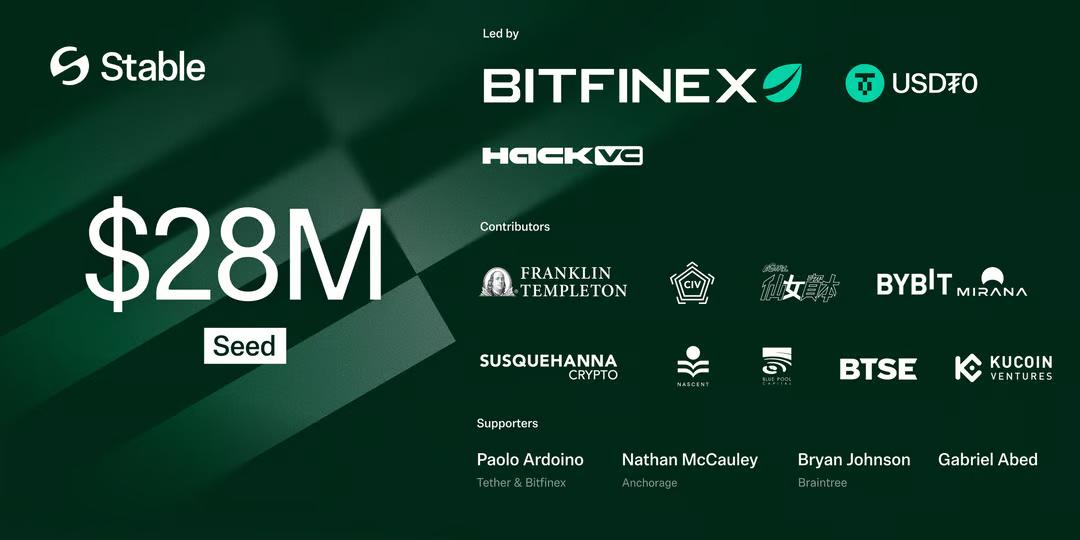
Source: Stable News - Stable Raises $28M to Build the Financial Rails for USDT
Bitfinex participated in the design during the project's incubation phase, ensuring that Stable's underlying structure aligns with USDT's actual usage logic. The involvement of Tether's management also ensured smooth compliance and collaboration during USDT's native deployment on the network.
PayPal Ventures' strategic investment expands Stable beyond native crypto payments, giving it the potential to integrate with existing payment systems. By introducing PYUSD, Stable is seen as a new type of infrastructure that can support compliant stablecoin settlements, rather than a sub-network of a single asset.
In the early stages of the mainnet launch, Stable has completed the basic integration of payment channels, wallet connections, liquidity, and cross-chain infrastructure. Currently, users can transfer USDT and other stablecoin assets to Stable through mainstream cross-chain bridges such as Stargate and Relay, providing the foundation for liquidity and trading activity in the early stages of the mainnet.
In the DeFi and on-chain finance sectors, the Stable team has also collaborated with protocols such as Curve and Morpho to support the liquidity and yield management of stablecoins.
The value anchor of the STABLE token
Stable employs a dual-token structure that separates front-end payment assets from back-end governance assets. Ordinary users only need to interact with USDT, while the network's governance, security, and incentive mechanisms are handled by the STABLE token.
STABLE was previously available for airdrop distribution when the mainnet launched. It is currently listed on spot exchanges such as Bitget and Bybit, and is also available on Binance and OKX futures trading platforms.
STABLE's core value does not come from payment consumption, but is directly linked to the actual transaction fee revenue generated by the network. All gas fees are settled in USDT and enter the fee pool, then distributed to participants who stake STABLE according to the rules. Therefore, token rewards are directly related to the network's settlement volume, rather than relying on inflation incentives.
In terms of distribution structure, both team and investor tokens have a relatively long lock-up and release period to reduce early selling pressure and strengthen long-term operational incentives.
From settlement networks to invisible financial infrastructure, Stable Pay is poised for takeoff.
Stable's long-term vision is not just to build a high-performance public blockchain, but also to seamlessly embed underlying settlement services into applications.
The planned Stable Pay will lower the barrier to entry for users through a Web2-like interaction, making stablecoin transfers more similar to the traditional payment experience. The application is currently in its final development stage and is open for waitlist applications.

Image source: Stable News - Introducing Stable Pay, the Stablecoin Payment Wallet on Stablechain
In terms of technological evolution, Stable will gradually improve batch transfers, enterprise-level bandwidth guarantees, and developer tools, enabling third-party applications to natively embed stablecoin payment functionality.
With further optimization of the consensus and execution architecture, the network aims to eventually evolve into an underlying financial track focused on the circulation of stablecoins, providing a predictable digital dollar settlement foundation for retail payments, corporate settlements, and cross-border clearing.