
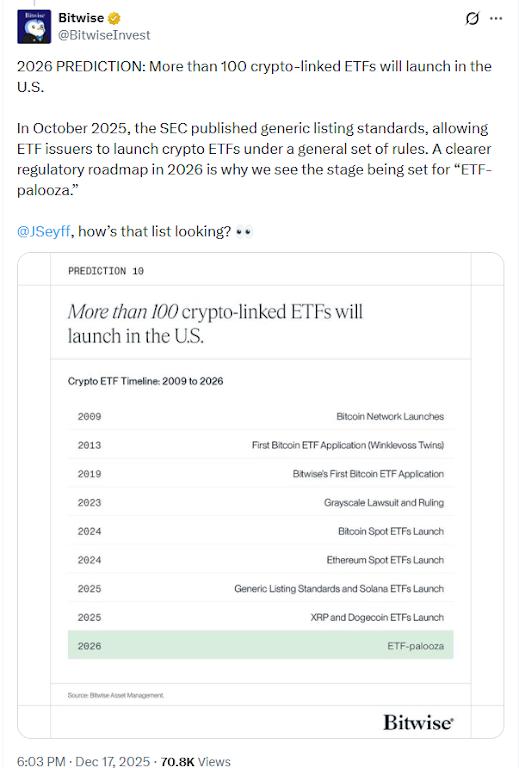
As the regulatory barriers loosen and issuers hurry to bring to market under new listing rules, industry projections indicate that more than 100 crypto-linked exchange-traded funds will be launched in the United States in 2026. According to analysts, a more transparent rule by the U.S. Securities and Exchange Commission has produced the circumstances of what some may call an ETG-palooza. This may transform how investors can access digital assets in the traditional markets.
The forecast is based on a policy change in October 2025, when the U.S. Securities and Exchange Commission released generic listing standards of crypto-linked ETFs. The standards enable fund sponsors to introduce products under a similar rule to achieve fewer case-by-case approvals. According to market participants, this transformation by itself eliminates years of regulatory friction and opens a flood of new products related to Bitcoin, Ethereum, XRP, Solana, and other digital assets.
A Regulatory Shift Sets the Tone for 2026
The fact that the SEC shifted to a more standardized listing requirement signified a departure of the agency from its more conservative route. For more than 10 years, proposals for crypto ETFs have been repeatedly put off, rejected, or subjected to legal disputes. That was the defining moment when the decisions of the court compelled regulators to reconsider the way they compare the evaluation of the spot crypto products with the funds that were based on futures.
The issuers had a forecast of the path to take by the end of 2025 after the release of generic standards. The ETF managers did not have to negotiate specific approvals for each product. Rather, they may create funds that were defined based on the established standards in regards to custody, source of prices, disclosures, and market monitoring. This regulatory clarity, according to analysts, is why the number of filings waiting to be launched in 2026 is high.
The proponent of this pessimistic view has been led by asset manager Bitwise Asset Management. The company predicts the emergence of over 100 crypto-linked ETFs in the U.S. in the year 2021, covering spot holdings, income funds, and diversified baskets. Bitwise also claims that a combination of standardized rules and the increased institutional demand has reduced years of product development to a single cycle.
From Bitcoin to Broad Crypto Exposure
In 2024, the initial wave of U.S. spot crypto ETFs was nearly exclusively Bitcoin and Ethereum. These launches became the turning point in the evolution of the digital asset industry by attracting the attention of such Wall Street giants as BlackRock/Franklin Templeton/etc. The first reaction of the retail investors was very intense, with the placement of billions of dollars in the newly approved products.
Limits to that early enthusiasm were experienced later on, however, as market volatility revealed itself. Some ETFs ofBitcoin and Ether registered high outflows in a day during times of intense price decreases, and this indicates the vulnerability of short-term capital. On-chain analytics providers recorded that millions of dollars tend to leave such funds when prices are falling, although the long-term holdings are significant.
Nonetheless, according to analysts, Bitcoin ETFs have continued to raise tens of billions of dollars in net inflows since their inception, and Ether-linked funds have also amassed large asset bases. Later entrants, such as XRP-linked ETFs, have been more regularly inflowing daily since they were launched, but their size is significantly smaller in comparison.
In the future, issuers are gearing up to leave the single-asset exposure behind in 2026. The products planned are multi-asset crypto baskets, rule-based indexes, and income-oriented strategies that seek to smooth returns. There are also some suggestions on premium-income structures that yield by overlaying options instead of just appreciating the price.
Solana, XRP, and Altcoins Enter the ETF Race
It is not only Bitcoin and Ethereum that are expected to grow. Regulators have made it clear that they do not regulate large-cap digital assets, which have increased filings that are associated with Solana and XRP. Applications mentioning Solana became popular in 2025, and interest in XRP-based products revived, as the legal uncertainty calmed down.
Analysts believe that such altcoin ETFs may appeal to another group of investors. Although Bitcoin funds are typically used as a macro hedge or a store-of-value proxy, network-based products could be of interest to investors who want to be exposed to the development of blockchain infrastructure. XRP-linked ETFs have attracted attention instead, due to their comparative resistance to inflows at times when Bitcoin and Ether funds were experiencing redemptions.
Those who are in the business are warning that not all products will do well. The high concentration in the market increases the possibility of ETFs with low trading volumes being unable to attain sustainable scale. Nevertheless, the massive number of filings highlights the confidence of issuers that demand will expand as more people can access them.
Among the best cases to make in support of a crypto ETF influx is the growth of institutional access. Most of the large brokerage platforms are likely to have crypto ETFs in 2026, along with traditional investment products. Such products have already been approved by several large financial institutions for retail and advisory clients, which is an indication of a change in the approach to internal risk assessment.
Bitwise and other analysts believe that the ETF will take the lead in the on-ramp of institutional capital. ETFs are easier to custody, comply with, and report. This form fits more with pension funds, endowments, and wealth managers who have strict mandates.
The supply-demand factors are also indicated by the market researchers. It is estimated that with current rates of issuance, the new supply of Bitcoin, Ethereum, and Solana going into circulation in 2026 would be fully absorbed by ETF demand alone.
Assets Under Management Could Double
The projections of assets under management are different, though there are analysts who are united by a similar theme. Crypto ETF AUM, which was only slightly under $200 billion in late 2025, may end up near or even surpassing 400 billion by the close of 2026. That growth would not only be an indication of the new product launches that would be undertaken, but also increased penetration among the traditional investors.
Analysts believe that the ETF is now the most important access point to regulated exposure to crypto. With the sovereign wealth funds and large institutions testing allocations, ETFs offer a well-known package that reduces operational issues. This rotation, they claim, may cement the transformation of Bitcoin into a more macro-responsive asset having longer cycles and less volatility.
Not every forecast is bullish, although the optimistic ones are good. James Seyffart, the ETF analyst at Bloomberg, has cautioned that a flood of liquidations of crypto ETFs may follow the first boom. Seyffart states that the market has more than 120 filings that are already counted, and many of them might fail to raise enough assets.
He indicates that the process of consolidation might start as early as the end of 2026 and a more severe shakeout by the end of 2027. When this happens, ETFs with low volumes of trade or in a niche strategy can go out of business, with more liquid ETFs taking over the market share. This trend is similar to one observed in the classic ETF markets, whereby only a small percentage of launches are long-term viable.
Past information justifies this warning. In other asset classes, a rationalization period is marked by a long period of rapid proliferation of products. Analysts emphasize that a closure is not always an indicator of asset class failure, but rather an indication of a maturing market that favors scale and efficiency.
The post U.S. Crypto ETF Boom Expected In 2026 After SEC Clears Listing Path appeared first on Metaverse Post.