
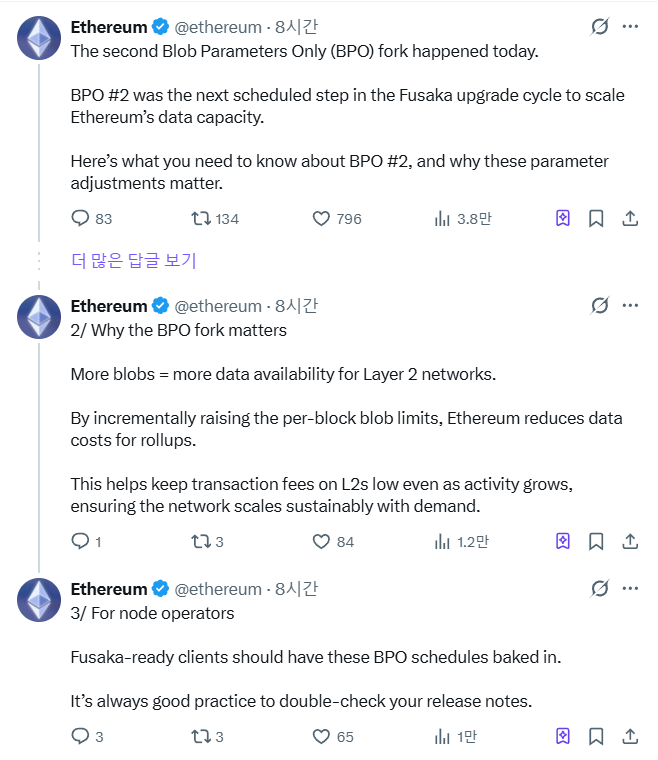
Ethereum today successfully completed its second "Blob Parameters Only" (BPO) fork, the final step in its Fusaka upgrade plan. This fork is being praised for significantly improving data availability and demonstrating the effectiveness of network expansion through phased updates.
"Instead of waiting for the annual major upgrade to adjust network capacity, the BPO fork allows Ethereum to independently and efficiently fine-tune certain parameters, such as the blob target," the official Ethereum X channel explained. "This gradual scaling approach allows the network to safely test higher loads in stages."
Blobs are large temporary data blocks introduced in the Ethereum Dencun upgrade in 2024. They are primarily used by Layer 2 rollups to record transaction batches on the mainnet at low cost. These data repositories (Binary Large Objects) are stored for 18 days and then permanently deleted.
Many of the 13 Ethereum Improvement Proposals (EIPs) included in Pusaka focused on improving Ethereum's data availability layer. Specifically, the PeerDAS upgrade allows nodes to verify blob data by verifying only small data samples, and the BPO mechanism gradually increases the blob size cap.
The first BPO fork was activated on December 9th of last year (approximately a week after the launch of Pusaka), increasing the target number of blobs per block from 6 to 10 and the maximum limit from 9 to 15. This upgrade on the 8th further increased the target number to 14 and the maximum limit to 21, further enhancing network scalability.
Joohoon Choi joohoon@blockstreet.co.kr
"Instead of waiting for the annual major upgrade to adjust network capacity, the BPO fork allows Ethereum to independently and efficiently fine-tune certain parameters, such as the blob target," the official Ethereum X channel explained. "This gradual scaling approach allows the network to safely test higher loads in stages."
Blobs are large temporary data blocks introduced in the Ethereum Dencun upgrade in 2024. They are primarily used by Layer 2 rollups to record transaction batches on the mainnet at low cost. These data repositories (Binary Large Objects) are stored for 18 days and then permanently deleted.
Many of the 13 Ethereum Improvement Proposals (EIPs) included in Pusaka focused on improving Ethereum's data availability layer. Specifically, the PeerDAS upgrade allows nodes to verify blob data by verifying only small data samples, and the BPO mechanism gradually increases the blob size cap.
The first BPO fork was activated on December 9th of last year (approximately a week after the launch of Pusaka), increasing the target number of blobs per block from 6 to 10 and the maximum limit from 9 to 15. This upgrade on the 8th further increased the target number to 14 and the maximum limit to 21, further enhancing network scalability.
Joohoon Choi joohoon@blockstreet.co.kr







