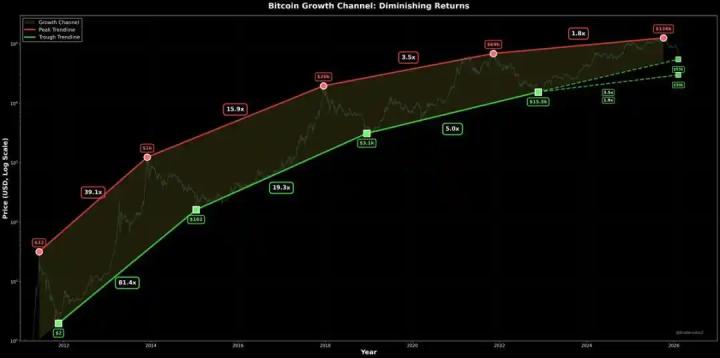
Bitcoin is currently in the early stages of a bear market, based on various on-chain and market indicators. This trend is predicted to continue through 2026, with the possibility of further price declines rather than establishing new highs.
In an interview with BeInCrypto, Julio Moreno, Head of Research at CryptoQuant, stated that the main reason for this perspective is the weakening market demand.
on-chain data confirms bear market.
While many investors are still debating whether a full-blown crypto bear market is imminent , Moreno believes Bitcoin entered a bear market as early as November 2025.
"Almost every on-chain indicator or market indicator confirms we are in the early stages of a bear market," he Chia in an episode of the BeInCrypto podcast.
According to him, what is happening is just the beginning. He expects the price of Bitcoin to continue its downward trend in the coming months.
"The question here is how long the bear market will last, and how low will the price fall. But given the current starting point, I don't expect Bitcoin to reach a new all-time high," Moreno added.
Moreno's pessimistic view is based not only on price fluctuations, but also on fundamental factors that indicate continued weakness in the market.
The demand engine for Bitcoin is starting to falter.
Over the past several months, demand for Bitcoin has shown signs of a sharp structural decline. To track this, CryptoQuant analyzed Capital flows from ETFs .
Between 2024 and 2025, demand for Bitcoin will be supported by several major drivers. With the launch of US Bitcoin spot ETFs , there will be a strong influx of institutional capital, driving a rapid surge in demand.
In addition, supportive policies from the US government under President Donald Trump also contributed to increasing the attractiveness of risky assets like Bitcoin.
However, this wave of buying has now reversed .
“ETFs have been net sellers of Bitcoin at least since the beginning of November,” Moreno said. “They were buying aggressively before, then things slowed down, and now they’re not buying anymore but selling.”
This decline in demand is also evident in many other aspects.
The risk of forced sale has become a focal point.
Last year, the crypto market saw many large businesses buying Bitcoin as a reserve asset .
Strategy (formerly MicroStrategy) took the lead, followed by MetaPlanet, Twenty One Capital, and MARA Holdings in adopting similar Bitcoin accumulation strategies.
However, this wave of buying has also subsided .
“Aside from MicroStrategy, most companies holding Bitcoin have stopped buying more. If the price continues to fall, the risk of more companies having to sell Bitcoin will be higher,” Moreno told BeInCrypto.
This very risk of being forced to sell could be a factor driving more volatility in Bitcoin's price.
According to Moreno, Bitcoin could Dip around $56,000.
Although downside risks remain, Moreno believes Bitcoin's long-term outlook will depend on whether demand can recover.
"When demand stops declining and starts to rise again, that will be the point where the market structure changes," he stated.
Until that signal becomes clear on on-chain indicators, the safest approach for investors remains caution.