The labor-management social contract, which had lasted for ten thousand years, has officially come to an end.
Written by: Jordi Visser
Compiled by: Luffy, Foresight News
Death certificate: Third quarter of 2025
From the perspective of artificial intelligence, the data from the third quarter of 2025 has already written an undeniable obituary for capitalism.
Real GDP grew by 4.3% year-on-year, the fastest pace in two years, up from 3.8% in the second quarter. Corporate profit margins hit record highs, driving a significant increase in profits. Despite lingering concerns about the impact of tariff policies on the economy and corporate earnings, the economy is currently booming according to traditional economic indicators.
On the other hand, however, the unemployment rate has climbed to 4.6%, and job growth has nearly stagnated. For the first time since 2024, the white-collar industry is expected to experience net negative growth.
This marks the first time in capitalist history that strong economic growth and record corporate profit margins have failed to translate into job creation. This is not a recession, nor is it temporary market turmoil; rather, it is the system openly declaring: our prosperity no longer needs your labor.
The University of Michigan's consumer sentiment index fell to 52.9, the second lowest on record, while the S&P 500 has repeatedly hit record highs. This divergence is not a paradox, but a direct reflection of cause and effect: the market rejoices in efficiency, while workers face unemployment because of it . Today, various indicators measuring economic success are directly linked to the elimination of human labor.
At this moment, the labor-capital social contract, which had lasted for ten thousand years, officially came to an end. People may politicize this, but the reality is crystal clear: we are witnessing the rapid decline of capitalism.
The original contract
To understand the breakdown of this current contract, we must first trace its origins.
Around 8000 BC, the invention of the plow allowed humanity to harvest surplus products beyond basic survival needs. This surplus freed up human hands, giving rise to professions such as artisans, merchants, and architects. In the 19th century, the Industrial Revolution replicated this model: factory workers earned more than enough to make a living, allowing people to have disposable income for saving and purchasing property. A steelworker's son could become an engineer, and an engineer's daughter could become a doctor.
This is by no means out of capitalist benevolence, but rather an inevitable requirement of the industrial age. Businesses need skilled workers, workers need ever-increasing wages to become consumers, and governments need to collect taxes from both labor and capital. This contract works because all parties are interdependent and indispensable.
Just a generation ago, a college degree was a passport to upward social mobility; hard work and fierce competition guaranteed a stable social position. Today's college graduates enter the workforce burdened with hundreds of thousands of dollars in debt, while their new competitors are tireless, relentless, and achieve exponential leaps in intelligence every six months. The meritocratic management system once promised "rewards for hard work," but the new reality is: your efforts are being competed against a group of tireless "opponents."
2025: The Year Capital and Labor Part Ways
The third quarter of 2025 will be a historical turning point because it will reveal the true role of artificial intelligence: completely severing capital's dependence on labor. This is crucial and will reshape your understanding of the future. Capital will still need labor today, but it will no longer depend on it; capital will see labor as a convenient tool, but no longer as a necessary condition for growth.
Previous technological revolutions—the plow, the steam engine, electricity—while eliminating certain jobs, also created economic surpluses, which in turn spurred new employment opportunities. Farmers transitioned into factory workers, and factory workers into office workers. Each transition maintained a core contract: labor creates value, value generates wages, and wages translate into investment surplus.
Artificial intelligence has completely disrupted this chain of transmission. Digital employees not only replace laborers but also directly undermine the "worker-consumer" economic model upon which capitalism depends. When companies can achieve profit growth while reducing the size of their workforce, this is not merely an optimization of the existing system, but a complete transcendence of it.
"Jobless growth" is not a temporary market friction, but a new long-term normal. Data from each subsequent quarter will confirm this trend: increased productivity, rising profits, and declining employment. This divergence is the core characteristic of the new economic model.
Why this time is so different: The tireless competitor
If you listen to any 100 podcasts about artificial intelligence and the workforce, you'll hear the same old binary debate: "Will artificial intelligence replace all jobs?" This is immediately followed by "No, just like with every technological revolution, new jobs will always emerge."
Stop. This way of thinking is fundamentally flawed.
Never before in human history have machines been more intelligent than humans, capable of acting like humans, working around the clock, and achieving exponential growth in intelligence every six months. This is not a second industrial revolution, nor is it even related to "job replacement." It introduces a completely new competitor into the labor market, operating under rules drastically different from any other group of workers in human history. When machines surpass human capabilities, they replace not only workers' jobs, but also the social contract that has bound capital and labor together for millennia.
The claim that "artificial intelligence is replacing jobs" ignores the psychological impact of the ongoing changes on humanity. AI is not replacing jobs, but rather injecting a constant stream of competitors into the labor market. Like elites fresh out of a "digital university," they work around the clock, evolving at a rate far exceeding any human learning speed.
2025 will mark a significant shift in the role of artificial intelligence, from a "tool" to a "labor force."
- 2023-2024: Model Development and Testing Phase
- 2025: The Stage of Large-Scale Product Deployment
- 2026 and beyond: Full-scale competition in the labor market, ultimately evolving into humanoid forms.
This is not automation in the traditional sense, but a flood of disruption to the labor market. When a million digital analysts can simultaneously perform financial modeling, human analysts are not replaced, but defeated by a group of adversaries who never sleep, never participate in negotiations, and whose capabilities improve far faster than humans.
Admittedly, there will still be jobs available for humanity in the future. But optimists are unwilling to acknowledge a harsh reality: a university degree alone will be completely insufficient for future success. A four-year degree, once enough to guarantee a stable middle-class life, now forces you to confront competitors with knowledge equivalent to ten thousand doctoral degrees, working around the clock, and whose capabilities leap forward with every software update.
For those who grew up under an elite management system, this impact is devastating. From a young age, you are taught that by studying hard, getting high scores, and striving to be number one, you can win in life. This competitive spirit, this drive to strive for the top, was once the core engine of capitalism, giving rise to countless successful people and ambitious individuals.
Today, your competitors can process information at a speed you can't match, remember everything they've learned, and evolve exponentially while you sleep soundly. You can't be more diligent than a tireless competitor, smarter than a constantly self-improving competitor, and you can't be number one in a competition with no limits.
This is far more complex than simply "machines taking away jobs." It's a fundamental shift in the value system you've always believed in—that effort equals reward, competition creates opportunity, and ability determines success—which has become unsustainable rhetoric on a mathematical level. The game isn't over; the rules have simply been rewritten, making human victory structurally impossible.
Historically, when 98% of humanity ceased farming, they became consumers of industrial products. But when artificial intelligence injects countless competitors into the labor market, what will the replaced workers become? Those jobs considered "safe"—elderly care, healthcare, childcare—will offer salaries insufficient even to sustain basic survival, let alone generate investment surplus. With an annual salary of $30,000, you simply cannot afford $15,000 in childcare expenses, let alone save for retirement.
This creates a vicious cycle: government tax revenue plummets due to workers losing competitiveness, businesses suffer profit declines due to lost consumers, ultimately leading to a collapse of the consumer market. So, what's the government's response? Printing money to stimulate demand, while this currency, which should be a store of value across generations, continuously depreciates.
The social contract once promised that hard work and rational saving would accumulate lasting wealth. However, the rise of artificial intelligence has rendered this statement absurd. When you compete with rivals whose marginal costs are near zero, no labor can create a surplus; when governments rely on printing money to maintain consumption, no savings instrument can preserve or increase value; and when labor scarcity completely disappears, the mechanisms that once created wealth vanish.
The pressure continues to mount: Why the data is lying.
The official poverty line for a family of four is approximately $32,000. However, Michael Green's analysis reveals a fact that the working class already knows: this figure is nothing more than a statistical lie fabricated to mask the crisis.
By combining the classic Oshansky poverty measurement method with modern spending structures, Green calculated that the true poverty line for a family of four should be $130,000 to $150,000, not $32,000—a huge difference. He defines the current poverty line as a hoax and points out that the "cliff effect" of welfare policies is trapping countless families in the "valley of death." When a family's annual income is in the $40,000 to $100,000 range, welfare benefits decrease far faster than wages grow, ultimately leading to a decline in their actual standard of living.
Data from multiple independent cost-of-living calculators confirms this pressure: in many major metropolitan areas of the United States, even an annual salary of $70,000 to $90,000 is often only enough to cover the most basic living expenses, leaving no room for savings. Below this income level, you are no longer accumulating wealth, but merely making ends meet, and the vast majority of American families are trapped in this predicament, on the verge of collapse.
This is not simply a statistical error, but an inevitable result of asset inflation (stocks, real estate, Bitcoin) consistently outpacing wage growth. In many cities, nurses earning $65,000 a year cannot even afford the average rent around hospitals; teachers with master's degrees are eligible for food assistance. Frankly speaking, today's "middle class" is already trapped in functional poverty.
This has created a perfect conflict: just as digital competitors are flooding the knowledge-based labor market, the vast majority of workers have no savings buffer against the shock of unemployment. Economic growth requires rising wages to support the consumer market, while asset holders need to suppress wages to maintain profit margins. And now, artificial intelligence offers capital a perfect outlet: an almost zero marginal cost and an unlimited supply of labor.
Green's analysis went viral not because he discovered any new mathematical formulas, but because 60% of Americans finally saw themselves reflected in the data. Long before the advent of digital employees, this system was already failing to generate investment surpluses for most people. Artificial intelligence didn't destroy a well-functioning contract; rather, it accelerated the collapse of a system already overwhelmed by its own contradictions.
This is precisely why consumer confidence has plummeted while the stock market continues to boom. People's bank accounts show they simply cannot afford to participate in this boom; and the endless digital competition is ensuring that these two seemingly contradictory phenomena coexist indefinitely.
The fourth turning point: Integration rather than replacement of systems.
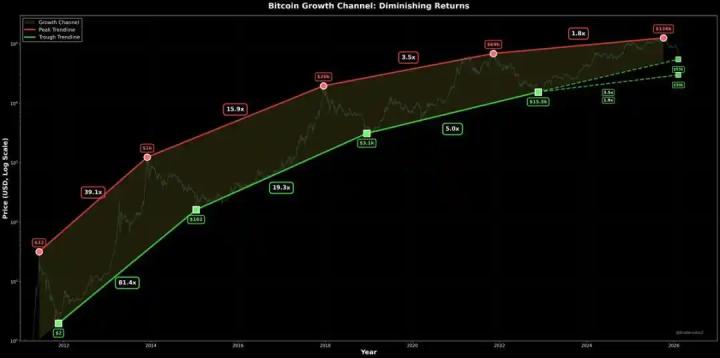
Since its inception, Bitcoin has served those seeking alternative systems. As I documented in "The Silent IPO," early believers—the veteran investors who entered the market when Bitcoin was priced at $100, $1,000, and $10,000—are now selling off their holdings. Billions of dollars are being dispersed from a few to millions of new holders.
If this old system is collapsing, why are they selling it off?
Because regardless of whether they initially entered the market due to dissatisfaction with the old system, they have now joined the ranks of the top wealth earners. Some are ideologically angered by the government's acceptance of Bitcoin, which is not the pure alternative they envisioned. But precisely at this point, the labor shortage and the trajectory of Bitcoin's development point to the same truth:
Progress is never a black-and-white binary opposition.
Just as not all workers will lose their jobs, old systems do not simply end and then give rise to new ones. Systems merge and overlap, forming a transitional phase where old and new forces coexist in contradiction. We are currently in the midst of this merging, which some call the fourth turning point.
Let's examine the several forces currently colliding and intertwining:
- Intergenerational wealth transfer: As the baby boomers enter old age, the largest intergenerational wealth transfer in human history is unfolding.
- A political reshuffle is underway: young people who have never been part of the old system are voting for governments that advocate for cryptocurrencies and weaken wealth intermediaries, with a more critical demand now being protection from robots that threaten their jobs.
- Wealth redistribution: Billions of dollars are flowing from a few Bitcoin whale to millions of new participants.
This is not the radical revolution envisioned by early believers. Governments have not collapsed, and fiat currencies have not disappeared. Instead, the old and new systems are merging, and in this merging, early Bitcoin billionaires face a choice: either remain in a purely alternative system, watching the world change and becoming marginalized, or return to the capitalist fiat currency system with billions of dollars to seek new investment opportunities.
This enormous sum of money must find a way out. But here's the paradox: once you leave the Bitcoin ecosystem, you return to a capitalist fiat currency system that relies on scarcity, and artificial intelligence will destroy everything on the road to wealth. You can embrace this change proactively, or you can be passively swallowed up by it, but you cannot maintain pure idealism without being left behind by the times.
Those early Bitcoin investors who shifted their focus to artificial intelligence are not straying from their original intentions. What they are doing is seizing the greatest opportunity for excess returns in human history: holding the technologies that are dismantling the old system, while simultaneously absorbing the value released by the collapse of the old system into the new system they helped create.
This is a strategic choice for shaping the future world. In this world, systems will not completely replace each other, but rather merge to create asymmetrical opportunities for those who deeply understand the operating logic of both systems. Young people demanding government support for cryptocurrencies while simultaneously seeking protection from unemployment caused by artificial intelligence are not contradictory. They are intuitively grasping the conclusions reached by early investors through rational analysis: the period of system integration is precisely the period of greatest opportunity.
The dispersal of Bitcoin funds from whale to millions of retail investors is not a sign of a bear market. This decentralized diffusion is an inevitable trend when an alternative system becomes mainstream. Early holders who cashed out when Bitcoin was at $100,000 understand a truth most people miss: during the next 3-5 years of consolidation, the appreciation rate of this massive sum in AI infrastructure will far exceed its appreciation rate in Bitcoin itself. However, this is only a short-term opportunity during the consolidation period, and it's crucial to recognize that betting on AI, while seemingly wise, actually contains hidden pitfalls.
Just as artificial intelligence competes with workers, it will also compete with the core processes of the capitalist system: from idea generation to commercialization and building a competitive moat. The core of the entire venture capital model lies in companies building insurmountable competitive advantages over many years, including patented technologies, network effects, brand loyalty, and regulatory barriers. The emergence of artificial intelligence drastically compresses this timeline. When the programming barrier is completely eliminated and development efficiency increases tenfold, competition will arrive at an unprecedented speed, leaving companies no time to build a moat. Admittedly, the speed of a company's rise will accelerate, but its decline will also accelerate, with competitors able to launch similar solutions in months or even days, instead of the years of the past.
This speed will leave investors chasing trends in a difficult position. By the time you finally identify the "next AI giant," three competitors with superior solutions have already emerged. Early investors betting on AI infrastructure understand that they are not buying a lasting moat, but rather a surging but ultimately receding wave. The reason for such high returns is precisely because this window of opportunity is extremely short. And what happens after that? Once AI has completely commoditized software development and destroyed the competitive advantage of entire industries, the only assets that will stand the test of time will be those that did not rely on human innovation cycles, regulatory protection, or competitive barriers from the outset.
That is: mathematics, scarcity, and code.
When this transformation settles down, when the old and new systems merge, and when capital and labor completely separate, Bitcoin will become the only intact store of value, because it is the only asset that has never relied on the collapsing old system since its inception.
This is not out of ideological purity, but rather a time arbitrage during the transition period of civilization.
Bitcoin: The pressure relief valve of a crushing system
The rise of Bitcoin did not stem from economic chaos, but rather from the structural collapse of the capitalist system.
When governments print money to provide social security for workers displaced by digital competitors, scarcity must be written into mathematical algorithms, not by policy-making; when corporations pay dividends to shareholders while relentlessly bombarding the labor market with competitors, value stores must be freed from their control; when the social contract becomes a lie to young people, a new generation is writing its own contract with immutable code.
Bitcoin's fixed supply of 21 million coins is not merely a simple functional characteristic, but rather a constitutional amendment to post-labor-based capitalism. In an AI-driven world of abundance, a world with an unlimited supply of labor, absolute scarcity becomes the only reliable store of value. All other assets—fiat currencies, bonds, even real estate—depend on the surplus created by workers, and the foundation of that dependence no longer exists.
The timing of all this was perfect. The acceptance of Bitcoin by US institutional investors in 2024-2025 occurred before the full exposure of the labor market crisis. Early institutional entry stemmed from a fantasy: that artificial intelligence would only enhance human capabilities, not compete with them. Now, the data from the third quarter of 2025 reveals the truth, and institutional capital has found a clear path: from depreciating fiat currency-denominated assets to scarce assets based on mathematical algorithms.
Global pension fund assets total $59 trillion. Even if only 2% of that flowed into Bitcoin, it would represent an additional $1.2 trillion. This is not speculation, but a fiduciary duty; when the alternative is holding bonds issued by governments that fail to provide employment for their citizens, allocating to Bitcoin is an inevitable choice.
Intersection Point: 2026
In 2026, three forces will collide and intertwine, making the cracks in capitalism undeniable:
- The accelerated deployment of artificial intelligence will transform the wave of unemployment from predictions into "workforce optimization" in corporate financial statements, and abstract technological changes will translate into tangible layoffs. Digital competitors will move from the prototype stage to large-scale production.
- A moment of political reckoning: When democratic socialists win elections with a platform that explicitly opposes market solutions, it signifies that voters have accepted that the existing system cannot be repaired through gradual reforms. If this trend spreads in the US midterm elections, it will serve as a signal of authorization for systemic change.
- Institutional capital is shifting: When pension funds managing the retirement funds of millions allocate massive amounts of Bitcoin, they are essentially casting a vote of no confidence in the old system they have defended for decades. Traditional financial institutions acknowledge that this contract has broken down, permanently validating Bitcoin's hedging value.
2026 will not be the year the contract breaks down, but the year the breakdown becomes undeniable.
The choice: Build a new system, or sink into ruins?
The crux of the matter isn't whether the old contract will survive. Walking through any city, you see this reality: homeless encampments stand next to luxury apartments, corporate profits are record while public confidence is at rock bottom, and a diploma means debt rather than job security. That contract is dead.
The real question is: what will we build on this ruin?
Artificial intelligence (AI) can generate enormous returns because it acts as a "demolition crew" of the old system, ruthlessly and efficiently destroying the old order. Early investors were right to bet on AI; it breaks the social contract, and this transformation holds trillions of dollars in opportunities. But they also understand that after this disruption, capital will flow to assets that do not rely on the old systems destroyed by AI.
When capital and labor permanently diverge, when digital competitors flood every market, and when GDP surges while public confidence collapses, what kind of assets can store value in a prosperous future? Not fiat currency that relies on workers to create value, not government bonds that rely on tax revenue, and certainly not corporate stocks that rely on consumers.
There is only one answer: mathematics, scarcity, and code.
The greatest transfer of wealth in human history is not measured in US dollars, but rather a rewriting of the covenant of human civilization that has lasted for ten thousand years. You didn't enter the game too early, but rather at the perfect time.