As consumer behavior itself becomes a programmable asset, the high walls of traffic built by traditional e-commerce platforms are beginning to crack. DeSpend's latest move may be showing us another possibility for Web3 consumer infrastructure.
What does it mean when a coffee shop in Seoul, South Korea, a specialty restaurant in Kuala Lumpur, Malaysia, a spa in Jakarta, Indonesia, a handicraft workshop in Hanoi, Vietnam, and a designer boutique in Hong Kong can all provide services directly to global cryptocurrency holders through the same protocol?
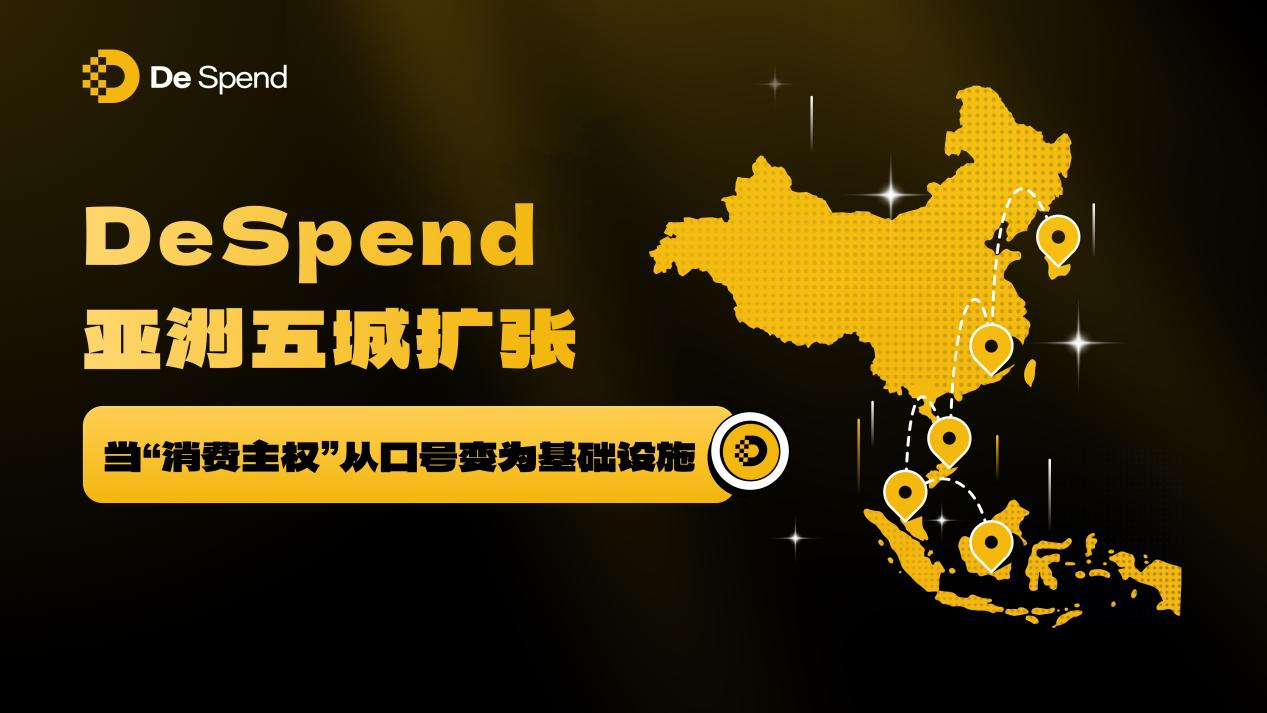
Recently, DeSpend, a Web3 consumer ecosystem, announced that it is opening its platform to local service providers in five major markets: South Korea, Malaysia, Indonesia, Vietnam, and Hong Kong.
This seemingly ordinary business expansion is actually a structural challenge to the traditional "platform-merchant" relationship, and the beginning of a large-scale social experiment on whether "agreements can replace platforms".
01 Paradigm Shift: From "Traffic Tax" to "Value Network"
The core contradiction of Web2 e-commerce lies in its "platform-centralized" architecture. Giants such as Amazon and Alibaba act as "digital landlords," controlling traffic entry points and payment channels to charge merchants "digital rent" as high as 15%-30%.
In this model, merchants' growth is trapped in a vicious cycle of "increasing traffic costs and decreasing profit margins," while the data and network effect value contributed by consumers are captured by the platform free of charge.
DeSpend attempts to build a different underlying logic. It is not another Web3 application trying to replicate the traditional platform model, but rather it modularly reconstructs the basic elements of business—payment, rights, governance, and incentives—through smart contracts to form an open "value exchange protocol."
Above this protocol layer, the relationship between merchants and consumers is no longer defined by the platform's intermediary rules. Every consumption behavior is transformed into a set of programmable, composable, and verifiable on-chain interactions through smart contracts.
This is not merely a difference in technological implementation paths, but a fundamental adjustment in production relations. Merchants no longer bid for "exposure" on the platform, but instead attract and retain Web3 native users who value "consumer sovereignty" and "value return" by providing high-quality services and unique experiences.
02 Architecture Breakdown: A Three-Layer "Composable Business" Stack
To understand DeSpend’s ambitions, it is necessary to analyze its three-layer core architecture, which forms the cornerstone of its “protocol-based business”.
The top layer is the Web3 e-commerce front-end application layer. This provides users with a seamless shopping experience indistinguishable from traditional e-commerce, supporting the display and transaction of multiple categories of goods and services. Its unique feature is that each transaction generates a corresponding on-chain equity record through a smart contract.
The middle layer is the engine for finance and assetization. This is the core of the DeSpend ecosystem's value cycle. When a user completes a transaction, they receive not only goods or services, but also on-chain credentials representing specific rights associated with that transaction. These credentials can be traded and combined on the secondary market, and even used as collateral for higher-level financial activities.
At the bottom layer is the encrypted social and growth protocol layer. This layer aims to solve the challenges of cold start and sustained growth for Web3 projects. Through a sophisticated incentive mechanism, DeSpend returns traffic sovereignty to users and early adopters.
Community members can not only earn rewards through direct referrals, but also receive continuous "network effect dividends" from subsequent consumption and ecosystem interactions within their community.
This design attempts to replicate and surpass the social fission of the Web2 era, but places it within a transparent, verifiable, and clearly owned on-chain framework.
03 Economic Model: Constructing a Value Flywheel of "Consumption-Assets"
DeSpend's token economy model is key to its long-term sustainable development. At its core, it creates a positive feedback loop that tightly links consumer behavior with asset value growth.
In this model, the platform's main revenue (derived from extremely low protocol fees paid by merchants) is injected into a global dividend pool. Any user holding DeSpend's governance token, DSG, can share in the pool's daily earnings proportionally, with their dividend weight linked to the amount of tokens held and their membership level.
This creates a unique consumer psychology: every purchase a user makes indirectly strengthens the value backing of the tokens they hold.
The deflationary mechanism of DSG is achieved through multiple paths: a portion of transaction fees is used to repurchase and destroy DSG in the open market; specific functions within the platform (such as accelerating dividend withdrawal) require burning a certain amount of DSG; and long-term staking by users to upgrade their equity level temporarily reduces the circulating supply.
This mechanism attempts to address the common problem of "weak value capture" in Web3 consumer projects. It allows the prosperity of the ecosystem (reflected in the growth of total transaction volume GMV) to be clearly mapped and fed back into the price discovery process of the core asset DSG, thereby incentivizing early users and builders to make long-term investments.
04 Five-City Expansion: A Precise Stress Test
Choosing South Korea, Malaysia, Indonesia, Vietnam, and Hong Kong as the targets for the first round of offline expansion was a carefully calculated move.
These markets together form a diverse "testing ground": there are highly developed international cities with a high acceptance of innovative technologies, as well as emerging markets with widespread mobile internet access and a huge young demographic dividend.
For DeSpend, this expansion is far more than just increasing the number of merchants. Its deeper objectives include:
Validating compliance and operational frameworks across jurisdictions. How to handle payments, taxation, and consumer protection in different legal environments is a hurdle that any global agreement must overcome.
Testing the adaptability of the "protocol layer" to diverse business models. From high-end dining to street food, from hotel bookings to one-time experiences, can the protocol rules be universally and flexibly applied to serve vastly different business models?
Observe the behavioral feedback of the token economy model in real-world, high-frequency consumption scenarios. Will users really change their consumption habits because of dividends and deflationary mechanisms? How do businesses view this new relationship of "consumers becoming shareholders"?
The answers to these questions will determine whether DeSpend's vision of "protocol-based commerce" is a scalable future or an overly idealistic concept.
05 Challenges and the Future: The Cambrian Era of Protocol-Based Commerce
DeSpend's model is undoubtedly attractive, but the road ahead is also full of challenges.
The "last mile" of user experience. How can ordinary consumers unfamiliar with private key management and gas fee concepts use DeSpend as easily as they would use Taobao or Meituan? Its integrated multi-chain wallet and fiat currency channel solution will face a real test of usability.
Uncharted waters of regulation. Tokenizing consumer rights and globalizing profit sharing—these innovative models may touch upon the complex regulatory boundaries of different countries regarding securities, payments, and taxation. The flexibility and adaptability of the project's "compliance middleware" will be crucial to its survival and expansion.
The cold start of network effects. Any two-sided market faces the "chicken or the egg" dilemma. DeSpend needs to attract a sufficient number of high-quality merchants and users with strong purchasing power simultaneously. Whether its token incentives and early community building can successfully ignite this flywheel remains to be seen.

Nevertheless, DeSpend's attempt marks a new phase in the Web3 consumer space: a shift from hype and financialization experiments to building usable infrastructure and sustainable economic models.
If successful, it may prove that future business empires may no longer be built by centralized platforms that control traffic and data, but rather by countless individuals spontaneously collaborating and co-evolving on open, composable value protocols.
Just as the internet broke the monopoly on information, protocol-based commercial infrastructure may eventually break down barriers to the flow of value. This experiment, which began in five Asian cities, deserves our continued attention.