



Author: Di Yafan
In 2022, a Stanford graduate's net worth once exceeded $2 billion .
He founded OpenSea, the world's largest NFT trading marketplace, valued at $13.3 billion.
Just months before the NFT bubble burst, he made a more crucial decision: to leave .
Two years later, his new company grew tenfold in seven months , securing all-star investments from a16z, Sequoia, and Menlo, and reaching a valuation of $500 million.
His name is Alex Atallah . His new company is called OpenRouter.
This is a story about timing and methodological replication .
Who is OpenRouter? What does it do?
If you are an AI application developer, you are certainly familiar with the name OpenRouter. Its biggest advantage is that it helps developers solve the pain of model switching:
I wanted to write code using Claude, but I found that it often ran out of space. I want to use GPT for analysis, but the price is painful for me. I wanted to try the open-source model, but found that I had to rewrite an entire API integration.
Each model vendor has a different API. You have to modify the code every time you switch models.
OpenRouter does something similar to Ctrip, putting all airlines into one app.
One API, accessing 300+ models and 60+ providers. Switch models? Change just one line of code.

Two startups, the same methodology
Alex Atallah already had a strong software background before starting his business: a Stanford computer science degree, an engineer at Palantir, and the co-founder and CTO of OpenSea…

He explained the commonalities between his two startups in his podcast:
"OpenSea organized this very heterogeneous inventory and put it together in one place... You see a lot of those similarities with how AI works today."
What is his methodology?
Find a "fragmented ecosystem" and then create an "aggregation layer".
NFT Era: Diverse Metadata Standards → OpenSea Aggregation AI Era: Diverse API Standards → OpenRouter Aggregation
Alex said something in a podcast that really stuck with me: If you can train a large AI model for just $600, then there could be tens of thousands, even hundreds of thousands of models in the future. At that point, they'll need their own 'market' .
In early 2023, this was an extremely counterintuitive assessment. The prevailing narrative at the time was that OpenAI was already far ahead, and other models were just playing catch-up.
But Alex guessed right.
Today, there are thousands of open-source models alone. Claude, Gemini, Llama, Mistral, DeepSeek... new players enter the market every few weeks.
In a world where models are exploding in size, an "aggregation layer" is needed. That's exactly where OpenRouter comes in.
A huge market that has been underestimated
The success of OpenRouter stems from a now visible trend in the AI market: "inference" will replace "training" as the main driver.
The difference between inference and training, and the future trends of this market, were explained quite clearly in Groq's analysis yesterday; feel free to check it out.
COO Chris Clark's perspective can be used as a reference:
We believe that inference costs will surpass salaries as the dominant operating expense for most knowledge-based companies over the next five to ten years.
This can actually be seen from OpenRouter's own data.
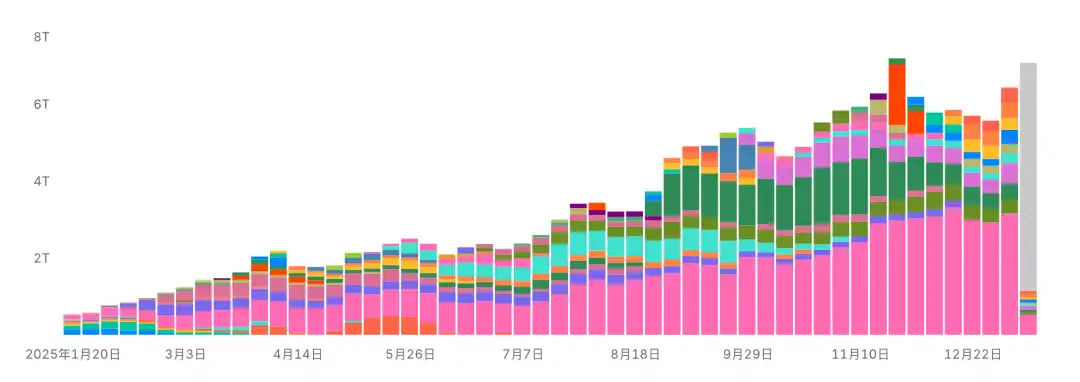
The well-known AI model in the industry, "Dianping"
As one of the earliest participants in this field, OpenRouter has a unique advantage: leaderboards .
After processing over 100 trillion tokens, they knew:
Which model is the strongest for writing code? Which model offers the best cost-performance ratio? Which model suddenly takes off on a specific task?
This ranking list has become an important reference in the industry and enjoys high recognition in the developer community.
What's even more outrageous? In April 2025, a mysterious model called "Quasar Alpha" was launched on OpenRouter.
A few days later, everyone learned that this was GPT-4.1, and OpenAI had chosen to exclusively launch it on OpenRouter.
Because OpenRouter has a killer asset: the largest multi-model usage dataset on the entire internet.
Every day, millions of developers call different models here. OpenRouter knows:
Which model performs best on which task? Which provider is the most stable? Which time period is the cheapest?
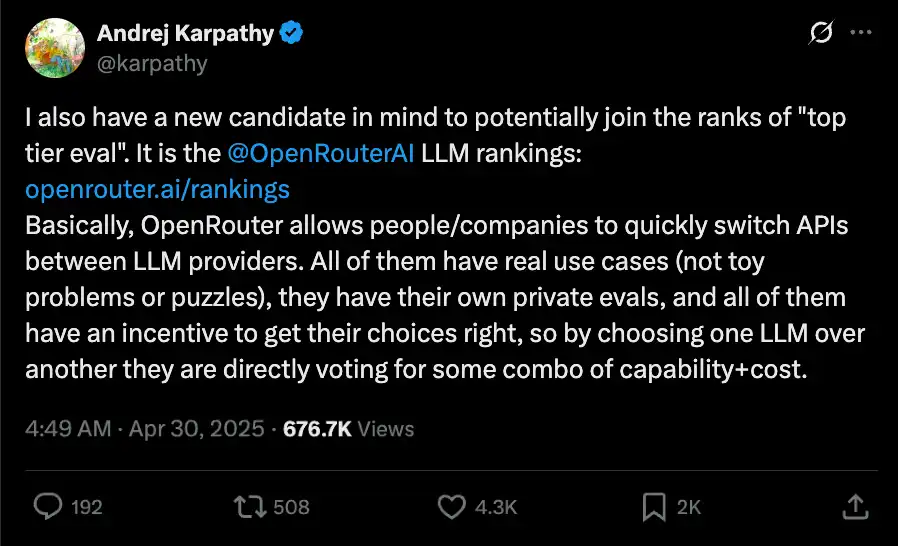
These data have created the most authoritative LLM ranking in the industry . According to Menlo Ventures, even Andrej Karpathy (former Tesla AI Director and co-founder of OpenAI) has publicly recommended it.
Once the data flywheel starts spinning, it's very difficult for newcomers to catch up.
How does OpenRouter make money?
OpenRouter's business model is relatively simple: you spend 100 yuan on a model, and they take 5 yuan.
They charge the same price as the model manufacturers. They earn a "toll," not a "price difference."
This model is quite similar to the business model of intermediaries in Europe and America:
Maintaining a neutral stance : If OpenRouter has its own model, would you trust its leaderboard? As the market grows naturally : the larger the AI market, the larger his share. Network effect : More users → More accurate data → More valuable leaderboards → More users
Alex's original words : "We want developers to not feel vendor lock-in. We want them to feel like they have choice and they can use the best intelligence, even if they didn't before."
Financial data (as disclosed)
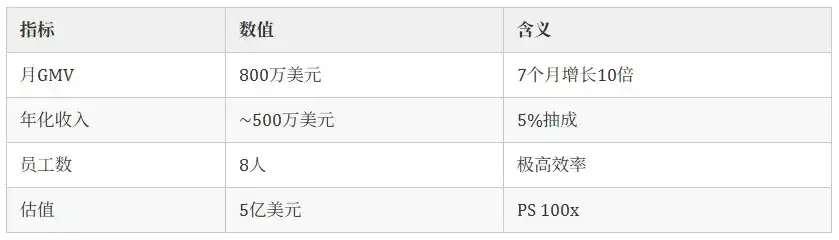
Eight people, with an annualized GMV of nearly 100 million .
This efficiency ratio is among the best in its class of startups.
Big market, small space
Having discussed the highlights, we must now address some issues with this model:
OpenRouter's core advantages are "data" and "community." The flywheel has started to turn (the more users → the more accurate the data → the more valuable the leaderboard), but this model also means that its prosperity and decline are closely related to the development of the developer ecosystem.
The prosperity of this business depends on the emergence of more and more small and medium-sized developers, because they do not have time to do this kind of aggregation development, nor do they have the scale to negotiate prices with AI manufacturers, so they need an intermediary to do this.
This business might have some value for large companies when conducting testing, but they will definitely leave it behind when it's truly deployed at scale.
In fact, not to mention large companies, medium-sized projects with a large user base will want to bypass it. For example, there is now an open-source alternative called LiteLLM , which is free and self-deployable.
Cost-sensitive developers might ask, "Why should we give you 5%?"
If competition intensifies, this commission rate could drop from 5% to 3% or even 2%.
Whether the latest disclosed valuation of 100 times can be maintained at that time is unknown.
Of course, it is still in its early stages and will continue to grow at a high speed. Its upper limit is just a question to be considered in advance when analyzing it.
Understand OpenRouter in one minute
Q1: What is OpenRouter?
OpenRouter is an LLM (Large Language Model) API aggregation platform. Through a single API interface, developers can access more than 300 models (including GPT-4, Claude, Llama, etc.) without having to integrate the APIs of each model vendor separately.
Q2: What is the difference between OpenRouter and LiteLLM?
Both offer LLM API aggregation, but their models differ. OpenRouter is a managed SaaS with a 5% commission; LiteLLM is an open-source project that can be self-deployed and is free. OpenRouter's unique advantage lies in its publicly available model leaderboard and broader provider coverage.
Q3: Who is the founder of OpenRouter?
Alex Atallah, a computer science graduate from Stanford University, was the co-founder and CTO of OpenSea (the world's largest NFT marketplace). He left OpenSea in 2022 and founded OpenRouter in 2023. His personal wealth once exceeded $2 billion.
Q4: How much funding has OpenRouter received?
In June 2025, OpenRouter completed a total funding round of $40 million (seed round + Series A), led by a16z and Menlo Ventures, with Sequoia participating, valuing the company at approximately $500 million.
Q5: Why is OpenAI testing new models on OpenRouter?
According to OpenRouter, OpenAI has anonymously tested new models on its platform to obtain unbiased feedback from developers. This demonstrates the influence of the OpenRouter community within the industry.






