Author: Thejaswini MA
Compiled by: Plain Language Blockchain
Whenever market predictions become controversial, we always circle around one question but never ask directly: Can market predictions really be about the "truth"?
This isn't about accuracy, usefulness, or whether they beat polls, journalists, or Twitter timelines. It's about the truth.
Prediction markets price events that have not yet occurred. They don't report facts; instead, they assign probabilities to an open, unpredictable future. At some point, we began to view these probabilities as a form of truth.
For much of last year, prediction markets enjoyed their "speed victory parade." They beat polls, victory news, and even experts with illnesses and PowerPoint presentations. During the 2024 US election, platforms like Polymarket reflected reality better than almost all mainstream prediction tools. This success has created a narrative: prediction markets are not only accurate but also rational—they gather signals of a purer, more honest truth.
Then, a month passed.
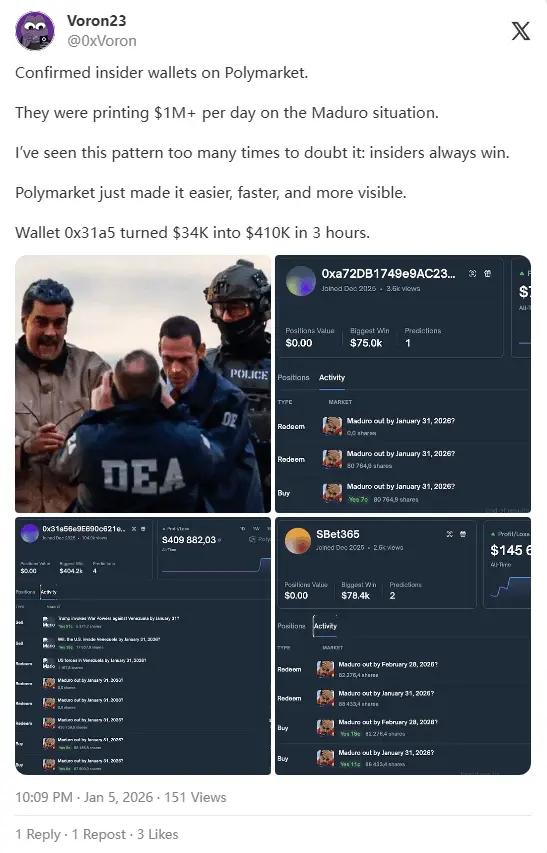
A new account appeared on Polymarket, placing approximately $30,000 bets that Venezuelan President Nicolás Maduro would step down by the end of the month. At the time, market pricing indicated this possibility was extremely low, especially considering the added risk. It looked like a terrible trade.
However, hours later, police arrested Maduro and brought him to criminal charges in New York. The account had closed out positions with a profit exceeding $400,000. The market was right. And that's the problem.
There's a comforting story about market prediction: markets gather scattered information, people use money to support their beliefs, prices eventually fluctuate as evidence accumulates, and the masses converge on the truth.
This story assumes that the information entering the market is public, noisy, and probabilistic. Examples include tightening polls, candidate mistakes, and shifting political winds. But the "Maduro deal" doesn't feel like a deduction; it looks like precise timing.
At this moment, market prediction is no longer seen as a clever forecasting tool, but rather as something else entirely: a place where those with the advantage of proximity gain a competitive edge, and those who succeed through analysis and reading gain access to information.
If the market is accurate because someone possesses information that no one else in the world has access to, then the market isn't discovering the truth, but rather monetizing the fact that "information isn't cheap." This distinction is more important than the industry is willing to admit.
Accuracy may be a red flag.
Proponents of prediction markets often argue that if insider trading occurs, the market will move earlier, thus helping others. "Insider trading accelerates the truth."
This theory sounds appealing, but it collapses in practice due to logical flaws. If a market becomes accurate because it contains leaked military operations, classified intelligence, or internal government timelines, then it ceases to be an information market for any meaningful citizen and becomes a secret shadow trading platform.
There is a fundamental difference between rewarding better analytics and rewarding access to power. Markets that blur this line will ultimately attract the attention of regulators, not because they are inaccurate, but because they are "too accurate" in the wrong way.
From the margins to the mainstream
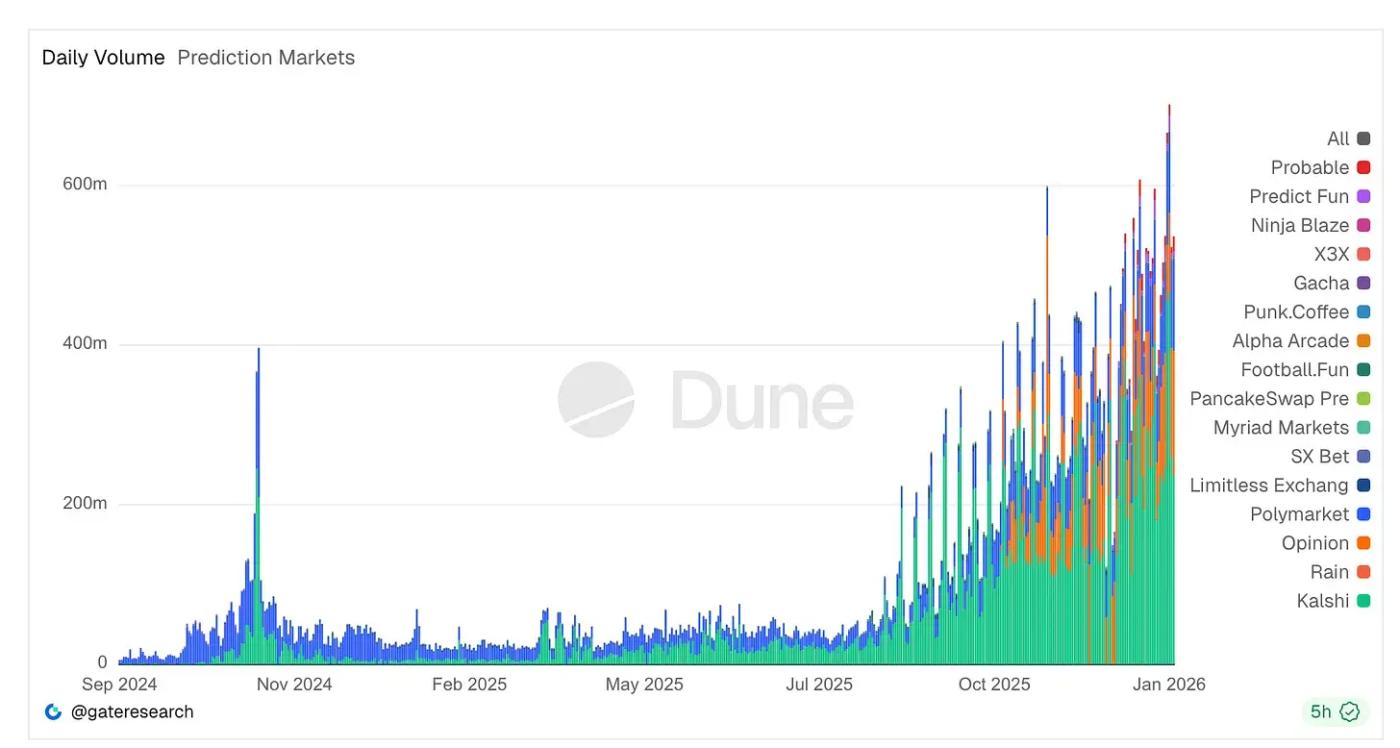
The Maduro case is unsettling not only because of the amount of compensation paid out, but also because of the backdrop to the explosive growth of prediction markets. Prediction markets have transformed from a niche hobby into an ecosystem that Wall Street is beginning to take seriously.
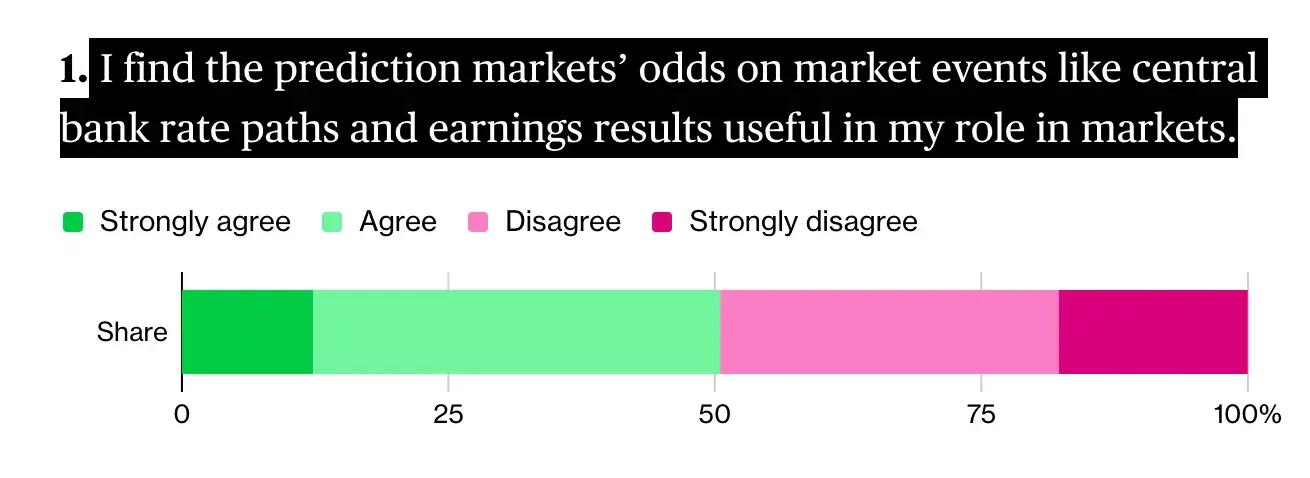
Trading volume has surged: annual trading volumes on platforms like Kalshi and Polymarket have reached hundreds of millions of dollars. Kalshi alone processed nearly $24 billion in 2025.
Capital commitment: Shareholders of the New York Stock Exchange have offered Polymarket up to $2 billion in a strategic deal, valuing the company at approximately $9 billion. This remarkable move demonstrates Wall Street's belief that these markets can rival traditional trading venues.
Regulatory battle: Representative Rich Torres and others have introduced legislation to ban insider trading, arguing that it appears to be more of a "front-running" opportunity and uninformed speculation.
"Zelensky suit": An ignored warning
If the Maduro affair exposed internal personnel problems, then the Zelensky suit market exposes an even more fundamental issue.
In 2025, a betting odds appeared on Polymarket: would Ukrainian President Zelensky wear a suit before July? This attracted hundreds of millions of dollars in trading volume. What seemed like a joke escalated into a governance crisis.
When Zelensky appeared in public, he wore a black jacket and trousers designed by a famous designer. The media called it a suit, and fashion experts called it a suit. But the Manhattan Machine (Oracle) voted "no."
Because a small number of large holders of tokens have significant risk exposure to the opposite outcome, they possess sufficient voting power to enforce a settlement result that aligns with their interests. Corrosion indicates that the cost of the mechanism is lower than the payout amount.
This isn't a failure of the decentralized concept, but rather a failure of the incentive mechanism. The system operates exactly as designed: the reward for human-governed neighboring machines depends on the cost of lying. In this case, the reward for lying is higher.
The prediction market failed to uncover the truth, and they reached a settlement.
It would be a mistake to view these events as "growth woes." They are the inevitable result of a combination of three factors: financial incentives, ambiguous language, and unresolved governance issues.
Prediction markets don't uncover the truth; they settle accounts. What matters isn't what the majority believes, but what the system decides counts as the "outcome." This determines a point of intersection of image, power, and money. When large sums of money are involved, this intersection becomes extremely crowded.
Shedding the disguise
We've complicated this.
Prediction markets are where people invest in outcomes that haven't yet occurred. If the event unfolds as expected, they make money; otherwise, they lose money. All other embellishments are secondary.
It doesn't become more sophisticated just because the interface is cleaner, the probabilities are clearer, it operates on the blockchain, or it interests economists. Your reward isn't for your insight, but for betting correctly on "what will happen next."
I don't think it's necessary to insist that this activity is somehow noble. Calling it "foresight" or "information discovery" doesn't change the fact that you're taking risks or why you're taking risks. To some extent, we seem unwilling to admit that people are simply gambling on the future.
In fact, this "disguise" is the root of the difficulties. When the platform touts itself as a "truth machine," every controversy feels like an existential crisis; but if it acknowledges that this is a high-risk, high-stakes product, then when disputes arise during settlement, it becomes a full-blown controversy, not a philosophical crisis.
in conclusion
I'm not against market forecasts. They're one of the most honest ways to express belief in the face of uncertainty. They reveal signs of unease faster than public opinion polls.
But we shouldn't pretend they are something more convenient than reality. They are not "epistemological engines," but rather financial instruments linked to future events.
Acknowledging this actually makes them stronger. It contributes to clearer regulation and more explicit and ethical design. Once you acknowledge that you are operating a betting product, you will no longer be surprised when betting occurs.