Phoenix is not just an asset encapsulation protocol, but a native financial system for RWA . Faced with the current situation where $ 17 billion in RWA assets are fragmented, silent, and disconnected from the rapid flow of DeFi on-chain, Phoenix has launched a solution consisting of a unified settlement layer ( PUSD ) and a smart yield engine, aiming to transform static real-world cash flows into composable DeFi protocols.
I. Why do we need Phoenix ?
" We've completed the on-chaining of assets, but we've overlooked the on-chaining of financial logic. "
In 2025 , stablecoin trading volume surpassed $ 33 trillion, far exceeding traditional payment giants like Visa . However, the RWA (Real-World Asset) sector remains stuck in a rudimentary " asset mapping " model. Despite the successful tokenization of government bonds and credit, the market still faces severe structural mismatches:
Liquidity gap: Tokenized bonds on Ethereum cannot circulate on Solana .
Capital is passively idle: Static tokens lie in wallets and cannot participate in the high-frequency closed loop of DeFi .
Mismatch in yield cycles: Real-world assets pay out yields monthly or quarterly, while DeFi pursues block-level compound interest growth.
Phoenix Finance is committed to bridging this gap. We not only bring assets onto the blockchain, but also build an Intelligent Execution Layer to orchestrate these assets.
II. Product Matrix: Financial Refinery
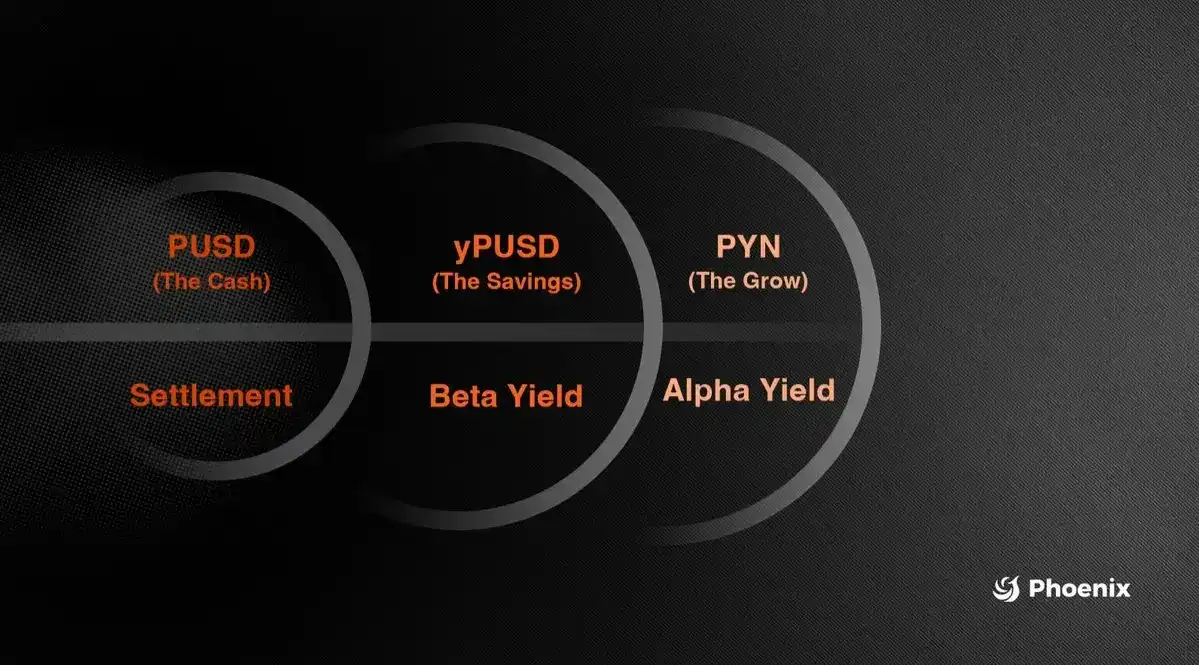
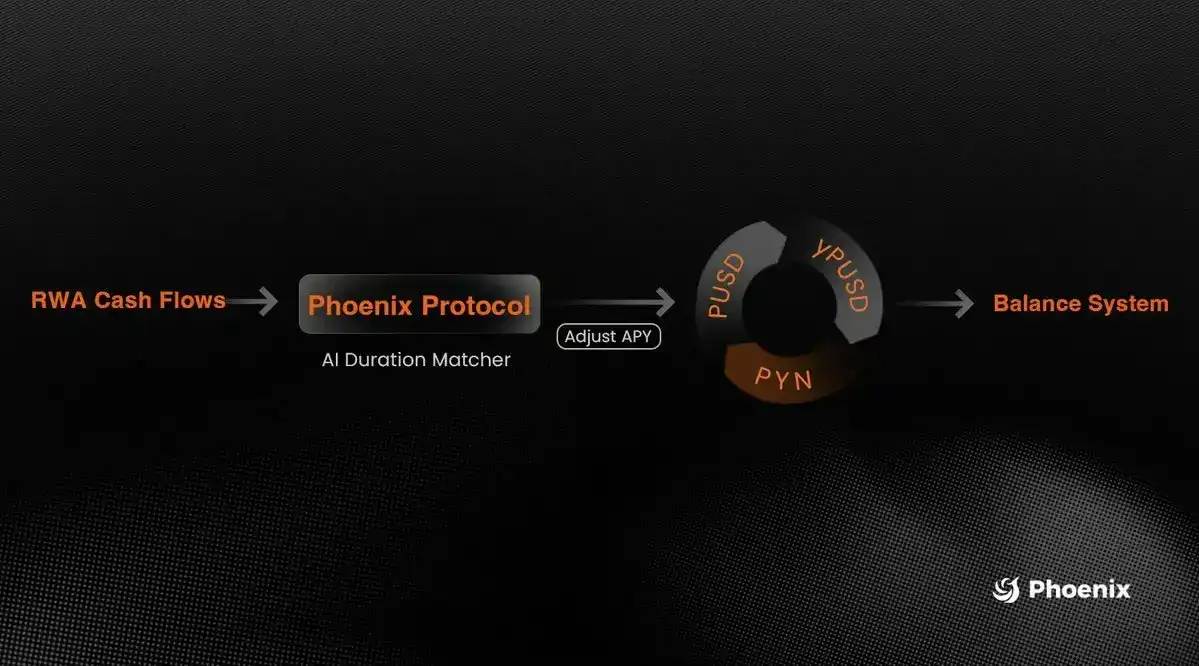
Phoenix acts as a " refinery, " extracting raw, non-standardized real - world returns into DeFi- friendly standardized products:
PUSD (Settlement Layer): A unified cross-chain stablecoin. Without the need for traditional cross-chain bridges, PUSD enables " instant transfer " between chains, allowing for frictionless circulation.
yPUSD (Base Yield Layer): Offers Beta yields delivered through an automatically compounded exchange rate. The system smoothly transforms fragmented RWA repayments into a continuous yield curve, allowing users to increase their returns simply by holding the product, without needing to manually claim rewards.
PYN (Structured Yield Layer): Fixed-term NFT notes ( 7/31/89/181 days). Users earn an alpha premium by locking liquidity to match specific RWA maturity dates (such as structured credit cycles). This is equivalent to a crypto-native principal token backed by real-world cash flow.
III. Core Engine: Mechanism and Logic
1. Teleporter Mechanism: Unified Credit and Native Minting. Traditional cross-chain bridges often rely on the high-risk " lock -and -mint " model. Phoenix Teleporter operates as a unified credit protocol, mapping users' collateral and credit status across different chains, allowing for direct native minting of PUSD on the target chain. This means that PUSD is a native asset on any chain, achieving zero fragmentation.
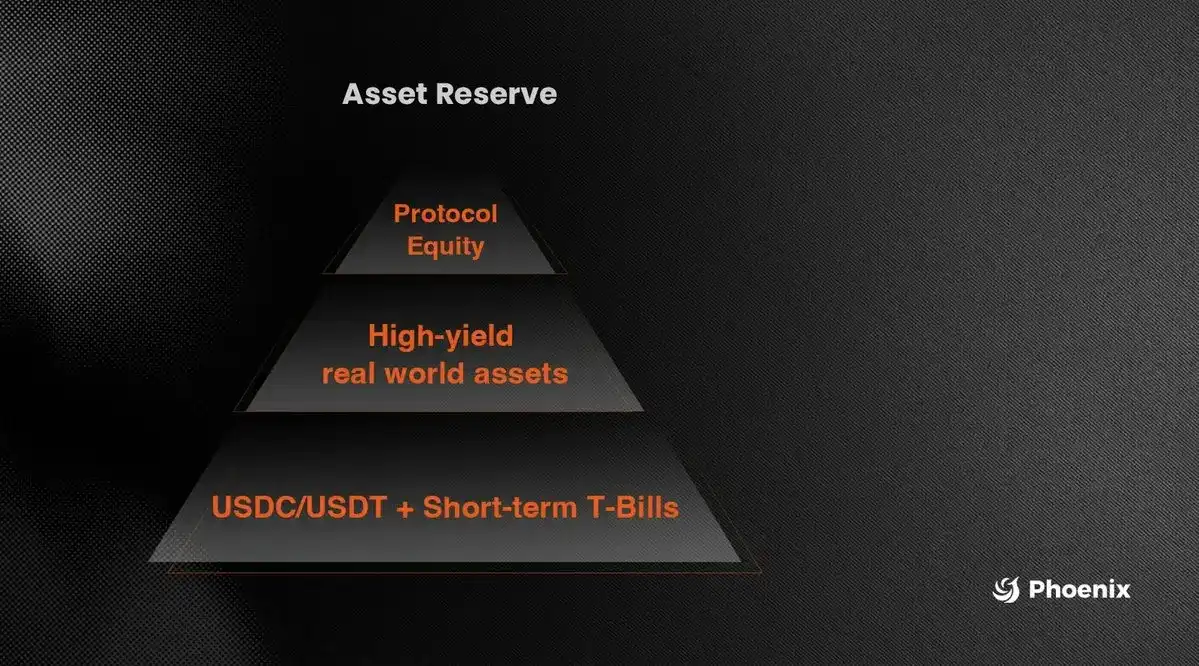
2. Dynamic Tiered Reserve Stack ( The Reserve Stack 80/15/5 ) Solvency is a binary opposition — either solvency or default. To ensure the former, we employ a dynamic tiered mechanism:
Liquidity Layer ( 80% ): Composed of USDC/USDT and short-term US Treasury bonds, ensuring users can withdraw their funds at any time with guaranteed redemption.
Yield tier ( 15% ): Composed of high-rated private credit and structured RWA , it is the core engine of the system's revenue.
Buffer layer ( 5% ): Protocol revenue is used as a " first - loss " layer to absorb risk before fluctuations reach users.
 3. AI as Controller: Phoenix 's AI is not used for price speculation, but rather acts as a " cycle adapter " and " risk sentinel. " When the system detects a mismatch between on-chain liquidity demand and the maturity dates of off-chain assets (such as rigid quarterly interest payments RWA ), the AI dynamically adjusts the APY of specific maturity PYNs (such as 89- day notes). This incentivizes users to lock up capital through market mechanisms, precisely balancing their balance sheets.
IV. Transparency and Security
From Trust to Verification:
Proof of Reserve : Feeds all underlying asset data on-chain in real time.
Phoenix Hunters (Clearance Network): A proactive defense network comprised of whitelisted keepers . When the value of collateral falls below a threshold, Hunters automatically bid at approximately 95% of the value, instantly clearing bad debts without waiting for a lengthy governance process.
No black box: Every penny of yPUSD 's earnings comes from a verifiable on-chain source or an audited SPV .
RWA should not be reduced to an asset museum. Phoenix is transforming it into a highly efficient on-chain economy.