While Ethereum is still scaling, Solana has already moved towards Alpenglow.
Written by: Delphi Digital
Compiled by: Nicky, Foresight News
Solana's 2026 roadmap may be the most radical upgrade cycle in the network's history, involving a complete overhaul of everything from consensus mechanisms to infrastructure, in order to become a decentralized Nasdaq.
Solana's roadmap aims to transform it into an exchange-grade environment, enabling its native on-chain centralized limit order book (CLOB) to compete with centralized exchanges (CEXs) in terms of latency, liquidity depth, and fairness. The following are all the upgrades that will achieve this goal.
Alpenglow: Comprehensive Overhaul of Consensus Mechanism
Alpenglow represents the most significant protocol-layer change in Solana's history. It introduces a completely new consensus architecture built around two core components: Votor and Rotor.
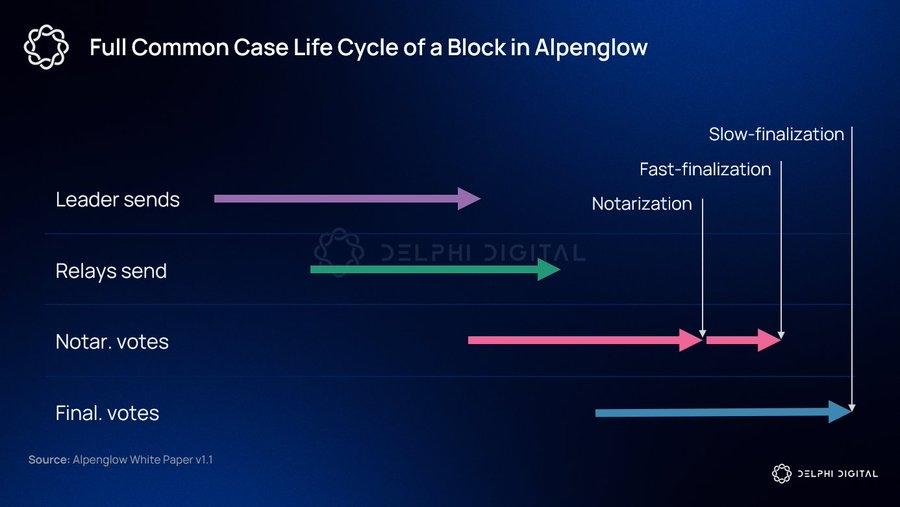
Votor revolutionized the way the network reaches consensus. Instead of chaining multiple voting rounds together, it allows validators to aggregate votes off-chain and submit final confirmation within one or two rounds. As a result, the theoretical final confirmation time has been reduced from 12.8 seconds to 100-150 milliseconds.
Votor runs two final confirmation paths in parallel. If a block receives overwhelming support (over 80% of the stake) in the first round, it is immediately confirmed. If the support is between 60% and 80%, a second round of voting is initiated. If the support in the second round also exceeds 60%, the block is confirmed. This design ensures that final confirmation can be achieved even if some nodes in the network are unresponsive.
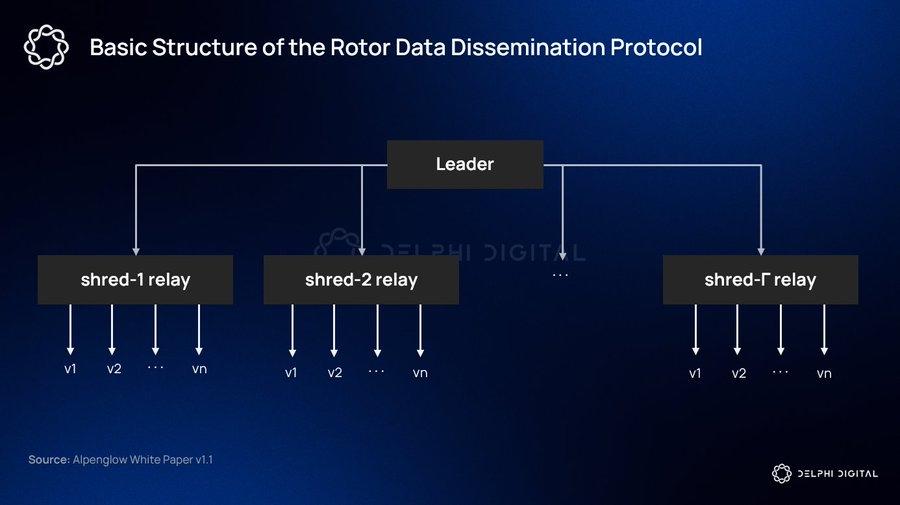
Rotor revolutionized the block propagation mechanism by directly routing messages through validators with high stake and stable bandwidth.
Alpenglow also introduces a "20+20" resilience model: security is guaranteed as long as the total stake of malicious activity does not exceed 20%; even if an additional 20% go offline, the system's activity can still be maintained. This means that Alpenglow can still maintain final confirmation even when up to 40% of the nodes in the network are malicious or offline.
In Alpenglow, the Proof of History mechanism has been effectively deprecated, replaced by deterministic time-slot scheduling and local timers. This upgrade is expected to roll out in early to mid-2026.
Firedancer: Runtime Performance Improvements
Since its inception, Solana has relied on a single validator client (now called Agave). This reliance on a single validator has long been one of the network's core weaknesses. Any vulnerability or failure at the client level could cause a network-wide outage.
Firedancer is a second standalone validator client developed by Jump and written in C++. Its design goal is to transform Solana's validator into a deterministic, high-throughput engine capable of handling millions of TPS with minimal latency variations.
Frankendancer is a transitional version that combines Firedancer's network and block production modules with Agave's runtime and consensus components. As Firedancer gradually reaches mainnet readiness, validator diversity is expected to increase significantly.
Against this competitive backdrop, both teams underwent numerous iterations.
DoubleZero: High-performance fiber optic infrastructure
DoubleZero is a private network overlay that connects validators via dedicated fiber optic cables. This infrastructure is the same as the networks used for microsecond-level transmissions by traditional exchanges such as Nasdaq and CME.
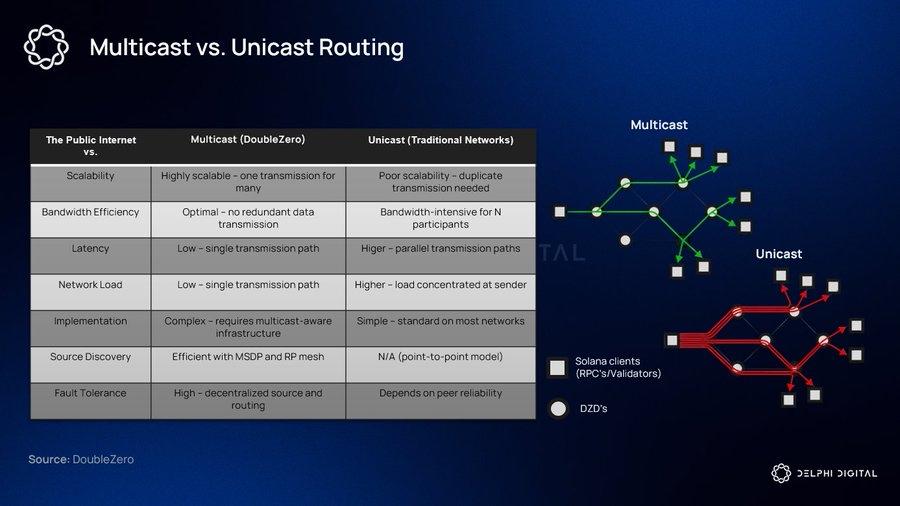
As the set of validators grows, message propagation becomes more difficult. More nodes mean more destinations, which introduces time inconsistencies in the network. DoubleZero eliminates this discrepancy by routing messages along optimal paths, rather than hopping back and forth across the public internet.
Alpenglow's final confirmation model relies on validators receiving and responding to messages within strict time windows. If propagation is inconsistent, votes arrive late, quorum formation slows, and final confirmation takes longer. By narrowing the latency gap between validators, DoubleZero allows Votors to complete final confirmation faster and Rotors to propagate more evenly.
DoubleZero also supports multicast, which replicates data within the network and delivers it to all validators simultaneously.
Block Construction: BAM and Harmonic
Two complementary trends are reshaping Solana's block building layer:
BAM (Block Assembly Marketplace) is Jito's reimagining of the Solana transaction pipeline. Instead of slot leaders unilaterally determining transaction ordering, it inserts a market and privacy layer between ordering and execution. Transactions are imported into a Trusted Execution Environment (TEE), meaning that validators and builders cannot see the original transaction content until the ordering takes effect. This prevents opportunistic pre-execution behaviors such as front-running.
Harmonic addresses another aspect of the pipeline—who builds the blocks. It introduces an open block builder aggregation layer, enabling validators to accept block proposals from multiple competing builders in real time. Harmonic can be viewed as a meta-market, while BAM is a micro-market.
Raiku: Deterministic Execution Guarantee
Raiku fills the remaining gaps. Solana has arguably solved most throughput bottlenecks, but it doesn't natively provide deterministic latency or programmable execution guarantees for specific applications. The granular control required for high-frequency trading (HFT) style matching and on-chain centralized limit order books (CLOBs) far exceeds what a single-layer network (L1) can reasonably provide.
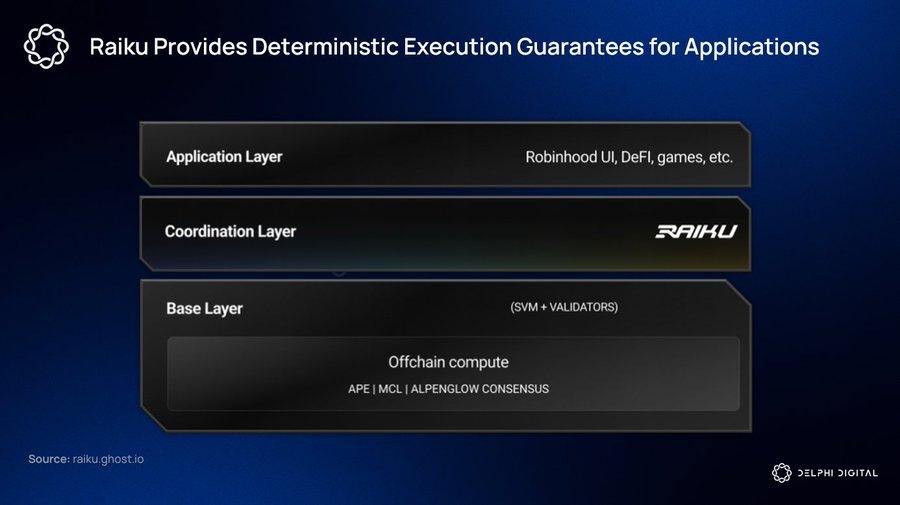
Raiku provides a scheduling/auction layer that runs in parallel with the Solana validator set, offering applications a programmable, deterministic pre-execution environment without modifying the L1 consensus mechanism. It ensures guaranteed execution of pre-submitted workflows through Ahead-of-Time (AOT) transactions and meets real-time execution requirements through Just-in-Time (JIT) transactions.
Bringing capital markets onto the blockchain
Solana remains dominant among high-performance public blockchains, but this dominance is meaningless without users and an efficient on-chain market. While the vast majority of Meme tokens are still traded on Solana, the on-chain perpetual contract market is rapidly consolidating on a few platforms.
To compete with centralized players, performance must reach a comparable level. We believe the Solana ecosystem is aware of this and optimistic about closing the gap. Upcoming upgrades are anticipated, and new Solana-native perpetual contract exchanges like BULK will launch earlier this year.
Retail user demand for trading spot assets on Solana remains substantial. While Hyperliquid currently dominates the perpetual contract market, Solana has established itself as the preferred L1 platform for trading any spot trading pair. Centralized exchanges still hold a significant lead, but Solana is currently the preferred solution for on-chain trading.
Products like xStocks are bringing on-chain stocks directly to Solana. Liquidity, price discovery, and speculative attention are converging on this single chain that offers faster settlement, a better user experience, and more intensive capital.
This is why Solana brings capital markets onto the blockchain.