Written by: TechFlow TechFlow
The anxiety surrounding customer acquisition for Web3 projects is a well-worn topic.
Airdrops are used to fleece users, KOLs ' hype lasts less than three days, and addresses acquired for tens of dollars may just be bots... Everyone is looking for a solution to "sustainable customer acquisition," but for most projects, the answer is still to spend more money and issue more tokens.
In fact, sports fans are a good customer acquisition target.
With strong emotional connection and stable attention cycles, seasons, matches, and transfer windows are natural peak activity periods. Several projects have experimented with football-related fan economies a few years ago, but the Fan Token approach hasn't produced many successful examples.
Recently, a project also wanted to try out the fan economy model in the fighting game arena.
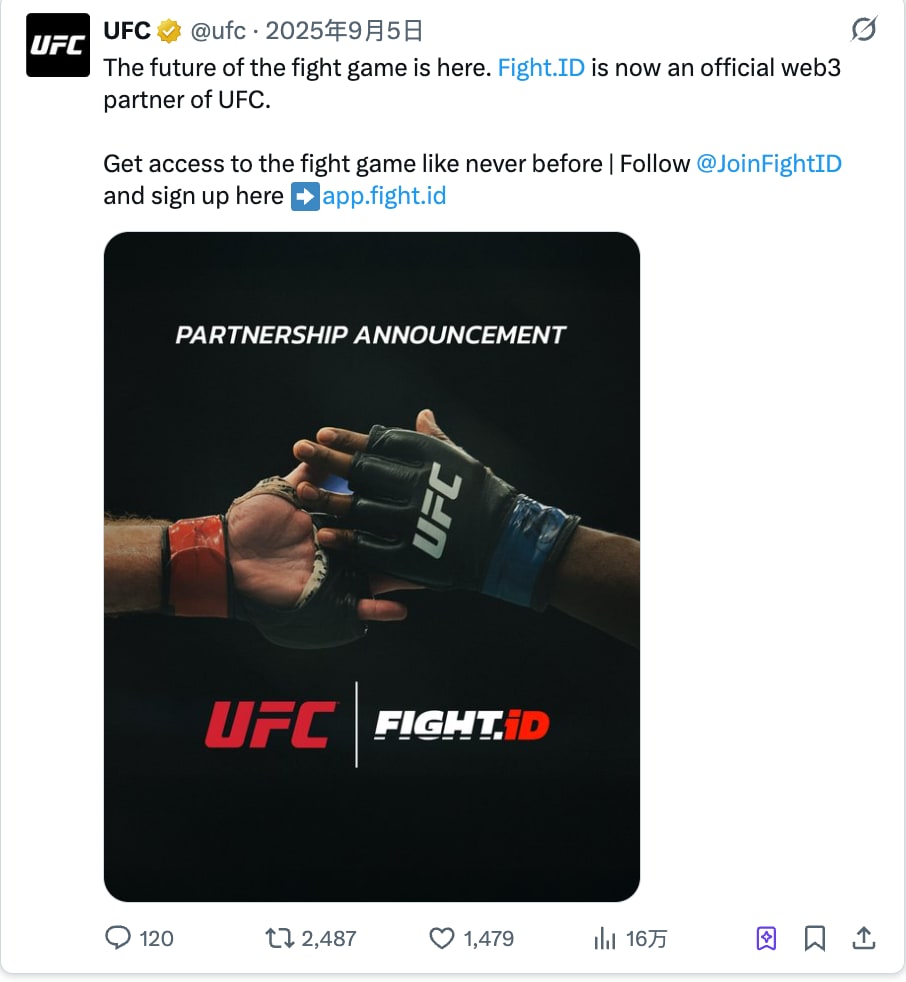
Fight.ID is an official partner of the UFC , which is the world's largest mixed martial arts league, hosting over 40 events annually and reaching an audience of 700 million. The token $FIGHT completed a public sale of nearly $200 million last October; TGE is imminent.
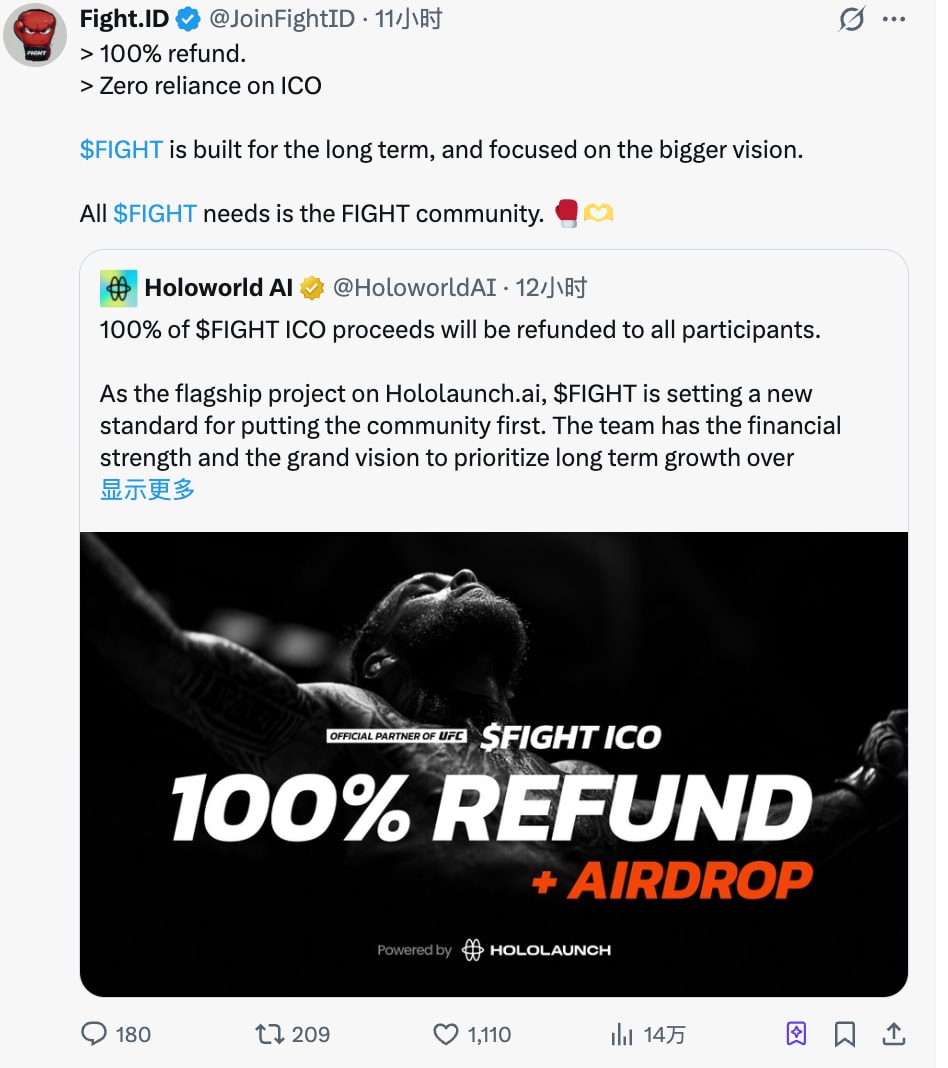
But just in the last two days, the project team announced a move: 100% of the funds raised in the ICO will be returned to all participants, and an additional 85 million tokens (0.85% of the total supply) will be airdropped to early supporters.
In other words, those who participated in the ICO can not only get their principal back, but also receive an airdrop for free.
This is an unusual move in the industry. The fact that they raised nearly $200 million and then withdrew so easily shows that the team has plenty of money and that they want to leave TGE's assets to the community rather than trapping early investors.
On January 22, Binance Alpha announced the listing of $FIGHT, and Coinbase also added it to its listing roadmap a few days ago.
In the current market environment, most projects are still trying to extract money from the community's pocket, while Fight.ID is doing the opposite, putting money into the community's pocket.
How much recognition and participation can this pattern garner? Binance Alpha has been confirmed to launch on January 22, and Coinbase has also added it to its listing roadmap. The market is giving its first round of feedback.
Meanwhile, combat sports are among the most popular sports in the United States, with a substantial audience. Can this project's model be viable, and what value can be explored in the token?
The value of the UFC IP license lies in its usage scenarios.
UFC holds over 40 events a year, and each event's broadcast, live coverage, and social media presence provide exposure. Obtaining the IP license means Fight.ID can create activities, publish content, and drive users in sync with the event schedule, instead of paying for traffic itself. It's like renting a continuously running customer acquisition machine.
Concept Labs was able to obtain this license because of a previous collaboration.
In 2022, it took over the UFC Strike NFT project, which features the image of a fighting athlete, from Dapper Labs and has been operating it ever since.
The project also features an interesting athlete committee design.
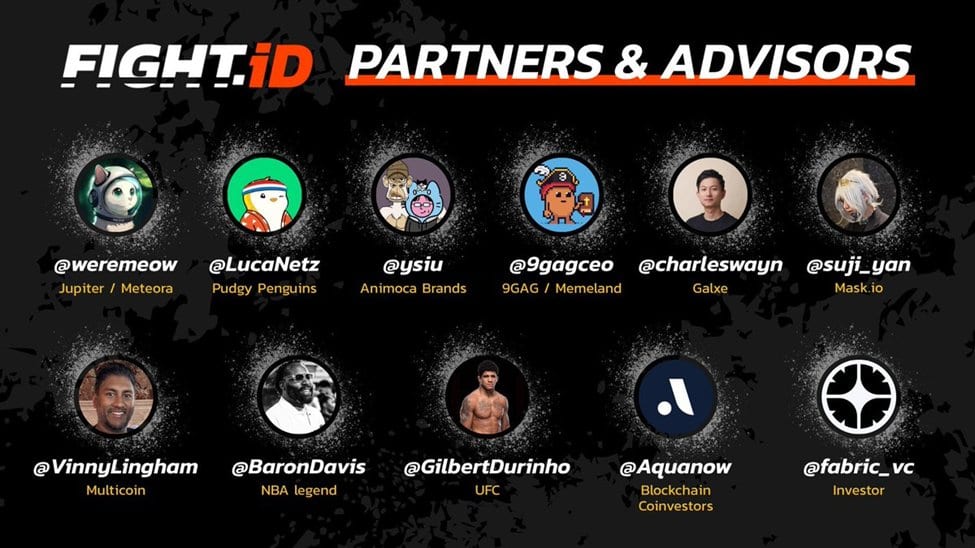
Simply put, it involves active UFC fighters in project governance, not just in photo ops. Committee members include Gilbert Burns, Alexandre Pantoja, and Dan Ige, all ranked active fighters. Their responsibilities include reviewing product features and deciding how the prize pool is distributed.
The participants' rewards are tokens, unlocked in installments based on their participation; those who don't participate won't receive the full amount. The intention behind this design is clear:
The goal is to ensure athletes have a genuine stake in the deal, rather than simply receiving an endorsement fee.
In terms of financing, a round of institutional funding was completed in September 2025, with investors including Aptos Foundation, Jupiter, and Memeland, but the amount has not yet been disclosed.
With IP licensing and event exposure, the next question is how to convert viewers into on-chain users.
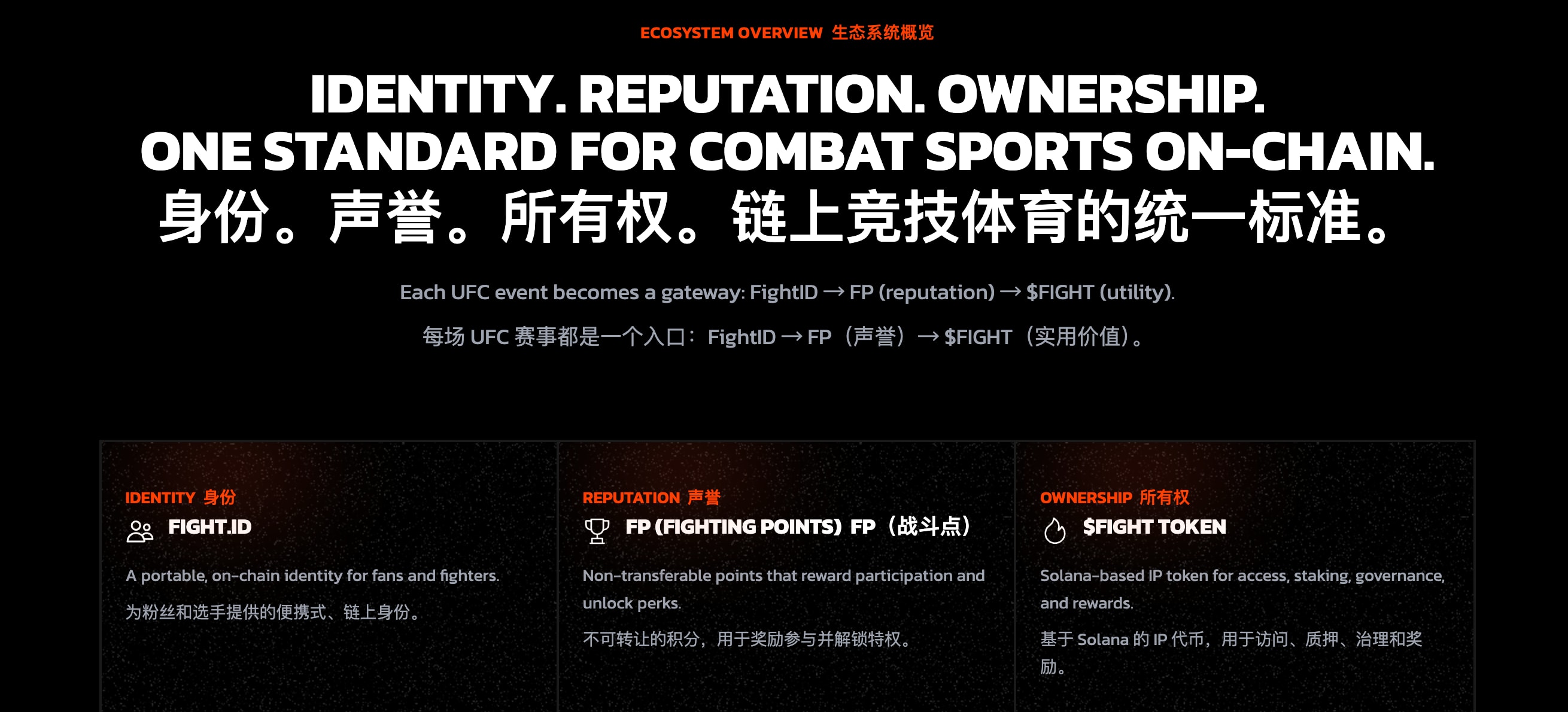
Fight.ID designed a three-layer structure to do this.
First, at the very bottom is Fight.ID itself, an on-chain identity. After registration, this identity can be used across platforms to participate in various activities;
The middle layer is FP, short for Fight Points, which is a type of reputation score. FP cannot be bought, sold, or transferred; it can only be earned by participating in activities. Watching matches, making predictions, buying digital collectibles, and engaging in community activities can all earn FP.
The top layer contains the token, $FIGHT, many of which are tied to FP: staking rewards are increased based on FP level, and some athlete communities require an FP threshold to join.
The intention behind this design is quite clear: to find a way to effectively leverage the fan economy through points and tokens.
First, attract users with UFC events; second, use FP points to keep users engaged and give them the expectation of earning points; and finally, use token functionality to monetize the value of FP.
Every UFC fight can become an entry point into this customer acquisition funnel, rather than a one-off marketing event.
From a cost perspective, this model has another advantage:
A large portion of customer acquisition costs is spread across UFC's content production and event operations. UFC already organizes fights, broadcasts, and manages social media, so Fight.ID essentially hitches a ride on that success. This cost structure is healthier than buying traffic and running ads themselves.
Of course, whether a model is good or not still needs to be verified by data. Fortunately, an event last December provided the first data sample.
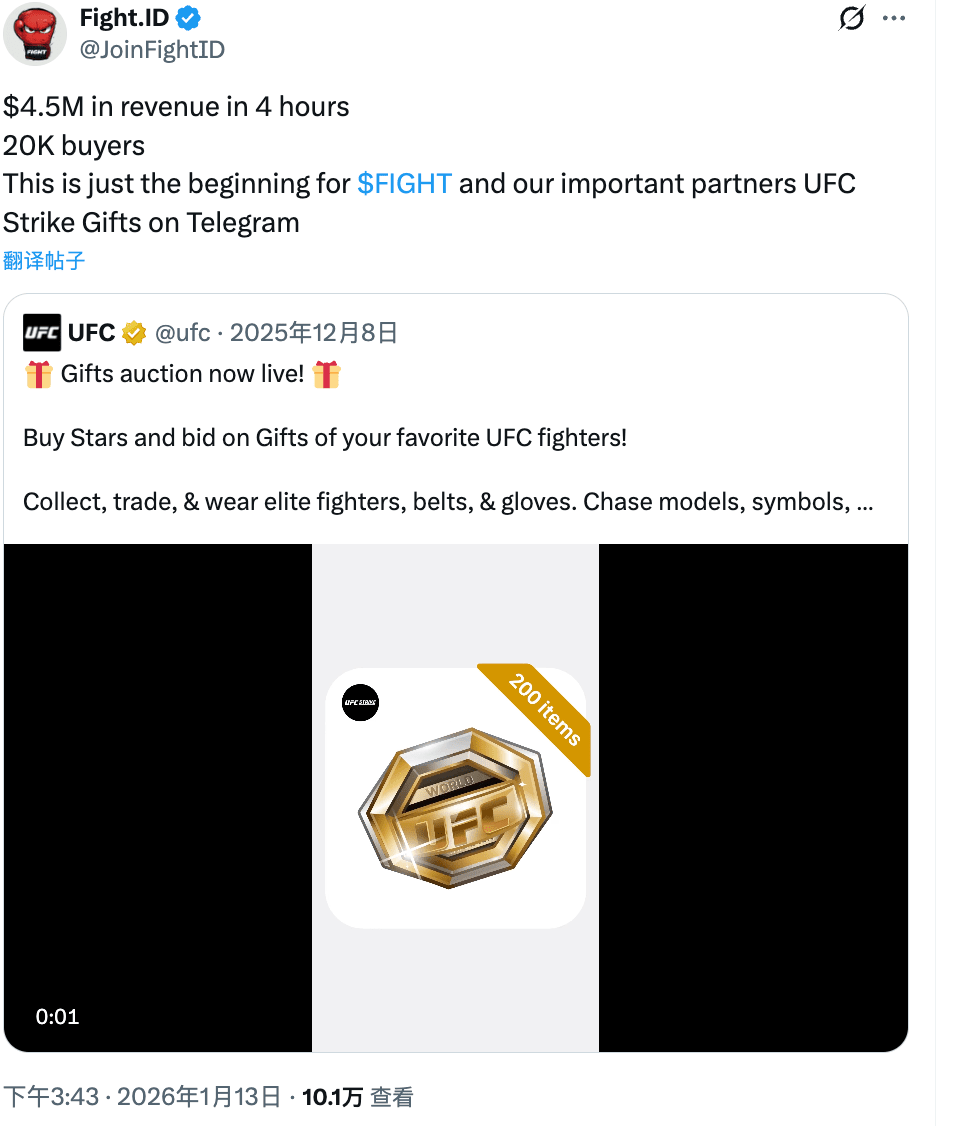
On December 7, 2025, Fight.ID launched a digital collectibles campaign on Telegram in conjunction with the UFC event that week.
The gameplay involves purchasing UFC Strike digital collectible packages and earning FP points. You might think that the fan economy of this kind of sports event is niche and lacks popularity, but the actual results are quite good.
Official data shows that 60,000 gift packs sold out in 4 hours, generating $4.5 million in sales, with approximately 20,000 buyers and over 600,000 on-chain transactions. During the event, Fight.ID rose to fourth place among BNB Chain's social DApps.
In the context of a crypto bear market, this number is actually quite good, and it also reflects the appeal of the UFC brand.
At the same time, it is also important to recognize that $FIGHT's TGE has not yet occurred. This event is essentially a warm-up and user accumulation before the TGE.
The persuasive power of a single event is limited and cannot be simply extrapolated linearly to every subsequent event. There is currently no publicly available data on how many of the 20,000 buyers were drawn by the potential airdrop.
In addition, this event leveraged the traffic from Telegram Gifts. Telegram has recently been promoting its digital collectibles feature, and UFC Strike is one of the collaboration examples. The platform itself is also driving traffic to the event.
There is a point of reference: the previous UFC Strike project operated for more than two years, selling more than $20 million worth of digital collectibles and accumulating 110,000 wallet addresses.
However, this December event alone generated $4.5 million, equivalent to more than 20% of the total historical amount. Even with the added hype from TGE, this conversion rate demonstrates that the event cycle-driven model is viable, at least in the initial stages.
The next question is: once users come in, how do we use tokens to capture this activity?
Let's look at the fundamentals first.
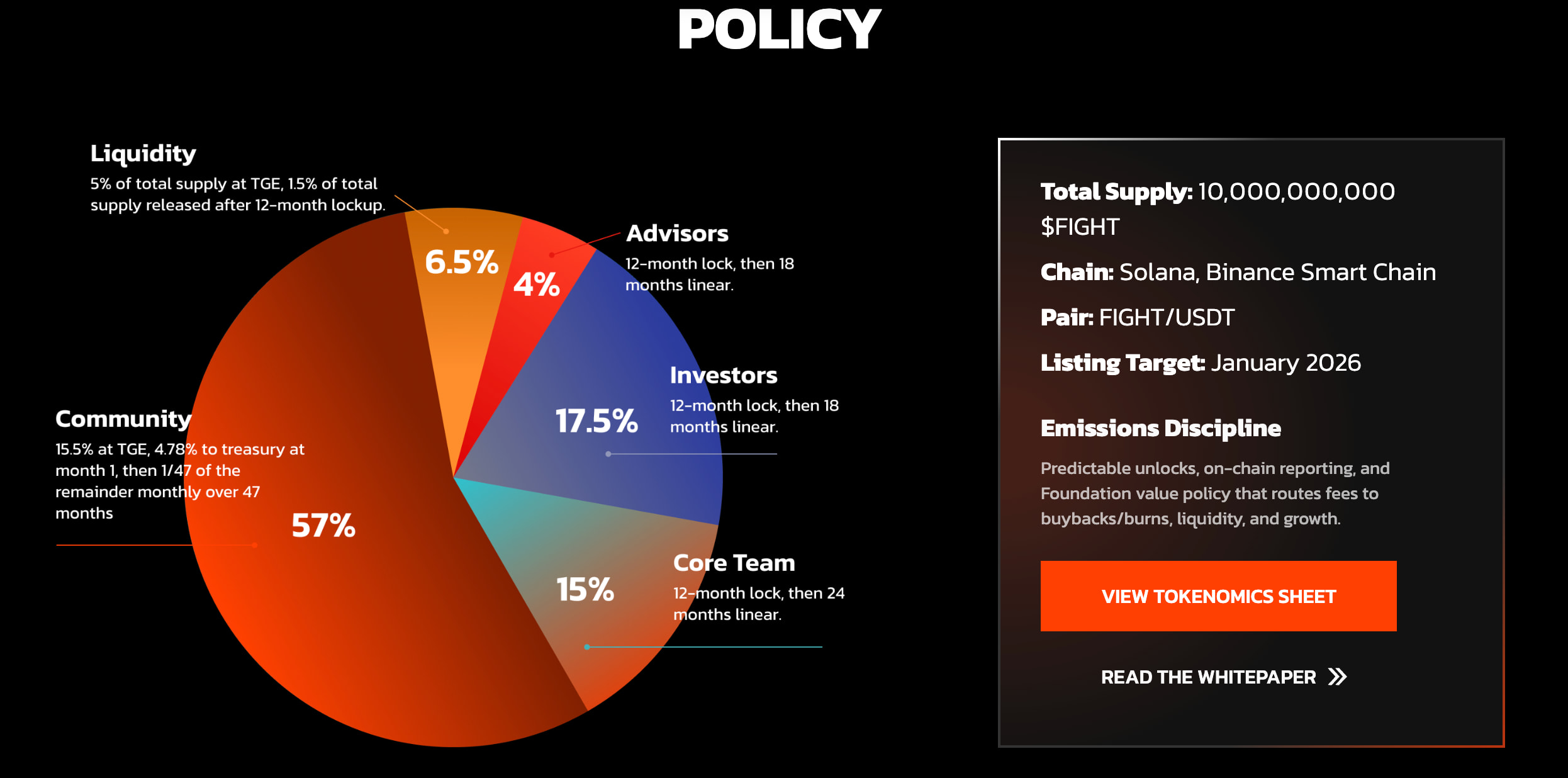
$FIGHT is Solana's native token, with a total supply of 10 billion. The public sale price was $0.05, which translates to a FDV of approximately $500 million. The circulating supply at TGE is estimated to be around 20%.
In terms of distribution structure, the community takes 57%, which is the majority. Investors take 17.5%, the team 15%, liquidity 6.5%, and advisors 4%. The portions allocated to the team, investors, and advisors all have a 12-month lock-up period, followed by linear unlocking over 18 to 24 months. In other words, there will be no selling pressure from these portions within the first year after TGE, but unlocking will begin continuously after that year.
The allocation ratio is fairly average for a Web3 project; the community's share isn't particularly high, but it's not low either. The key is whether the utility design can generate real demand for the token.
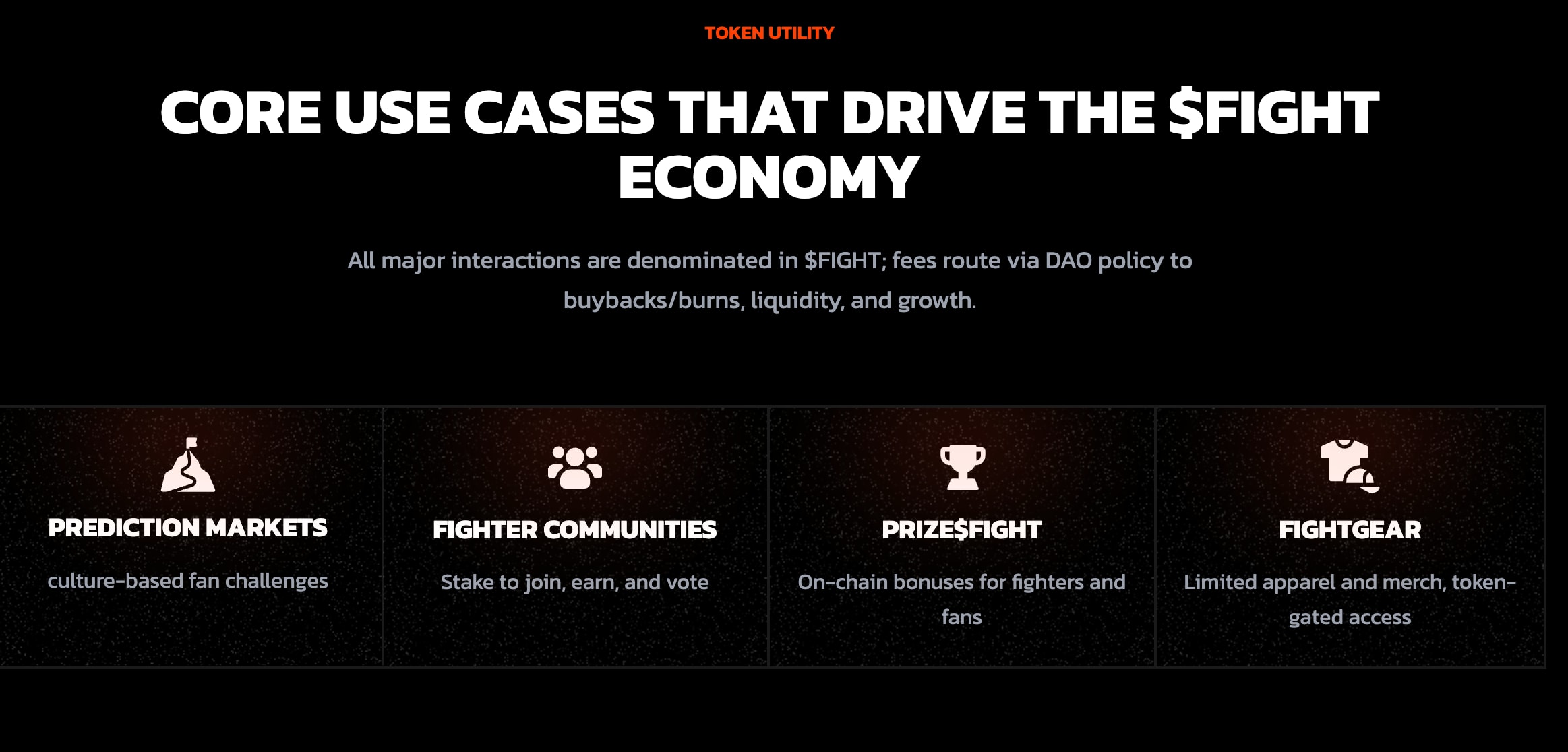
In terms of utility design, $FIGHT has several scenarios.
The first is staking and Fighter Communities. Users can stake $FIGHT to join the on-chain fan club of a specific athlete and gain exclusive content, AMAs, priority access to merchandise, viewing parties, and other benefits.
The design has several details: the larger the community, the higher the entry staking threshold, giving early supporters an advantage; joining fees and community revenue are distributed proportionally to existing members and the DAO Treasury; members with higher FP levels receive bonuses and priority privileges.
This mechanism locks the tokens in the community, and each UFC fight week can bring in new members, driving up the entry price and generating more fees.
The second is Partner Ecosystem Access, which is officially defined as a core utility. Ecosystem partners who want to reach Fight.ID's user base need to purchase FP distribution quotas using FIGHT, and then distribute FPs to users as incentives through tasks, activities, and challenges. This is a B2B model.
Partners pay for traffic, users earn FP, and FIGHT becomes the ecosystem's entry-level currency. As the Fight.ID user base expands, more and more partners are willing to pay to reach these established and reputable users, ensuring a continued demand for the token.
Thirdly, there are related scenarios. FightGear is an apparel brand offering limited-edition collaborations and event-themed collections. FightGear holders have priority access to these items and can pay with tokens. PrizeFight is an on-chain prize pool funded by sponsors, the community, and the DAO, rewarding outstanding performances and fan participation. Funds and transaction fees are denominated in $FIGHT. The UFC Strike digital collectibles continue to operate and will be integrated with the Fight ecosystem in the future. Holding collectibles can accelerate FP accumulation.
At the governance level, $FIGHT holders can vote on treasury allocations, emissions plans, and ecological grants. All revenue generated from all use cases flows into the DAO treasury for ecological support and growth.
Whether it will run successfully is something we can't say for sure right now.
The activity level of the athlete community and the real needs of ecosystem partners still need to be verified. But at least from a design perspective, $FIGHT is not a token that you can "buy and hold". Its utility is deeply tied to the FP reputation system, forcing holders to participate in the ecosystem.
If we put Fight.ID in a broader context, it is trying to answer an old question: How exactly does the sports fan economy work in Web3?
Chiliz and Socios started issuing Fan Tokens to football clubs in 2019; Barcelona, Juventus, and Paris Saint-Germain have all received them. The model involves buying tokens in exchange for voting rights, which can be used to decide minor things like jersey colors and entrance music.
Over the years, the problems have become very clear: the voting rights are too weak, and once you vote, there's nothing else to do. After buying tokens, fans either sit back and wait for the price to rise or cut their losses and leave, with no reason to continue participating.
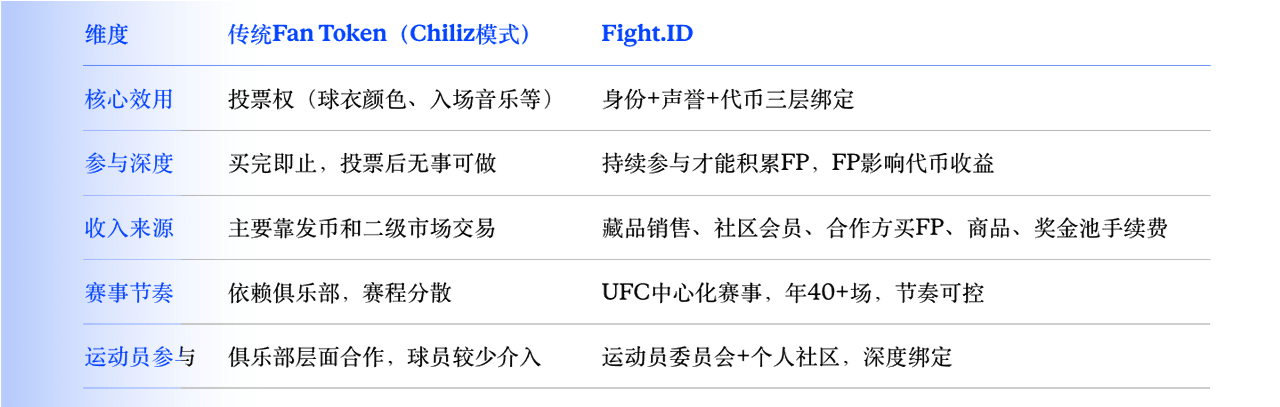
Fight.ID wants to take a different approach, so we can create a table for a clear comparison:
From a design perspective, Fight.ID adds an extra layer compared to traditional Fan Tokens: it doesn't just sell tokens, but first builds an identity, then cultivates a reputation, and finally monetizes the tokens.
This three-tiered structure of "identity-reputation-token" pulls users from "buying and leaving" into a cycle of "continuous participation".
This is an iterative attempt at applying the sports fan economy to Web3. Whether the direction is right or not will be the first feedback from the product launch and user data in Q1.
Returning to the initial question: Can a customer acquisition model driven by the event cycle work?
Fight.ID's answer is a combination of strategies: using UFC IP licensing to provide exposure, a three-tier architecture to drive user engagement from registration to continued participation, and token utility tied to reputation to keep holders active.
Players interested in the project can pay attention to the following verification nodes:
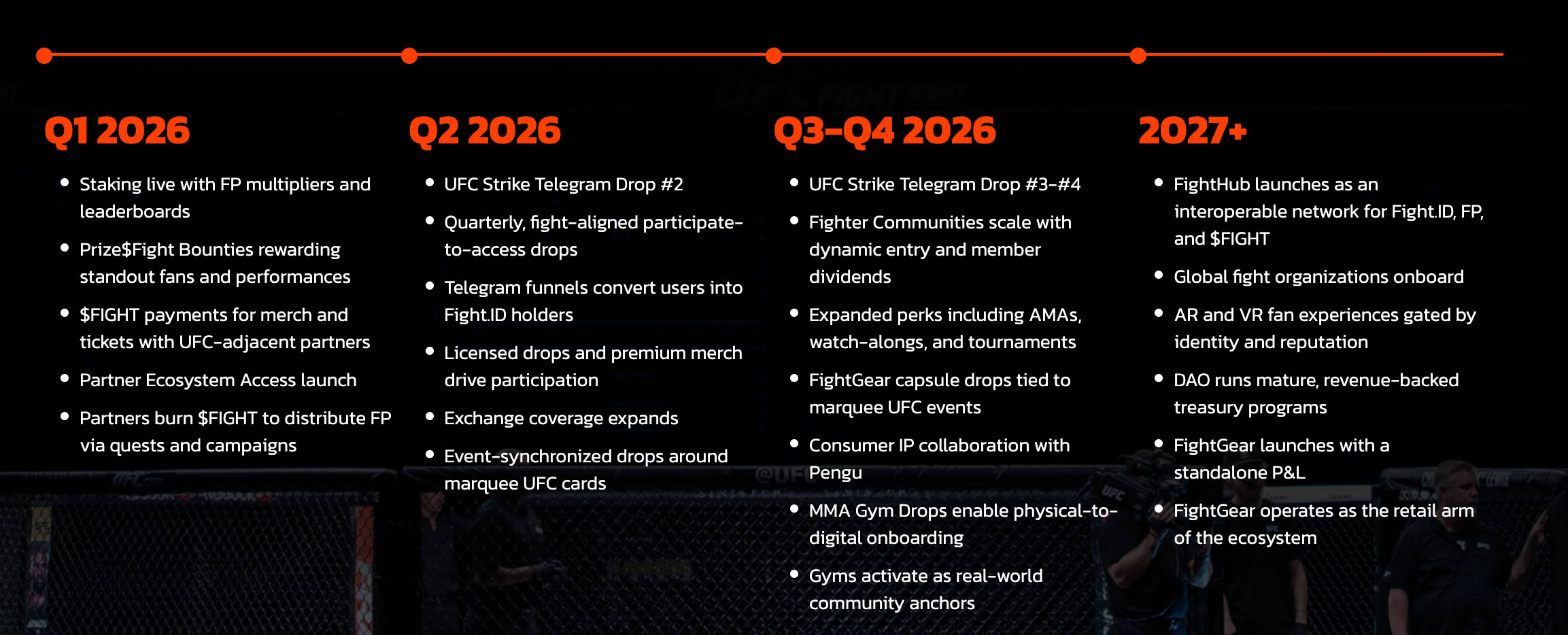
Recent developments (January-February) : Binance Alpha launched on January 22nd, TGE was launched, and Coinbase's listing review process is progressing. This is the first hurdle for liquidity and price discovery.
Q1 2026 : Staking feature launched (with FP multiplier and leaderboard), Partner Ecosystem Access launched (partners start burning tokens to buy FP distribution quotas), PrizeFight prize pool launched, Fight prize pool launched, Fight prize pool launched, FIGHT payment for goods and tickets. This is the core validation period for token utility.
Q2 2026 : UFC Strike's second Telegram airdrop, expanded exchange coverage, and regular quarterly event-related activities. This is a window to observe whether the customer acquisition model can be sustained.
Q3-Q4 2026 : Fighter Communities scaling up (dynamic entry price + member profit sharing), FightGear apparel collaboration, and MMA offline gym partnerships taking shape. This is a crucial period for the ecosystem to extend from online to offline.
Combat sports are one of the most popular sports in the United States, with UFC boasting over 40 events a year and a base of 700 million viewers.
If Fight.ID can convert even 1% of its audience into on-chain users, that scale would be enough to support a vertical ecosystem.
In the Web3 space, previous attempts at fan economy have mostly stopped at the stage of "issuing tokens and collecting money". Fight.ID wants to take it a step further, turning fans into participants and events into a customer acquisition engine.
The direction is interesting; execution will prove its worth.
TechFlow is a community-driven in-depth content platform dedicated to providing valuable information and insightful thinking.
Community:
WeChat Official Account: TechFlow TechFlow
Subscribe to our channel: https://t.me/TechFlowDaily
Telegram: https://t.me/TechFlowPost
Twitter: @TechFlowPost
Add the assistant's WeChat ID to join the WeChat group: blocktheworld
Donate to TechFlow TechFlow and receive blessings and a permanent record.
ETH: 0x0E58bB9795a9D0F065e3a8Cc2aed2A63D6977d8A
BSC: 0x0E58bB9795a9D0F065e3a8Cc2aed2A63D6977d8A