Cryptocurrency custodian BitGo ($BTGO) officially rang the opening bell at the New York Stock Exchange on January 22nd , Eastern Time.
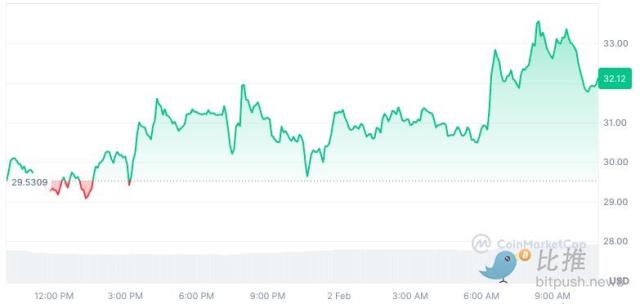
This company, considered the "lifeline" of crypto asset infrastructure, completedits IPO at $18 per share, and immediately surged to $22.43, a short-term jump of about 25% on its first day, kicking off a wave of crypto company IPOs in 2026.

Based on its IPO price, BitGo is valued at approximately $2 billion. While this figure is significantly lower than Circle , the stablecoin issuer that went public last year with a valuation of nearly $7 billion, BitGo's performance is still considered solid as one of the first major crypto companies to go public this year.
Ten years of honing a skill: From a pioneer in multiple signings to a gatekeeper for institutions
BitGo is the latest native crypto company to attempt to go public, following the successful IPOs of several crypto companies in 2025.
Its story begins in 2013, when the crypto world was still in its "wild west" phase, with frequent hacking attacks and private key management being a nightmare. Founders Mike Belshe and Ben Davenport keenly realized that if institutional investors were to enter the market, what they needed was not fancy trading software, but "security".

Bitgo founder Mike Belshe
Standing on the bell-ringing platform at the New York Stock Exchange, Mike Belshe might recall that afternoon more than a decade ago.
As one of the first ten employees on the Google Chrome founding team and a key figure in the development of the modern web page acceleration protocol HTTP/2, Mike was initially uninterested in cryptocurrencies and even suspected them of being a scam. However, he used the most "programmer-like" method to disprove it: "I tried to hack Bitcoin, and I failed."
This failure instantly transformed him from a skeptic into a hardcore believer. In order to find a safer place for his old laptop, which was full of Bitcoins, under the sofa, he decided to dig a "trench" for this wild market himself.
In its early days, BitGo's office was more like a laboratory. While Coinbase was busy acquiring customers and boosting retail trading volume, Mike's team was researching the commercial potential of multi-signature (Multi-signature). Although he had a close personal relationship with Ben Horowitz, the founder of Netscape and head of a16z, he did not choose the fast track of being a "venture capital promoter," but instead chose the slowest and most stable path.
BitGo pioneered multi-signature (Multi-signature) wallet technology, which later became the industry standard. However, BitGo did not stop at selling software; it made a crucial strategic choice: to transform into a "licensed financial institution."
By obtaining trust licenses in South Dakota and New York, BitGo successfully transformed itself into a "qualified custodian." This role played a crucial role in the crypto ETF boom of 2024 and 2025. When asset management giants like BlackRock launched Bitcoin and Ethereum spot ETFs, it was service providers like BitGo who were responsible for safeguarding asset security and handling settlement processes.
Unlike exchanges like Coinbase , BitGo has built a robust "institutional flywheel": first, it locks up assets (AUM) in highly compliant custody, and then develops staking, liquidation, and block brokerage services around these assets.
This "infrastructure-first" logic has allowed BitGo to demonstrate remarkable resilience amidst market fluctuations. After all, regardless of whether the market is bullish or bearish, as long as the assets remain in the "safe," BitGo's business continues.
With a price-to-sales ratio of 10, what gives them the confidence?
Looking at BitGo's prospectus, its financial data looks quite impressive.
Due to US GAAP (Generally Accepted Accounting Principles) requirements, BitGo must include the entire principal of transactions in its revenue. This resulted in a staggering $10 billion in gross revenue from "digital asset sales" for the first three quarters of 2025. However, in the eyes of sophisticated investors, these figures are merely "money that has passed through their hands" and do not reflect true profitability.
What truly supports its $2 billion valuation is its "subscription and services" business segment.
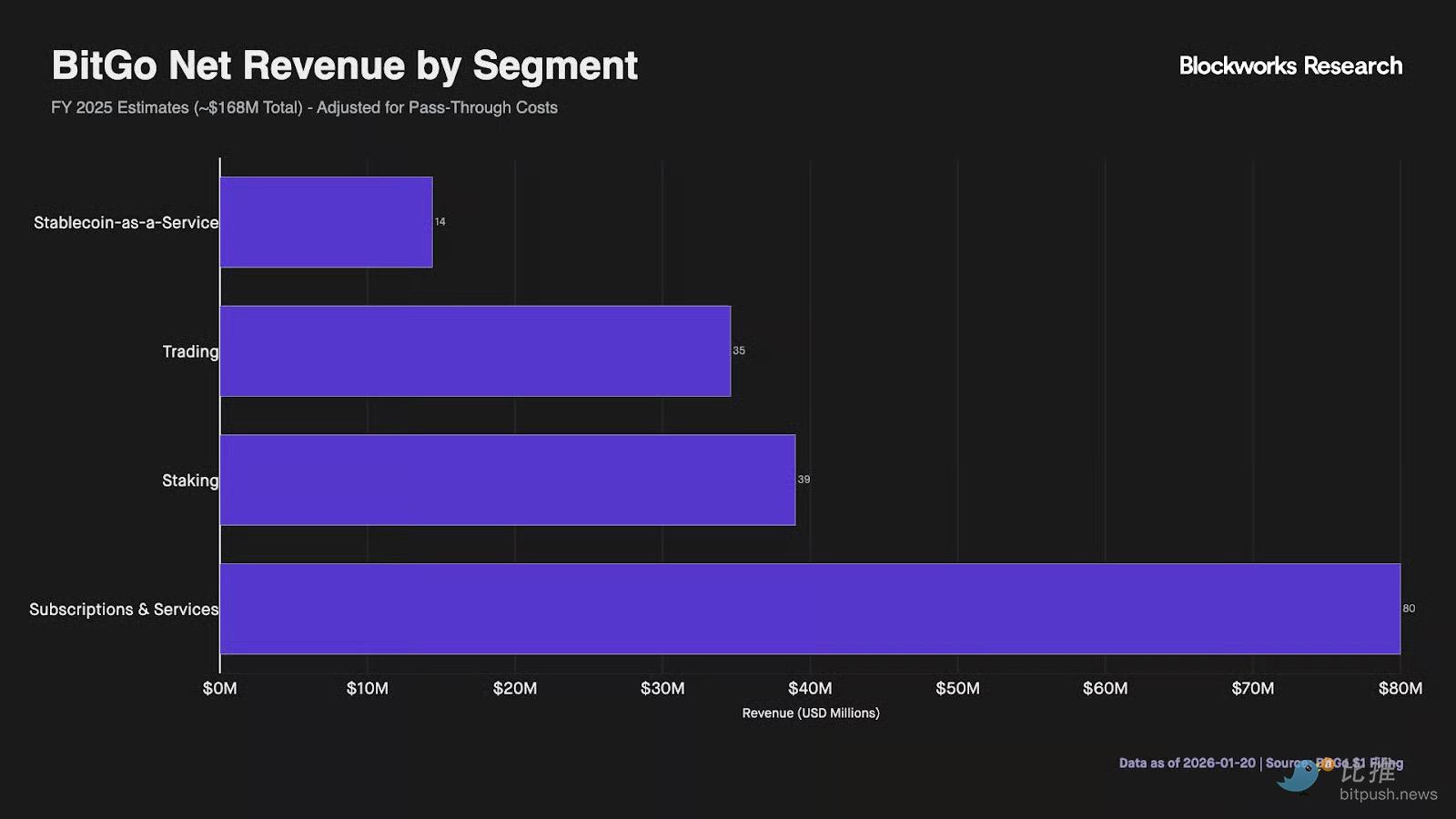
According to charts from Blockworks Research, BitGo's core revenue (excluding payment processing fees and pass-through costs) is projected to be approximately $195.9 million in fiscal year 2025. Subscription revenue accounts for the vast majority of this high-margin recurring revenue, contributing nearly 48% of total net revenue at $80 million. This revenue primarily comes from recurring fees charged by BitGo to its more than 4,900 institutional clients.
Furthermore, staking became an unexpected growth driver. Staking revenue reached $39 million, ranking second. This reflects that BitGo is no longer just a simple "safe deposit box," but has greatly improved capital utilization efficiency by providing added value on top of the assets under its custody.
Looking at the trading and stablecoin business, although trading volume accounts for the largest share of total revenue, it only accounts for $35 million of adjusted net income.
The newly launched "Stablecoin-as-a-Service" contributed $14 million, demonstrating a certain degree of market penetration despite being a relatively new product.
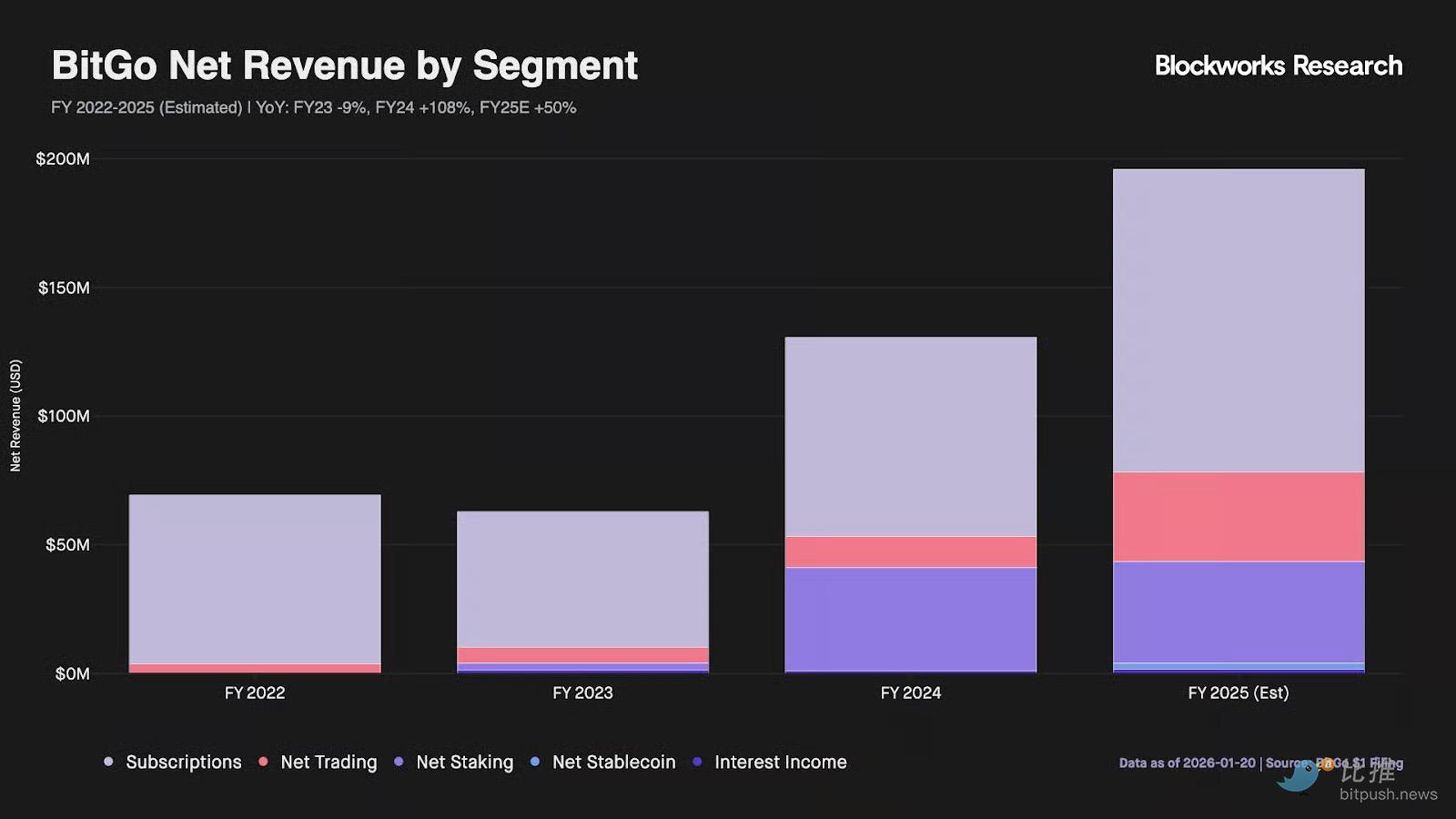
To understand BitGo's true valuation, its on-paper financial metrics need to be adjusted. Based solely on its approximately $16 billion in GAAP revenue, its valuation appears extremely low (price-to-sales ratio of about 0.1). However, after removing non-core items such as pass-through transaction costs, staking commissions, and stablecoin issuer payments, its core business reveals a deep competitive advantage:
Core economic income for fiscal year 2025 (estimated): approximately US$195.9 million
Implied valuation multiple: Enterprise value / core revenue ≈ 10 times
This 10x valuation multiple puts it above its retail-focused wallet peers, with the premium reflecting its regulatory moat as a "qualified custodian." Simply put, at a valuation of $1.96 billion, the market is willing to pay a premium for the subscription business; the low-margin trading and staking businesses are merely icing on the cake.
Matthew Sigel, research director at VanEck , believes that BitGo's equity is a more tangible asset compared to the vast majority of crypto tokens with market capitalizations exceeding $2 billion that have never generated net profits. The essence of this business is "selling shovels"—regardless of whether the market is bullish or bearish, as long as institutions are still trading, ETFs are still operating, and assets need to be held, it can continuously earn transaction fees. This model may not be as eye-catching as some Altcoin in a bull market, but in volatile and bear markets, it's a "guaranteed job."
Even more symbolic is its listing method itself. Unlike other crypto IPOs, BitGo took a more "crypto-native" approach: by partnering with Ondo Finance, it synchronized its shares on-chain on the first day of trading.
The tokenized BTGO shares will circulate on Ethereum, Solana, and BNB Chain, allowing global investors to access this newly listed custodian almost instantly. Tokenized BTGO shares may also serve as collateral in DeFi lending protocols, bridging the gap between Traditional Finance (TfF) and DeFi.
summary
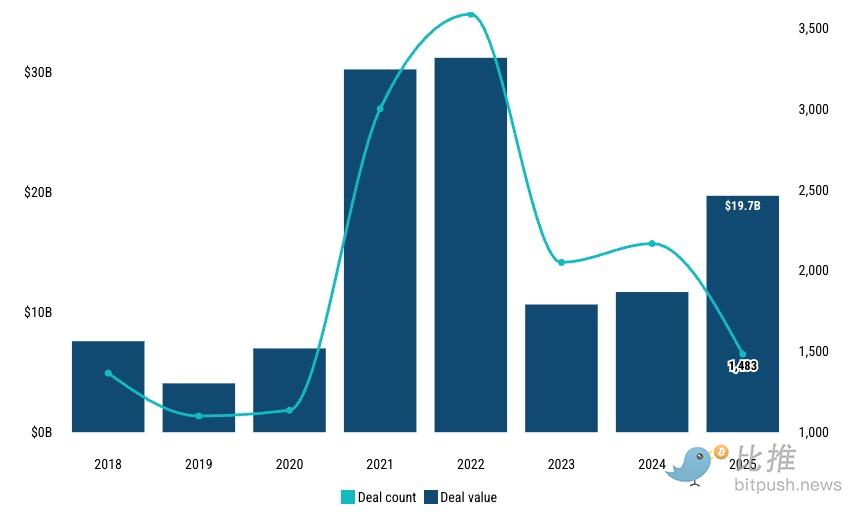
Image source: PitchBook
Looking back at 2025, crypto venture capital (VC) deals surged to $19.7 billion. As PwC IPO expert Mike Bellin said, 2025 completed the "professionalization" of cryptocurrencies, and 2026 will be the year of a complete liquidity explosion.
Following the successful IPOs of pioneers like Bullish, Circle, and Gemini in 2025, crypto company listings have exhibited a dual characteristic of "infrastructure-ization" and "giant-ization." Currently, Kraken has filed a confidentiality application with the SEC, potentially aiming for the largest crypto exchange IPO of the year; Consensys is working closely with JPMorgan Chase to gain a stronger voice in the Ethereum ecosystem's capital markets; and Ledger, riding the wave of surging self-custody demand, has set its sights on the New York Stock Exchange.
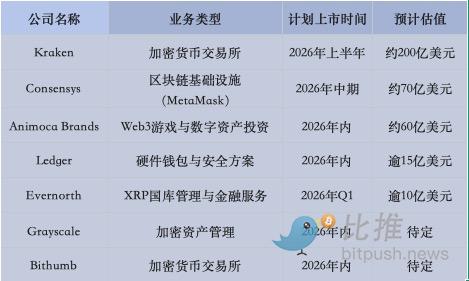
Of course, the market has never escaped the fluctuations of the macro environment, and the memory of some companies' IPOs falling below their issue price in 2025 is still fresh. But this precisely illustrates that the industry is maturing, and capital is no longer buying into every good story, but is beginning to scrutinize financial health, compliance frameworks, and sustainable business models.
Author: Bootly
Twitter: https://twitter.com/BitpushNewsCN
BitPush Telegram Community Group: https://t.me/BitPushCommunity
Subscribe to Bitpush Telegram: https://t.me/bitpush