When you truly know the outcome of something, it's impossible not to use your knowledge to make money, even if you're already very wealthy.
In a prediction market called Polymarket, someone made hundreds of thousands of dollars in just 10 days by relying on insider information that "he knows who the next Federal Reserve Chairman will be"—an information that is absolutely confidential to the world.
Even more outrageous is that during this period, Trump repeatedly disrupted the market with his signature nonsense, once again proving that "news is noise for the masses, and the flow of real money is the only signal."
The mechanism of market prediction is not complicated. Traders can bet on whether an event that has not yet occurred will happen by buying and selling binary options.
For example, regarding the question "Will Trump nominate XXX as the next Federal Reserve Chairman?", if the "yes" option price is $0.50, it means the market believes there is a 50% probability that the event will occur. If the event occurs, the option settles for $1; if it does not occur, it becomes zero.
This mechanism, combined with the anonymity of blockchain, has rapidly turned prediction markets into a haven for those with an information advantage. With just a click of the mouse to place a bet, insider information can quietly translate into real money.
The appointment of the Federal Reserve Chairman has always been one of the most sensitive topics in global financial markets. The addition of the notorious prankster Trump has turned this issue into a months-long reality show.
As of January 25, 2026, the cumulative trading volume for the question "Who will Trump nominate as Federal Reserve Chairman?" has exceeded $300 million.
Trump deserves much of the credit for this astronomical figure:
On December 1, Trump said aboard Air Force One, "I know who I'm going to choose."
The following day, Trump publicly told one of the candidates, Kevin Hassett, "I guess there's another potential Fed chair candidate here... Thank you, Kevin."
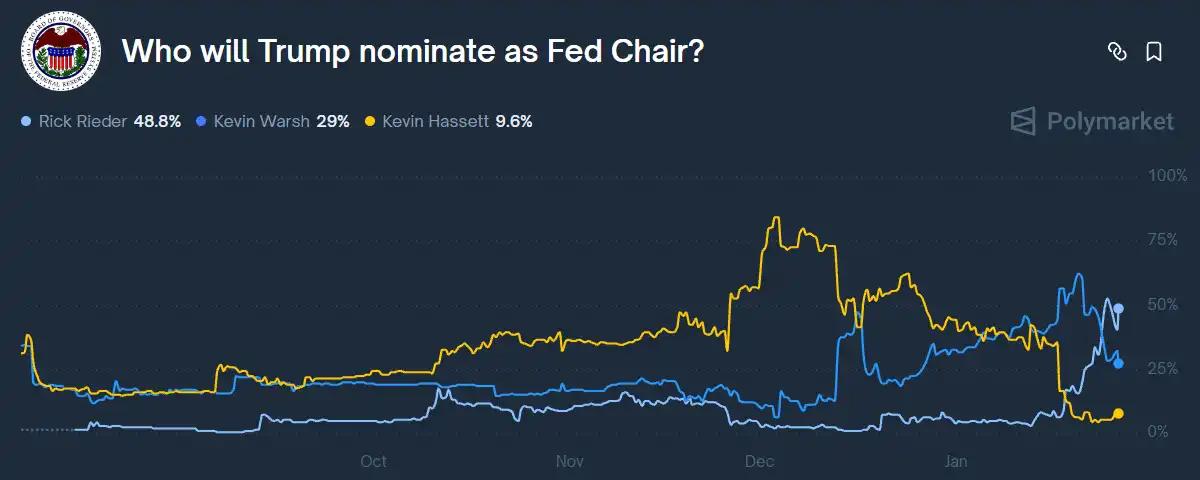
Trump's remarks were immediately reflected in the prediction market: Kevin Hassett's chances of being elected were once pushed up to 85%.
But just ten days later, Trump changed his tune in an interview, listing Kevin Warsh alongside Kevin Hassett as his top choices, and specifically emphasizing Warsh's support for interest rate cuts.
The probabilities of the two Kevins were redistributed, both hovering around 45%.
Among the many other candidates with a less than 10% chance of being selected, there is a BlackRock executive named Rick Rieder: as the world's largest asset management company, BlackRock currently manages more than $14 trillion in assets.
Rieder, currently BlackRock's Chief Investment Officer (CIO), has over 20 years of experience in the financial sector. Despite his impressive resume, his chances of being selected were once less than 1% due to his lack of political experience.
Unknown truths
Until mid-January, Rieder's chances of being selected were still below 10%. Mainstream media barely discussed him, and market attention was highly focused on the two Kevins.
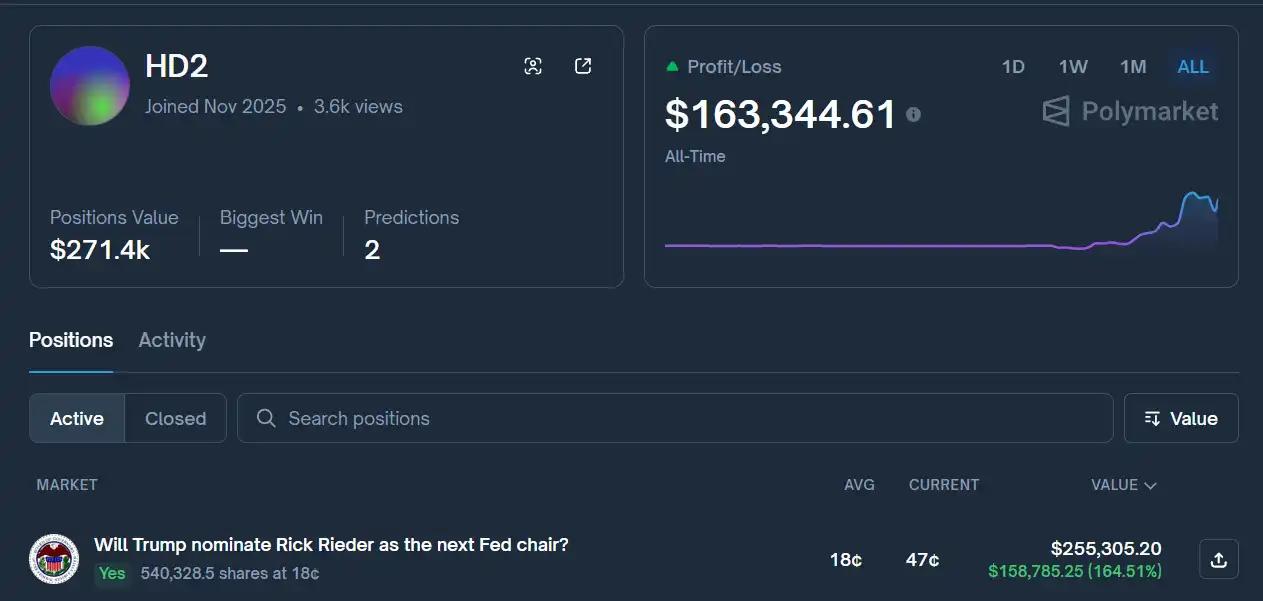
Against this backdrop, an account named HD2 bet approximately $10,000 on Rieder's selection on January 15.
In a market saturated with hundreds of millions of transactions, this deal was insignificant and went largely unnoticed, except for a brief announcement by PolyBeats 10 minutes after it occurred.
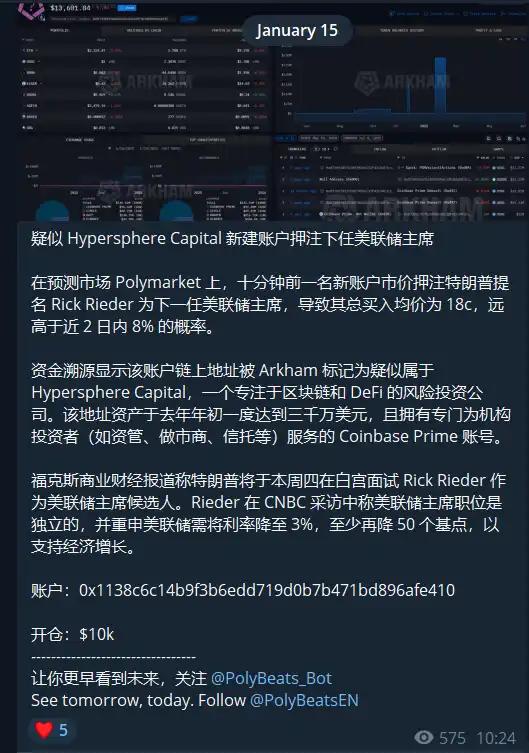
PolyBeats broadcast the transaction 10 minutes after it occurred, based on on-chain activity and transaction profile analysis.
It wasn't until 40 hours later that an on-chain analytics platform mentioned the transaction on X. Only then did the market begin to focus on Rieder, conducting in-depth analysis of his potential appointment as Federal Reserve Chairman.
Starting January 21st, mainstream media outlets began reporting on Rieder: "Trump has formally interviewed Rieder," "Trump publicly praised Rieder as outstanding," "Rieder may become a dark horse"...
As reports surfaced in rapid succession, the market quickly revised its expectations: As of January 25, Rieder's chances of winning had approached 60%. Meanwhile, the combined chances of Kevin, who had previously dominated the media spotlight, were now less than 30%.
HD2's bet from a week ago has now yielded a profit of over $150,000.
Capture the inside story in 10 minutes
The suspicious aspects of HD2's transaction were not entirely without clues.
While blockchain technology offers anonymity, all actions are permanently recorded. According to PolyBeats' report, HD2's on-chain activity was ultimately traced back to a crypto venture capital firm called Hypersphere Capital.
In light of the January 15th context, this deal becomes even more intriguing: Rick Rieder, as BlackRock's CIO, has close ties to capital and finance, while Hypersphere's own crypto attributes are also closely linked to Trump's support for cryptocurrencies.
Another point is that the 15th was the date Trump interviewed Rieder.
As these fragments were pieced together and more and more analytical results were disseminated, the market gradually realized: "Perhaps Rieder's chances of being selected have been severely underestimated."
Those media outlets that focus solely on "current odds" miss HD2 and the signal itself because they are always chasing after probabilities.
Besides HD2, PolyBeats has also mentioned several other suspicious insiders regarding Rieder's impending election as Federal Reserve Chairman.
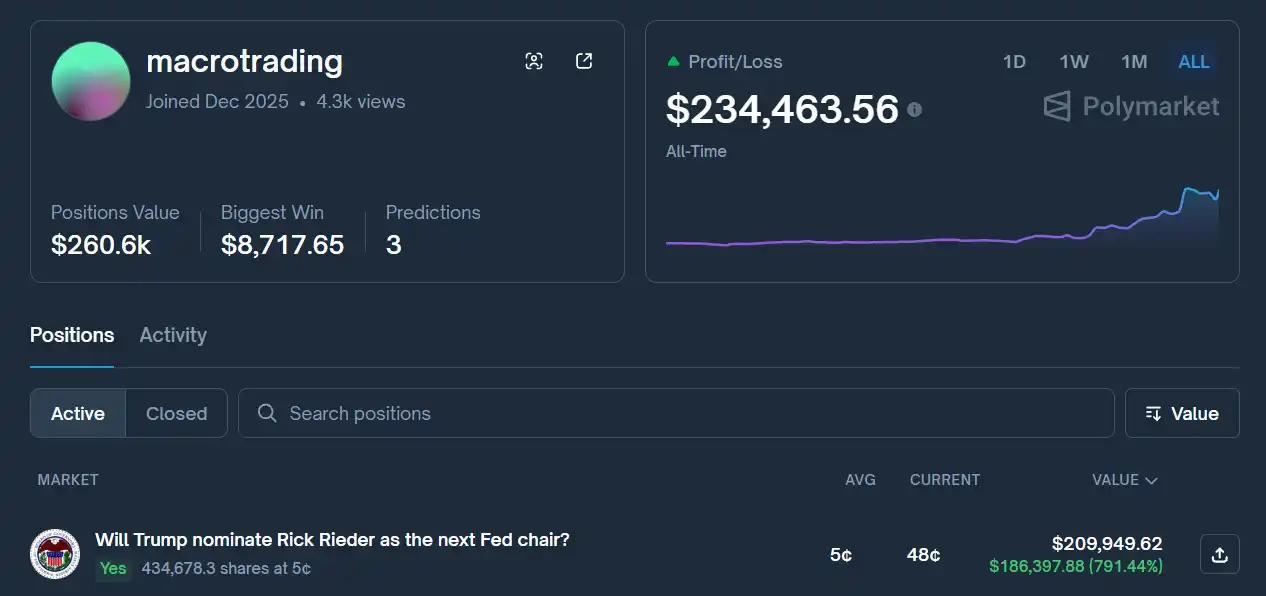
For example, macrotrading, a new account that was just registered in December 2025. At that time, the topic of the Federal Reserve Chairman was hotly debated, with everyone speculating about "when Trump will announce the next chairman" and "whether he will choose Hassett or Warsh."
Macrotrading wagered $10,000 when the odds of Rieder were only 5%. A month later, that sum had grown to $210,000, a twentyfold increase.
In addition, the other three accounts mentioned on the channel all bet when Rieder's chances of winning were less than 10%, and their current returns are between 4.4 and 10.6 times.
This brings us to the core controversy surrounding prediction markets: if it's merely a tool for insiders to monetize information, then it's nothing more than a gray casino where a few exploit retail investors. But if we view it as an oracle that reveals the truth in advance, with the aid of on-chain analytics tools, it might allow ordinary people to glimpse the outline of the future.
Prediction markets do not create the truth, but they provide a megaphone for those who know the truth earliest to maximize its dissemination value.