Original author: Stacy Muur
Original translation: TechFlow TechFlow
Introduction: Following the phenomenal success of Hyperliquid, the perpetual contract decentralized exchange (Perp DEX) sector has entered a phase of fierce competition. Despite the dramatic volatility of the crypto market in 2025, trading volume in this area surpassed $1.2 trillion.
This article, written by senior researcher Stacy Muur, systematically reviews eight Perp DEX projects with active points programs that are most worth watching in 2026. It also details practical strategies for leveraging funding rate arbitrage to achieve low-risk volume manipulation and obtain airdrops. For investors hoping to get a piece of the trillion-dollar derivatives market, this is an invaluable guide to avoiding pitfalls and making profits.
The full text is as follows:
This guide covers 8 leading Perp DEXs with active credit programs that are worth farming, along with proven strategies and tools. Ready? Let's get started.
introduce
Since the launch of Hyperliquid, Perp DEX has entered its most competitive phase. Trading volume in the sector grew from $647.6 billion in 2023 to over $1.2 trillion in 2025, and even during the market crash of October 10-11, 2025, its market share in global perpetual futures trading rose to 26%.
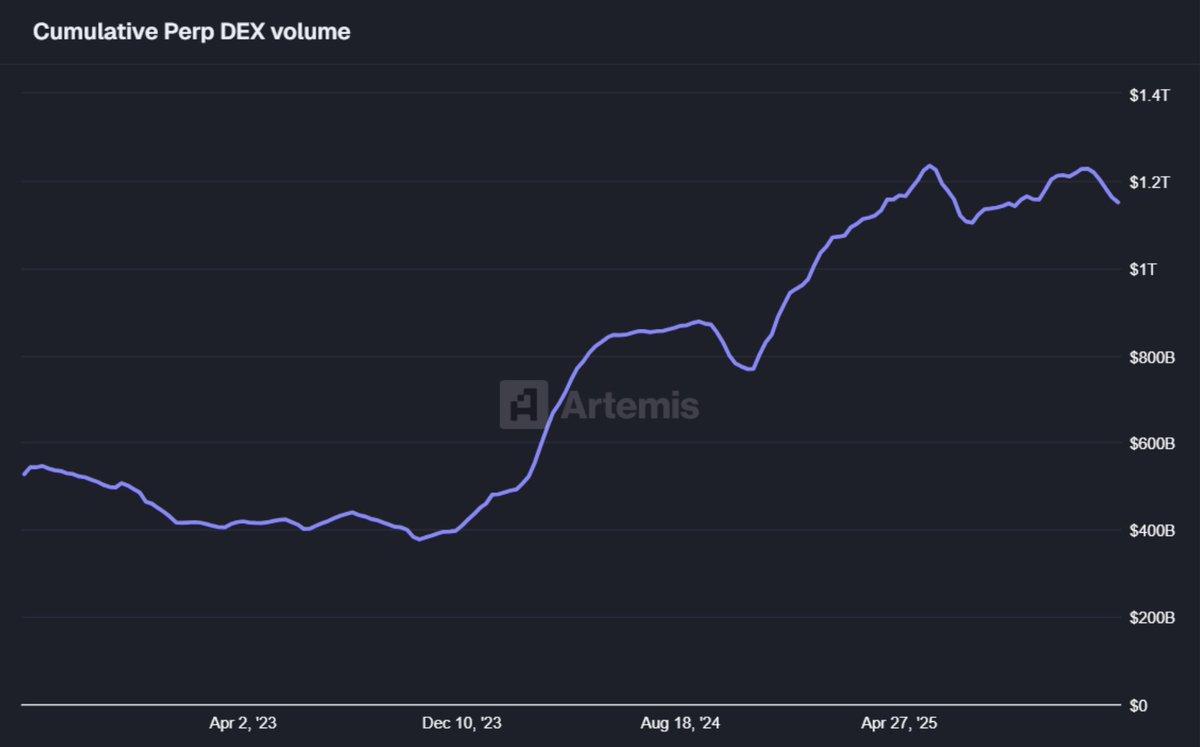
Caption: Data source: Artemis
At the time, Hyperliquid accomplished what was considered impossible. They built an exchange that truly challenged Binance, thereby capturing over 70% of the decentralized perpetual contract trading volume.
However, new Perp DEXs have begun to emerge, with new platforms appearing every day.
But why are we seeing so many on-chain perpetual contracts now? Is it because of Hyperliquid's huge success?
While this is indeed true, and Perp DEX has become a lucrative sector, the fundamental reason is that before 2025, the competition in Perp DEX was primarily focused on technology. It relied on a more powerful L1 layer, a more advanced ZK proof system, and a higher throughput DA (Data Availability) layer. But by 2025, the competition has shifted from technology to incentives.
The current state of the industry shows that emerging Perp DEXs are putting increasing pressure on the market, offering comparable latency, lower fees, and attractive incentive programs.
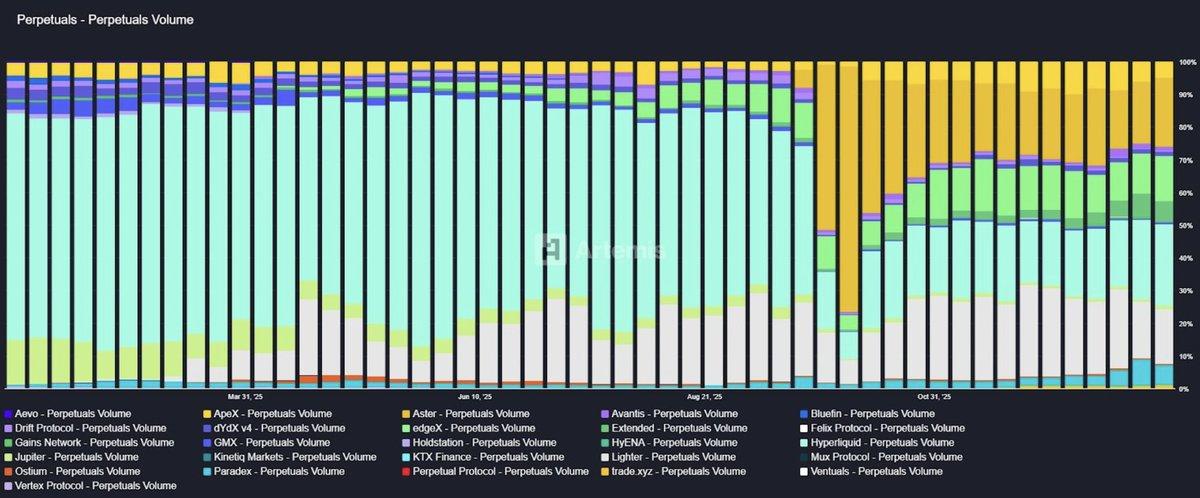
Caption: Data source: Artemis
Hyperliquid's market share has now fallen to around 20%, posing a substantial threat to new platforms. For example, Variational attracts users not only through airdrops/credit programs but also through refunds for trading losses.
In October 2025, trading volume reached a record $1.2 trillion, almost double the total of the previous month. This was primarily driven by incentives, namely points programs and airdrops. The track has become one of the most successful narratives in the airdrop game. Protocols are preparing to distribute millions of dollars in airdrops to drive liquidity and user activity.
This article analyzes various opportunities in the Perp DEX space and highlights practical mining strategies.
8 Perp DEXs to Watch

The main risks associated with Perp DEX are that some platforms have no intention of issuing tokens at all, and some ultimately have no value and are not worth the time (such as projects that exist primarily to extract transaction fees from users). Therefore, the core question is never "Can I use it?", but rather "Is it worth using?"
This section identifies Perp DEXs worth investing time in based on DefiLlama data as of January 16, 2026, considering factors such as trading volume, open interest, user growth, and fee economics.
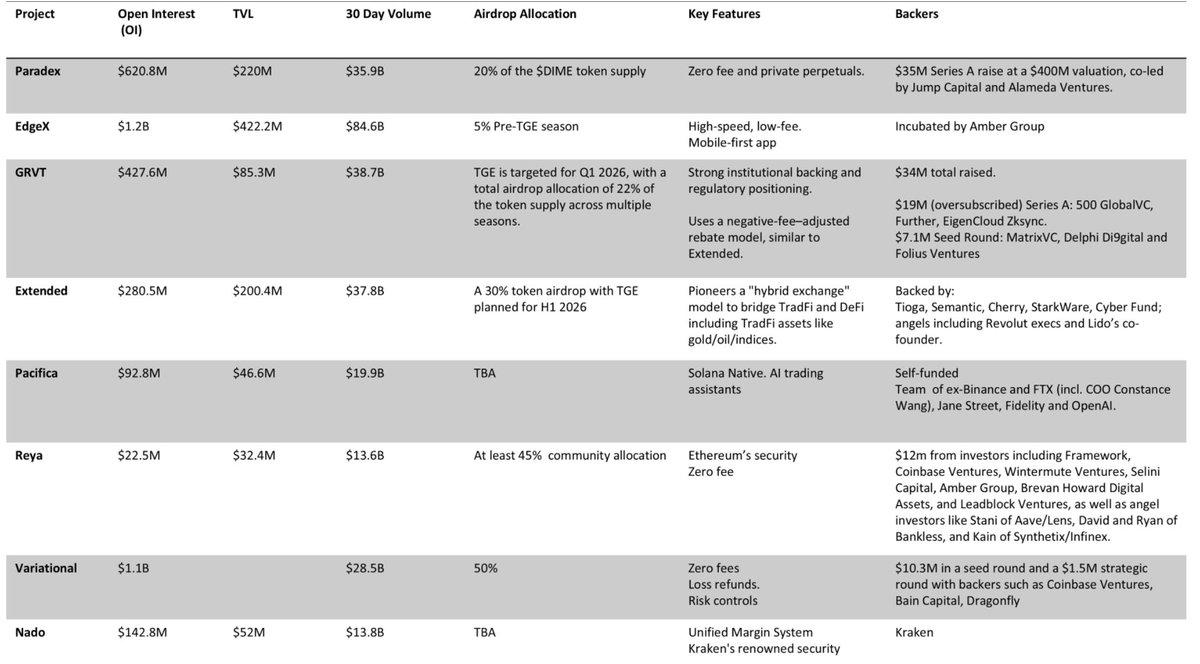
1. Paradex V2
Paradex is a privacy-focused Perp DEX built on Starknet's first application blockchain. It offers zero transaction fees, deep liquidity across hundreds of crypto and pre-market assets, atomic settlement, and institutional-grade privacy features through a mobile-optimized interface.
Architecturally, it is designed as a unified DeFi ecosystem (Paradex Ecosystem), consisting of the Paradex exchange, the Paradex chain, and XUSD (a native synthetic dollar powered by the $DIME token).
Core features:
- Offers leverage up to 50x in multiple markets.
- Low fees: Maker orders 0.02%, Taker orders 0.05%
- Cross margin margin function
- Employs Ethereum-level secure ZK-Rollup technology
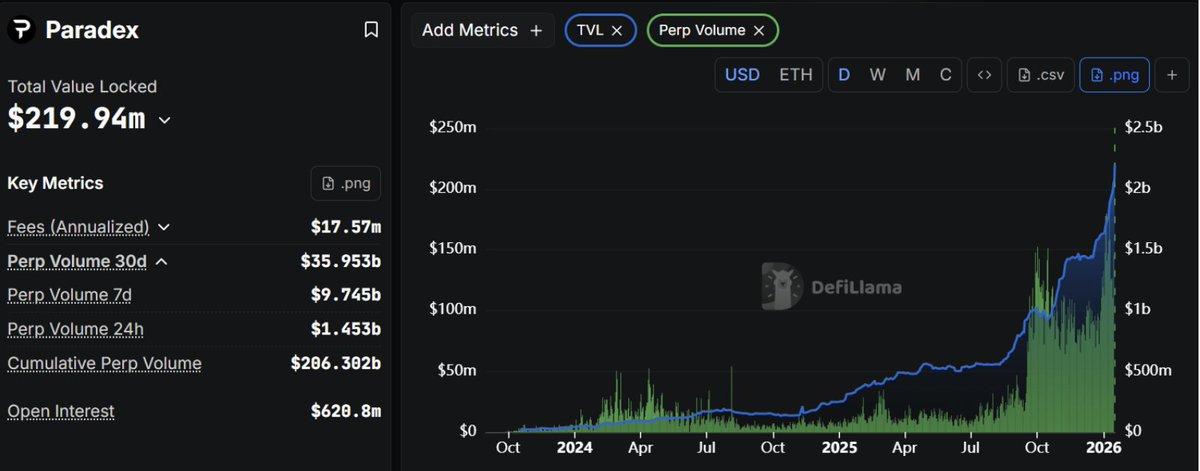
Caption: Source: Defillama
Paradex has shown impressive growth to date:
- TVL: Approximately $220 million (nearly six times the $25 million at the beginning of 2025)
- Total trading volume: US$206 billion
- Positions held: approximately $620 million
- 30-day trading volume: $36 billion
Points program:
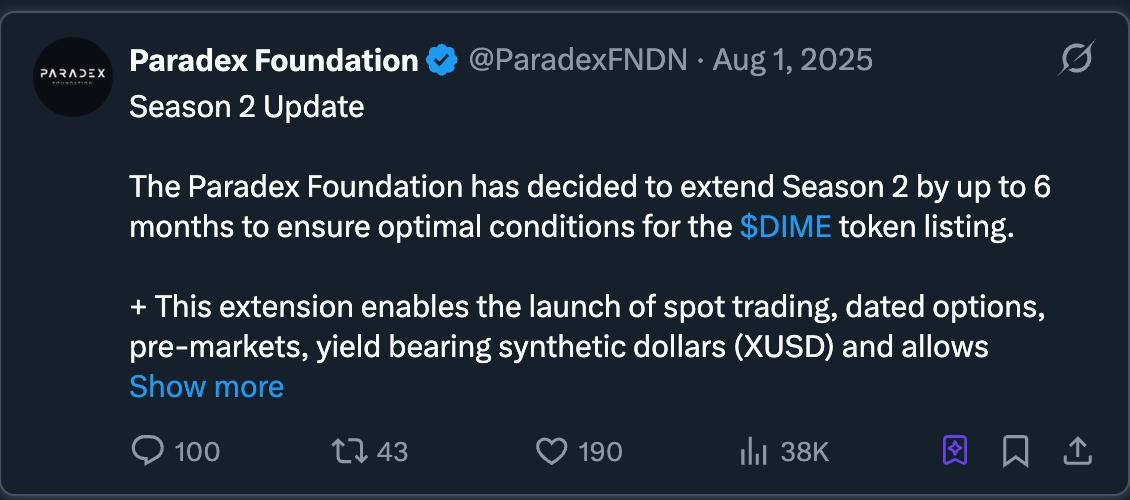
The Paradex Foundation has decided to extend the second quarter by up to six months to ensure optimal conditions for the token listing. This extension will support spot trading, periodic options, pre-market trading, and the launch of yield-generating synthetic US dollars (XUSD).
The airdrop event's pre-season and first phase ran from February 1, 2024 to January 2, 2025. Paradex is currently in its second phase, distributing 4 million XP (credits) to active traders every Friday.
How to participate:
- Register and set up an account on Paradex, then connect your EVM-compatible wallet.
- Set your nickname. Link to X/Discord for anti-Symptom checks and gain Community XP boosts.
- Deposit USDC and start trading.
- Earn XP from holding positions, XP from transaction fees, and even XP from liquidation.
- Earn Vault XP by depositing liquidity into the USDC Vault.
- Share your referral link to earn 10% of the invitee's XP. The invitee receives a 5% XP bonus.
2. edgeX
edgeX is a Layer 2 (L2) exchange that offers perpetual and spot trading. It was initially incubated by Amber Group on StarkEx ZK-rollup and launched as a Perp DEX based on ZK-rollup. It is currently transitioning to EDGE Chain: an Ethereum L2 platform built for high-throughput financial applications.
Core features:
- Built on StarkNet (zk-Rollup), it offers fast settlement speeds.
- Up to 50 times leverage
- Pending orders: 0.02% / Taking orders: 0.05% (One of the cheapest Perp DEXs)
- Based on the Central Price Limit Order Book (CLOB) model
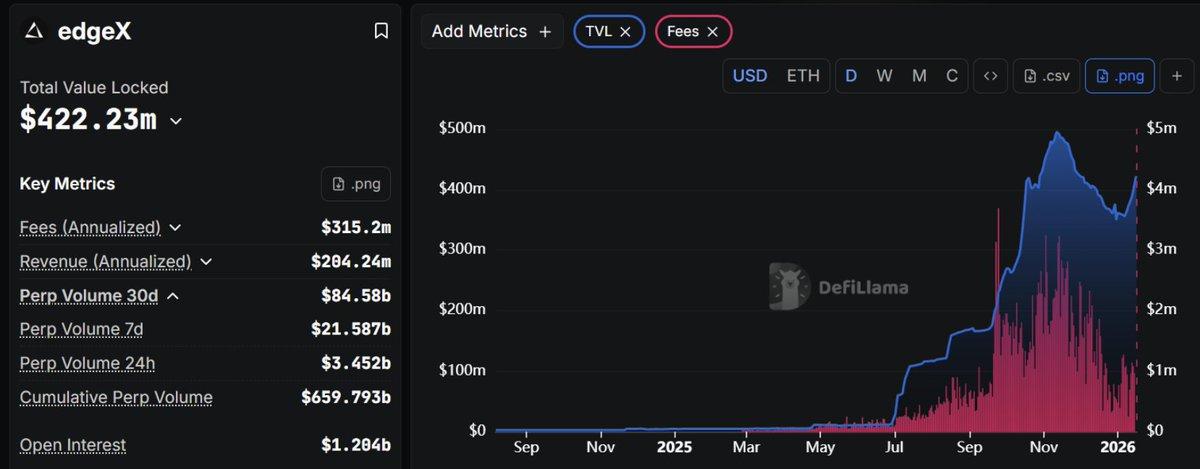
Market performance:
- Weekly trading volume: $21.59 billion
- 30-day trading volume: $84.58 billion (consistently ranked in the top 5)
- Positions held: $1.2 billion
- TVL: $422 million
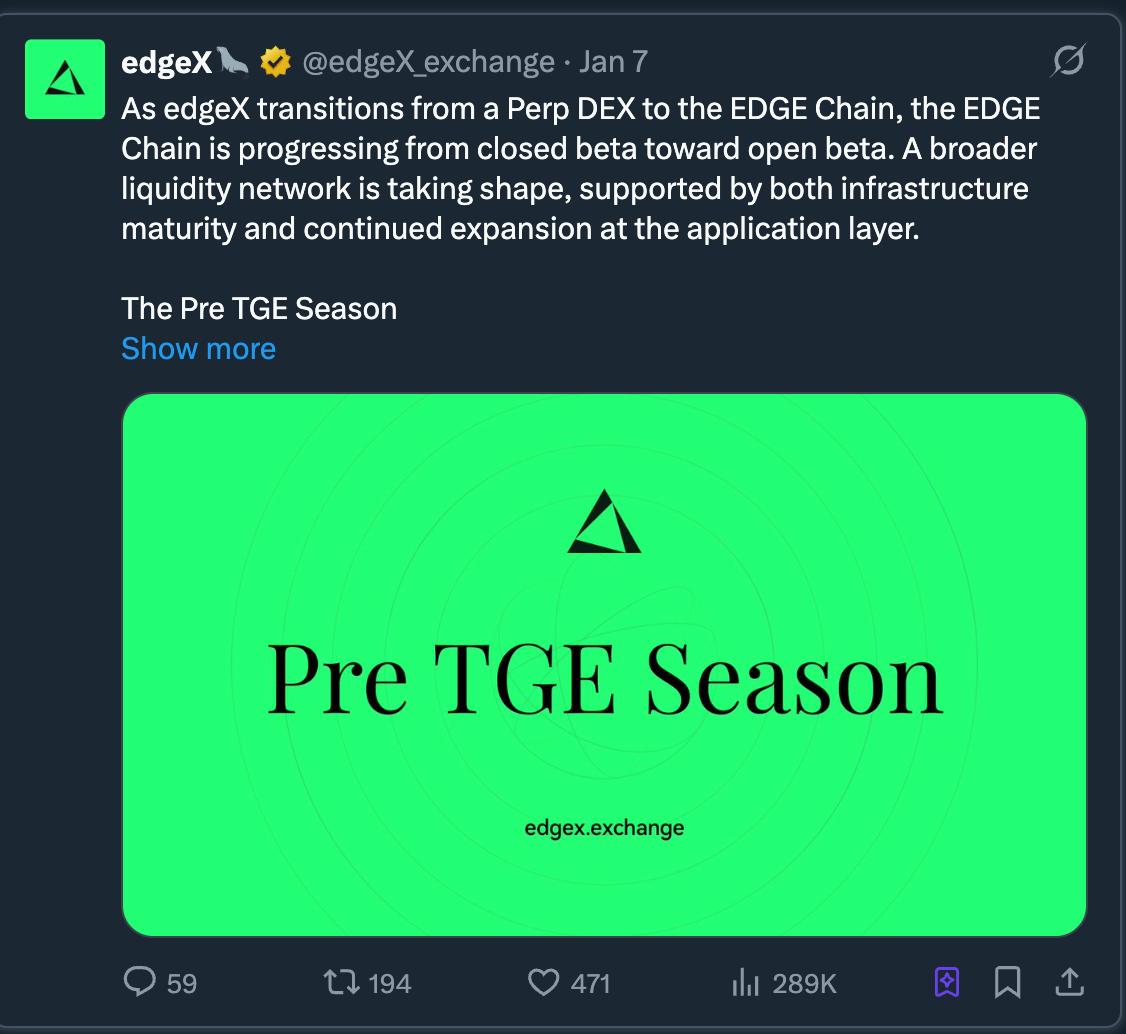
Points Program: edgeX recently ended its 27-week "Open Season" points program. The Pre-TGE season, which began on January 7, 2026, was designed to reward organic use of the XP rewards platform. XP was distributed weekly until TGE (expected to occur on or before March 31).
How to participate:
- Create your own trading account: https://pro.edgex.exchange/referral/MUUR
- Deposit and start trading. Priority is given to spot trading, and you can enjoy a 3x XP multiplier on trading volume.
- You can get a 1.2x XP bonus when trading directly on the edgeX mobile app.
- Holding MARU tokens unlocks an additional 1.05x–1.15x XP multiplier. Signing up for Messenger grants an additional 1.05x–1.1x XP boost.
- Perpetual contract trading losses account for 10% of XP distribution. This increases total trading volume as it contributes 60% of the weekly XP allocation.
3. GRVT
GRVT (pronounced "Gravity") is a Perp DEX founded in 2023, built within the zkSync ecosystem, and using a modular ZK Stack architecture. It runs as an L3 Validium application chain, optimized for high-performance perpetual contract transactions, and inherits Ethereum-level security through zero-knowledge proofs.
Core features:
- Privacy-focused exchanges
- Combining a self-hosted Layer 2 (ZK/Validium) settlement layer with off-chain CLOB
- ZKsync Atlas enables high-performance perpetual contracts to be compatible with Ethereum's composability.
- The L3 design allows GRVT to prioritize throughput and latency without sacrificing cryptographic proofs.
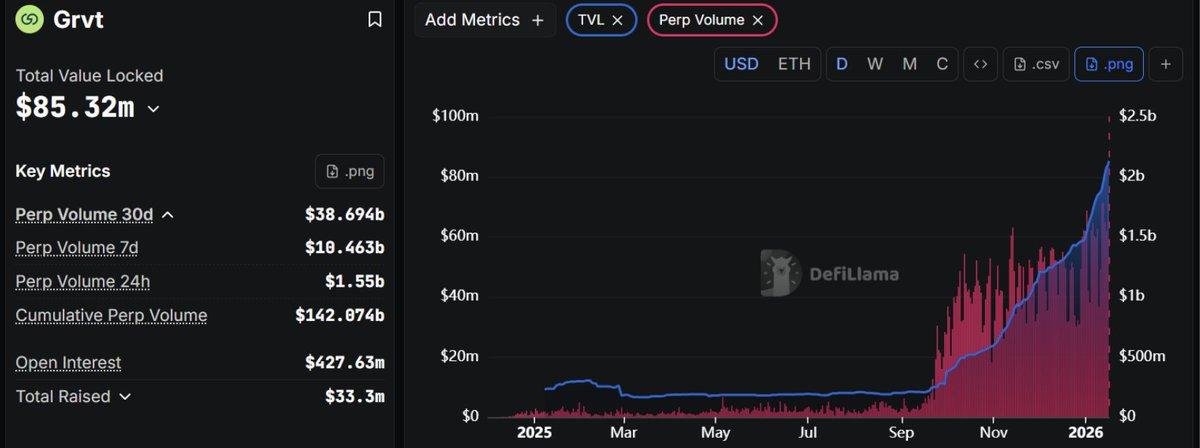
Growth indicators:
- TVL: Approximately US$85 million
- Cumulative trading volume: US$2,142.1 billion
- Positions held: Approximately $427 million
- 30-day trading volume: $38.7 billion
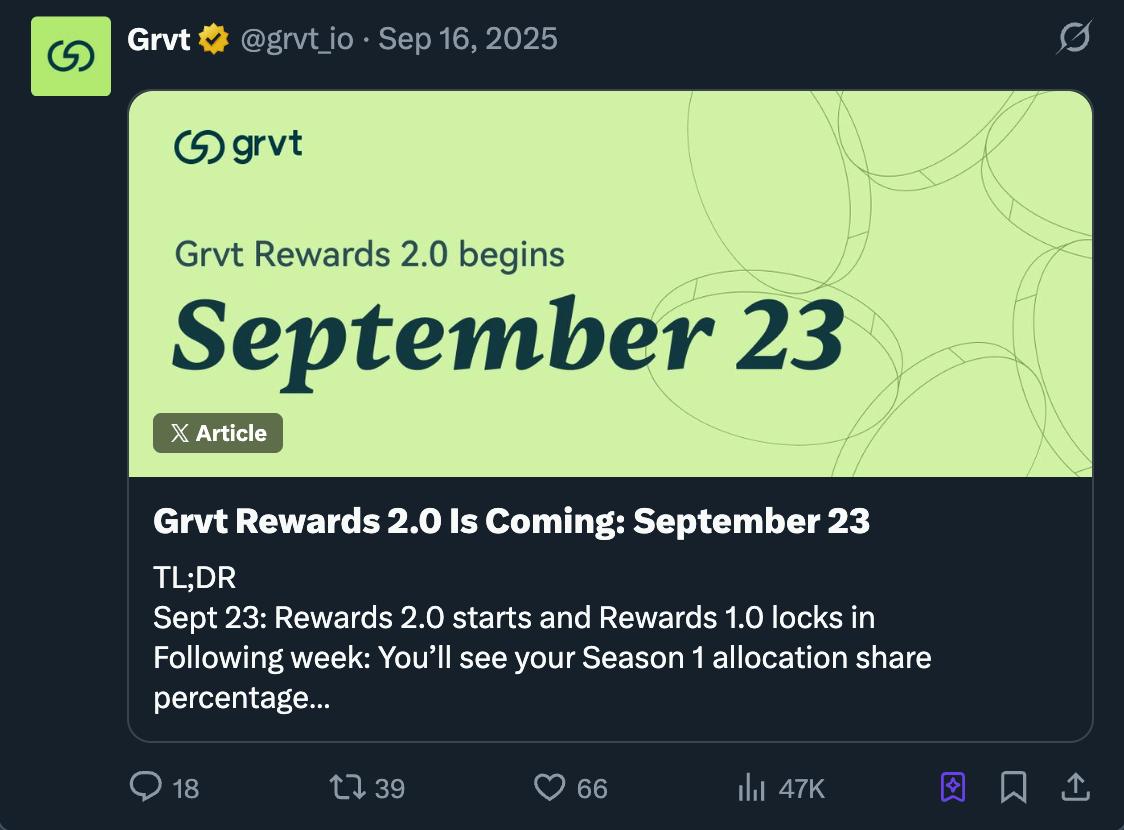
Points Program: After a long development period, GRVT officially launched its points incentive system in 2024. It is currently in Season 1 and rewards users who contribute to trading activity, liquidity, and position size.
How to participate:
- Register an account and deposit funds.
- Opening a position generates points, with special emphasis on maintaining the position, as its weight has been increased.
- Join the referral program to earn extra commission rebates.
4. Extended
Extended (formerly X10) is a high-performance perpetual contract DEX on Starknet, built by the former Revolut team. While initially focused on perpetual contracts, the protocol is expanding towards a unified margin model, supporting spot trading and integrated lending.
Core features:
- Hybrid architecture: Off-chain CLOB for matching and risk control + on-chain settlement
- Offers up to 100x leverage on crypto and traditional financial (TradFi) assets.
- Unified margin is achieved through XVS vault shares, integrating lending and liquidity.
- The market includes synthetic traditional financial assets
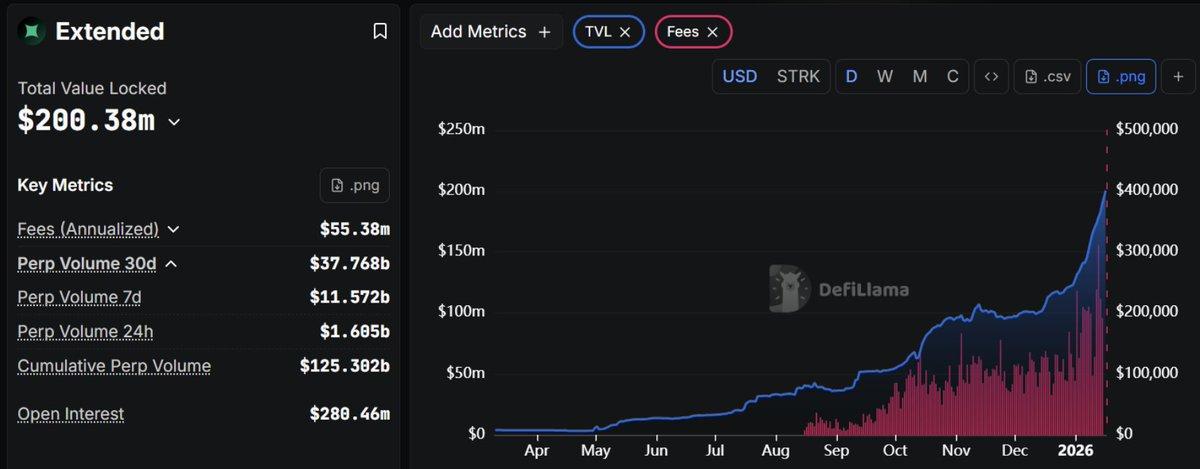
Market performance:
- TVL: $200 million
- 30-day trading volume: $37.8 billion
- Holdings: $280 million (45.2% increase year-to-date)
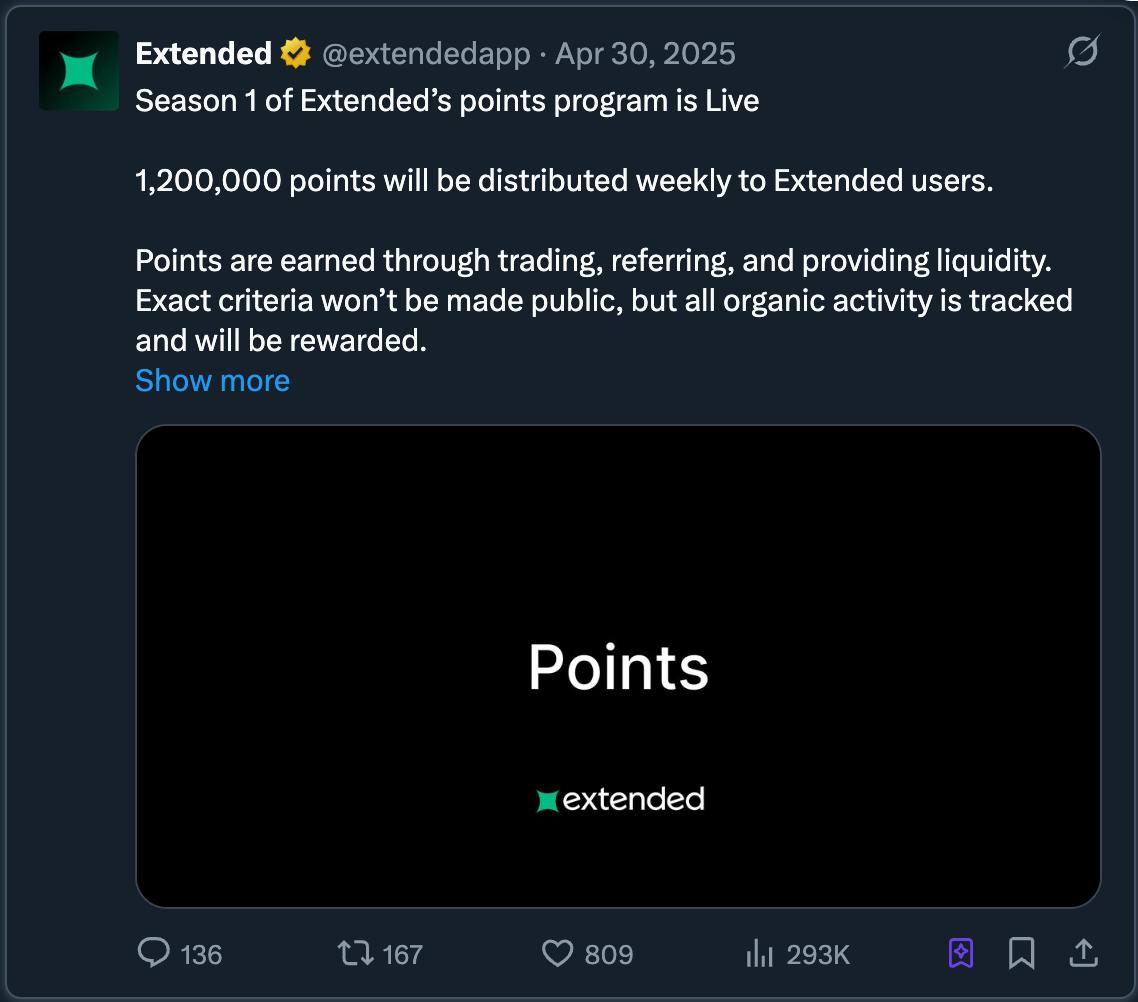
Credits Program: On April 30, 2025, Extended launched its credits program, distributing 1.2 million credits weekly among traders and liquidity providers (LPs).
How to participate:
- Depositing funds and opening positions generates trading volume.
- Earn an extra 20% credits while providing liquidity to the vault.
- Once your trading volume reaches $10,000, you'll unlock your referral link and earn a 10% commission and 2.5% points from the referrer.
5. Pacifica
Pacifica is a Solana-native hybrid Perp DEX currently in closed beta testing. Despite its early stage, it has already attracted significant trading volume, sometimes even surpassing established Solana DEXs like Jupiter and Drift.
Given that previous Solana perpetual contract protocols (such as Drift and Zeta) have had decent airdrops, and that Pacifica is self-funded, the likelihood of this project having a meaningful airdrop is above average.
Core features:
- Hybrid architecture: Off-chain CLOB + Solana, on-chain settlement
- Up to 50 times leverage
- AI Trading Assistant
- Liquidation care points receive bonuses
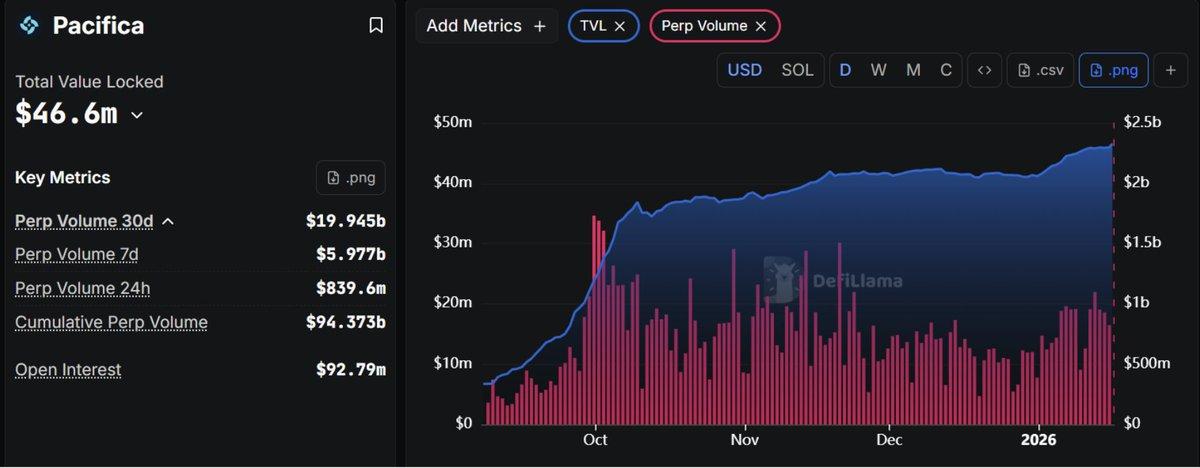
Market performance:
- 24-hour trading volume: $839 million
- 30-day trading volume: $19.95 billion
- Positions held: $92.8 million
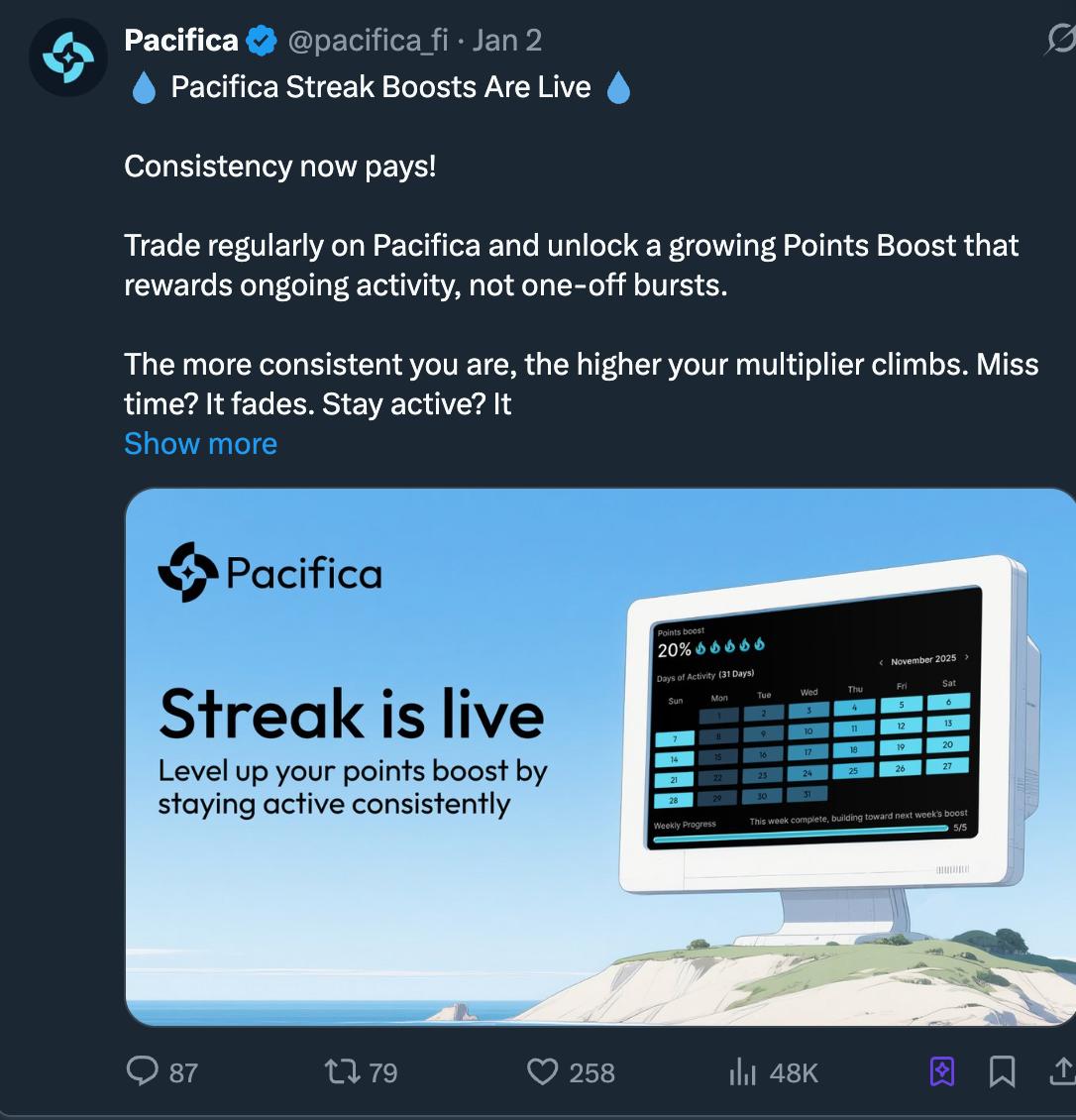
Points Program: Pacifica launched a consecutive trading points bonus on January 2, 2026, offering up to 23% extra points. After 5 consecutive days of trading, the bonus increases by 2% daily, up to a maximum of 10%.
How to participate:
- Use the invitation code to enter the closed beta.
- Connect your wallet, deposit funds, and open a trading account.
- Join the referral program to get your own access code.
6. Reya
Developed by Reya Labs, Reya is a modular L2 trading platform with optimized features built on a custom implementation of Arbitrum Orbit. More than just a single DEX, Reya is a foundational execution layer with shared liquidity, upon which multiple trading front-ends can be built.
By centralizing liquidity at the network layer, Reya aims to solve the problem of liquidity fragmentation.
Core features:
- It has a ZK Rollup specifically designed for trading.
- Robust security, enabling verifiable order execution and settlement through ZK proofs.
- It owns rUSD (a yield-generating stablecoin), powered by Reya's unified liquidity framework.
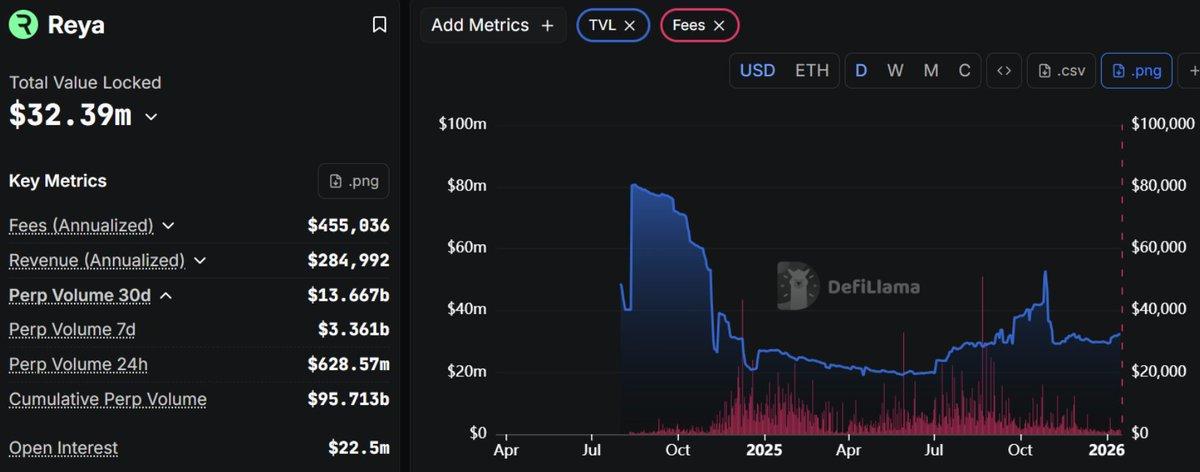
Market performance:
- 30-day trading volume: $13.7 billion
- Total trading volume: US$95.7 billion
- TVL: $32.4 million
Reya Chain Points Program: Reya Chain Points (RCP) are used to track contributions and are converted to $REYA upon TGE (token issuance). Transaction activity typically earns the highest rewards, and points are distributed every Monday at noon (GMT).
How to participate:
- Top up or cross-chain USDC.
- Deposit liquidity into the LP Vault via the "Stake" tab, convert rUSD to srUSD, and lock funds to earn loyalty points and 4.8% APY.
- Open trading positions to increase trading volume and maximize your points.
7. Variational
Variational is a peer-to-peer perpetual contract and generalized derivatives trading protocol built on Arbitrum. It automates the entire cycle from trade to settlement.
Variational operates two main applications: Omni (a leveraged perpetual contract trading platform for retail users) and Pro (an advanced trading platform for non-linear derivatives).
Core features:
- P2P Request for Quotation (RFQ) instead of order book
- The vertically integrated market maker is called Omni Liquidity Provider (OLP).
- Zero transaction fee
- Loss refunds
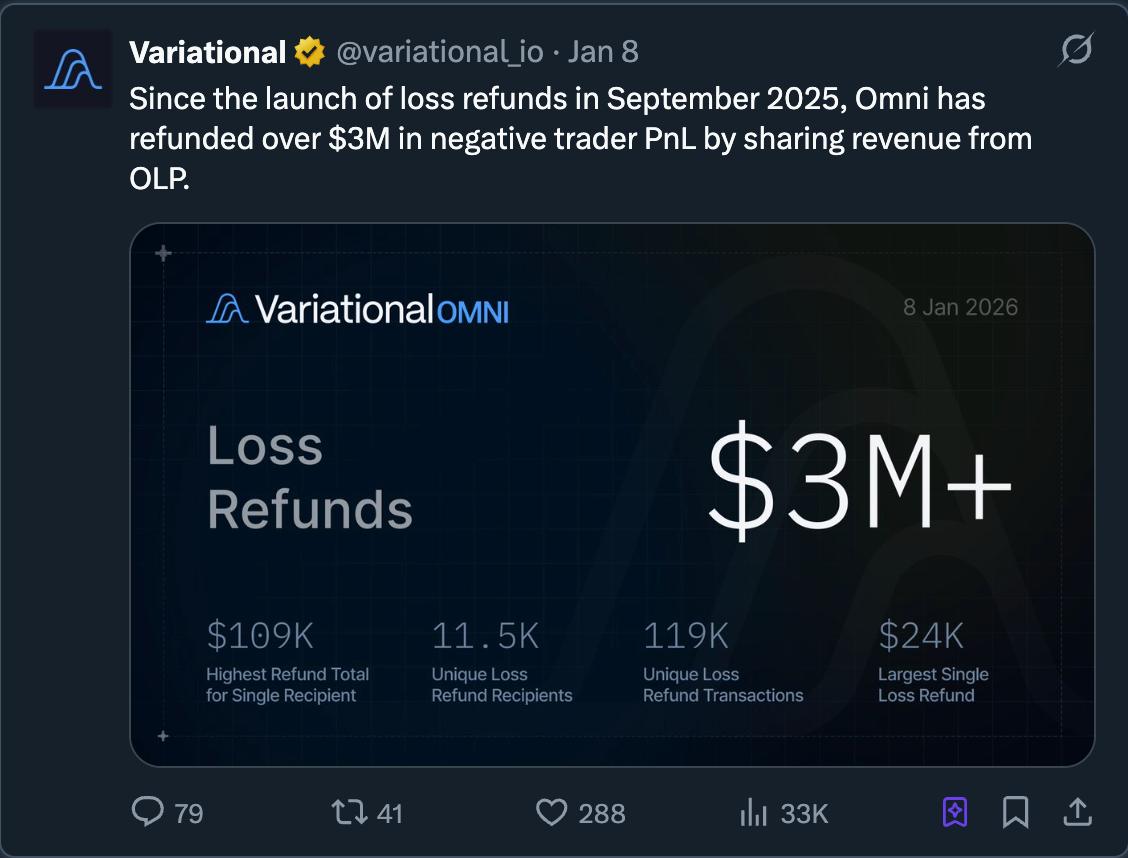
In 2026, Omni evolved from a testnet to become one of the largest periodic platforms in the cryptocurrency space, attracting attention with its loss refund feature.
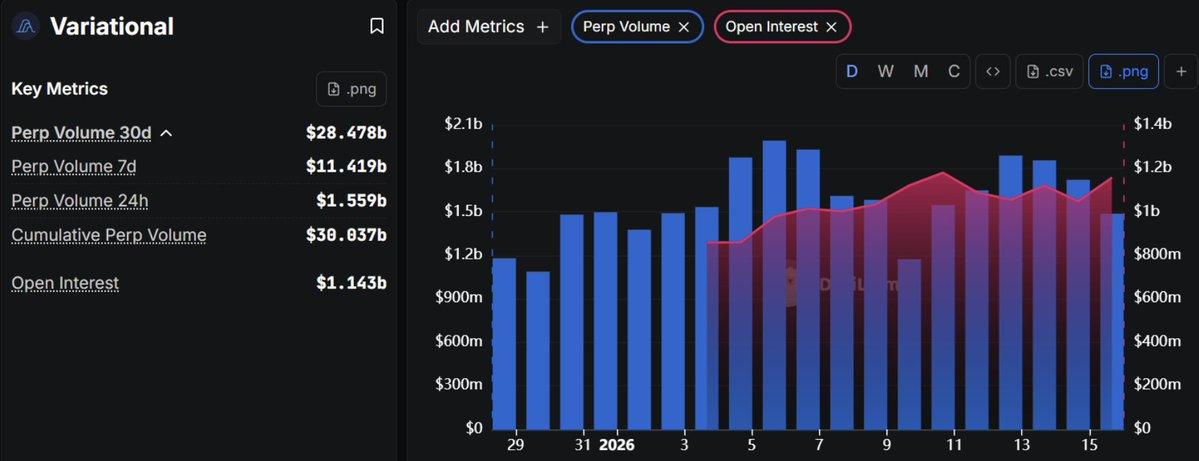
Growth indicators:
- Total trading volume: US$30 billion
- Weekly trading volume: $11.4 billion
- Open interest: $1.1 billion (Top 5 on Perp DEX)
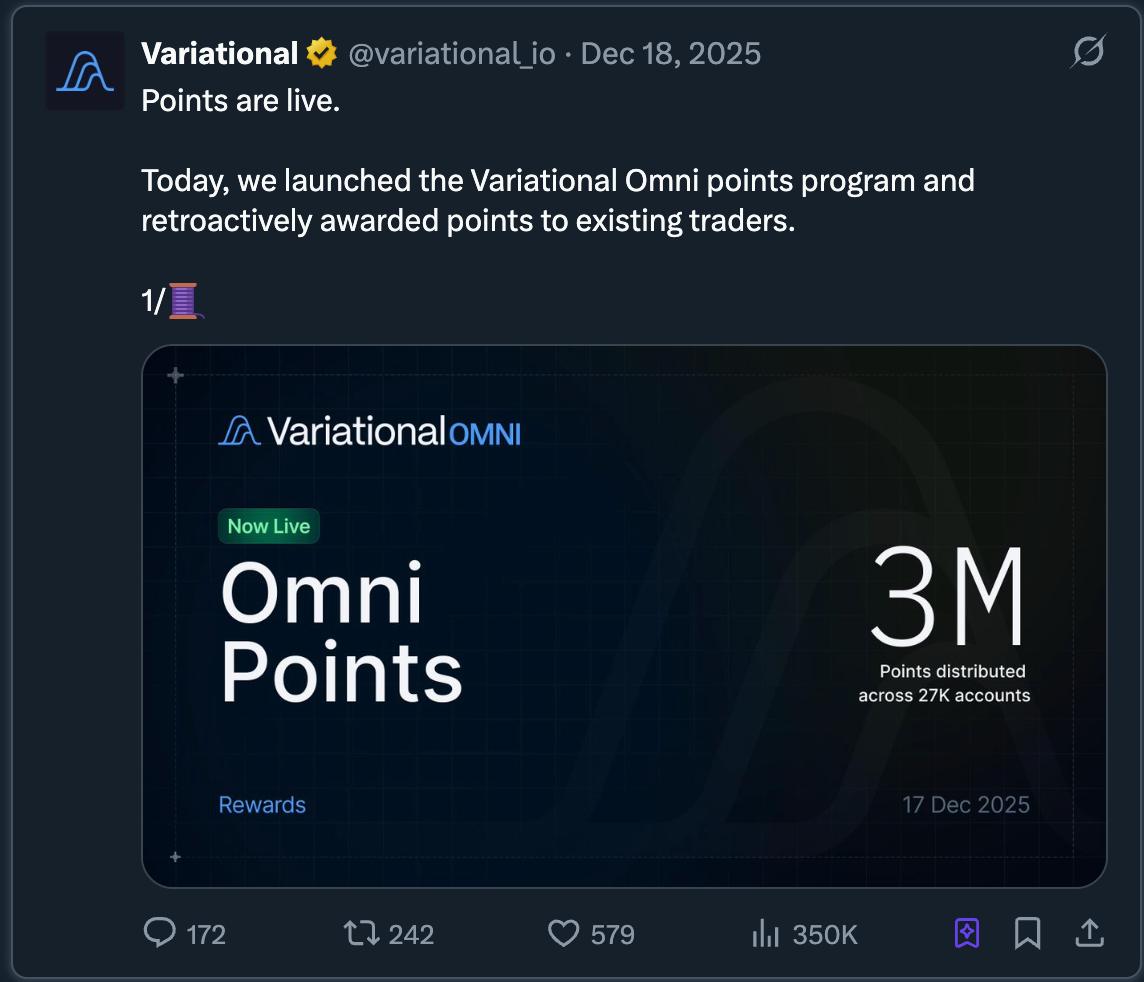
Points Program: Variational Omni has officially launched its loyalty program. Users earn base points based on their activity level. Points are distributed every Friday at 00:00 UTC.
How to participate:
- Register an account and deposit funds.
- Earn points by generating transaction volume.
- Benefits such as increased probability of loss refunds and bonus points are offered based on the reward level of the past 30 days' activities.
8. Nado
Nado is built on Ink (Kraken's Ethereum L2) and is a comprehensive CLOB DEX integrating spot trading, perpetual contracts, and a money market. It is currently in private alpha testing and is only available to invited users.
Core features:
- Integration of spot and perpetual contracts under a unified margin model
- Nado's liquidity provider, NLP, deploys idle funds to the order book to earn APY.
- Order matching time is only 5–15 milliseconds
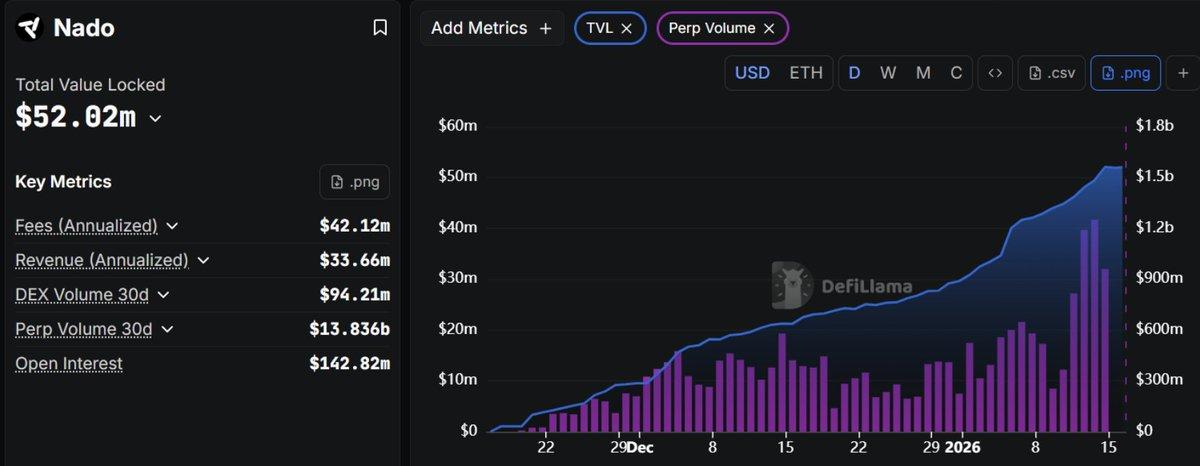
Market performance:
- 30-day trading volume: $13.8 billion
- TVL: $52 million
- Positions held: $142 million
Points Program: After the private beta ends, the platform will open up airdrops.
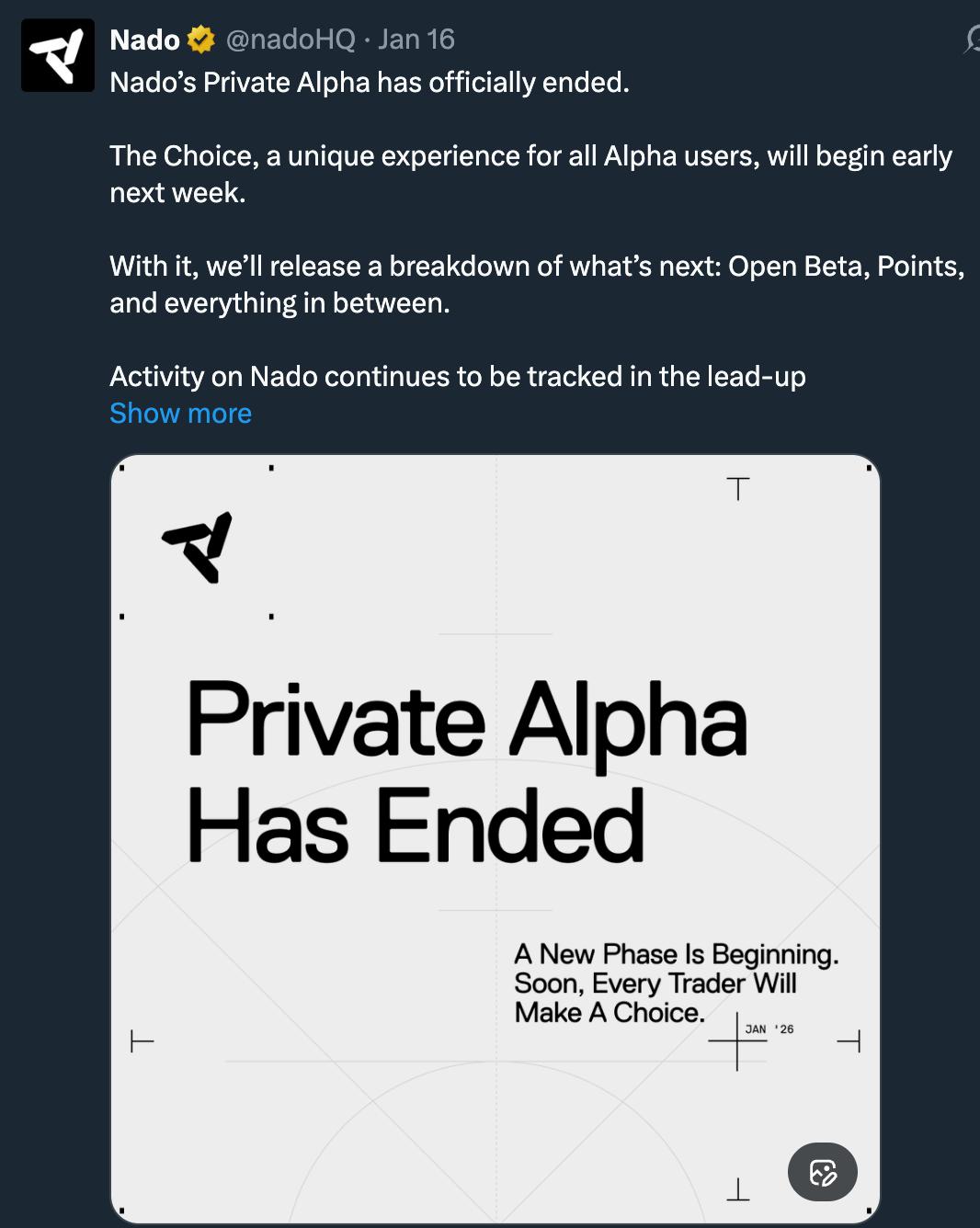
It is unclear whether Nado will conduct platform-specific airdrops, but it is certain that early adopters will receive Ink airdrop credits as a reward.
Practical Strategy: Funding Rate Arbitrage
The perpetual contract market has become the largest financial market in terms of trading volume among cryptocurrencies. Weekly open interest (OI) frequently exceeds $5 billion.
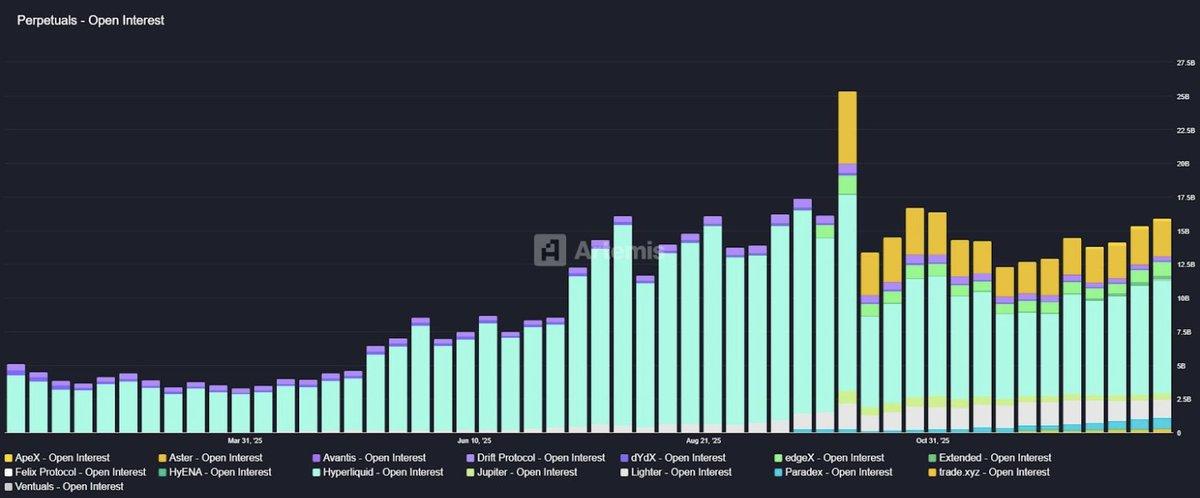
When farming Perp, it is recommended to use Altcoin with lower market capitalization to generate more reward points than high-market-cap assets, although this carries risks.
For inexperienced users or those unwilling to risk active trading for airdrops, funding rate arbitrage is a proven strategy that can generate trading volume while maintaining profitability or at least breaking even.
What is Funding Rate Arbitrage?
Funding rate arbitrage is a typical form of cash-and-carry trade in perpetual futures markets.
Funding rates are essentially the cost of holding a position. When funding rates are positive, long positions pay funding fees to short positions; when funding rates are negative, short positions pay funding fees to long positions. In most perpetual contract markets, funding rates are typically positive.
The operational logic of this strategy is as follows:
- Open a long position on a DEX.
- Open an equal short position on another DEX.
- This allows them to capture revenue from funding rates.
- It also generates a continuous volume of transactions for the account, which is used for points accumulation and reward acquisition.
Simply put, let's assume:
- BTC spot price: $50,000
- BTC perpetual contract price: $50,100
- Funding fee: +0.01% every 8 hours (positive value)
You need to do the following:
Open a long position of $10,000 in BTC on one DEX and a short position of $10,000 in BTC on another DEX.
In this way, whether the price of BTC rises or falls, your gains and losses will offset each other (hedge). However, since the funding rate is +0.01%, your short position will receive a funding fee every 8 hours.
$10,000 × 0.01% = $1 (every 8 hours).
If the fee rate remains stable: $3 per day, $90 per month. All of this is unaffected by the dramatic price fluctuations of BTC.
The reason for choosing to open long and short positions on different DEXs rather than the same platform is to avoid Sybil detection and potential blacklisting risks. Funding arbitrage allows users to "farm" on various Perp DEXs without relying on price fluctuations.
This strategy is highly effective because it generates profits even with moderate leverage. Furthermore, traders don't need to worry about volatile market conditions and can easily generate consistent trading volume to accumulate points.
Key risks that must be understood:
While funding rate arbitrage reduces risk exposure, it is not foolproof. Some risks are unavoidable, such as short-side liquidation or negative funding rates. Therefore, the following practical steps must be taken to further reduce risk:
- Continuously monitor positions: Actively manage open positions to avoid forced liquidation.
- Setting stop-loss (SL) and take-profit (TP): This is a hard safeguard against forced liquidation, especially for short positions.
- Avoid high leverage.
Funding Rate Robots and Tools:
Tracking funding rates is very time-consuming. Skilled "farmers" often use bots, but less experienced airdrop users can also benefit from the following tools. These tools can visualize the best funding rate arbitrage opportunities across the major Perp DEXs.
For example, they will show the annualized rate of return (APR) and the specific actions required to achieve that return (e.g., opening a long position on one exchange and a short position on another).
- @LorisTools : A complete dashboard and filter that aggregates funding rates from CEX and DEX platforms, making it very effective for discovering cross-exchange arbitrage opportunities.
- @Arbitraxdexs : Still under development, but can be used to view token APR, spreads, and funding fee differences between exchanges.
- @cexchange_sh : Features a built-in funding rate arbitrage aggregator, focusing on rate strategies between DEX trading pairs.
- @fundingviewapp : Funding Rate Arbitrage Strategy Finder. It helps traders identify historically profitable arbitrage pairs and calculate the average APR over multiple time periods.
- @p2p_army_here : Another arbitrage scanner that integrates analytics tools to identify funding fee spreads between exchanges. It also provides real-time spread scanning, historical rate tables, and alerts.
- @dextrabot : As an automation platform, it focuses on airdrop credit acquisition and copy trading on perpetual contract DEXs such as Lighter, Aster, Hyperliquid, Extended, and Variational, emphasizing low-cost strategies such as Delta-neutral bots and grid trading.
Conclusion
2025 will be a pivotal year for Perp traders and exchanges in many ways. From the successful airdrop to the market crash of October 10-11 (one of the biggest single-day market crashes in crypto history), the automatic liquidation (ADL) cycle was triggered, resulting in huge losses even for traders using funding rate arbitrage strategies.
However, Perp DEX is still on the rise, but this time traders should be more cautious. The core lesson is: where you trade is just as important as what you trade. Always carefully read the documentation of new exchanges to avoid becoming a victim of exploitative exchanges.
This article provides you with the tools you need to start your Perp DEX hair removal journey. In addition, experience and discipline will guide you.
Critics often point out that most emerging protocols are simply trying to be "the next Hyperliquid." Personally, I don't think this is a problem. Perp DEXs' competitors aren't each other, but rather their centralized competitors (CEXs). As Perp DEXs continue to grow, opportunities will still exist, but the barriers to entry will only increase over time.
Remember, the biggest regret in the crypto industry is "fading trends".