


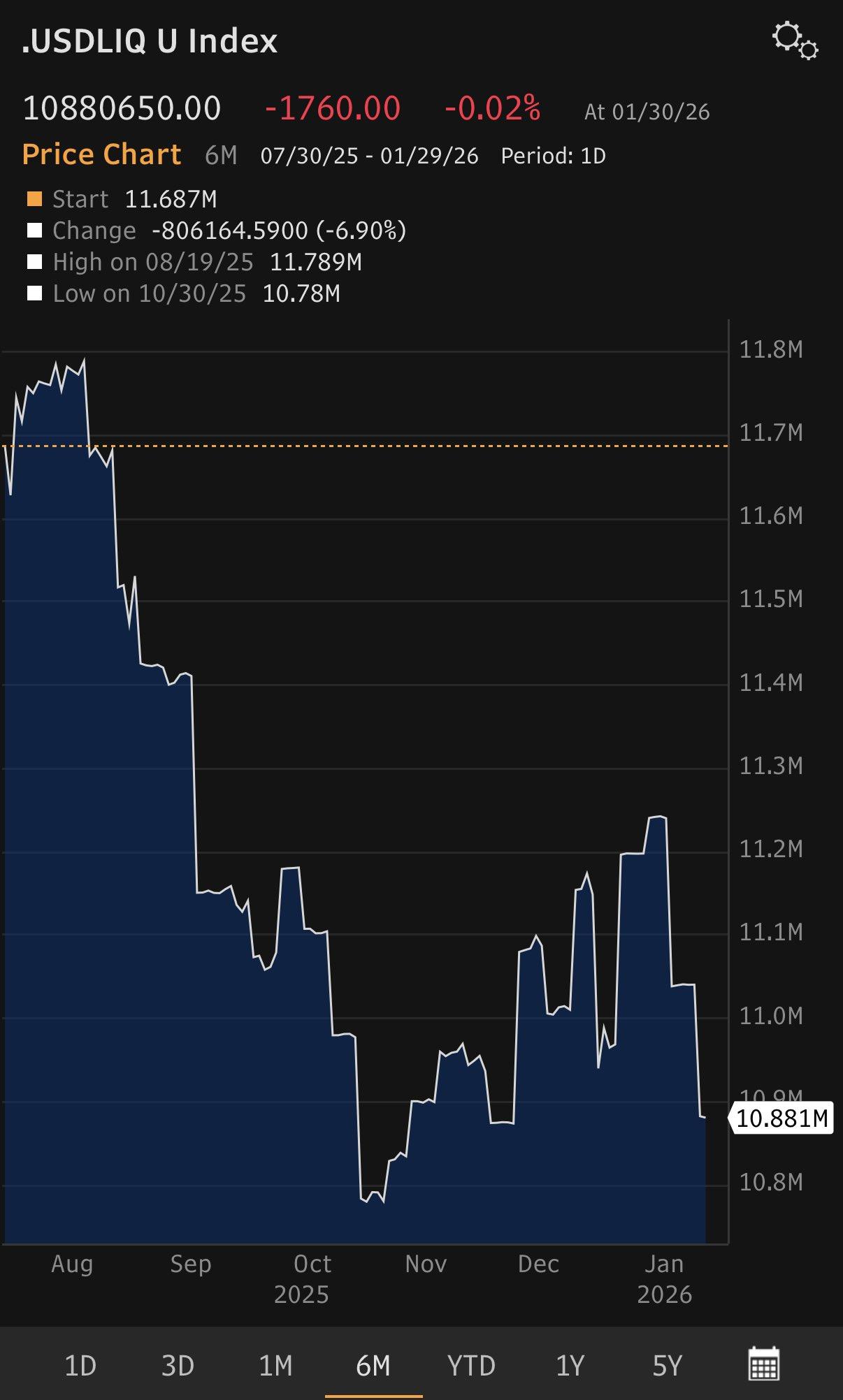
 The USDLIQ index has fallen nearly 7% in the past six months, reflecting tightening financial conditions.
Arthur Hayes argues that Bitcoin's recent correction doesn't stem from an inherent weakness in the crypto market, but rather from a sharp decline in USD liquidation , which has spread across the entire global financial market.
In a post on X, the former BitMEX CEO pointed out that USD liquidation has decreased by approximately $300 billion in recent weeks, primarily due to an increase of about $200 billion in the US Treasury General Account (TGA).
According to Hayes, the US government is likely restocking cash to prepare for spending in the event of a government shutdown, thereby drawing liquidation out of the financial system.
The USD liquidation index fell 7%, putting pressure on Bitcoin.
This contraction is clearly reflected in the USDLIQ index – a measure of the broad liquidation of the US dollar.
According to market data Chia by Hayes, USDLIQ has fallen nearly 7% in six months, from a peak of around 11.8 million in August to approximately 10.88 million at the end of January.
According to Hayes, the weakening of Bitcoin's price during the same period is perfectly understandable.
"The drop in BTC is not surprising given the liquidation ," Hayes wrote, emphasizing that the cause stems from macroeconomic factors rather than the individual sentiment of the crypto market.
Liquidation has long been a key driver for Bitcoin and other risky assets. Periods of expanded USD supply often coincide with sharp price increases, while when funds are diverted to government accounts or financial conditions tighten, speculative assets often struggle due to reduced leverage and decreased risk appetite.
Hayes's assessment comes as Bitcoin has yet to regain momentum after recent corrections, despite some investors still hoping for catalysts such as interest rate cuts or a return of funds to spot ETFs.
Instead, the focus is shifting to “macro-infrastructure” factors, including how the US Treasury manages cash and the availability of the US dollar, which are becoming short-term drags on the market.
Bitcoin falls as Fed adopts cautious stance and geopolitical tensions escalate.
Bitcoin has retreated below the $89,000 mark after a brief rebound, pressured by tightening financial conditions and escalating geopolitical tensions, which have led to a sell-off in risky assets.
According to XS.com analyst Samer Hasn, the neutral to hawkish stance of the US Federal Reserve (Fed), along with tensions in the Middle East, has weakened demand for speculative investments in the crypto market.
Market data indicates declining trader confidence. Statistics from CoinGlass show that the total open interest in the crypto Futures Contract market has fallen 42% from its peak, while attempts at breakouts are repeatedly reversed by sharp sell-offs.
Simultaneously, Capital is shifting towards traditional safe-haven assets like gold and silver, making it difficult for digital assets to attract new investment amidst high volatility.
With Federal Reserve Chairman Jerome Powell yet to signal a rush to cut interest rates, and geopolitical risks continuing to drive investors toward tangible assets, analysts believe Bitcoin remains a high-risk trade until monetary policy becomes more accommodative or global tensions ease.





