
In the virtual info-overload of 2026, a business intelligence (BI) platform has evolved beyond its ability to just whip up some snazzy charts. High-growth organisations see the choice of a tool as a make-or-break decision that's got far-reaching implications for every department, from product engineering to the very top of the corporate ladder.
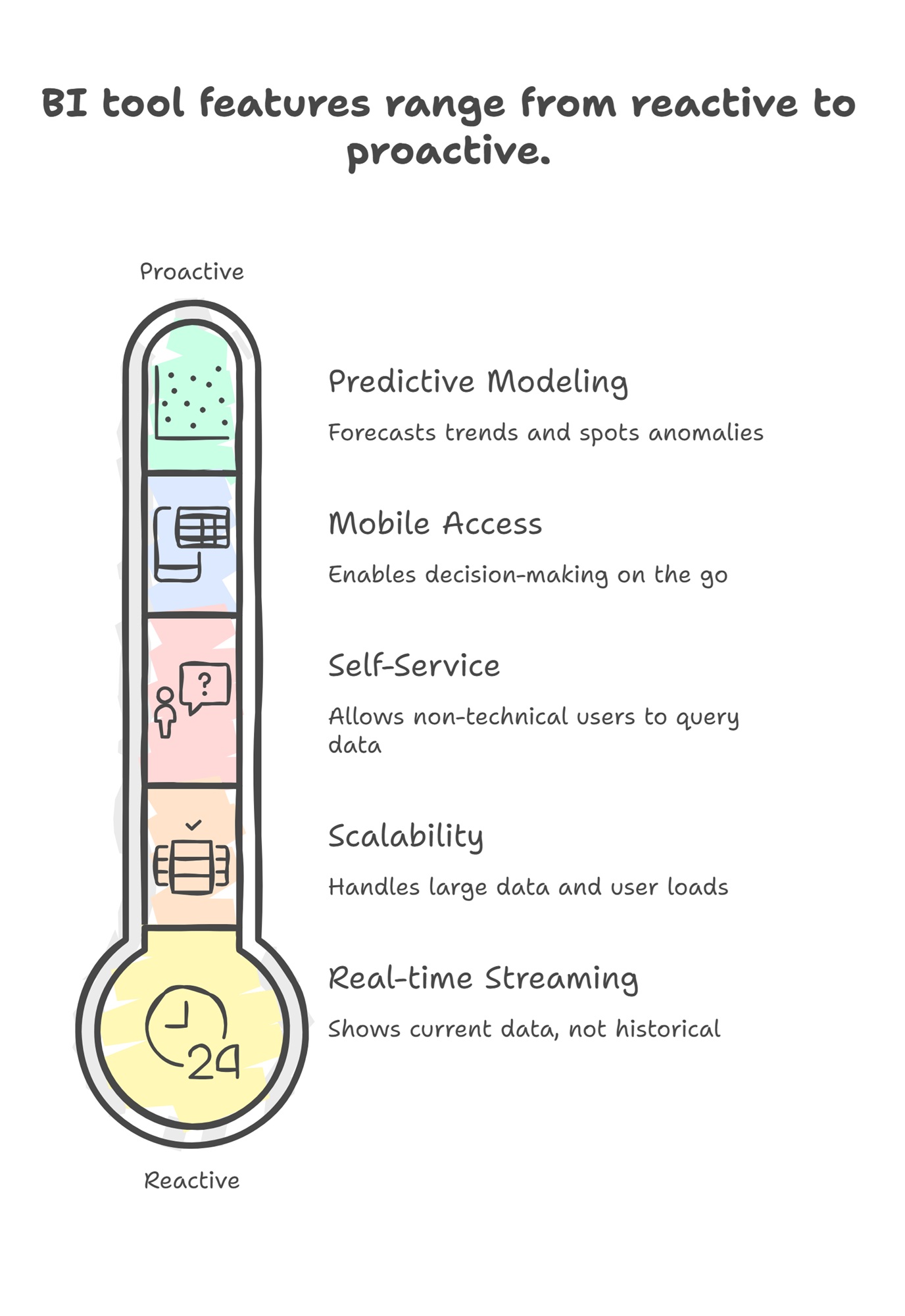
Picking the best business intelligence tool means moving beyond superficial prettiness and looking at the underlying technical muscle of the software. To make sure your investment pays off in the long run, you should pit leading platforms against each other and see how they stack up in terms of which one is best for your unique data setup and user skill levels.
1. Streaming in Real Time
Modern markets are moving at light speed, not at the plodding pace of quarterly reports. A top-notch BI tool needs to support real-time data connections or near-instant streaming of data - so when you view a dashboard, you're seeing what's happening right now, not what happened hours ago. Platforms like Looker and Domo really excel here by hooking directly into cloud data warehouses, so you can be sure that you're always up to date.
2. Building for the Big Leagues
As your data starts piling up from a few gigabytes to a full-on petabyte mountain, your BI tool can't just be a flash in the pan. It needs to be able to scale to meet the challenge - and that's not just about how much data you're dealing with, either; it's about how many users are trying to access it at the same time. Tools like Microsoft Power BI have figured this out by tapping into the cloud's elastic power to keep performance rock solid even when hundreds of team members are trying to get answers from the same dataset all at once.
3. Give the people what they want - data that makes sense
The best BI tools don't just lock up the data in a vault - they hand it out to anyone who needs it. Features like "Natural Language Querying" (something that Tableau's Ask Data or Qlik Sense's Insight Bot pioneered) mean non-technical managers can just ask for what they need in plain English, without having to get a degree in data science. That keeps your IT team from getting bottlenecked, and lets your analysts focus on the really tough stuff, like building predictive models.
4. On the move - decision-making in real time
In 2026, decision-making happens 24/7, and that means you need a BI tool that can keep up. A native mobile app that's not just a watered-down web view, but a fully-fledged mobile experience with offline access, mobile alerts, and the ability to drill down into metrics on a smartphone or tablet - that's not just a nice-to-have, it's a non-negotiable.
5. Gazing into the crystal ball - predictive modelling
A top-flight BI platform should be telling you about what's going to happen, not just what did happen. Integration with machine learning (ML) for spotting anomalies and forecasting trends is the holy grail. Whether it's built-in AI in Qlik Sense or Python/R scripts integrated into Tableau, these features let businesses shift from being reactive to proactive and stay one step ahead of the game.
The bottom line
Choosing the right BI tool is a balancing act between power and usability. By keeping in mind the five key features - real-time ingestion, scalability, self-service, mobile, and AI - leaders can make sure their data strategy stays on solid ground. And let's be clear, surface-level dashboards may look good in the demo, but it's the ones that deliver the goods that will be the ones still standing in 2030.
#SaaS #BusinessTools