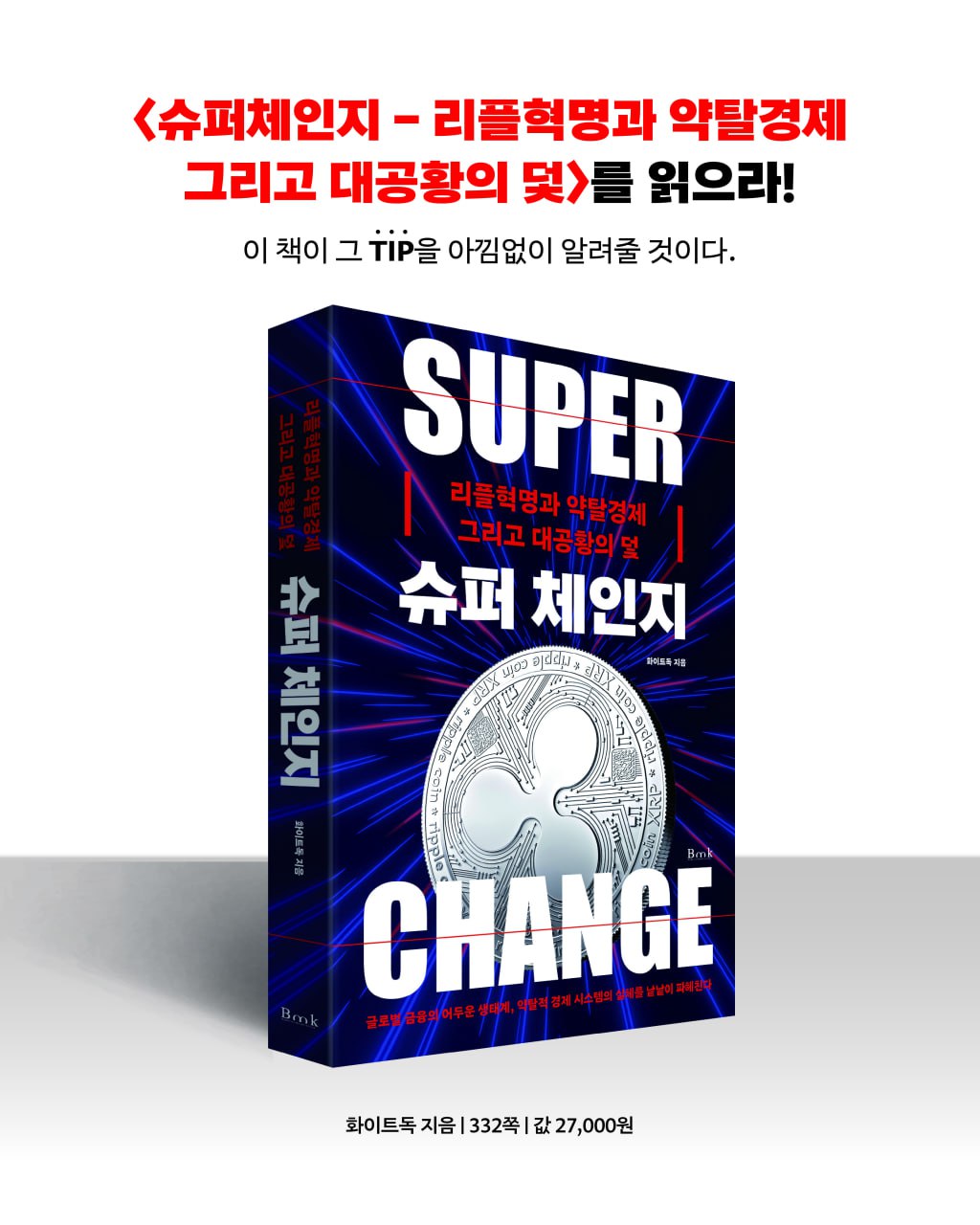
White Dog, the author of " Super Change: The Ripple Revolution, the Predatory Economy, and the Trap of the Great Depression," has been tracing the evolving "predatory economy" that straddles the boundaries of contemporary art and economics. In his new book, "Super Change: The Ripple Revolution, the Predatory Economy, and the Trap of the Great Depression, " he sharply examines the underbelly of the global financial system. His insights, which go beyond mere wealth accumulation and call for a "defensive awakening" for survival, reveal the blueprint for the reorganization of financial power centered around Ripple (XRP) and guidance for navigating the coming wave of the Great Depression. [Editor's Note]
Could you introduce yourself?
As a contemporary artist, I have long studied the evolution of "plunder." Throughout human history, plunder manifests itself in vertical forms, such as the caste system and slavery, and aggressive forms, such as war and colonial expansion. These forms have erased not only human physicality and spirituality, but also the primordial cultures and civilizations of local regions. Since the late 20th century, a system of economic plunder far more efficient than war has developed. In the 21st century, with the incorporation of blockchain and cryptocurrency technologies, its scale and destructive power have grown even further.
The purpose of his artistic work and economic research is to trace and expose this constantly evolving structure of exploitation, thereby creating an opportunity for the public to become aware of reality and awaken to it.
After graduating from the Department of Painting at Hongik University, he completed his master's degree in Media Art MATT Lab at Soongsil University Graduate School and then pursued a doctoral degree.
He has held six solo exhibitions since 2008, and in 2019, he was the only Korean invited artist to participate in the Nord Art international art exhibition in Germany, the world's largest art exhibition. In 2013, he lectured on 3D Max and illustration at the Department of Media at Suwon University.
He wrote his master's thesis, "A Reinterpretation of Walter Benjamin's Originality," and his thesis, "Carl Jung's Archetype Theory and the Decline of the Aura" (Art and Media, Vol. 12, No. 1).
While running the "Predatory Economics Research Institute," he wrote the first book on the predatory economy, "The 100-Year Global Economic Collapse Crisis and the Ripple Revolution," in 2020. He also shares economic insights with a wider audience through the YouTube channel "White Dog," which researches predatory economics.
In 2023, the museum held an art exhibition titled "The Devil's Millstone," which explored themes of archetypes, plunder, and economics.
Could you tell us about the motivation and process that led you to write this book?
My "Predatory Economics Report" began its journey in earnest with the publication of " The 100-Year Global Economic Collapse Crisis and the Ripple Revolution, " in 2020. After laying the foundation for the predatory economy through my first book, I expanded upon it in the second phase with the YouTube video series " Ripple Revolution and Currency Reform ." Building on the extensive data and case studies accumulated over the years, I wrote this book, the third installment of that series.
This book is not simply an economics book. Rather, it's a comprehensive work that analyzes the "complex neural network" structure of the economy, encompassing diverse fields like climate, environment, science, infrastructure, politics, and finance, all tightly interconnected. By transcending conventional wisdom and exploring the complex interactions hidden within the economy, I hope this book will serve as a kind of comprehensive economic reference.
This book also exposes the true face of the predatory economy, while illuminating the dark ecosystem of global finance, a field often overlooked by the general public. Furthermore, it anticipates the coming convergence of industrial society and represents a novel attempt to explore the intersection of finance and science. Rather than addressing "easy money" like typical economics books, it examines the reality of a repeatedly recurring predatory economic system and its future.
This book isn't a guidebook that spurred short-term desires like, "This is how you'll get rich." Rather, it's a warning, a call to action to protect the wealth you've worked so hard to cultivate. In an era where massive debt dependence, like the current "debt-to-investment" phenomenon, is rampant, preserving money is more important than earning it. The reality of individuals, corporations, and even nations saddled with massive debt carries the risk of a "zombie economy" where total income cannot cover interest payments.
Building on this critical awareness, this book systematically traces the historical foundations of economic plunder, which have persisted since the 19th century. Focusing on the 20th century, when the foundations of the predatory economy were laid, it gathers key evidence and reveals the current state of the predatory system, which has evolved even more aggressively in the 21st century. Furthermore, it offers practical insights for national and individual economic defense strategies and for preparing for the profound transition of industrial convergence, thereby providing practical guidance for those living in this age of change.
What is the main content of the book?
Ripple (XRP) and the Restructuring of Global Financial Infrastructure
I analyze that Ripple (XRP) is not simply a private cryptocurrency, but rather a core node in a global network that is forming the standard for international remittances. The book demonstrates the deep expansion of Ripple's network into the global financial infrastructure through examples such as the initial integration of Fidor Bank, the Earthport integration with Visa, experiments with Western Union and MoneyGram, and payment tests with R3. The book describes these movements not as isolated events, but as a "potato stem network," interconnected like a single stem. The book describes this process as a 21st-century "Bong-i Kim Seon-dal-style free money project," and criticizes it, saying, "On the surface, it appears to be a success story, but in reality, it's more like a pre-arranged card game, with the public unaware of the rules."
The invisible power of the US and European financial powers and the BIS
The book points out the peculiar structure in which the Bank for International Settlements (BIS) dictates global financial rules despite its lack of legal binding authority. The book explains why the BIS is leading CBDC projects and why central banks' experiments follow BIS standards, drawing on historical context and the structure of financial power. The author describes this as an "invisible international financial mafia," criticizing the undemocratic and opaque nature of the modern financial system.
- Modern I → Modern II: The Era of Simultaneous Convergence of AI, Climate, and Industry
The latter part of the book analyzes the process by which technology, industry, population, and climate converge, ushering in a new era of convergence, dubbed "Modern II." It explains that AI is compressing labor, industry, and social structures, that increased solar activity is simultaneously bringing about climate cooling and the risk of collapse of the electric civilization, and that these changes are accelerating financial volatility and the pace of superchange.
The Trap of the Great Depression and the 'Final Super Change'
The author diagnoses the current asset market as “the last stage of a debt-fueled liquidity bubble.”
He warns that the long-term bubble structure spreading across the stock, real estate, coin, and bond markets could eventually lead to a structural recession deeper than that of 1929, or the "Great Depression," and that unprepared individuals and nations could become victims of a predatory economy.
In particular, it empirically presents scenarios for value transfer between the dollar and Ripple, the institutional dominance of central bank digital currencies (CBDCs), and the process of standard transition in global finance.
- The rise of East Asia and the new global geopolitics
It forecasts the potential for East Asia to become a "new economic pasture" following the weakening of American hegemony. It meticulously analyzes future geopolitical landscapes, including the potential for regime change in China, unification scenarios for the Korean Peninsula, a transcontinental railroad, and Busan's transformation into a mega-logistics hub.
What do you want to say to the readers through the book?
This book isn't a guidebook that spurred short-term desires like, "This is how you'll get rich." Rather, it's a warning, a call to action to protect the wealth you've worked so hard to cultivate. In an era where massive debt dependence, like the current "debt-to-investment" phenomenon, is rampant, protecting money is more important than making it. The reality of individuals, companies, and even nations saddled with massive debt carries the risk of a "zombie economy" where total income cannot cover interest payments.
Building on this critical awareness, this book systematically traces the historical foundations of economic plunder, which have persisted since the 19th century. Focusing on the 20th century, when the foundations of the predatory economy were laid, it gathers key evidence and reveals the current state of the predatory system, which has evolved even more aggressively in the 21st century. Furthermore, it offers practical insights for national and individual economic defense strategies and for preparing for the profound transition of industrial convergence, thereby providing practical guidance for those living in this age of change.
What is the purpose and significance of writing this book?
This book, an expanded version of the author's previous work, "The 100-Year Global Economic Collapse Crisis and the Ripple Revolution," explores the predatory economy. It's not a guidebook on how to "get rich" by reading economic trends and investing wisely. Instead, it's a warning book that evokes "defensive awareness." Its purpose is to help readers understand the recurring predatory economic system and prepare for the coming shocks, protecting their hard-earned wealth. In an era of widespread debt dependence, such as "debt-to-investment," protecting money is more important than making it.
The reality of massive debt burdens not only individuals but also corporations and nations poses the risk of a "zombie economy" where total income cannot cover interest payments. Drawing on extensive data and academic research accumulated over the past several years, international financial case studies, and signals of industrial change, the author deciphers the "complex neural network" of the global economy and illuminates the structural risks facing individuals, corporations, and nations.
Building on this critical awareness, the author systematically traces the historical basis of economic plunder, which has persisted since the 19th century. Focusing on the 20th century, when the foundations of the predatory economy were laid, the author gathers key evidence and reveals the current state of the predatory system, which has evolved even more aggressively in the 21st century. Furthermore, by offering practical insights that can help nations and individuals prepare for economic defense strategies and the profound transition of industrial convergence, the author aims to serve as a practical guide for those living in this era of change.
Get real-time news... Go to TokenPost Telegram
Copyright © TokenPost. Unauthorized reproduction and redistribution prohibited.