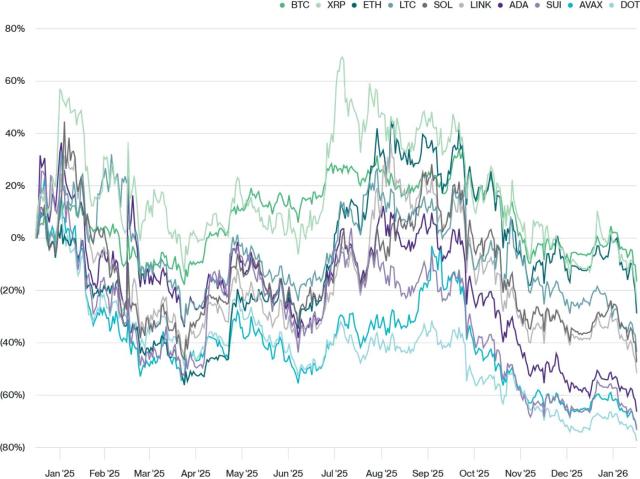
As global markets become more sensitive to macroeconomic variables in 2026, cryptocurrencies are increasingly trading like "leveraged tech stocks." Alea Research, a cryptocurrency research firm, recently analyzed in a report that a weak dollar (DXY decline), a surge in precious metals, the Federal Reserve's interest rate freeze, political uncertainty, and prolonged institutional trust risks are having a structural impact on the cryptocurrency market as a whole.
Bitcoin (BTC) retreated below $84,000 last Friday, simultaneously reacting to economic uncertainty and the rally in precious metals. During the same period, silver prices posted their highest weekly returns since 1979, suggesting that Bitcoin is no longer viewed as "digital gold" but rather as a short-term risk beta. According to Alea Research , these signals highlight that the future path of interest rates, implied by the dollar and precious metals, is more important than the fact that interest rates have remained stable.
The market's preference for hard assets has become more pronounced. The launch of a "currency debasement" ETF, which includes Bitcoin alongside gold and silver, suggests that investors are exploring alternatives to physical currencies in the current system. Amid this trend, the decline in the DXY is strengthening buying sentiment in the hard asset market. At the same time, market uncertainty is growing as Kevin Warsh, a former Fed board member, is being mentioned as a possible candidate for the next Federal Reserve Chairman, raising the prospect of a "regime change" scenario and resurfacing questions about the Fed's independence.
This macro environment is further strengthening the cryptocurrency derivatives-centric structure. In the DeFi space, AAVE reaffirmed its structural leadership by regaining 50% of the lending market share for the first time since 2020. Furthermore, Hyperliquid's HIP-3 achieved an open interest rate of approximately $800 million in stock trading, challenging existing centralized exchanges (CEXs). Alea Research emphasized that these platforms' derivatives operations are evolving beyond mere competition to the point of restructuring the entire market structure.
Structural changes are also accelerating in prediction markets. The monthly trading volume of the leading platform, Polymarket (POLY), has reached record highs for four consecutive months, emerging as a rare narrative that persists beyond the election. This suggests its strengthening role as digital financial infrastructure. Furthermore, Litecoin (LTC) is being re-evaluated as a potential buy target due to its de-correlation with gold and silver, and alongside the ETF review, it is also being highlighted as an opportunity for short-term de-beta movement.
Meanwhile, Tether's consideration of increasing its gold holdings is expected to further accelerate the institutionalization of stablecoins. With Tether launching its new GENIUS Act-compliant USAT stablecoin this week, regulatory pressure could intensify on competing tokens like USDC and PYUSD. This could shift the overall stablecoin market from a "nurturing" to a "regulation-first" phase.
Ultimately, the cryptocurrency market is at a structural inflection point: the centralization of derivatives, the absorption of infrastructure linked to TradFi, and the strengthening of linkages with hard assets and precious metals. This week's major event highlights the importance of proactively reacting to reactions rather than buying expectations. Alea Research concluded that while the market offers "high liquidity and numerous opportunities," it also carries "more traps and liquidation traps." Now is the time for a strategy that understands structural trends, not price movements.
Get real-time news... Go to TokenPost Telegram
Copyright © TokenPost. Unauthorized reproduction and redistribution prohibited.