
"This Irish tradition within British mercantilist writing may be compared with a rather similar Scots tradition, whose foremost exponent John Law has often been taken as Berkeley's immediate forerunner in the field of monetary theory"
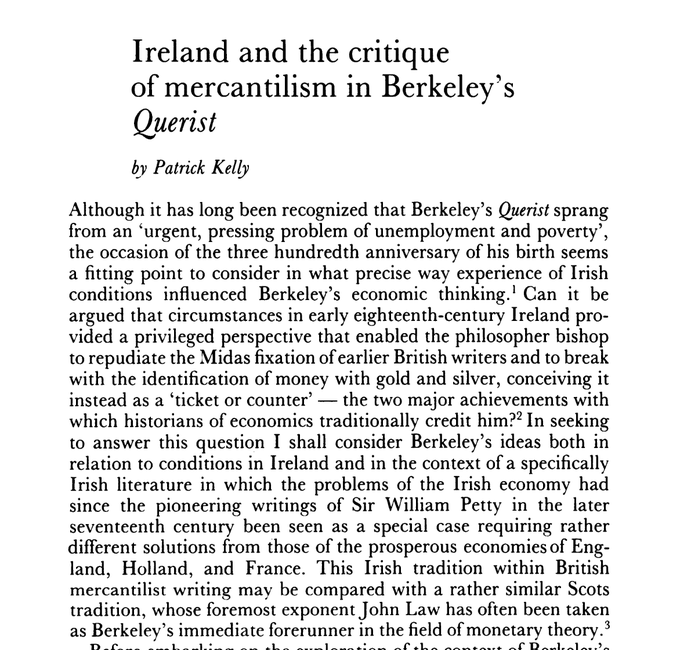
"It was this perception of the implications of the distinction between a dependent and backward economy and those of England and Holland, where a substantial part of the population were already largely dependent on production for international trade that was the foundation of the Irish tradition in economic writing."
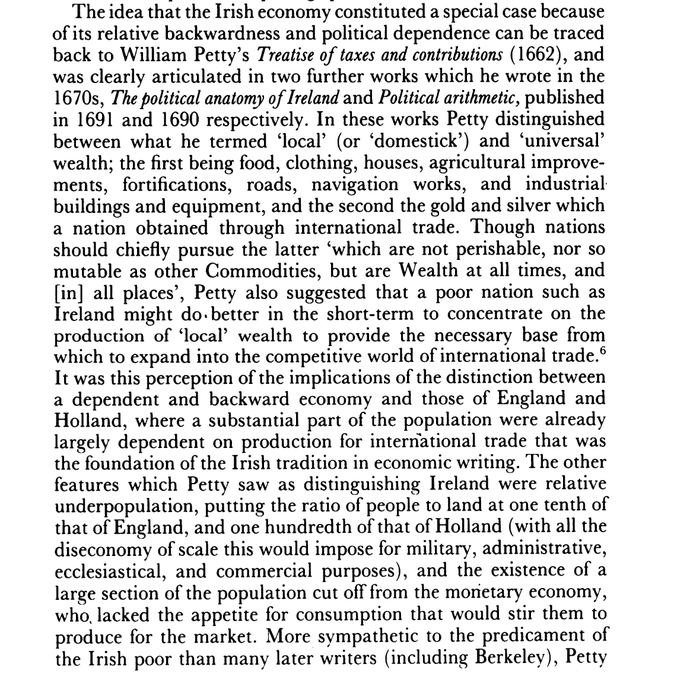
"The call to increase the volume of monetary circulation in practice covered two demands which, with the growth of credit arrange ments, were now coming to be understood as distinct phenomena in a way that had not been so readily apparent in the seventeenth century. The first was the shortage of capital for productive activity, particularly for the small artisan and tradesman, and the second was the physical shortage of coin to service transactions and the impact which this had on price levels. That Ireland was short of coin in the 1720s and 1730s seems beyond question. No Irish silver money had been coined since the reign of James I in 1605 and though a small amount of copper halfpence and farthings had been issued in the later seventeenth century, the economy was largely dependent on English money and a wide variety of Continental coins, often of inferior quality. In order to keep such a currency system functioning even reasonably effectively, correct ratios had to be maintained between gold and silver, and between the precious metals and their nominal rating in pounds Irish"
"In arguing for a paper currency to supplement the circulation of gold and silver Berkeley was almost unique amongst the Irish writers of his day"
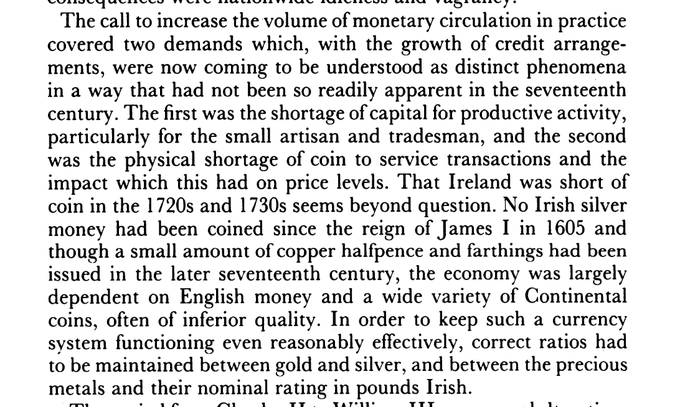
Berkeley's unique American experience that shaped his positive views on paper money
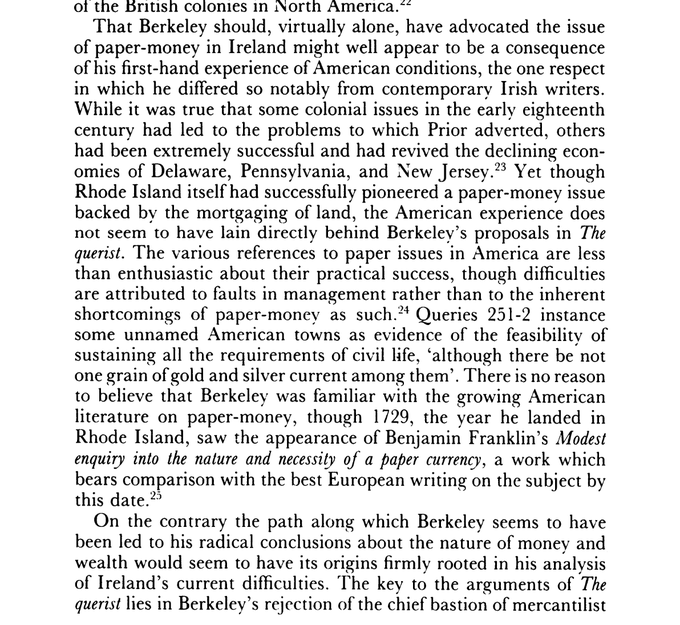
Berkeley's alternative: "a self sustaining prosperity, made possible by a state-issued paper currency backed by land"
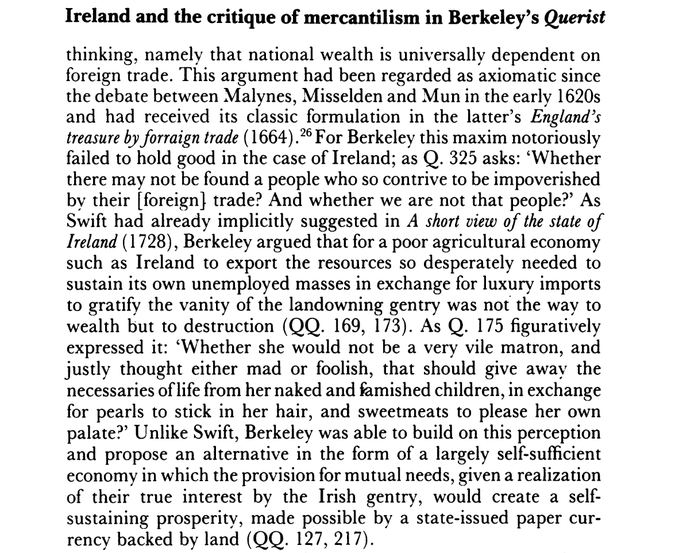
Berkeley's Recipe for National Wealth:
Print the money. Take care of your people. Develop industry.
The state should regulate the masses and the elites from spazzing out.
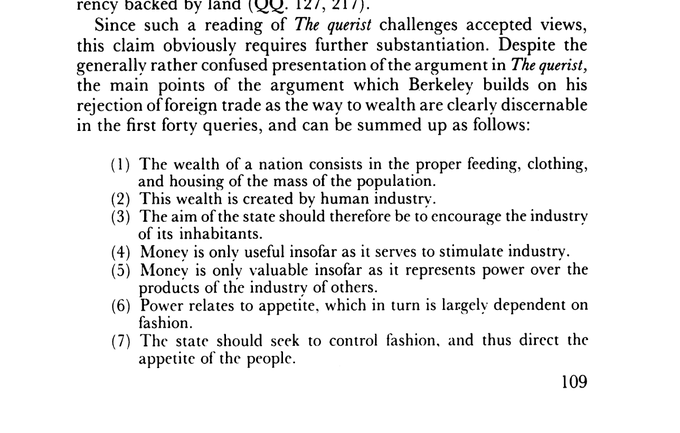
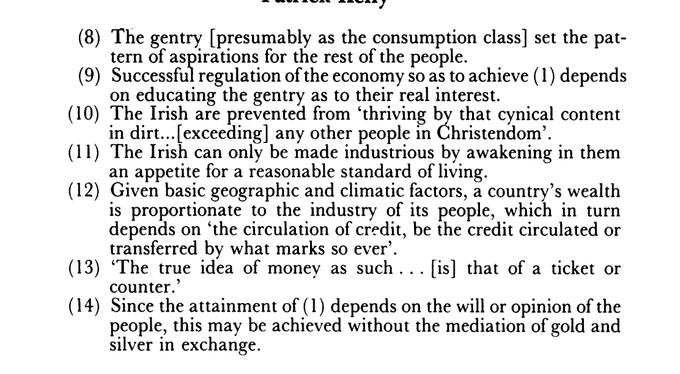
"Here then the theoretical basis of the argument is complete: by creating paper-money the state transforms the needs and wants of individuals into effective demand proportionate to their labour product, which provides the stimulus of credit necessary to marry wants and industry within the closed economy"
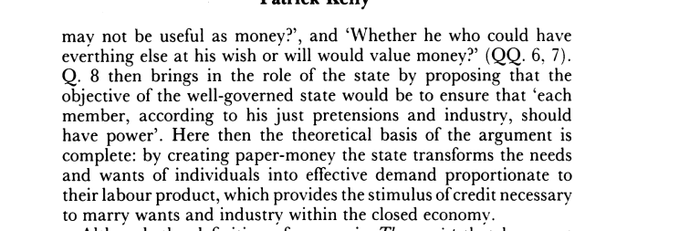
"Berkeley's main emphasis is not on the inert function of the medium of exchange but rather the credit creating role of the circulating medium, the 'ticket entitling to power' of Q. 441. Since coin and paper-money are seen as tokens of the power over goods and services represented by money (Q. 475), the actual material of which the ticket is constituted is not of particular consequence"
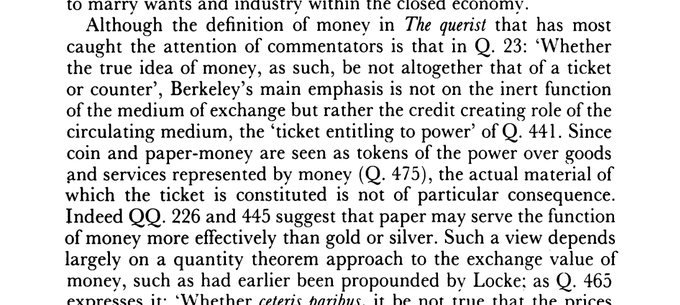
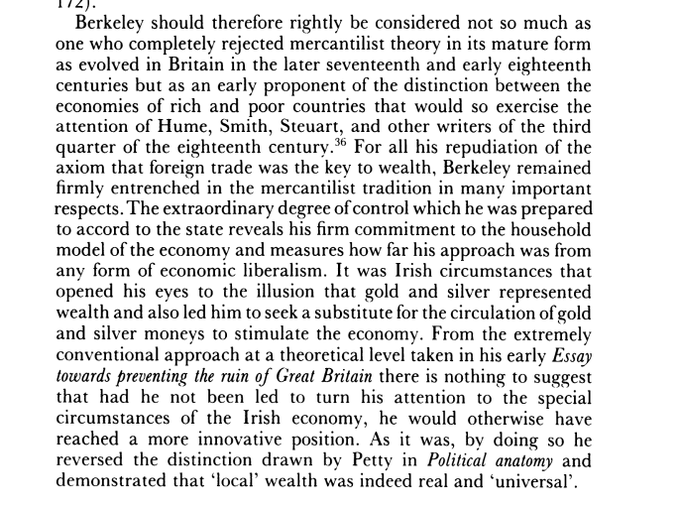
"Berkeley should therefore rightly be considered not so much as one who completely rejected mercantilist theory in its mature form as evolved in Britain in the later seventeenth and early eighteenth centuries but as an early proponent of the distinction between the economies of
Another interesting source from it
Basically about the development of this mercantilist / protectionist / developmentalist view on economics among the Anglo Irish Protestant elite who were getting uppity but then converging on the emergent Gaelic Irish Catholic intellectual

From Twitter
Disclaimer: The content above is only the author's opinion which does not represent any position of Followin, and is not intended as, and shall not be understood or construed as, investment advice from Followin.
Like
Add to Favorites
Comments
Share
Relevant content