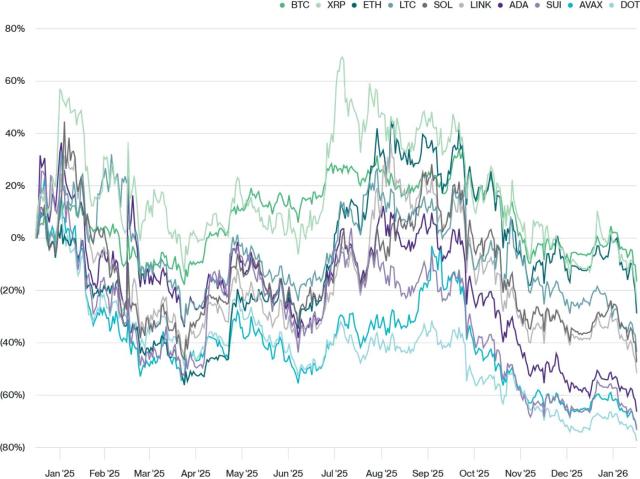
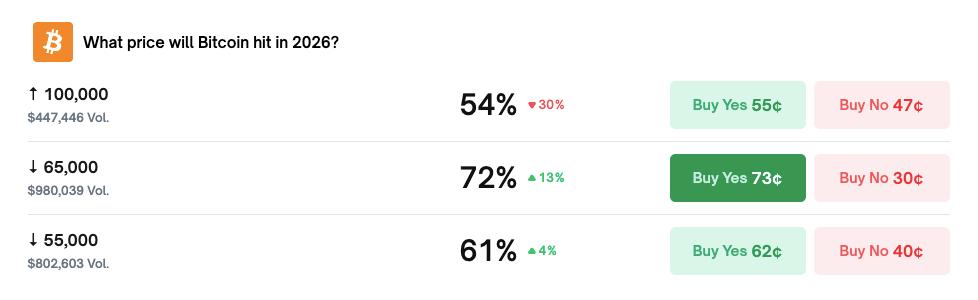
The weekend sell-off briefly pushed Bitcoin's price below the psychological threshold of $75,000, seemingly shifting market sentiment overnight. On the prediction platform Polymarket, a notable bet is heating up: the probability of Bitcoin falling below $65,000 in 2026 has surged to 72%, attracting nearly a million dollars in wagers. This is more than just a numbers game; it reflects the undercurrents surging deep within the current crypto market—from the euphoria following Trump's election victory to the current widespread anxiety about a potential "squat," a shift that has been remarkably swift.
What alarmed some veteran investors even more was that this drop put MicroStrategy, the publicly traded company holding the most Bitcoin globally, at risk of its average cost basis being breached for the first time since the end of 2023. It's like a runner in an endurance race suddenly finding the track beneath their feet slippery.
Why did market sentiment suddenly turn sour?
On the surface, this appears to be a price correction. However, upon closer inspection, you'll find several forces converging and pulling the market together.
First, there's a technical "breakdown" signal. According to some on-chain analysis firms, since Bitcoin broke below its 365-day moving average in November 2025, it has actually entered what they define as a "bear market" cycle. This long-term moving average is often considered a "bull-bear dividing line," and once it's breached, it often triggers systematic selling by technical investors. I recall that during the 2018 bear market, after a similar breach of a long-term moving average, the market experienced months of gradual decline and bottoming out; buy the dips too early was tantamount to "catching a falling knife."
Secondly, the "tap" of macro liquidity appears to be tightening. Some macro analysts point out that the current pullback stems more from the overall tightening of liquidity in the US financial environment than from any fatal problem with cryptocurrencies themselves. Changes in the Federal Reserve's balance sheet and the draining effect of Treasury bond issuance—these seemingly distant macroeconomic factors are actually being precisely transmitted to Bitcoin's price through the pricing logic of risky assets. When the tide (liquidity) recedes, the most volatile assets are often the first to be exposed.
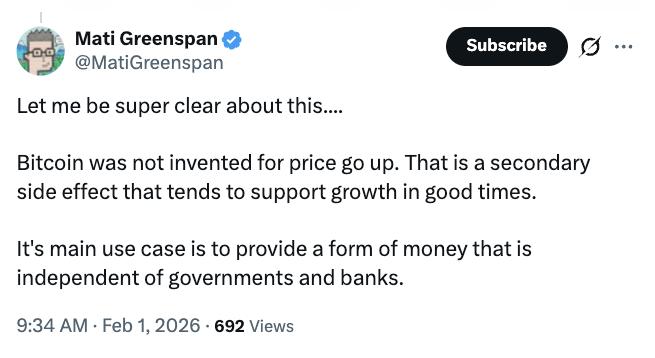
Finally, an interesting perspective comes from within the industry. Mati Greenspan, CEO of Quantum Economics, reminds us that perhaps we've been focusing on the wrong thing all along. He wrote on social media that Bitcoin's core design goal is to be a currency independent of the traditional banking system, and price appreciation is merely a potential "side effect," not its fundamental purpose. This viewpoint is like a bucket of cold water, prompting us to consider: when the market focuses solely on price fluctuations, has it strayed from its original vision?
How accurate are the "crystal balls" used to predict the market?
The high probability bets on Polymarket have undoubtedly amplified pessimistic market expectations. Besides betting on a drop below $65,000, there's also a 61% probability of betting on Bitcoin falling to $55,000. At the same time, there's still a 54% probability of betting on it returning to the $100,000 mark by the end of the year. This standoff between bulls and bears precisely illustrates the significant divergence in market sentiment.
But here's a crucial question: does predicting the market's "probability" equate to predicting the future's "facts"? Not necessarily. It reflects more the collective sentiment of current market participants, voted with their real money. This sentiment is highly contagious, self-fulfilling, but can also be instantly reversed by a sudden positive development. Just like the crash in March 2020, no one could predict the subsequent epic bull market. Predicting the market is an excellent window into sentiment, but it's by no means a roadmap for investing.
Furthermore, Polymarket itself is facing some regulatory challenges, such as licensing restrictions in places like Nevada. This reminds us that this "sentence barometer" is itself in a dynamic and changing environment.
When institutional opinions conflict, whose advice should retail investors take?
Faced with market uncertainty, large institutions have also shown an interesting phenomenon of conflicting opinions.
On the one hand, bearish sentiment pervades the prediction market and among some analysts. On the other hand, just a few months ago, several top institutions released rather optimistic forecasts. For example, Grayscale Investments predicted that Bitcoin could break its all-time high of $126,000 in the first half of 2026, based on continued institutional adoption and a gradually clearer regulatory environment. Analysts from Standard Chartered Bank and Bernstein also gave a target price of $150,000 for 2026, although they later lowered their expectations due to a slowdown in ETF inflows.
This contradiction is not uncommon. Institutional long-term logic (such as Bitcoin's scarcity and the digital gold narrative) and short-term market fluctuations (liquidity, sentiment, technical analysis) often operate under two different languages. For investors, the key is to distinguish which voice they are hearing. Is it a trend assessment spanning several years, or a warning of risks for the next few quarters?
What should investors focus on right now?
There's a lot of noise in the market, so I think we should focus on a few more substantial points of observation instead of being led by the nose by the mere probability of rises and falls.
- MicroStrategy's Battle to Defend its "Cost Line": As a market "flagship," the relationship between its stock price and its holding cost price is worth noting. If Bitcoin continues to fall below its average cost, will it shake its long-term holding strategy or influence the attitude of other listed companies to follow suit? This is an important indicator.
- Real data on macro liquidity: Instead of speculation, focus on real data such as the Federal Reserve's balance sheet and the U.S. Treasury's General Account (TGA) balance. These are the "driving forces" behind all risky assets, including cryptocurrencies.
- The "Quality" and "Quantity" of On-Chain Activity: When prices fall, are long-term holders panic selling or calmly accumulating? On-chain data can tell us whether tokens are dispersed or concentrated. For example, looking at indicators such as changes in the supply of long-term holders and the inflow and outflow of tokens on exchanges is often more forward-looking than looking at price charts.
- Does your own investment logic still hold true? This is the most important point. What were your initial reasons for investing in Bitcoin? Was it because you believed in its long-term potential as a store of value, or was it merely short-term speculation? If the long-term logic remains unchanged (such as global over-issuance of currency, sovereign credit risk, etc.), then market fluctuations are actually a test of your beliefs and provide better entry opportunities. If you're just following the crowd, then any slight disturbance will be enough to keep you up at night.
Markets always oscillate between excessive optimism and excessive pessimism. When 72% of people on Polymarket are betting on a decline, it might be the time we need to remain calm and think contrarian. After all, in the crypto world, consensus is often expensive, and real opportunities often arise where consensus breaks down. Of course, any judgment must be combined with one's own circumstances. The market will always be uncertain, and good position management and risk control are essential lessons for navigating any cycle.