Author: Pavel Paramonov
Compiled by: Jia Huan, ChainCatcher
This article was primarily inspired by Vitalik's recent tweets about change and the current state of the market. While the entire market is declining, it's difficult to blame any specific person, and I'm not here to point fingers at anyone.
I wrote this as someone who has worked with many Ethereum teams, invested in multiple protocols built on Ethereum on behalf of venture capital funds, and is generally a huge fan of Ethereum and EVM-related things.
Unfortunately, I can no longer say the same thing, because I feel that Ethereum doesn't know where it's headed (and many others feel the same way).
I don't want to discuss ETH's price movements, but I can't ignore the fact that, as the world's second-largest cryptocurrency, its performance is quite volatile. Regardless of where global markets go, ETH behaves more like a de-anchored stablecoin.
This article aims to explore what has happened to Ethereum over the past few years, and why many people are losing hope, or have already lost hope. Ethereum didn't lose to Solana or anything else; Ethereum is losing to itself.
Rollup-centric roadmap
When Ethereum unveiled its Rollup-centric roadmap, almost everyone was excited. Its promise was that Rollups (and Validium) would scale, so end-user transactions would occur on Rollups. Ethereum would act as a validation layer, focusing primarily on being the L1 layer for Rollups, not for users.
Developing Rollups is much faster and cheaper than developing L1, so the future of thousands of Rollups looks very likely and optimistic. What could possibly go wrong?
As it turns out, anything can go wrong. Endless debates, prioritizing ideology over needs, constant infighting within the community, identity crises, and abandoning the Rollup-centric vision too late.
Every possible place went wrong. Most community members initially viewed Max Resnick as an utterly incompetent villain, only to find that he was right about almost everything. During his time at Consensys, Max spoke extensively about what Ethereum needed to do to move forward, but received little to no support and only criticism.
The peak of folly is when the entire industry starts debating whether a certain L2 is actually Ethereum, for example:
Viewpoint A: "Base is an extension of Ethereum, and we have made significant contributions to the Ethereum ecosystem."
Viewpoint B: "Base is not an extension of Ethereum; it is an independent entity."
What the hell are we even talking about? How can this kind of conversation lead to a better future for Ethereum and its ecosystem? Why are people seriously arguing about what Ethereum is and what it isn't? Aren't the problems we need to solve more important?
If we consider Rollups to be extensions of Ethereum because they use ETH for gas fees, then we are on the right track. If we consider Rollups not to be extensions of Ethereum, but rather applications that benefit from Ethereum, we are also on the right track.
Is that right? Absolutely not.
This ideological discussion isn't really a discussion; it's a confrontation between two self-absorbed little cliques trying to prove who's right. We don't need PvP; we need PvE. We need to understand that this isn't about us fighting each other, but about us uniting to confront problems and the future. Unfortunately, many people prefer intellectual stimulation and aren't even willing to consider that their views might be incorrect.
Technological ideology takes precedence over user needs.
Based rollups, booster rollups, native rollups, gigagas rollups, keystore rollups.
- Which one is better, what will the future hold, and how will they be connected?
- "This type is the future." "No, that type is the future."
- There's no reason not to develop roll-based rollups.
- "Native rollups will take over the ecosystem because they have Ethereum orthodoxy."
All these discussions... resulted in Arbitrum and Base continuing to win big.
Technological advantages can bring many benefits to participants, but not by comparing apples to pears, or oranges to tangerines. They are too similar, so similar that users simply don't care. Outside the bubble, nobody cares. Worrying about whether to add or remove a pre-compiled feature won't help you win this war.
“Oh, actually we have Ethereum orthodoxy, we have an advantage, we are very close to Ethereum and reflect its core values, users will choose us.”
What are your core values? And which users would choose you?
@0xFacet became the first Stage 2 Rollup, defining Ethereum orthodoxy. Where are they? Where are their users, developers, tech KOLs, and supporters of the Ethereum ecosystem and orthodoxy?
Where are those people? How many of you have heard of Facet? How many apps are available on Facet? I personally have no problem with Facet. I've spoken to the founder many times, I respect him, and he's a great guy. But where are those people who say we need more Phase 2 Rollups? I don't know, and neither do you.
Economic incentives are far stronger than technological incentives
I'm a huge fan of Taiko, especially their research on based rollups. The benefits are numerous: stronger censorship resistance, neutrality, no risk of sorter downtime, and L1 validators earning more money. Where are the pitfalls?
The trap lies in the financials behind the model. You can't force people to give up income just for "legitimacy".
Arbitrum promises a decentralized sorter. Scroll promises a decentralized sorter. Linea, zkSync, and Optimism also promise decentralized sorters. Where are they? Where are those sorters?
Every Rollup team's documentation includes the line: "We currently have a centralized orderer, but we have a strong desire to decentralize it in the future." Almost no one delivers on this promise. Metis delivered, but fortunately or unfortunately, people don't care about Metis.
Do I think they're deliberately over-promising to pander to influential ETH minimalists (maxis)? Yes. Do I think they genuinely want to decentralize their sorter? Also, but even if they did, it wouldn't make sense for them.
Coinbase (Base) is legally obligated to generate as much revenue as possible to provide value to the company. The same applies to other teams; why would they stifle your revenue stream? It makes no sense. Only about 5% of Base's revenue goes to Ethereum. Rollups have never been an extension of Ethereum.
Taiko once had a time when it paid more in ordering fees to Ethereum than it earned from user transaction fees. And companies like Taiko clearly have many other expenses besides paying fees to Ethereum.
Based rollups, or any rollup vision for “Ethereum orthodoxy,” can only be realized if the team forgoes revenue. I'm not underestimating the importance of decentralization, security, and permissionlessness. But none of that matters when your sole objective is to be ideologically correct, rather than user-centric.
Unsurprisingly, this weakness and commitment to Ethereum orthodoxy have attracted speculators to the space.
Consequences of a Rollup-centric roadmap
Eclipse, Movement, Blast, Gasp (Mangata), Mantra: These protocols were never intended for the long-term future. It's really easy to hide behind masks of Ethereum orthodoxy, making Ethereum better, or introducing SVM into Ethereum.
They all collapsed to some extent. All the rollups realized that their tokens were almost useless because they paid fees in ETH, while their own tokens had virtually no utility.
Speculators realized that you could create a lot of hype around a Rollup-centric narrative and profit by dumping worthless tokens on retail investors.
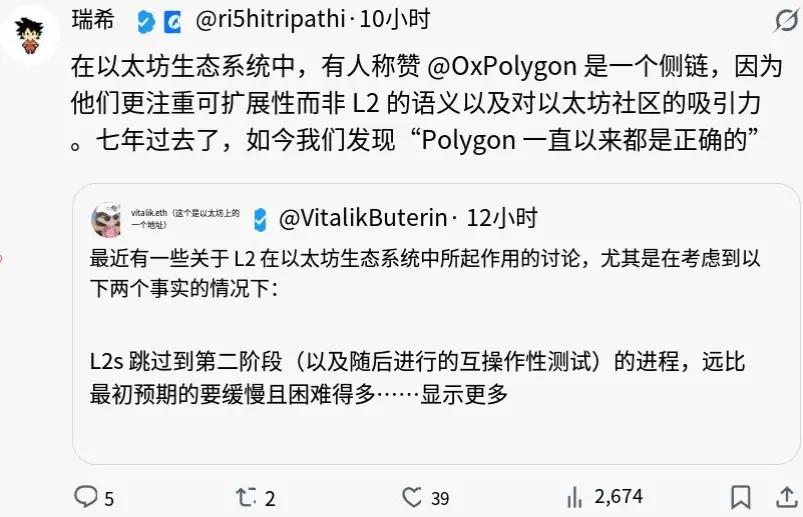
Ethereum has never acknowledged Polygon as a true L2 blockchain, despite their significant role in locking up more value for ETH. If you believe Rollups are an extension of Ethereum's "culture," why not acknowledge something more closely related to Ethereum's security and usability?
Polygon was crucial to Ethereum during the 2021 bull market and made a significant contribution to the growth of ETH as an asset. However, it is not Level 2 and does not deserve the appreciation of the Ethereum community. If Polygon were Level 1, its valuation would be much higher.
Even Paradigm, arguably one of the best venture capital firms in the crypto space, which has contributed the most to the Ethereum ecosystem and even developed its own L2 (Ithaca), has switched to working with Stripe on L1 (Tempo). I believe that when even your most loyal supporters leave you and join your competitors, you've definitely encountered a serious problem.
The Ethereum Foundation lacks direction.
While Ethereum is technically decentralized, it is culturally centralized around Vitalik. The inner circle of Ethereum truly exists. As people say, to succeed, all you need is to get close to Vitalik and the attention of a few influential venture capitalists.
I'm not saying you have to agree with everything Vitalik says, but his views basically define what's good and what's bad for Ethereum, and you can't argue with that.

First, it's a hyper-deflationary currency. With EIP-1559 and the merger, ETH's economic model became deflationary, making it a better store of value than Bitcoin. However, in 2024, ETH's annual inflation rate turned positive.
So the vision of an ultrasonic currency only lasted three years? That means it couldn't be a store of value. That narrative is dead, and it was never true, because ETH wasn't designed as a store of value; that's Bitcoin's purpose, and you can't compete with that.
Ethereum then cannot decide whether its token is a commodity (not applicable due to dynamic supply changes and staking mechanisms) or more like a tech stock (not applicable because there is not enough revenue to value Ethereum like a tech company).
Others argue that ETH isn't a currency at all. What's going on? We need to choose sides. Ethereum can't be multiple things at the same time—you either have a globally defined direction, or you fall behind.
Let's talk about economic incentives again...
I still can't imagine a lead engineer like Péter Szilágyi receiving only about $100,000 a year for his contributions to Ethereum. This guy, who was there from the beginning and helped Ethereum grow from almost nothing to a $450 billion market capitalization, only received 0.0001% of that market capitalization.
The most influential and successful protocol in crypto history (second only to Bitcoin) offers no incentives or equity. This is easily justified by hiding behind the spirit of decentralization, open source, and permissionless operation: "We're not here to make money, we're here to move forward."
But you have to motivate even your most loyal soldiers, or they'll leave or take on side jobs. Péter left, Danny Ryan left, and Dankrad Feist went straight to Tempo.
Justin Drake and Dankrad accepted advisory positions at EigenLayer in 2024 and received token allocations there, which led to the community beginning to hate them.
The poor guys at EF are paid meager salaries (compared to FAANG companies and AI research labs), yet they are hated for making money and helping an independent protocol that is not Ethereum but wants to make Ethereum better.
Are you guys stupid? Sometimes I feel like if you're an honest, hardworking person on Ethereum, you're not allowed to make money, but are expected to be a slave just to gain "approval" from Ethereum. EF frequently sells ETH to fund various operations, initiatives, and research. But maybe pay your researchers first?
Refusing to adapt and change
"Day 1. Ethereum will win. The most decentralized blockchain with the highest uptime."
We hear this every day, just like we hear the same excuses from Ethereum every day.
Yes, Ethereum is expensive and slow. But we have Rollups, and with Rollups, Rollups are Ethereum! Yes, ETH's price lags behind everything else. But Ethereum has the largest developer ecosystem, we have a solid foundation, and demand will follow.
Ethereum is the most decentralized blockchain! Solana is terrible; they lack client diversity. Ethereum has 100% uptime! Solana is terrible; it has crashed several times.
Ethereum's network activity is lower than Solana's. Well, that's because Solana's activity consists of spam and meme gamblers. We are a moral chain!
Same excuse, same answer, same reaction over the past few years. Everything except Ethereum and Rollups is garbage. If Ethereum underperforms on any metric, we say it's Day 1, we know what we're doing, and there's nowhere better than Ethereum.
Everyone is tired of the excuses the community keeps making. Ethereum feels like a wealthy old lady who refuses any innovation even when she's frail, but gives her money to her parasitic children and grandchildren.
reforms that came too late
Just hours before I finished this article, Vitalik tweeted that the Rollup-centric roadmap was failing and that they needed to find different paths and expand L1.
You know, it's good to see people realize their mistakes; it takes courage to say it out loud. But I think it might be too late. Ethereum has once again found the path it has been on for a long time, but things are still progressing slowly.
EF has recently undergone several changes: a new leadership team, increased treasury transparency, a restructuring of R&D, and many other things. EF has begun recruiting new young talent in developer relations and marketing, such as Abbas Khan, Binji, and Lou3e.
But change needs to happen quickly. Ethereum must sprint to prove everyone wrong.
Let's see if, after these reforms and changes at EF, we can see Ethereum become an exciting object, rather than an object of blind faith and disappointment.