The newly released Epstein documents contain a lot of insider information about Bitcoin and the cryptocurrency industry. We provided a more complete overview of this information in our previous article , "Analyzing the Epstein Documents: He Met Satoshi Nakamoto."
Today we're going to talk about the "Bitcoin hijacking theory," which has gained renewed attention due to the Epstein Papers.
What is the "Bitcoin hijacking theory"?
The "Bitcoin hijacking theory" originates from Roger Ver's 2024 book, "Hijacking Bitcoin: The Hidden History of BTC." This was the first time he systematically elaborated on the "Bitcoin hijacking theory" using both the title and the entire book.
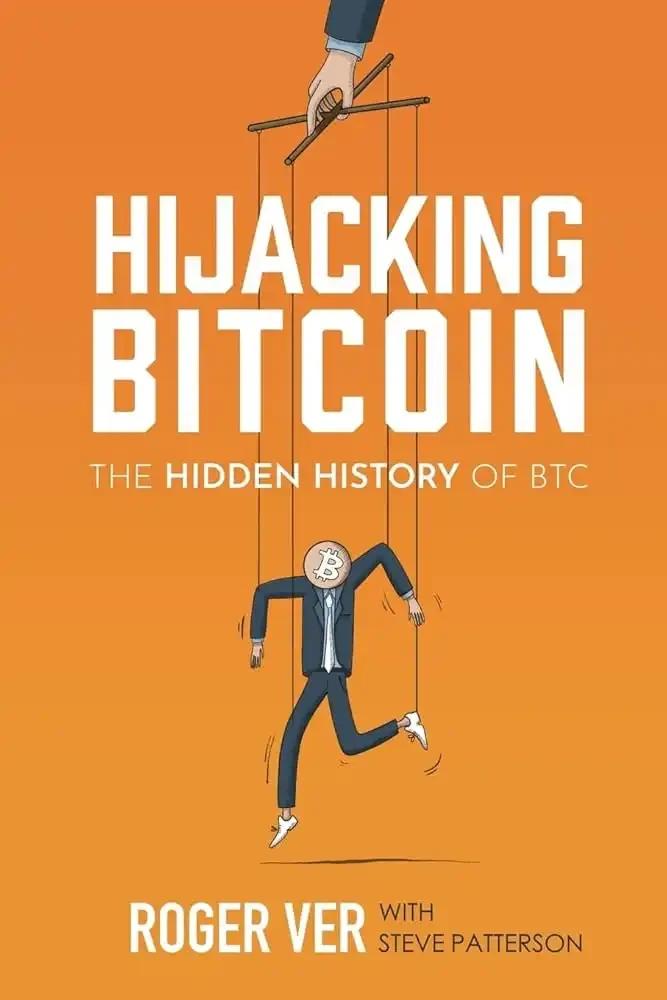
The "Bitcoin hijacking theory" argues that Bitcoin has transformed from a "peer-to-peer electronic cash" intended to counter the hegemony of fiat currencies into a speculative "digital gold." This not only deviates from the mission originally given to Bitcoin by Satoshi Nakamoto, but is also the result of deliberate influence from multiple conspiracies (internal commercial interests, external funds such as Epstein, and the US government's efforts to maintain the dollar's hegemony). In other words, "Bitcoin's development was not natural and organic; it was supposed to be a currency that people all over the world could finally choose to use, but it was ultimately dominated by the narrative of digital gold as a store of value."
Roger Ver argues that Bitcoin Core developers' decisions are not independent but influenced by external funding. In 2014-2015, the collapse of the Bitcoin Foundation left Bitcoin Core developers without stable salaries. The Digital Currency Initiative (DCI) at MIT Media Lab began paying several Bitcoin Core developers, leading Gavin Andresen, Wladimir van der Laan, and Cory Fields to join the lab.
This information has become a hot topic of discussion again due to the latest Epstein documents, but it was already known to the public as early as 2019 when MIT admitted to receiving donations from Epstein. Roger Ver included this information in his book as evidence of external funds influencing the development of Bitcoin, even though the developers who received funding from MIT were unaware that the donations came from Epstein.
He also mentioned Blockstreram, led by another Bitcoin Core developer, Adam Back, which receives VC funding from a16z and others. Mainnet congestion benefits the company's business, and commercial interests have led to Bitcoin being "hijacked" to serve the sidechain/Bitcoin Layer 2 narrative.
During the "block size war," Bitcoin Core developers insisted on small blocks and rejected various scaling proposals. They openly supported and pursued full blocks, high fees, and transaction congestion, believing this to be a "natural state of market competition" and a long-term solution to incentivize miners to maintain network security, replacing block rewards.
Roger Ver, however, believes this ultimately makes Bitcoin transactions slow, expensive, and unreliable, hindering its widespread adoption as a global currency and everyday payment tool. He hopes Bitcoin can truly become a part of ordinary people's lives—for drinking coffee, buying clothes, watching sports...
"If the blocks are always full, it's as absurd as Starbucks deliberately selling out of coffee every day. Block space is a consumable, and miners should meet the real-world needs of Bitcoin's use."
He further pointed out that Bitcoin, due to its small block size limitations, has been forced to shift towards custodial wallets or solutions like the Lightning Network. Bitcoin has become a settlement layer, no longer electronic cash. Furthermore, whether it's custodial wallets or sidechains/Bitcoin Layer 2, they will ultimately still force users to rely on centralized services.
The proponents of large blocks lost the "big-small block war," with Roger Ver switching to BCH, which later forked into BSV and XEC. However, did the proponents of small blocks "win"? At the time, they argued that large blocks would drastically increase the cost of running a full Bitcoin node, making it unaffordable for ordinary people and leading to the control of Bitcoin's verification rights by governments, mining pools, large corporations, and data centers.
However, years later, the influence of governments on Bitcoin continues to grow. The original vision of "decentralization first, payments can be implemented gradually" has not developed as well as expected. Companies such as Valve, Stripe, Dell, and Expedia once supported direct Bitcoin payments (without converting to fiat currency), but eventually withdrew from support due to excessively long transaction times, high fees, or low user willingness to use it.
Currently, few people are discussing Bitcoin's status as a global currency; the narrative of digital gold has become mainstream.
He then went further, mentioning the involvement of the US government, pointing out that US intelligence agencies were interested in similar technologies long before Bitcoin's emergence, citing the NSA's 1996 paper, "How to Make a Mint: The Cryptography of Anonymous Electronic Cash," as evidence. This paper described an anonymous digital currency system similar to Bitcoin, which he argued indicated suggests the US government may have monitored or attempted to influence Bitcoin's development from its early stages to prevent it from truly threatening the national monetary system.
In a 2024 interview, he further stated:
"Back in 2011, we already knew the CIA was interested in Bitcoin because they had asked Bitcoin developers for information about it. The CIA had already begun researching Bitcoin before most people had even heard of it."
Around 2012, however, a man calling himself "John Dylan" claimed to be a member of an intelligence agency and spent over $10,000 (a considerable sum) to create propaganda attempting to mislead people into believing that keeping Bitcoin blocks small would make it more decentralized. This was completely contrary to the facts and the original design intentions of Bitcoin's creator, Satoshi Nakamoto. At the time, Bitcoin's design philosophy and usage were not based on this. Initially, no one believed this propaganda.
Later, the Bitcoin community experienced a massive wave of censorship. An anonymous group took control of all major Bitcoin discussion platforms, and overnight, any advocacy for Bitcoin's use as currency was banned. They censored anyone trying to promote Bitcoin for payments. Initially, people could see through these operations, but as new users joined, they were indoctrinated with these censored ideas.
Credibility of the "Bitcoin hijacking theory"
Roger Ver is a highly influential early evangelist and builder in the crypto industry. He began investing in Bitcoin in early 2011 and is the founder of Bitcoin.com, co-founder of Ripple and Blockchain.com, and a seed investor in Kraken. He actively promoted Bitcoin and cryptocurrency-related startups in the early days and was already a millionaire before investing in Bitcoin, yet he still sold his Lamborghini to buy more Bitcoin. Therefore, he earned the nickname "Bitcoin Jesus."
However, since the "big-small block war," he has consistently criticized small block advocates, Bitcoin Core developers, and Blockstream, while remaining a supporter of BCH. Therefore, his comments within the Bitcoin community have almost unanimously been sarcastic, with statements such as, "Roger is still making excuses for the war he lost in 2017; BCH is the real hijacking of Bitcoin."
In 2024, he published a new book that for the first time integrated various elements such as the "big-small block war," Epstein's funding of Bitcoin Core developers, NSA papers, and potential US government censorship of pro-big-block rhetoric into a complete "Bitcoin hijacking theory."
About three weeks after the book's publication, he was arrested in Spain on tax fraud charges, and the United States subsequently requested his extradition. The U.S. Department of Justice accused him of failing to report the sale of approximately $240 million worth of Bitcoin in 2017 (causing the IRS to lose at least $48 million) and underreporting the value of his Bitcoin assets when he renounced his U.S. citizenship in 2014. He faces eight charges, including email fraud, tax evasion, and false tax filing, and faces a maximum sentence of 109 years in prison.
In a subsequent interview, Roger Ver claimed that he was retaliated against for revealing "the truth about the Bitcoin hijacking" and the actions of the US government involved. However, the charges against him actually existed months before the book was published; the charges were only made public and his arrest carried out after the book's publication.
In October 2025, he reached a deferred prosecution agreement with the U.S. Department of Justice, and the case was dropped after he paid approximately $49.9 million (taxes, penalties, and interest).
In summary, while he has a stance (supporting large blocks and BCH), and there's no direct evidence that his arrest was due to "revealing the US government's deliberate attempt to diminish Bitcoin from a currency to a speculative asset in order to maintain the dollar's hegemony," his continued insistence on expressing his views despite misunderstanding and even attacks from the Bitcoin community cannot erase his early contributions to Bitcoin. More importantly, his view that "Bitcoin has deviated from its original purpose, thus diminishing its value" has actually garnered considerable acceptance.
In an interview last year, PayPal founder Peter Thiel explicitly stated that Bitcoin had deviated from its original intentions of decentralization and resistance against the system. It was no longer a revolutionary tool against the old regime, but rather it had been "co-opted" by it, becoming part of it. Thiel pointed out that the FBI had told him they preferred criminals to use Bitcoin rather than dollars, indicating that Bitcoin had not achieved its intended anonymity and censorship resistance, but instead had become an easier tool to track. While Bitcoin ETFs have introduced incremental growth into the market, this does not mean that traditional finance has bowed to cryptocurrencies; on the contrary, Bitcoin has been "co-opted" by traditional finance. The free technology that disrupted fiat currency has ultimately become a mainstream financial product.
The latest and most extensive disclosures of the Epstein Papers have caused a shock to thinking and cognition. This information was previously unavailable and unimaginable, so when it was finally revealed, those who were shocked and stunned by it will, in turn, "retaliate" by amplifying their imaginations.
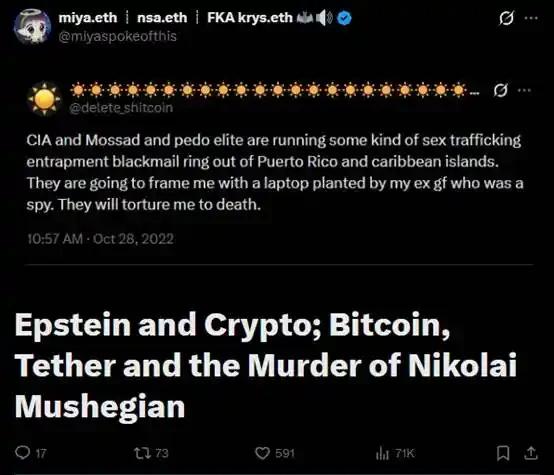
Roger Ver's "Bitcoin hijacking theory" has also begun to regain attention, with many believing he is "right." @miyaspokeofthis even combined the death of Nikolai Mushegian (co-founder of MakerDAO and leader of WETH development) with Epstein, Tether co-founder Brock Pierce, and the "Bitcoin hijacking theory" in a complete article.
I am reluctant to call all of this a "conspiracy theory" because when the tip of the iceberg of evil is suddenly exposed to the light of day, no one can convince themselves that "human nature is inherently good, and I should not have any more doubts."