Author|jk
In the past 24 hours, the cryptocurrency market has experienced its worst sell-off this year, with major cryptocurrencies collectively plummeting by more than 15%, and panic continuing to spread.
OKX market data shows that BTC price fell to a low of $60,000, a maximum drop of 18% in the last 24 hours, and is currently trading at $63,150; Ethereum fell below $2,000, reaching a low of $1,744, and is currently trading at $1,860, a drop of 13.7% in the last 24 hours; Solana fell below $70, reaching a low of $67, a drop of 19% in the last 24 hours. Major cryptocurrencies all saw drops exceeding 12%.
Major assets suffered heavy losses.
According to the latest data from CoinGecko, as of press time, Bitcoin was priced at $63,576, a 13.3% drop in the past 24 hours. At this time yesterday, Bitcoin was at $73,311 . Bitcoin's market capitalization has evaporated by over $160 billion, and 24-hour trading volume surged to $142.4 billion, indicating escalating panic selling in the market.
Ethereum suffered a more severe blow, with its price plummeting to $1,848 , a 14.3% drop in 24 hours. This marks the first time Ethereum has fallen below the psychological threshold of $1,900 since April 2025. Ethereum's market capitalization shrank to $224 billion, with a 24-hour trading volume of $61.5 billion.
Other major cryptocurrencies were not spared either. BNB fell to $611, a drop of 12.4%, shrinking its market capitalization to $83.3 billion. Solana plummeted 14.0% to $79 , with its market capitalization falling below $45 billion. Altcoin such as XRP and Cardano generally saw declines exceeding 15%.
Market liquidation volume hit a record high
This sharp drop triggered massive forced liquidations. According to Coinglass data, the total liquidation amount in the past 24 hours exceeded $2.66 billion, with long positions accounting for as much as 87%. The single-day liquidation volume ranks 10th in history, second only to the sell-off triggered by the tariff crisis in April 2025.
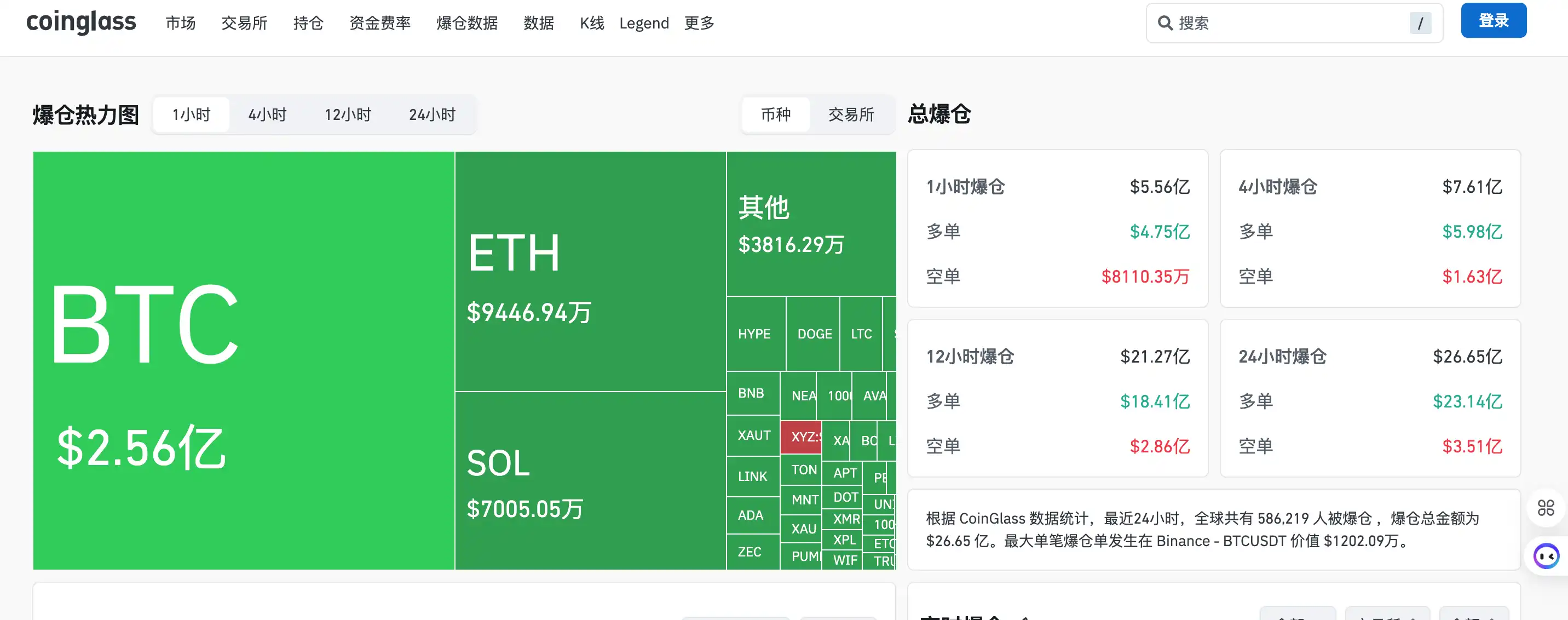
More than 580,000 traders were forced to liquidate their positions in this crash, and the chain reaction of liquidations exacerbated the downward pressure on the market, creating a vicious cycle.
Multiple factors combined to trigger panic
This sharp drop was not caused by a single factor, but rather by the convergence of multiple negative factors. During the previous decline, the market was concerned about the hawkish stance of Kevin Warsh, the nominee for the new Federal Reserve Chairman. Warsh was seen as likely to adopt a tougher inflation control policy than Powell, meaning the high-interest-rate environment could persist for a longer period. Simultaneously, the US dollar index rebounded strongly, directly suppressing dollar-denominated risk assets. Historical data shows a significant negative correlation between Bitcoin prices and the US dollar index; a stronger dollar is typically accompanied by a sell-off in crypto assets. Continued outflows of institutional funds further exacerbated market pressure. According to data from The Block, the US Bitcoin spot ETF recorded a net outflow of $272 million on February 4th, while the Ethereum spot ETF also experienced a $252 million withdrawal on January 30th. This large-scale withdrawal by institutional investors indicates a sharp decline in market risk appetite.
Future Trend Outlook
The market generally expects continued consolidation in the short term, with a V-shaped reversal unlikely. Key reasons include the structural weakness of Altcoin, risk aversion among retail investors, and the market's high sensitivity to news. Many Altcoin have fallen by more than 20%, exhibiting a structurally bearish bias and facing persistent selling pressure from retail investors. Retail investors, having suffered significant losses, are generally risk-averse, leading to a decline in speculative demand. Simultaneously, the market is extremely sensitive to geopolitical news such as changes in trade relations and monetary policy.
In the face of the current market environment, Odaily Odaily advises investors to strictly manage risk, avoid excessive leverage, and set reasonable stop-loss levels. Investors should focus on high-quality projects, choosing those with solid fundamentals and practical applications. Maintaining a long-term perspective is also crucial; historical data shows that the crypto market is cyclical, with recovery following each major downturn. Finally, during periods of panic, be wary of emotional trading, avoid chasing highs and lows, and rationally assess the market situation.