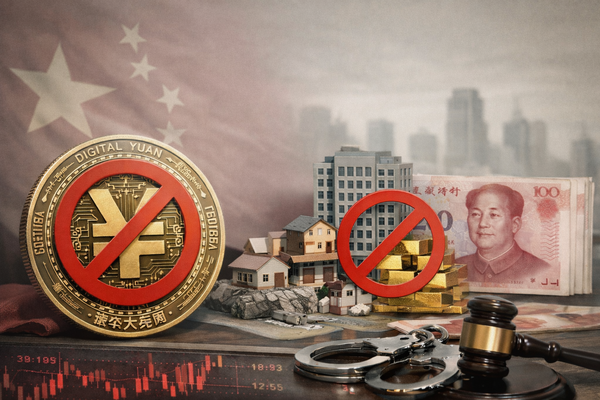
China has issued a joint regulatory notice banning the issuance of yuan-pegged stablecoins and the unauthorized tokenization of real-world assets (RWAs). The plan is to explicitly define these activities as illegal financial activities by 2026 and block any attempts outside of pre-approval and oversight systems. This reaffirms China's "controlled blockchain strategy," which stands in stark contrast to the global institutionalization trend surrounding digital assets.
This measure was announced in the form of a joint notice from multiple financial regulators, including the People's Bank of China (PBOC). Its key points are twofold. First, it prohibits the issuance and circulation of stablecoins pegged to the yuan without explicit approval from the authorities. Second, RWA projects, which involve tokenizing real assets such as real estate, raw materials, bonds, and equity, will be deemed illegal financial activities if conducted without prior approval.
China has maintained a hardline stance, banning virtual asset trading and mining since 2021. This announcement is considered a more sophisticated regulatory model, as it clarifies the scope of regulation to include stablecoins and RWAs. The separate mention of yuan stablecoins, in particular, clearly demonstrates the strategic goal of monetary sovereignty and capital controls.
China's ultimate goal is a centralized digital currency system centered around the digital yuan (e-CNY). This is based on the belief that the proliferation of privately issued yuan-pegged stablecoins could weaken existing policy tools such as tracking capital flows, managing the currency supply, and controlling capital movements. The RWA tokenization also appears to reflect concerns that it could accelerate cross-border movement and securitization of assets, potentially undermining financial stability.
An interesting point is the contrast with global trends. In the US, Hong Kong, and parts of the Middle East, there is a growing movement to institutionalize stablecoins and tokenized assets. Banks and asset management companies are directly issuing tokenized bonds and funds, while regulators are establishing licensing systems to strengthen management and oversight. In contrast, China has fundamentally blocked private-sector-led digital asset experimentation, opting for a structure that only allows it within state-designed infrastructure.
This is expected to impact the Asian digital asset landscape. Overseas businesses considering yuan-based stablecoins or RWA projects in China will inevitably have to adjust their strategies. At the same time, the shift of business bases to relatively open regions like Hong Kong, Singapore, and the Middle East is also likely to accelerate.
Ultimately, China's choice is closer to "sovereign control" than "open innovation." It signals that while blockchain technology itself will be utilized, the digitalization of currency and assets will be permitted only within state-designed boundaries. This strengthened regulation, which will continue until 2026, is expected to be another turning point, triggering a power reshuffle in the global stablecoin and RWA markets.