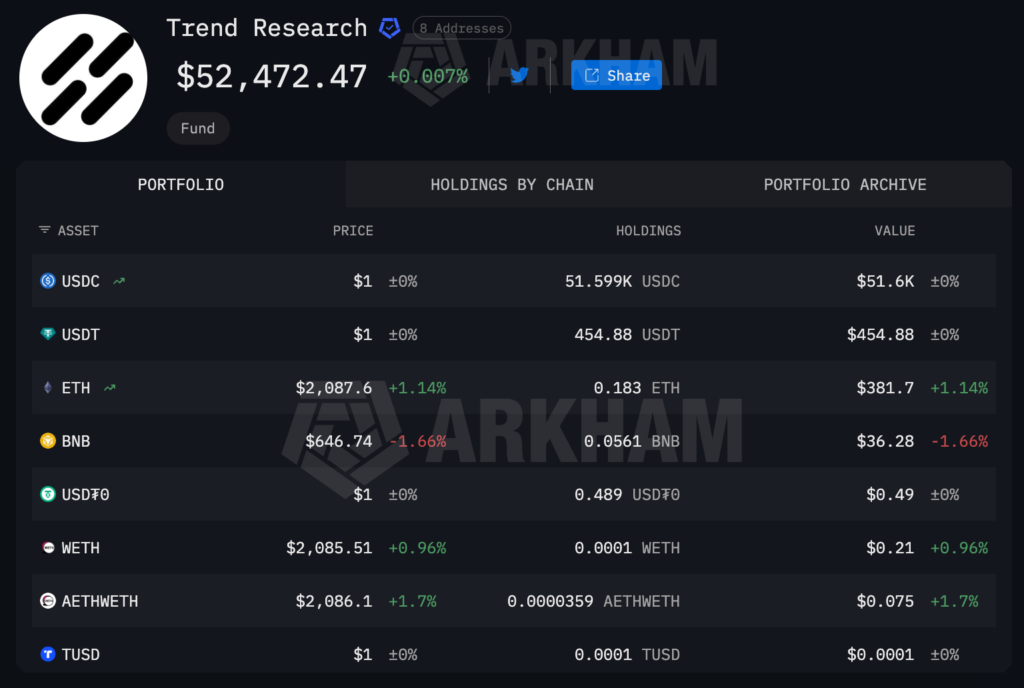
This morning, on-chain analytics platform Arkham detected that Trend Research, owned by Yi Lihua, transferred its last approximately 534 ETH to Binance, worth about $1.11 million. Following this transaction, the address, which once held over 650,000 ETH with a portfolio size of $2 billion, now has a balance of only 0.18 ETH.
According to calculations, Trend Research entered the market with an average price of approximately $3,180 to long on 651,500 ETH, and then sold off its holdings at an average price of approximately $2,053, resulting in a loss of approximately $730 million and a painful exit from the market.
Revolving leverage becomes a disaster in a bear market
To understand the scale of this disaster, we must first understand its structure.
Yi Lihua's strategy is not complicated: deposit ETH as collateral on the DeFi lending protocol Aave, borrow the stablecoin USDT, then use the borrowed USDT to buy more ETH, and then deposit the newly purchased ETH back into Aave as collateral to borrow more USDT, and so on.
This is what's known as "cyclic leverage." Each cycle amplifies your exposure: if ETH rises by 10%, your gains will be far more than 10%; but if ETH falls by 10%, your losses will also be far more than 10%. More importantly, as the price falls, the value of your collateral shrinks, and the Aave protocol will require you to replenish your margin, otherwise it will trigger forced liquidation.
By its peak on January 20, Trend Research's ETH holdings exceeded 650,000, and stablecoin lending reached approximately $958 million. In a bull market, this machine is a money-printing machine; but in a bear market, it's a paper shredder.
Unable to resist reading more, the cognitive traps behind a single confession.
In his subsequent response, Yi Lihua made a thought-provoking statement: "I can't help but be bullish, which is related to my past entrepreneurial experience."
His logic was this: He entered the crypto in 2015 and made his first fortune by consistently being bullish on Bitcoin and Ethereum. However, during the subsequent bear market, he couldn't bear the losses and prematurely liquidated his Bitcoin holdings, missing out on the surge that began in March 2020. That "punishment for being bearish" left a deep impression on him, so much so that his investment decisions have consistently leaned towards a bullish stance ever since.
This is a typical variant of the "loss aversion bias": it's not the fear of loss that matters, but the fear of missing out. The regrets of the previous round become the shackles of the current round.
He admitted that "being bullish on ETH too early was indeed a mistake," believing that ETH was undervalued at $3,000. But the market doesn't care what you think is undervalued. When the price falls below your cost basis by 35%, your "value judgment" becomes just another reason to lose more money.
Even more alarming is his other assessment: "The four-year cycle pattern has failed, and now is the best time to buy the dips crypto." This statement was made just before ETH began its collapse from the $3,000 range.
Ethereum whale collectively suffer a $7 billion loss.
Yi Lihua is not the only victim. According to statistics from on-chain analysis agencies, Ethereum bull whale collectively lost approximately $7 billion in this round of decline. Their common characteristics are: long in ETH through DeFi lending protocols to gain excess returns when prices rose, but facing the risk of forced liquidation when prices fell.
Another widely discussed case is BitMine, owned by Tom Lee. However, unlike Trend Research, BitMine adopted a strategy of "low leverage, high staking, and zero debt," holding $586 million in cash reserves, with 67% of its ETH staked, generating a fixed cash flow daily.
Both are whale, but one was sunk in the storm while the other remained unscathed. The difference lies not in their belief in Ethereum, but in how they used leverage; after all, belief cannot pay your margin.
DeFi's transparency is a double-edged sword.
This story also reveals another side of DeFi's "transparency".
In traditional finance, a hedge fund's positions are confidential. Even if it faces liquidation risk, it is difficult for outsiders to track them in real time. But on Aave, every collateral, every loan, and every liquidation price is publicly available.
What does this mean? When the market knows that a large player's liquidation price is $1,685, short sellers have a clear objective: push the price to that level, trigger a forced liquidation, and then profit from the sell-off. On-chain data does show an unusually concentrated short positions during Trend Research's most dangerous period.
This may not necessarily be a deliberate "hunt," but could simply be a rational trader's logical judgment based on publicly available information. The result is the same: DeFi's transparency in a bear market becomes a revealing mirror, leaving every wounded whale nowhere to hide.
A lesson bought for seven hundred million dollars
Yi Lihua's story is not a simple narrative of "greedy speculators deserve it." He is a seasoned investor who has been deeply involved in the industry for nearly a decade and has experienced complete bull and bear cycles. His mistake was not being bullish on Ethereum: in fact, Ethereum's long-term fundamentals have not fundamentally changed due to this round of decline.
His mistake was using the wrong tools to express the correct viewpoint.
The essence of cyclical leverage is to compress a long-term judgment into a short-term bet. You may be completely correct in your judgment of Ethereum's five-year prospects, but if the price fluctuations in one month exceed your margin tolerance, you will be liquidated before the "correct" outcome arrives.
The market can remain irrational for longer than you can remain solvent. This statement is old and worn out, but every cycle, someone always adds a new footnote to it with real money.