go
In the early hours of late November, Jack Brandt's father was driving a new Tesla Model Y on the westbound lane of I-20 in Georgia, heading from Atlanta to Birmingham to take care of his elderly mother, when he suddenly suffered a heart attack. The severe chest pain almost made him lose consciousness... Jack recounted that harrowing night on the X platform yesterday (7th).
Around 3:50 a.m., my phone rang. It was my dad calling. He was experiencing severe chest pain and was almost unconscious, unable to drive safely. However, the FSD (Full Self-Driving) function was already activated, and the vehicle was still moving. I immediately contacted my grandfather; we only had a few seconds to make a decision.
The grandfather contacted his uncle, who lived in Douglasville, Georgia, and was told there was a Tanner Medical Center nearby. Jack immediately found the hospital in Carrotton on Google Maps and sent the destination to his father's car via the Tesla App.
As the authorized driver for his account, I can remotely modify the FSD navigation on his Juniper.
"What happened next still gives me goosebumps," Jack wrote. The Model Y exited the highway at the next exit, turned back into the eastbound lane, returned to the Carrollton exit, and then navigated along a local road it had never driven before to the emergency room entrance.
They called the hospital in advance to inform them that the emergency team was already waiting at the door.
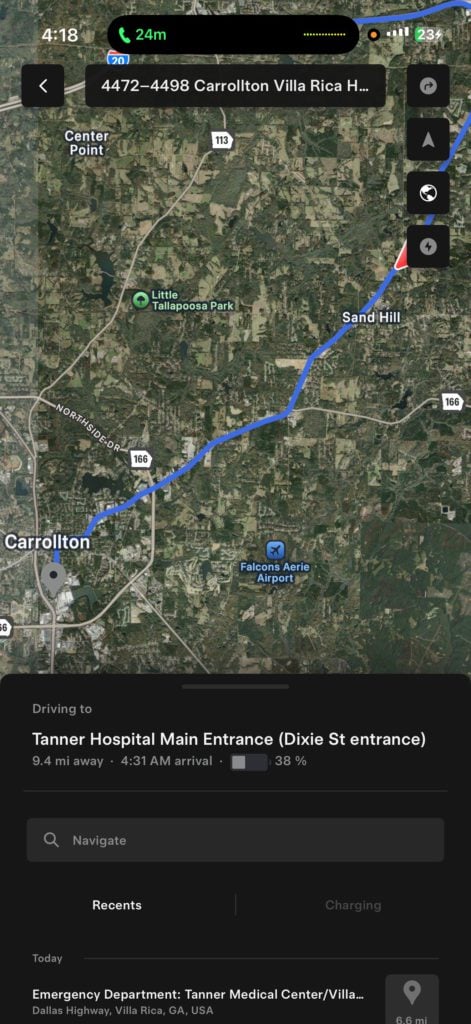
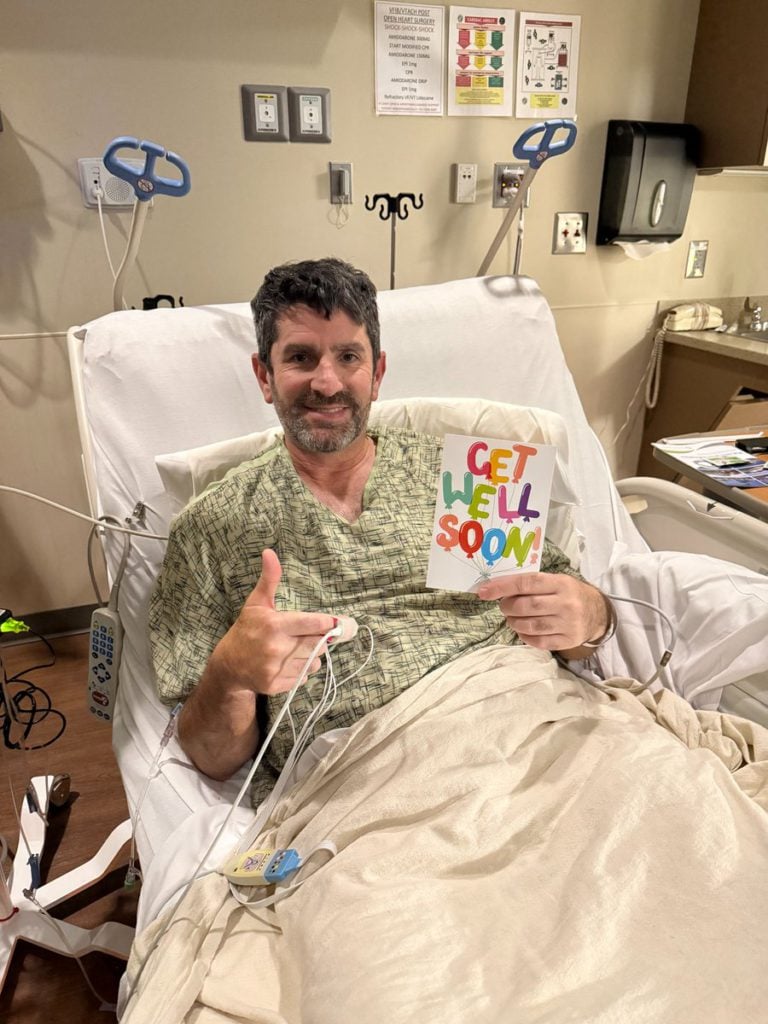
Three arteries were blocked, but they happened to go to the right hospital.
The attending physician quickly diagnosed that three coronary arteries were severely blocked, requiring immediate intervention. The medical team later told the Brandt family, "If he had pulled over and waited for an ambulance, or tried to continue driving to Birmingham, he wouldn't have survived."
This isn't a carefully crafted brand story from the marketing department. It's a statistically low-probability event that happens to fall at the intersection of technological capabilities and human vulnerability. Jack wrote in the article:
Thank you Tesla, Tesla AI, and Elon Musk for creating technology that can truly save lives. This isn't a hypothetical scenario; it's my father himself. He's still alive and recovering because, thanks to your team's work, the system was able to get him to the hospital in time when he suffered a STEMI heart attack at 4 a.m. on a dark interstate highway in Georgia.
I also want to thank the entire medical staff at Tanner Medical Center in Carrollton, Georgia—I truly believe there's no better hospital in the world. Your team performed exceptionally well. Thank you from the bottom of my heart.
This technology should be made available to more people.
FSD is more than just a convenient feature—it's a lifeline.
A rescue story is not proof of safety, but it points to a real possibility.
Of course, a single successful case cannot constitute statistical significance. This is the bottom line that must be upheld in any serious discussion of self-driving safety.
Although Tesla's official safety report shows that vehicles with FSD enabled experience only one accident per million miles on average, far lower than the average for human drivers, critics point out that the benchmark for these figures is flawed: FSD is primarily used in low-risk scenarios such as highways and suburban roads, while accident statistics for human drivers cover all road conditions.
Neither side is wrong. And that's precisely the most difficult part.
The true significance of the Brandt incident lies not in proving that FSD is "safe enough," but in demonstrating a possibility: when AI-assisted driving systems are combined with remote control interfaces, they can provide a lifeline that traditional cars cannot offer in extreme situations where human drivers are completely incapacitated. However, to transform this "possibility" into "reliability," what is needed is not only better algorithms, but also a regulatory framework that keeps pace with the speed of technological evolution.