The "whistleblowers" of AI safety are trapped in a cage of human risks.
Written by Eric, Foresight News
On January 28th, Beijing time, CNBC, citing sources familiar with the matter (https://www.cnbc.com/2026/01/27/anthropic-fundraising-microsoft-nvidia.html), confirmed that Anthropic has completed a funding round of over $10 billion at a valuation of $350 billion. Coatue and the Government of Singapore Investment Corporation (GIC) led the round, with Sequoia Capital participating. The sources indicated that the funding amount could have been even higher if Microsoft and Nvidia had also decided to invest.
Every time Anthropic makes headlines, it leaves Web3 practitioners, who experienced the glory of 2021 and the disaster of 2022, sighing with regret. After witnessing AI replace Crypto as the darling of technology, you might recall the person who, before ChatGPT was born, marveled at the speed of AI's iteration and specifically established a fund to invest in and support AI research.
A genius trader who bet heavily on AI early on
In April 2022, Anthropic completed a $580 million Series B funding round. Before Claude AI, known for its long-term contextual understanding capabilities, even existed, this round of funding was almost entirely dominated by a rising star from the cryptocurrency exchange industry.
This exchange is called FTX, and its founder is Sam Bankman-Fried (SBF), who has been serving nearly two years in a U.S. federal prison.
According to an announcement on Anthropic's official website (https://www.anthropic.com/news/anthropic-raises-series-b-to-build-safe-reliable-ai), the funding round was led by SBF, with participation from Alameda Research CEO Caroline Ellison, FTX Engineering Director Nishad Singh, Infotech Consulting founder Jim McClave, Skype co-founder Jaan Tallinn, and the Center for Emerging Risk Research (CERR). SBF alone invested a staggering $500 million.
Also in April 2022, Alameda Research invested in Anysphere, a company founded by four MIT graduates born in the 2000s, which had only been established for a little over three months. After failing in projects such as AI CAD and encrypted communication software, they created Cursor AI, a phenomenal product in AI programming. By the end of 2025, Cursor AI's daily active users (DAU) had exceeded 1 million, and its revenue per user (ARR) had exceeded $1 billion.
At its peak, SBF was known as a "genius trader." Although after FTX's bankruptcy, it was discovered that Alameda Research's "special treatment" on FTX (zeroing out negative balances, seeing user orders in advance, and freely misappropriating client funds) was the key reason for its stable profits, Alameda's annualized return of over 100% between 2017 and 2020 still proved the talent of this young man with the afro.
This "genius," whose credentials are a mix of genuine and fabricated, managed to secure investments in Anthropic and Anysphere within a month—a feat not merely a matter of luck. On February 28, 2022, SBF publicly launched the Future Fund at the Effective Altruism Forum (https://forum.effectivealtruism.org/posts/2mx6xrDrwiEKzfgks/announcing-the-future-fund-1). As part of FTX, this fund is managed by several FTX executives and focuses on areas that "improve the long-term prospects of humanity," such as AI safety, long-termism, and biological risks.
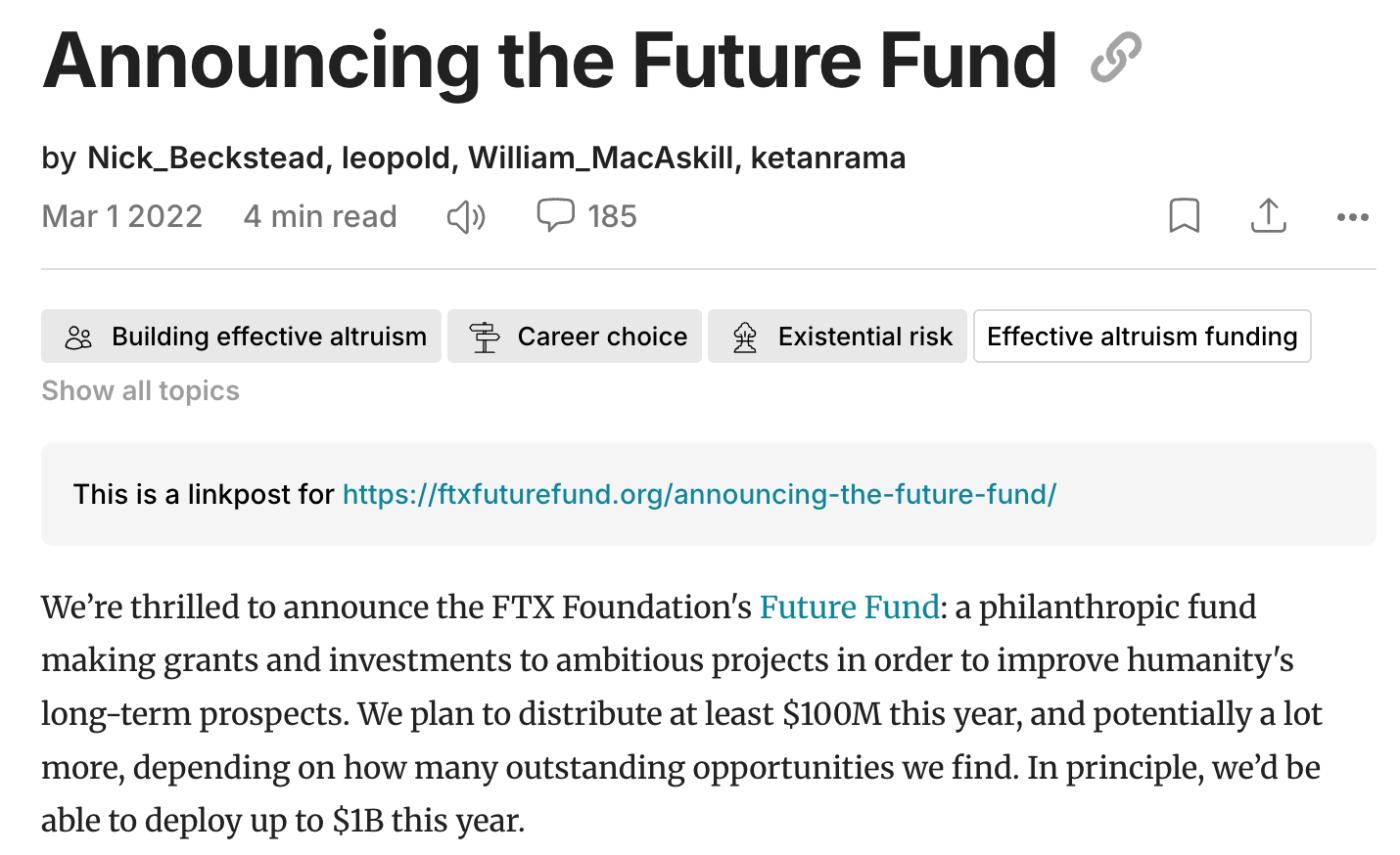
Although the investments in Anthropic and Anysphere were not made through Future Fund, the fund's establishment and significant investment in AI demonstrate SBF's emphasis on the field. According to publicly available information, Future Fund's funded projects include:
- It donated $1.25 million each to the Alignment Research Center and Cornell University for AI safety research;
- Donated millions of dollars to Lightcone Infrastructure, an AI security infrastructure provider;
- A year's salary and computing resources will be provided to Neel Nanda, a renowned researcher in the field of "mechanical interpretability" (a technique for understanding the causal relationships of behavior by analyzing the neurons, circuits, and computational paths within deep neural networks, particularly LLMs).
...
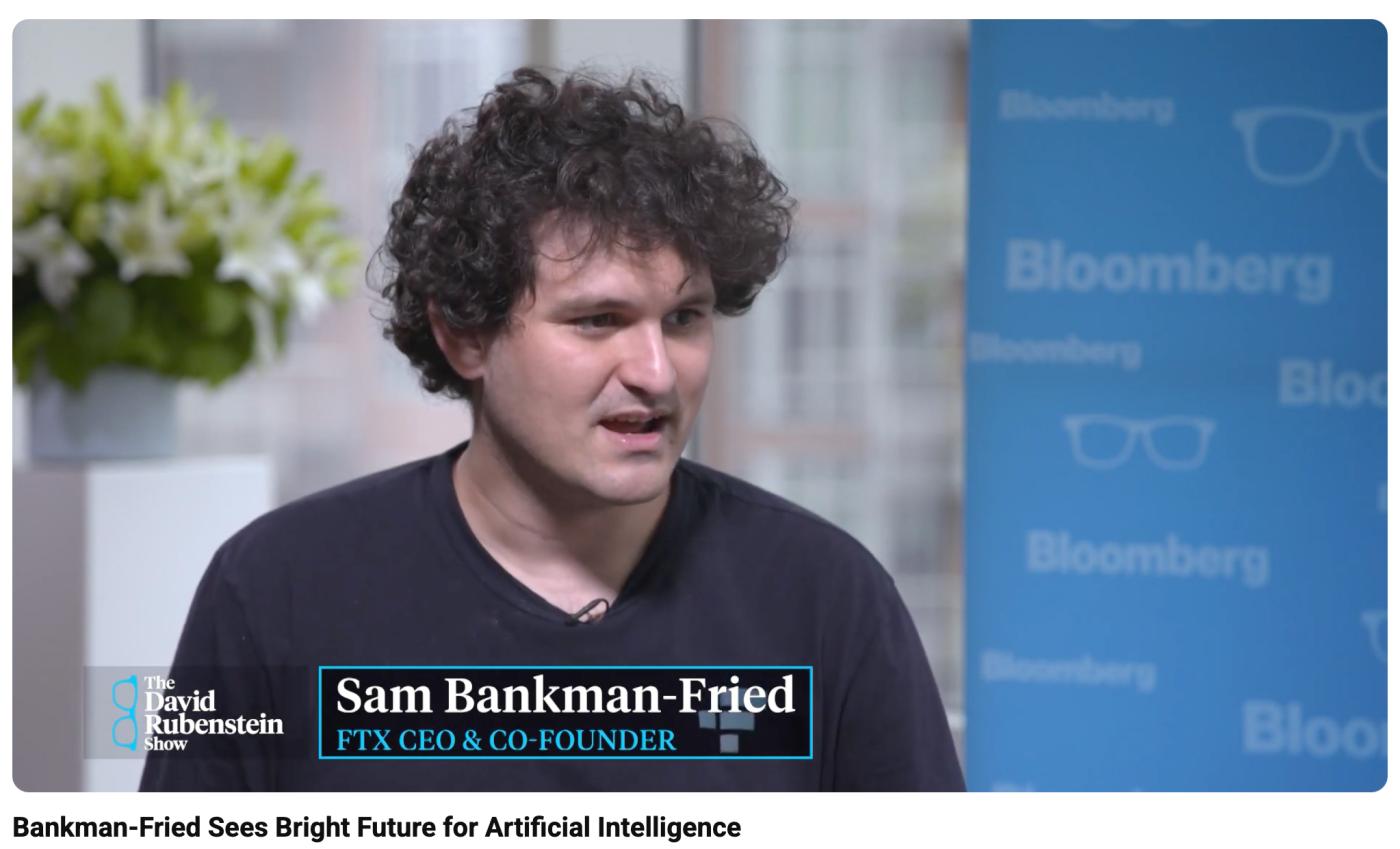
Before FTX's bankruptcy liquidation, SBF had repeatedly expressed its optimism about the future of AI in interviews with Bloomberg and CNBC, but also stated that it believed AI development was happening far faster than anyone imagined and should be limited while prioritizing AI safety. It's hard to imagine that SBF had already demonstrated its stance and provided answers to some of the companies and AI controversies that have only been widely discussed in the last two years, with real money invested in 2022.
If we wait until today...
Many people lament that if FTX had survived to this day, its investment in Anthropic alone would have completely covered all its losses.
SBF's investment in Anthropic gave him more than 10% of the shares, and even after multiple rounds of dilution reducing it to half, its current value is $17.5 billion. Meanwhile, according to documents filed with the court in March 2023 by FTX's bankruptcy administrator, John J. Ray III, FTX's liabilities to its customers amounted to $11.2 billion.
However, SBF's stake in Anthropic was sold for $1.3 billion long before AI became a global phenomenon, while its stake in Anysphere was sold for only $200,000, the same amount it invested in during its seed round. These shares are now worth over $500 million.
In addition to these two investments in the AI field, FTX and Alameda Research also invested in well-known Web3 projects including Sui, Aptos, LayerZero, and Starknet, and held more than 50 million SOL tokens at the time of bankruptcy. If calculated based on the highest value of each asset, SBF indeed had the ability to fully repay its debts.
But if FTX hadn't been exposed for misappropriating user assets and had survived to this day, would the hole dug by SBF really only be $11.2 billion? Would these assets, which at their peak had a total value of $30 billion or even $40 billion, be facing a $50 billion shortfall? We don't know, because reality doesn't allow for "what ifs." What is certain is that it's not a bad thing that this bomb exploded sooner rather than later.
Some say that SBF was a legend in Silicon Valley back then. His access to resources and his investment style of not pursuing short-term returns made it easier for him to invest in good projects. Many new projects considered it an honor to receive investment from FTX.
That's true, but even with numerous objective factors at play, his ability to almost single out Anthropic's Series B funding and his seed round investment in Anysphere is enough to secure his place as "the most successful AI investor." The line between genius and madness is often very thin. SBF certainly possesses extraordinary abilities in trading and investment, but his obsession and greed have also led his talent astray.
Interestingly, in the past two years, SBF has been described in many podcasts as "like a highly intelligent agent without emotional constraints." Michael Lewis, author of the novel *The Big Short* (later adapted into a film of the same name), stated on a podcast that SBF's story is like "a pre-rehearsal of letting AI pursue its goals without regard for their achievement." Perhaps SBF, which rallied for AI safety in 2022, is also attempting to redeem itself.