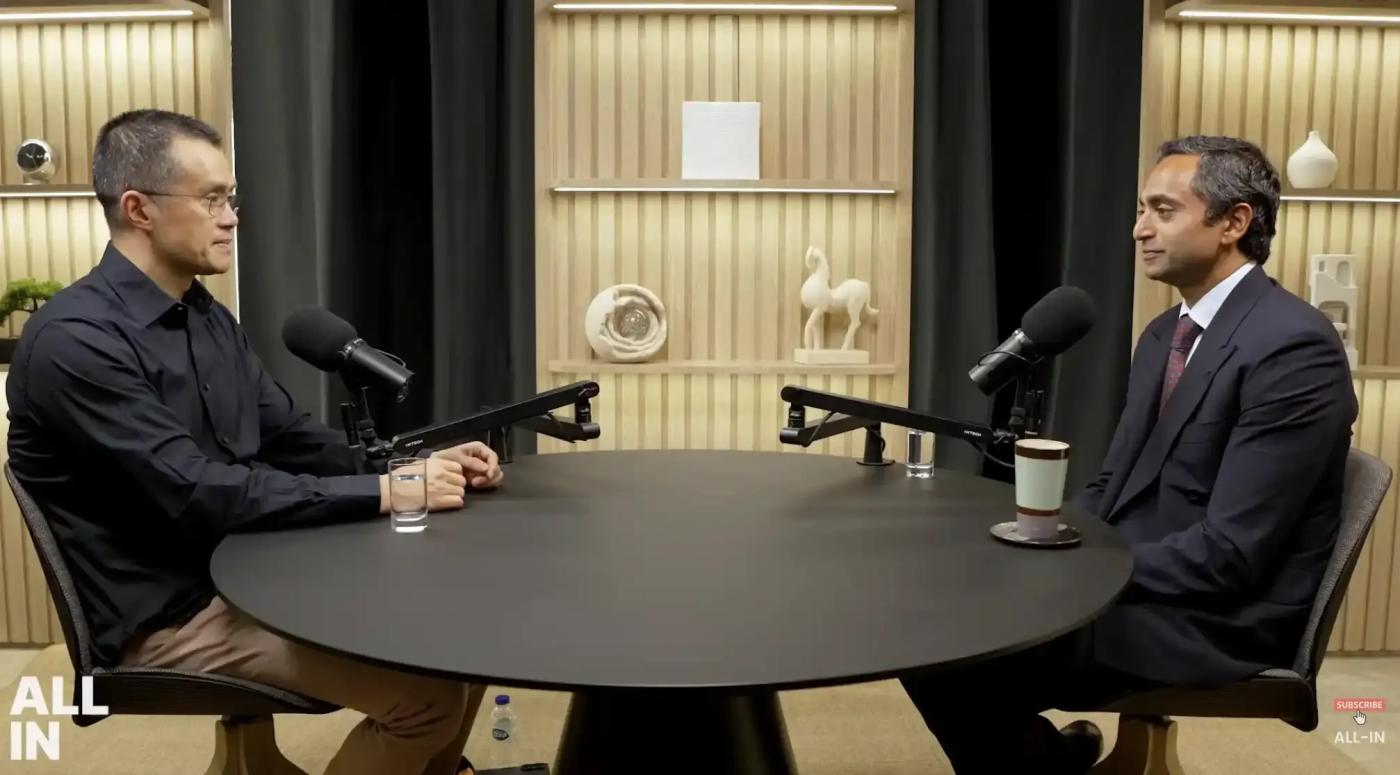
Original title: Binance CEO: 4 Months in Prison, $4 Billion Fine, and What Comes Next
Original author: All-In Podcast, YouTube
Original translation by Peggy, BlockBeats
Editor's Note: This interview documents the complete journey of CZ (CZ), one of the most influential and controversial figures in the global cryptocurrency industry, from his peak, imprisonment, to his rebirth.
He shattered the mythical image of billionaires, revealing an extremely real and minimalist ordinary person: he flipped patties at McDonald's, wrote low-level code for Bloomberg, and even after achieving financial freedom, he still habitually books economy class. Most impressively, besides Binance's rise, is his first detailed account of his battles with the Department of Justice, detailing how he maintained absolute emotional stability amidst weeks of psychological warfare, media-hyped extortion risks, and the complex racial and gang rules of Seattle prisons.
CZ candidly recounted the entire story of his feud with SBF, and the heartbreaking moment when he was forced to leave Binance's management. Now, he has turned his attention to a purely philanthropic global education cause without tokens. This is not only a chronicle of the crypto industry, but also a profound introspection on the boundaries of power, money, and freedom.
Highlights
Early experiences from China to Canada
• CZ's early career: Surprisingly "ordinary"
• Started the first company in Shanghai
My connection with Bitcoin
Cross margin in on the crypto industry
Why did you found Binance?
• The FTX Incident: Its Relationship with SBF and Its Collapse
• The Justice Department directly confronts the Biden administration's "anti-encryption" stance
What is life like inside a federal prison?
Life and new career after leaving Binance
The following is the full transcript of the podcast conversation:
Early experiences from China to Canada
Chamath: CZ, welcome to the All-In podcast. I want to rewind to the beginning because I feel many people don't know your background, or at least not as much as they should. One of your early experiences in Canada is very similar to mine, and that's something I'm particularly interested in. You worked at McDonald's, and I worked at Burger King.
CZ: My father went to study in Canada in 1984.
Chamath: How did this opportunity come about? Did your father stay in Canada after he went there?
CZ: He will come back to see us once or twice a year, but he spends most of his time in Canada.
Chamath: Was he a teacher in China?
CZ: He's a teacher, a professor. He first went to the University of Toronto on an exchange program, and then a few years later went to the University of British Columbia in Vancouver. Later, we also started applying to go there. Back then, it was actually very difficult to get a passport; it took three or four years to get one. We started applying around 1985 and it took us about two or three years to get our passports.
Chamath: You mean you got a Chinese passport?
CZ: Yes, Chinese passport. Then you have to wait several more years to get a visa; that's how slow the process was back then.
Chamath: So what's it like moving to Vancouver?
CZ: It's completely different; it's like entering a completely new country. I studied English for a year or two in school back in China, but I wasn't fluent at all. However, Vancouver is great. You know Canada—it's green, spacious, beautiful everywhere, and has a high standard of living. Everything is very clean. The fruit is also bigger. The overall environment is very comfortable.
Chamath: After the family reunited, did your parents both work?
CZ: My dad is an assistant professor at a university, earning about 1,000 Canadian dollars a month. The university also provides very cheap faculty housing, so we live on campus.
On our third day in Canada, my mother started working in a garment factory, doing sewing and stitching. She taught math and history in China, but her English wasn't very good, so she couldn't find a job at her level and had to work in a minimum wage factory. She worked there for about seven to ten years, doing that kind of work.
Chamath: My mom was a nurse in Sri Lanka. After we immigrated and got refugee status, my father couldn't find work. My mom worked as a housekeeper to make ends meet. Later, she went back to a job similar to a nursing assistant. I think I received my first paycheck when I was about 14 years old.
CZ's early career: Surprisingly "ordinary"
CZ: Yes, that's right. I also had my first job at McDonald's when I was about 14 or 15 years old.
Chamath: We're the same age, so I guess we were 14. Do you remember what the minimum wage was in British Columbia back then?
CZ: I remember, the minimum wage was 6 Canadian dollars back then.
Chamath: That's incredible. It was $4.55 in Ontario back then.
CZ: But at McDonald's, they only paid $4.50. That was less than the legal minimum wage, because McDonald's seemed to have a special exemption at the time, since they employed a lot of young people. I remember applying on my 14th birthday, and a week later I was flipping patties there. That was my first paycheck.
Chamath: So, back then, would you be considered one of those precocious "tech prodigies"? Like, the kind of kid who spends 24 hours a day writing code and studying computer science?
CZ: No, I don't think I qualify as that kind of person. I'm a tech enthusiast; I studied computer science in college, and I started to become interested in programming and taught myself in high school, but I'm definitely not a programming prodigy. I'd say I'm a pretty decent programmer, and I've written some decent code throughout my career. But around the age of 28 to 30, I started moving away from coding and doing more business development and sales work.
Chamath: Did you have many friends back then?
CZ: Quite a lot.
Chamath: Are there only Asian friends? Or are there friends of all races?
CZ: Yes, both. Actually, I have both Asian and non-Asian friends, but at my school, most Asian kids just stick together with other Asian kids. I'm an exception. I also have quite a few white friends and all sorts of different social circles. My teenage years in Canada were fantastic; they were some of the best years of my life. I think that time shaped my optimistic personality, and I'm generally a pretty happy person.
Chamath: When you didn't get into my alma mater, the University of Waterloo, and had to settle for McGill University, how did you feel? Did you feel stupid?
CZ: Well, actually, I was torn between Waterloo, McGill, and the University of Toronto. But I knew I definitely wouldn't go to the University of British Columbia because I wanted to change cities. UBC actually accepted me, but I just didn't want to go. A very respected elder suggested I become a doctor because doctors have a respectable life and high salaries. I took her advice and chose biology. But Waterloo isn't known for biology, right? So I went to McGill. But after one semester, I told myself: I'm not going to study biology anymore; I'm switching to computer science.
Chamath: Is that typical college life? Did you find a great job over the summer? Or were you like a regular college student, struggling to pay tuition?
CZ: I work every summer, and I also do part-time jobs during the school year.
Chamath: So no debt? Were you thinking at the time: I must graduate without any debt?
CZ: Yes, I didn't apply for student loans the first year. Actually, I still got 6,000 Canadian dollars from my dad. The second year, I still didn't have enough money, so my sister gave me 3,000 Canadian dollars. Since then, I haven't asked my family for a single penny, and I've been completely self-sufficient. So, luckily, I don't have any student debt, but it's all thanks to working non-stop every summer.
Chamath: You know what the best thing about the University of Waterloo was, and what saved me the most? It was its internship program. I landed some really great internships. Even so, I graduated with about $30,000 in debt, though I was pretty active in stock trading at the time.
Later, my boss, a man named Mike Fisher, did something incredibly generous to me. I was working as a derivatives trader at a bank, which was my main job, but I also traded stocks on the side and made him a lot of money. He asked, "How much debt do you owe?" I said about $30,000, $32,000 to be exact. He said, "Go downstairs to the Canadian Imperial Bank of Commerce right now and pay off your debt. I'll write you a check."
CZ: Wow.
Chamath: He wrote me a check for 32,000 Canadian dollars on the spot.
CZ: You should tell him you owe 33,000 or 300,000.
Chamath: That's the amazing thing about Canada. You can get an excellent education without being crushed by debt that you can't recover from, which is impossible for many people in the United States.
CZ: Even at McGill, there are many people who come from the US to study, paying international student tuition, but they find it's still cheaper than studying in the US. I thought that was crazy at the time. So we are really lucky that tuition in Canada is reasonable.
Chamath: So what did you do after graduating from McGill's computer science department?
CZ: Oh, actually I didn't graduate from McGill. I studied there for four years, and in my junior year I found an internship, but the internship was extended in my senior year, so I didn't go back to McGill. So I don't have a degree from McGill.
Later, I discovered that I needed a bachelor's degree to apply for a work visa in Japan. At that time, it was around 2000, at the peak of the dot-com bubble, so I enrolled in an online education program called "American Computer Science Academy" and obtained my degree there.
Chamath: My God! So you're officially a graduate of that school?
CZ: Nominally yes.
Chamath: Okay, so which internship did you get that made you decide to work there?
CZ: It was an internship in Tokyo. I've been doing programming-related work since my freshman year of college. I wrote simulation software at a company called Original SIM. In my junior year, I joined a company in Tokyo called Fusion Systems Japan. They were developing order execution systems for brokers on the Tokyo Stock Exchange platform.
Chamath: Is it a Japanese company with offices in Montreal or Canada?
CZ: No, I flew directly to Tokyo.
Chamath: You went to Tokyo?
CZ: Yes, actually it was a company started by a few Americans in Tokyo.
Chamath: So you felt like it was an adventure, like you were going to Tokyo for summer vacation.
CZ: Think about it, I was just a college student back then. Being able to live in Tokyo felt like a dream come true.
Chamath: So what kind of software development were you mainly responsible for at that time?
CZ: Primarily order execution software. Simply put, it's the system responsible for processing and transmitting transaction instructions.
Chamath: Is it similar to the underlying logic that supports Binance's business today?
CZ: That's a pretty good way to understand it; the architectural styles are very similar. However, none of the software I've helped develop involves decision-making algorithms; they're only responsible for efficiently executing instructions.
Chamath: When you first came into contact with this field, was your reaction "Wow, I love this so much," or did you simply think, "Since I've been given a coding assignment, and I understand the logic, I'll just finish it"? Were you attracted by the business itself, or did you just treat it as a job?
CZ: At first, it was purely a job. I was too young then and lacked a macro-level understanding of various industries. When I first joined the company, I was assigned to develop a digital image storage system. It wasn't as simple as the iPhone Photos app; it was a professional system for medical imaging.
But soon after, the company's core business shifted to order fulfillment systems, and I became involved in it. This became the focus of my career. What I liked about it was its extremely high level of technical expertise. The core of this field is efficiency: extreme response speed and ultra-low latency. This pursuit of efficiency subconsciously resonated with my personality.
Chamath: Let's delve deeper. High-frequency trading firms like Jump go to great lengths to optimize efficiency and latency, even developing their own circuit breakers and physical fiber optic infrastructure, all to save a few milliseconds. How is this extreme optimization manifested at the software level? How do you handle these extreme boundary conditions when writing code?
CZ: This involves multiple levels. First, there's software architecture optimization; you have to ensure the system is absolutely efficient. For example, to eliminate latency, we eliminate all database queries and move all operations to memory. We also streamline computational logic, especially for risk assessment processes before order placement and transactions. A more advanced stage involves the hardware level, such as using field-programmable gate arrays (FPGAs), which are programmable chips integrated on network interface cards (NICs).
Chamath: This way, data doesn't have to travel back and forth between memory and the processor, thus further improving speed.
CZ: That's right. About ten years ago, when I was still writing code, a single data round trip took about 100 microseconds; with hardware optimization, the latency could be reduced to 20 microseconds. Then came the optimization of physical infrastructure, such as seeking server hosting to minimize physical distance.
Chamath: This reminds me of Groq in the AI field. We had a similar insight when we started ten years ago: it was very inefficient to have data shuttle between GPUs and HBM (high-bandwidth memory). So we decided to use SRAM to keep all the data on the chip.
This approach is highly effective in the decoding phase of inference. Given that high-frequency trading involves such enormous sums of money, why haven't these institutions tried developing custom application-specific integrated circuits (ASICs)? I understand the applications of FPGAs, but it seems no one has gone to the point of developing their own specific chips (ASICs), or have they done so but kept it a secret?
CZ: I don't think chip customization at this scale is widespread, mainly because algorithm iterations are too rapid. While chip-based design is very efficient, the development cycle is too long if logic needs to be modified. In contrast, FPGAs achieve the best balance between performance and reconfigurability. Even so, the programming cycle for FPGAs is still ten times longer than that for pure software.
Chamath: Did the company you worked for in Japan later become successful?
CZ: Very successful. Just before the dot-com bubble burst in 2000, the company was acquired by a NASDAQ-listed company.
Chamath: Was the acquisition amount very large?
CZ: It was about $52 million at the time. That was a huge sum of money back then.
Chamath: Was that the opportunity that made you realize the business opportunity and decide to start your own business? Or was there another reason?
CZ: No, I was only in my early twenties then, too young. At the company, I was just an ordinary programmer, or as they say in Japanese, an office worker.
Chamath: I understand. So what happened after that?
CZ: After the company was acquired, a serious cultural conflict arose between the parent company and the original team. That was the first time I realized the potential difficulties of corporate mergers and acquisitions. Due to disagreements among management, the original partners decided to start their own business and establish another company.
Although I didn't get a share of the profits from that acquisition, my partners made a fortune. They rented an extremely luxurious office, but the new company only lasted a year. This proved that past success doesn't guarantee future success and can even be misleading. They spent money like water, but had no revenue, and the company went bankrupt in 2001. In early 2001, I started looking for new opportunities, and Bloomberg happened to be hiring. That was before 9/11; I received an offer, but hadn't officially started working yet.
Chamath: Where is the job located, in New York?
CZ: At the time, I was still in Tokyo, but my job was in New York. After 9/11, I called Bloomberg to ask if the position was still valid and if they still wanted me to come. They asked me in return, "Are you still willing to come?" I said, "No problem." So, I arrived in New York in November 2001.
Chamath: What was the atmosphere like at the time?
CZ: The streets were quiet, but I adapted well. Although New York was quiet for a few months, it quickly regained its former vitality, which didn't bother me too much. I've been working at Bloomberg for four years.
Chamath: During that time, were you still playing the role of an employee? Working for a large company, receiving a salary, bonuses, and perhaps some stock options.
CZ: Yes, I joined as a senior developer and was assigned to the "Tradebook Futures" team. That was a newly formed department that aimed to integrate and develop futures trading systems for the Bloomberg terminal.
Chamath: Didn't you have any thoughts of starting a business back then?
CZ: No, that's true.
Chamath: So what were you looking for back then? Stability? Why did you choose to work at Bloomberg in New York?
CZ: At the time, I was only 24 or 25 years old, just a young person who wanted to find a good job, experience different worlds, and explore my life's direction. I knew I lacked experience in starting my own business. In Tokyo, the company only had about 200 people, while Bloomberg already had about 3,000 employees.
It was enormous for me: the office was incredibly luxurious, with a fish tank and free food. I had excellent bosses after joining, and I was promoted three times in two years. Eventually, I started leading a team that grew from 60 to 80 people. That was a turning point in my career. I stopped coding and moved into a management role. For me, it was the most difficult transition of my career.
Founded the first company in Shanghai
Chamath: You then left your job and went to China? How did that happen?
CZ: In early 2005, my former colleagues from my time working in Japan planned to start a new fintech company. They were all in Asia at the time, hesitating between Tokyo, Shanghai, and Hong Kong. We chose Shanghai because we believed it had the most potential for future fintech development, although it later turned out that Hong Kong actually offered more business opportunities. I moved to Shanghai in 2005. The founding team consisted of six people: four white people, one Japanese person, and myself. I was the only one who could speak Chinese, although my Chinese was somewhat rusty at the time.
Chamath: You guys just parachuted into Shanghai like that. What were your business plans at the time?
CZ: We believe we have the most cutting-edge trading technology experience on Wall Street.
Chamath: Did your friends later go to New York? Or did they stay in Japan?
CZ: Two of them were with me in New York at the time, while the other three stayed in Japan. The six of us came together with the initial goal of introducing Wall Street trading technology to China, providing services to Chinese brokers and trading platforms. So, the team rented a very luxurious office…
Chamath: Wait, this was your first real entrepreneurial venture. Did you know to ask about equity distribution or equity structure diagrams back then? Or were you just blindly participating?
CZ: The distribution wasn't entirely equal. The core executives held about 39% to 40%, the remaining five of us split the remaining shares equally, and I held about 11%. At the time, I only knew this percentage, but I was completely ignorant of legal details such as shareholder rights and the difference between preferred and common stock.
Chamath: So you moved to Shanghai with those 11% shares.
CZ: Yes, I had absolutely no idea about it, I was just driven by enthusiasm. As a junior partner, since I speak Chinese, I was responsible for communicating with potential clients after arriving in Shanghai. It was only after contacting domestic brokerages that I discovered a fatal problem: we were registered as a wholly foreign-owned enterprise, and the policies at the time did not allow domestic securities firms or financial institutions to cooperate with companies of this type. We only realized this after the company was established. So we had to transform. To survive, we started taking on various IT outsourcing projects.
Chamath: Did it become a consulting service provider like Deloitte?
CZ: It wasn't even as good as Deloitte. We took on all sorts of jobs: printer repairs, SAP system implementations, and so on—our business was extremely broad. We persisted like this for several years. Surprisingly, we actually survived on these jobs and accumulated a large number of clients in the automotive industry, such as Shanghai GM, Shanghai Volkswagen, and FAW. About three or four years later, we opened an office in Hong Kong and began dealing with major international banks such as Morgan Stanley, Deutsche Bank, and Credit Suisse.
Chamath: So the business eventually took off.
CZ: Yes, that company still exists. I stayed there for eight years, until I left in 2013.
Chamath: Have you been staying in Shanghai for the past eight years?
CZ: Primarily based in Shanghai. But I also spent a lot of time setting up the Hong Kong office and frequently travel to Tokyo to serve clients there.
Chamath: What size did the company grow to later?
CZ: As far as I know, the company grew to about 200 people and maintained that size for a long time.
Chamath: As a junior partner, are you directly involved in profit sharing?
CZ: Actually, we didn't get much profit. I reinvested most of my savings back into the company and never cashed out a single penny. However, a few years later, the company's revenue was enough to support the partners' high salaries. By then, I had a family, my children were going to international schools, and my annual salary had reached six figures.
Chamath: Were you already married by then?
CZ: Yes, I got married while working in New York.
Chamath: How did you and your ex-wife meet?
CZ: I met her when I first went to Tokyo for an internship, around 1999. Later, she came to New York to find me, and we got married and had children. Although we've separated now, during my time in Shanghai, my salary was enough to provide my child with a good international school education, which was very satisfying for me.
Chamath: Looking back at your past experiences, there is still no indication that you are about to found Binance.
CZ: Not at all. I knew nothing about it at the time.
Chamath: That was between 2013 and 2014. How old were you then? Around 36?
CZ: In 2013, I was exactly 36 years old.
My connection with Bitcoin
Chamath: You were in your early thirties. You were a salaried employee, a junior partner at that company, successful in your career, and your children were attending private schools. So, what happened next?
CZ: I came across Bitcoin. It started when a friend recommended it to me and suggested I look into this thing called Bitcoin. It took me about six months to truly understand its essence, which was around July 2013.
Chamath: Is it because you read that white paper and then found that you needed to study it repeatedly to understand it?
CZ: Basically, yes. And at the time, the main forum for communication was BitcoinTalk.org, and I read almost everything on it.
Chamath: Have you read my article that I published on Bloomberg in 2012? Did it have any impact on you?
CZ: To be honest, I don't remember. I read a lot of materials at the time, so it's really hard to recall the specific source.
Chamath: Just kidding, but I did write it. Interestingly, I had a good relationship with Michael Bloomberg at the time. Although he was a senior figure and not exactly my mentor, he appreciated me. Around 2012, his team invited me to write a column. In it, I suggested that everyone should invest 1% of their net worth in Bitcoin as a form of insurance.
After the article was published on the Bloomberg Terminal, I had a profound realization about Bitcoin. It's the most fascinating technological product I've ever seen. What impressed me most—I wonder if you feel the same way—is that it's the only non-technical essay I read from beginning to end, marveling at its elegant prose. Unlike those obscure papers written only for PhDs, you can give it to anyone who doesn't understand technology, and they can understand it too.
CZ: Moreover, the entire text is only nine pages long.
Chamath: That's right. It takes a great deal of wisdom to write complex logic so concisely.
CZ: It's much harder to be concise than to write a lengthy treatise. If someone else were to rewrite this white paper, it would probably be 90 pages long.
Chamath: Who was the friend who introduced you to Bitcoin? Was it a colleague at the time, or a friend you met in Shanghai?
CZ: It's a friend of mine named Ron Cao. We didn't have any business dealings; he was the managing director of Light Speed Ventures China at the time. We often played poker together—the kind of casual, private games at home—with participants who were either aspiring entrepreneurs or venture capitalists.
During a poker game, Da Rong suggested I pay attention to Bitcoin. We then had an in-depth conversation, and Bobby Lee, who was working at Walmart at the time, was also preparing to resign to become the CEO of Bitcoin China (BTCZ).
As part of the deal, Darong, representing Lightspeed Venture Partners, invested in BTCZ. That was in July 2013. Seeing how seriously they both took it, I met up with Bobby for lunch the next day. Bobby suggested I invest 10% of my net worth in Bitcoin, reasoning that even if it went to zero, I would only lose 10%; but if it increased tenfold, my net worth would double. It sounded very convincing. So I started researching, and it wasn't until the end of 2013 that I was completely convinced of its value. But embarrassingly, Bitcoin skyrocketed from $70 to $1,000 in just six months in 2013.
Chamath: How did you feel when you watched it increase 15 times?
CZ: I think I missed the best opportunity. Because in the Bitcoin industry, no matter when you enter, you will always feel like you're too late, because everyone you meet seems to have been there before you.
Chamath: During your research, were there any circles you could connect with?
CZ: There was a very small community in Shanghai at the time. I was communicating with almost anyone in the world who was willing to talk about Bitcoin. I also had a few friends in Taiwan who worked at TSMC and were quitting their jobs to try developing Bitcoin mining chips. In addition, there were some miners, such as the big shot known in the industry as "Seven-Colored Angelfish" (Mao Shih-hsing), who was the founder of F2Pool.
They were in Hangzhou at the time, and we arranged to meet in Shanghai to exchange ideas. The most crucial turning point was the Bitcoin conference in Las Vegas in December 2013. I flew there and met everyone in the industry.
It was a small meeting with only 200 people, including today's tech giants like Vitalik Buterin (Ethereum founder) and Charlie Lee (Litecoin founder). At the time, the Silk Road website was under investigation, and the media portrayed Bitcoin as merely a tool of drug lords. But at the meeting, I saw a group of very polite tech geeks and young people. When you talk to Vitalik, you find he is a very simple and kind person.
Chamath: Were you still working at your previous company when you did these things? Did you just tell your partner you were going to Las Vegas for a few days?
CZ: Yes. After I came back, I suggested to my partners that the company should develop a Bitcoin payment system. At the time, Bitpay had just completed a $4 million funding round and was a leader in the industry.
Chamath: Speaking of Bitpay, I have a very interesting personal experience. Eager to prove Bitcoin's transaction capabilities, in 2012 or 2013, I bought a Land Rover using Bitcoin through Bitpay. At today's Bitcoin price, that car would be worth approximately $90 million. Even more outrageous, I also used Bitcoin to buy a piece of land in Lake Tahoe, just to demonstrate the feasibility of real estate transactions. Looking back now, that land was worth about $1 billion.
CZ: You can't look at it that way. Even if you didn't use Bitcoin at the time, you would have used the equivalent amount of cash to buy it. And that cash could have been used to buy even more Bitcoin. This is essentially a mental accounting problem.
Chamath: Getting back to the main point, you suggested to your partners that you create a competitor to Bitpay, and they clearly couldn't understand it. Did you buy Bitcoin at that time?
CZ: I only bought one coin to try it out at the time.
Cross margin in on the crypto industry
Chamath: And then what happened?
CZ: I told my partners that this was the biggest opportunity I'd ever seen in my life. I've witnessed three fundamental technological revolutions in my lifetime: the internet (I was too young to get deeply involved then), Bitcoin, and later, AI. I was 36 at the time, and I didn't want to miss out on Bitcoin. I decided to quit my job and dedicate myself fully to this industry.
To raise funds, I decided to sell my property in Shanghai. The sale took several months and ultimately fetched approximately $900,000. My family moved to a rented apartment in Tokyo, while I frequently traveled between Shanghai and Tokyo. The proceeds from the sale arrived in installments. The first installment arrived at a price of $800, which subsequently plummeted. I continued to buy more cryptocurrency at $600 and then $400, eventually averaging around $600 per unit.
Chamath: The entire house payment was converted into Bitcoin, but you didn't have a job at the time.
CZ: I was looking for a job at the same time, and my goal was very clear: only the Bitcoin industry. It took me less than three weeks from deciding to quit my job to finalizing a new one.
Chamath: Who hired you?
CZ: Initially, I spoke with Bobby from BTCZ, and he wanted to recruit me. But then Roger Ver from Blockchain.info (now Blockchain.com) contacted me. At the time, their team only had three people: founder Ben Reeves, newly hired CEO Nicholas Cary, and I was the third.
I was the VP of Engineering. I worked in York, North London, for a while. However, that experience wasn't smooth. After the team expanded to 18 people, the new CFO, Peter Smith, restructured the management to raise funds, leading to a dramatic change in the company culture. Many developers, including myself, chose to leave. I only stayed there for about six or seven months, but although it wasn't long, the experience was invaluable.
Chamath: Learn what you should never do.
CZ: You could say that. When I joined Blockchain.info, Ben Reeves said, "Look, we don't have a company, we don't have an office, everyone works remotely; we pay everyone in Bitcoin." I learned a lot from those practices. To this day, this philosophy is still widely adopted within Binance.
Another thing I learned was that at the time, Blockchain.info was one of the largest user platforms in the industry, with approximately 2 million wallets, even surpassing Coinbase at one point.
They had virtually no marketing strategy; their entire marketing effort relied on a single post on BitcoinTalk.org. The post was 150 pages long, and Ben Reeves constantly replied and interacted with the users, which is how the platform grew to 2 million users. That made me realize that with the right methods, even very "guerrilla" marketing can achieve scale. I learned a lot from that company, but later the corporate culture changed and no longer suited me, so I left. Then He He Yi recruited me at OKCoin.
Chamath: Doing development?
CZ: I became CTO. During this process, I felt that BTC China helped me again. Because after I left, I was looking for a job, and He Yi happened to be talking to me about this, and Bobby Lee contacted me after hearing about it. At that time, OKCoin offered 5% equity; then BTC China came and offered 10%. As a result, OKCoin matched the offer within three hours.
I was torn between Shanghai and Beijing at the time, but ultimately decided to join OKCoin in Beijing. He He Yi himself only owned 1% of the shares then, and by recruiting me, he was, in a sense, hoping I would become a more important partner—taking on greater business responsibilities. I stayed at OKCoin for about eight months, but didn't stay long either.
Chamath: Why?
CZ: The main issue was the incompatibility of culture and values; I couldn't agree with some of their practices. For example, when they ran promotions or advertised discounts on transaction fees, the ads made it seem like everyone could enjoy them, but in reality, you had to actively apply for them; it wasn't automatic. These kinds of details made me uncomfortable. So, in early 2015, I decided to leave. That's roughly it; it mainly happened in those few months of 2014, continuing into early 2015.
Why did you found Binance?
Chamath: So how did you end up doing Binance?
CZ: In 2015, a few former colleagues and I decided to launch a Bitcoin trading platform in Tokyo, Japan. This was because it was a year after the Mt. Gox incident, and there was a significant vacuum in the Japanese market.
On the same day I decided to leave OKCoin, two developers approached me; they had also just resigned. I suggested that the three of us work together. We agreed that I would be the CEO, receive more equity, and be responsible for fundraising; I would use my own savings to pay the two developers' salaries, while I wouldn't take a salary myself.
We quickly created a demo version, downloaded an open-source trading platform system, and slightly modified the interface to make it look better.
Chamath: So Binance started by using open-source projects?
CZ: No (laughs). Before Binance, we didn't say that publicly. I was very honest at the time; this demo was just a proof of concept we rushed out in two or three days to demonstrate our direction, not the final product.
In addition, we wrote a script to scrape Bitfinex's market data. Bitfinex was one of the major trading platforms at the time, and we essentially replicated its order book, making the interface constantly flash with trades and appear very active, which would make investors think our technology was very advanced.
But more importantly, when they ask questions, I can go into great depth, such as how to make matching faster, how to build an in-memory matching engine, how to design the database structure, etc. These are all things I have accumulated before.
Chamath: In other words, you've explained everything you've learned about memory matching and databases.
CZ: Yes. I could answer their technical questions in depth, so they believed it wasn't just a pretty demo. But they also pointed out that you might not be successful building a trading platform in Japan, since you don't speak Japanese. So they suggested why not sell the trading system to another trading platform? Because many Japanese trading platforms don't have strong technology.
I thought it was feasible, so I talked to a few companies. About two weeks later, we signed a contract with one of them. They bought the system for $360,000, paying an initial deposit of $180,000. That amount was enough for me to stop using my personal savings to pay my salary, so I was naturally relieved. Thus, we shifted from developing our own trading platform to becoming a trading system provider.
Chamath: which means selling software.
CZ: Yes, selling software. By July 2015, a group of Chinese companies also approached us, saying they also wanted to buy the system.
Chamath: Excuse me for interrupting, but this experience was amazing. In many startup stories, when people ask, "How is your company doing? How much is it worth?", people always think of that kind of "flash of inspiration, destiny" legend.
For example, Binance is now worth around $200 billion, and many people assume that such a company must have had a spectacular, explosive start. But your experience is more like real entrepreneurship: a process of exploration, learning, trial and error, and iteration. The path isn't straightforward, and a catalyst only appears at a certain moment. Even so, what you were doing back then wasn't a final, finished product, but rather licensing and providing services. Many people misunderstand the essence of entrepreneurship; it's more about resilience, the endurance to keep doing the hard and tiring work over and over again.
CZ: I completely agree. Many people romanticize entrepreneurship, thinking that inspiration strikes from the very beginning.
Chamath: Like the Facebook story, you just write something casually in college and suddenly you have millions of users.
CZ: Yes, stories like those of Facebook, Microsoft, and Google are the easiest to spread: garages, dorm rooms, taking off from scratch.
Chamath: But in reality, especially in finance, or for companies like Tesla, it's more of a long and arduous struggle.
CZ: Exactly, it's a continuous struggle. You have to try many different directions repeatedly, and at the beginning, you can't even see which path will lead to success. Those three companies are more like the very few exceptions who got it right from day one, but they shaped the public's imagination of entrepreneurship. In fact, 99% or even 99.9% of successful companies don't follow that path.
So, going back to our time, we were doing quite well in the software licensing business, serving a total of about 30 trading platform clients.
Chamath: Wait, really?
CZ: Yes, it really lasted for about two years. During those two years, we signed a lot of clients; it was actually a multi-million dollar licensing business. It could also be considered SaaS; we called it "Exchange as a Service," charging a fixed monthly service fee. The business was very stable; with each new client, revenue increased exponentially. It's actually a very good business model.
But in March 2017, the Chinese government shut down most of our clients. By May, we realized we had to transform.
Chamath: But they don't directly affect you because you're just a software vendor.
CZ: Yes, we're just a software provider; we don't operate the trading platform or handle the business itself. But the problem is, if we lose our clients, we lose our business. So in April and May, we were constantly thinking about how to transform our business.
During that period, many attempts were made. For example, three of my colleagues wanted to create a clone of Poloniex, which was one of the largest trading platforms at the time. I told them we had cash on hand and could invest; but three days later, they wanted to create software like on-chain chat rooms and on-chain trading, so I felt it wasn't worth investing in anymore.
Finally, I said, since we already have a trading system, why not create our own trading platform that only allows cryptocurrency-to-cryptocurrency trading? The system would require some customization, but the basics would be there. So at the end of May, we decided to rebuild the trading platform, focusing solely on cryptocurrency-to-cryptocurrency trading.
Chamath: How big was the team at the time?
CZ: There are about 20 people, with a full complement of technical personnel, but almost no marketing team, because we were originally a B2B company, relying mainly on sales. We only had two sales representatives plus myself. After deciding to transform, we said we'd start doing it ourselves: create a cryptocurrency trading platform.
Then, from June 1st to June 10th, Vinnik, the co-founder of BTC-e, conducted an ICO in China, raising $15 million in 10 days. I was shocked when I saw it. He only had a white paper and a website, no product, nothing at all, yet he managed to raise $15 million. I thought if he could do it, maybe I could too.
Chamath: What you need is venture capital. You're thinking that if I get 15 million, I can expand the team, invest in marketing, put the company on a growth curve, and not be so anxious about cash flow pressure.
CZ: Yes. We initially planned to go through VC funding, but after seeing that, I realized how efficient ICOs were. In mid-June 2017, I attended a conference where everyone was talking about ICOs, and everyone was telling me, "CZ, you have to do an ICO."
Around June 14th, I made up my mind to gather the team together. We were going to do ICO and write a white paper immediately.
Chamath: Were you already well-known in the Crypto or crypto community at that time? Whether in China, Japan, or elsewhere?
CZ: A little. I was already quite well-known at Blockchain.info, which was the most popular platform at the time. I was also the CTO of OKCoin, quite active on social media, and responsible for their international markets, mainly non-Chinese markets, because almost no one on the team spoke English better than me, even though my English isn't exactly great either. So I had some recognition in the industry; people knew who I was to some extent.
Chamath: To be an ICO, you need to have some reputation or resume to back you up, right?
CZ: Yes. That's an advantage of entering the industry early. Back then, I attended a few conferences, and there were probably only two hundred attendees. The first time you went, people didn't know you; the second time, people started to remember you; the third time, people would consider you an insider, even an expert. I did build up some reputation during that time.
I also noticed at the time that Vinnik, the person who conducted that ICO in China, was very famous domestically, but not internationally; while I had some exposure both domestically and internationally. Therefore, I judged that I had a high probability of being able to conduct an ICO and raise a similar amount of money. As it turned out, we did indeed do it.
Chamath: I still don't understand, and I still don't understand, who the buyer of your IC0 was.
CZ: To be honest, even today I find it difficult to give a completely accurate portrait.
Chamath: Chinese? Japanese? Or someone from all over the world who already knows you? Or is it because your white paper is exceptionally well-written?
CZ: In terms of investor composition, probably 80% to 90% are Chinese, with some international investors also participating. Data roughly shows that about 20,000 people subscribed to that ICO.
Chamath: 20,000 people?
CZ: Yes, about 20,000 people. For a brand new brand, the real endorsement is really just two things: a few people know me, and we've explained things clearly.
Chamath: So even though China cleared trading platforms from the market at that time, ICOs were still allowed?
CZ: I need to clarify that at that time, IC0 had not yet been explicitly banned.
Chamath: Yes, it wasn't banned at the time, but it wasn't exactly permitted either.
CZ: Strictly speaking, it wasn't approved; it was in a gray area. To add a crucial background, the trading platform clients we served at the time were primarily fiat currency trading platforms, not purely crypto trading platforms. Crypto trading platforms weren't shut down in March, but rather after we launched, they faced regulatory crackdowns in September. This period we're referring to is roughly June and July of 2017.
Chamath: You were practically threading a needle through the cracks in the regulations.
CZ: That's true. But we didn't know the policy would be implemented later; we made the decision based on the reality at the time.
Chamath: So how much of the company's shares did you sell back then?
CZ: We did not sell equity. We issued tokens, and there were no equity arrangements involved. We issued a new token, BNB, which still exists today. Our plan at the time was to sell 60% of the tokens, raising approximately $15 million. Of course, the fundraising was denominated and settled in crypto assets such as Bitcoin.
Chamath: What was the original token economic model you designed for BNB?
CZ: We've proposed several uses, but the most core and the one that can be implemented most quickly is that BNB holders will receive a 50% discount on transaction fees once the trading platform is launched in the future. This is the most direct value promise. We also mentioned that it will evolve into its own chain in the future, forming a more complete ecosystem, which will likely focus on three or four main directions.
Chamath: You must have been very excited at the time, raising $15 million and being able to launch the trading platform immediately. But then the policy came down in September, and trading platforms themselves were banned in China. What did you do?
CZ: On September 4, 2017, several Chinese government departments jointly issued a document stating: First, virtual currency trading platforms are no longer allowed to operate in China; second, ICOs are also no longer permitted; and third, mining is also prohibited. We have only one option: to relocate out of China.
At the time, China was still an important market, contributing about 30% of our users, but we still had about 70% of our users from other parts of the world. We judged that even if we lost that 30%, the business could still survive, and even have good growth potential, so I proposed moving the team to Tokyo.
Chamath: You really like Tokyo.
CZ: I am no stranger to Japan; at least it's not the first time I've adapted to a new culture.
Chamath: And you could speak Japanese by then too.
CZ: I know a little bit of Japanese, about the level you'd find for taking a taxi: I can say thank you, thank you for your hard work, and I can understand some restaurant orders; I can name most of the sushi. That's about my level. But the key is that Tokyo wasn't a completely unfamiliar city to me. At that time, there were about 30 of us, so we decided to move as a whole.
Chamath: Has everyone moved?
CZ: Almost everyone. That was eight years ago. Only one or two people on the team were married, and almost no one had children, so the relocation cost was relatively low. Everyone packed their bags and left. I remember one product manager cried because her boyfriend was still in China. But she eventually went to Tokyo with the team and later married that boyfriend. It still seems unbelievable when I think about it now.
In short, the platform continued to grow after we moved to Tokyo.
Chamath: When you first launched on Binance, was it an instant success, or did you need to put in a lot of effort to find Product-Market Fit (PMF)? How did the early spread of the virus occur? How was liquidity established?
CZ: I would say the product growth was good, but the token price once fell below the ICO price, a drop of about 30% to 40%, and it took about three weeks to recover. As for PMF, the crypto market was still very hot at the time, and we were building a cryptocurrency trading platform, which wasn't a completely new concept, so the demand already existed.
Chamath: So ICOs are crucial. People holding tokens can enjoy transaction fee discounts, so they'll prioritize Binance, right? But isn't your system architecture also significantly better? Faster and more stable?
CZ: Yes, the system performance is indeed significantly better. At that time, there was no need for complex comparisons; just intuitive experience was enough to see that Binance's order placement and matching speed was significantly faster than its competitors, and the performance advantage of the entire trading system was very prominent.
Chamath: Which platforms did you mainly compete with in 2017?
CZ: At the time, Poloniex and Bittrex were the two largest. In the Chinese market, there were also Huobi and OKCoin, while in the Western market, there was Coinbase. Gemini hadn't yet emerged; it appeared later. Bitstamp and Bitfinex were also there then, but they are much smaller now.
Chamath: You were almost 40 years old then, and things really started to take off. How did you process that success? Did you ever ask yourself, "What on earth happened? Is this real?"
CZ: There were definitely some truly unbelievable moments. For example, my finance colleague told me that our earnings during this period were around several hundred bitcoins. My first reaction was disbelief. How could this be? Did we really earn that much? Are you sure? They said yes. So we checked repeatedly, three times, and it was still the same result. That feeling was incredibly shocking.
There was also a period of three weeks when BNB was recovering its price. Our ICO price for BNB was around $0.10, then it dropped to around $0.06; then it started to rebound. During that time, it was almost like waking up to a 20% increase, coming back from a meeting to find it had increased another 20%, and even coming back from a trip to the bathroom seemed to have seen a further increase. Of course, that's an exaggeration, but the pace was indeed dizzyingly fast.
Chamath: At that point, you quickly realize, wait a minute, I seem to have become very rich.
CZ: The impact of the sense of wealth came a little later. Around the beginning of 2018, about six or seven months later, Forbes put me on the cover. It was at that moment that I truly began to realize that things might have changed completely.
Chamath: How did they contact you to design the cover?
CZ: I'm not really clear on the specifics. Forbes was working on a special issue on crypto at the time and contacted a lot of people in the industry. They got in touch with us through our PR team, which had about four or five people at the time, and they wanted to do an interview and photoshoot with me.
I wasn't initially keen on going, but the team believed that Forbes exposure would significantly boost brand awareness for a new brand, so I agreed. That shoot was also my first time wearing makeup and my first time being on camera for a formal studio shoot.
Chamath: What does money mean to you? Don't get me wrong, but you only became wealthy in middle age. Is money still important in your forties?
CZ: Money is important, of course, but it's not everything. A few things played a role for me:
First, I am indeed not young anymore. People in their forties are less likely to chase after luxury cars, parties, or conspicuous consumption like they do in their twenties; I am not interested in those things.
Secondly, my personality is relatively stable, and I am not easily swayed by external changes.
Third, wealth accumulation for me wasn't a gradual process. I almost jumped directly from achieving a little financial comfort to appearing on magazine covers and being told I might be a billionaire. But when I opened my wallet, my life beyond the numbers didn't change immediately. When someone tells me, "You might already be a billionaire," I think, "Really? Why don't I feel that way at all?"
Even during the time we moved from China to Japan, I was still booking red-eye flights in economy class. It wasn't until someone reminded me that I should upgrade to business class so I could lie down and sleep that I realized habits don't automatically change just because wealth increases suddenly.
If someone becomes wealthy in a step-by-step manner, from 1 million to 10 million, they might buy a car; at 200 million, they might buy a yacht. They will gradually develop a set of consumption and status habits. But I haven't experienced that step-by-step process, so many of the habits of the wealthy haven't grown in me.
Chamath: And now? Sometimes you're a billionaire, sometimes even a "billionaire," what do these numbers really mean?
CZ: It doesn't mean much to me. I think money has roughly two meanings:
First, basic necessities: food, shelter, and a sense of security. Frankly, these don't require a large sum of money. People often complicate life, but basic needs aren't expensive. In that sense, I certainly already have them. I live comfortably, but not extravagantly.
Secondly, the changes brought about by becoming wealthier aren't as significant as one might imagine. For example, the living room in my current house leaks every now and then because the house is quite old. Outsiders might think I live in extreme luxury, but that's not the case: I live in a house that's the right size, conveniently located, and meets my family's needs. It's not new, nor is it ostentatious; it's just functional. When something breaks, I fix it, that's all. The leak happened just a month ago.
Chamath: Does this mean you're pragmatic? Or that you're not easily moved by these things?
CZ: I value functionality more. As long as it solves problems and works properly, I'm satisfied. I don't care much about decoration, style, color, or shiny gold or similar symbolic things. As long as it works, that's enough.
Chamath: Do you experience strong feelings of insecurity?
CZ: Not really. I'm aware of my weaknesses and have learned how to deal with them. I hope I'm not an overly arrogant person.
Chamath: It might sound arrogant, but I've only really started to get to know you in the last couple of years. I watched your videos from the late 2010s to the early 2020s, and my immediate reaction, because that's also my own struggle—the tug-of-war between inferiority and arrogance—was...wow, this person is incredibly calm. It seems you have an exceptional ability to regulate your emotions and are very introspective.
CZ: Other people's emotions can fluctuate greatly, manifesting as extreme joy or sadness. I also feel happy or worried, but my range of fluctuations is narrower.
Chamath: This trait allows you to excel in many areas. This means that when you are engrossed in solving a difficult problem, the so-called "success" is somewhat illusory because outsiders don't know the hardships you've endured, and no one really cares about the tedious toil.
People tend to judge things in a simplistic and blunt way, like pointing at something and exclaiming, "Wow, look at everything you have!" And that's certainly true. If you're always buried in work and have no time to enjoy life, no one can truly understand that state.
CZ: That's right, that's exactly it.
Chamath: Okay, let's talk about the beginnings of Binance. You launched the platform, and it grew incredibly fast, but it also experienced some ups and downs. Do you feel like you were at some point overly obsessed with that growth?
CZ: I wouldn't say I'm addicted to growth, but I am definitely addicted to my work. In fact, the work itself gives me immense satisfaction and a sense of accomplishment.
Chamath: What was a typical day like for you back then? What were you mainly busy with?
CZ: I typically handle over 20 meetings a day, including scheduled conference calls or formal meetings, plus various miscellaneous tasks, and replying to users on Twitter, etc. But I find it very meaningful because it contains an indescribable sense of accomplishment. This feeling doesn't come from money or the scale of growth.
Chamath: What is it? How did you measure it during your time at Binance? Some people fixate on lagging metrics like revenue, but revenue and profit are actually reflections of work done six months or even a year ago. What are your most valued leading metrics? What is the North Star that you truly care about, reflecting the health of the system?
CZ: I think the core metric is daily active users, not transaction volume or revenue.
Chamath: Why daily active users (DAU) instead of other metrics?
CZ: That's the core idea. I believe that as long as you continuously serve more users, you're creating value for them. I firmly believe that a product only has value when people are willing to use it. Therefore, the more people use it, the more valuable the product will be, even if there's zero revenue.
This applies to any product: the wider the audience, the higher the value—that's my philosophy. In contrast, you can optimize revenue or profit for short-term gains, but that might sacrifice long-term growth potential. I firmly believe that in the long run, a platform's value lies in its large user base—it creates value not only for yourself but also for your users.
People choose to use your platform because it brings them value. That's my "North Star Metric." Beyond that, recognizing that hundreds of millions of people are using our services and benefiting from them is also incredibly meaningful. My view is that if users are willing to pay a fee, it's because we provide corresponding value.
Chamath: But daily active users are a double-edged sword, because these active users may include criminals. When did you first realize that this could become a serious problem and had to be taken seriously?
CZ: Actually, there's a very clear timeframe, which was New Year's Day 2018. At that time, Binance had only been established for about five months, and we were already quite large, the number one trading platform globally. Then, an official from the U.S. Department of Homeland Security contacted me, emailing us requesting our assistance in tracking down some hackers who might have transferred funds from the Ether Delta theft.
Ether Delta, a decentralized exchange, collapsed in 2017 due to a hack. That was the first time US government officials contacted us, and I had absolutely no idea how to handle it. No one on our team had experience dealing with law enforcement. So, I gathered a few colleagues and asked, "How can we help them?"
After verifying his identity, we provided him with the necessary information. He thanked us afterwards. I asked him, "Joseph, could you recommend someone with experience liaising with law enforcement so we can hire them in the future?" He did recommend one, but that person was in the United States at the time, and we didn't have a US entity then, so we couldn't hire staff there. But on New Year's Day that year, I realized this situation would happen frequently in the future.
Chamath: At that moment you realize that this is inevitable as the user base expands.
CZ: Yes, that's inevitable.
Chamath: Even with a surge in user numbers.
CZ: That day, I realized we had to hire professionals with law enforcement backgrounds.
Chamath: So what did you do after that?
CZ: We did eventually hire more professionals in this field.
Chamath: Obviously, you personally don't monitor every single transaction, so you can't see all the details. But if we fast forward, the core of the Biden administration's accusations against you is that Hamas or other organizations were using Binance for transactions, and your oversight was inadequate.
CZ: Regarding this, due to legal agreements and legal proceedings, I am subject to strict legal limitations on what I can and cannot say. While I am not a lawyer, I try to avoid touching on these sensitive topics. However, from a macro perspective, I would say that the Biden administration as a whole was quite hostile to the cryptocurrency industry; they even openly declared war on cryptocurrencies. Therefore, seeing the new administration's attitude undergo a 180-degree shift, I think this is a good thing for the United States and the world. I don't want to simply blame the previous administration, but I feel they genuinely failed to understand the industry at the time.
Chamath: Why do you think they are being so hostile?
CZ: It stems from a fear of new things, it's that simple. I think in their minds, to some extent, they want to protect the existing financial system, banks, and related stakeholders from shocks. Furthermore, these traditional industries may have also engaged in extensive lobbying, thereby brainwashing or influencing the thinking of decision-makers. This is human nature; while not ideal, it's understandable.
Chamath: You run a trading platform, and your business is booming. From 2018 to 2020, you gradually reach your peak. Finally, you decide to open a physical entity in the United States.
CZ: Yes, we launched Binance.US in 2019.
Chamath: Why did you feel it was necessary to do that at the time?
CZ: Back in 2019, there was some news, to put it bluntly, that the US government was targeting BitMEX. At that time, BitMEX and Bitfinex were facing a lot of negative news. I remember the Polish government froze about $600 to $800 million of their assets, while their market capitalization was only around $4 billion at the time, which was a huge sum.
Subsequently, the US government sued them for insufficient reserves. Seeing this news, we realized the US government was starting to pay attention to this industry, and we had better register. Similarly, I consulted many friends with legal backgrounds, and the general consensus was that we should operate in the US through a compliant registration. So in 2019, we registered Binance.US, a completely independent entity with its own deployment system, matching engine, and liquidity pools. From day one, Binance.US has been under regulatory oversight.
Chamath: From 2019 to 2021, everything ran smoothly.
CZ: Overall, yes.
The FTX Incident: Its Relationship with SBF and Its Collapse
Chamath: Then you started seeing other competitors emerge, like SBF and his FTX, who were incredibly strong. Tell me about that experience, how did you meet him?
CZ: We held a 20% stake in them at one point, but we exited after a year and didn't hold it for very long.
I remember first meeting him in January 2019 at a Binance conference in Singapore. I remember FTX hadn't even been established yet. Sam Bankman-Fried (SBF) was still running Alameda Research at the time. They hosted a cocktail party at the Singapore Aquarium in Sentosa and even had divers holding up signs in the aquariums.
At the time, they were a VIP client of Binance with a very high trading volume. So we had a friendly relationship with them; that was in January 2019. A few months later, they