Written by: Yi He
JPMorgan Chase & Co. ( NYSE: JPM), headquartered in New York City, has total assets of $4 trillion, total deposits of $1.5 trillion, and more than 6,000 branches, making it one of the largest financial services institutions in the United States.
JPMorgan Chase was formed in 2000 through the merger of Chase Manhattan Bank and JP Morgan, and subsequently acquired First Chicago Bank, Bear Stearns, and Washington Mutual. JPMorgan Chase is a multinational financial services firm and one of the largest banks in the United States, with operations in more than 60 countries, including investment banking, transaction processing, investment management, commercial financial services, and retail banking.
Amid the global wave of digital transformation in finance, JPMorgan, as a large traditional bank, is also actively embracing blockchain technology and digital currency applications. The bank is particularly focused on new financial infrastructures such as asset tokenization , stablecoins , and on-chain settlement , and has already conducted several pilot programs both internally and externally.
This article is intended for potential clients interested in financial innovation, introducing JP Morgan's overall strategy for crypto assets and blockchain: including official announcements and project collaborations, as well as their views and progress in tokenized assets, stablecoins (JPM Coin), decentralized finance (DeFi), and blockchain settlement platforms. Readers do not need a specialized technical background to understand the content.
I. JPMorgan's Overall Strategic Attitude
JPMorgan's blockchain business is spearheaded by its Onyx (now Kinexys) division. From the establishment of a blockchain research group in 2015 to the formal formation of the Onyx business unit in 2020, the bank's senior management provided continuous support. In November 2024, JPMorgan announced the renaming of its Onyx blockchain platform to Kinexys and its original JPM Coin payment system to "Kinexys Digital Payments," highlighting its strategy of expanding its application scope.
Since its inception, the Kinexys platform has processed over $1.5 trillion in transactions, with an estimated daily transaction volume of approximately $2 billion. In comparison, traditional banks handle approximately $10 trillion in payments daily, demonstrating that the current scale of blockchain applications is far smaller than that of traditional systems. JP Morgan has not remained merely a technology experiment: executives believe that blockchain technology is moving from research and development to "commercialization" and have incorporated it into their core business. Onyx has established four main business directions: the Liink Network (cross-border information flow), Coin Systems (on-chain value transfer), the Onyx digital asset platform (traditional asset tokenization), and "blockchain innovation" projects. In conversations with clients, 99.9% of the topics revolve around asset tokenization and on-chain payments.
Furthermore, JP Morgan has participated in numerous industry collaborations, such as the SIFMA-initiated Regulated Settlement Network project, to explore multi-asset settlement solutions on the blockchain that simultaneously utilize commercial bank funds, central bank currency, and government bonds. Overall, JP Morgan views digital assets as a key tool for improving payment and settlement efficiency and expanding its business models, actively promoting the transition of blockchain technology from experimentation to large-scale application in its macro strategy.
II. Asset Tokenization Direction
In terms of asset tokenization , JP Morgan is actively bringing traditional financial assets to the blockchain for trading through Kinexys/Onyx. The Onyx team has successfully tokenized assets such as US Treasury bonds and mortgage-backed securities within its internal network, allowing clients to trade these assets as on-chain collateral. For example, Onyx has reportedly tokenized assets such as US Treasury bonds, MBS, and cash, with external clients (such as Goldman Sachs and BNP Paribas) each having nodes participating in on-chain buyback operations. Through tokenization, these assets can achieve 24/7 instant settlement , reducing reliance on traditional intermediaries. As of October 2023, the Onyx digital asset platform had processed approximately $900 billion in transactions, with daily trading volume approaching $2 billion. It's worth noting that institutions like BlackRock have also joined such networks: In October 2023, Onyx launched the Tokenized Collateral Network (TCN), and the first real transaction involved BlackRock tokenizing money market fund units and using them as collateral for a derivatives contract, with Barclays as the collateral provider. This indicates that large asset management institutions are testing the use of blockchain to improve settlement efficiency.
Key milestones for JP Morgan in the tokenization space include: launching the JPM Coin internal payment system in 2019 ; participating in Project Guardian of Singapore's MAS in November 2022 to test deposit token trading for Singapore dollars and Japanese yen on the Polygon chain; launching TCN in October 2023 and completing on-chain settlement of collateral with BlackRock/Barclays; renaming the Onyx platform to Kinexys in November 2024 ; and collaborating with Ondo Finance and Chainlink in 2025 to pilot cross-chain atomic settlement of government bond tokens on the Public Layer-1 chain.
The following diagram briefly outlines the timeline of these milestone events (the horizontal axis represents the years, indicating the launch and pilot dates of the major projects mentioned above).
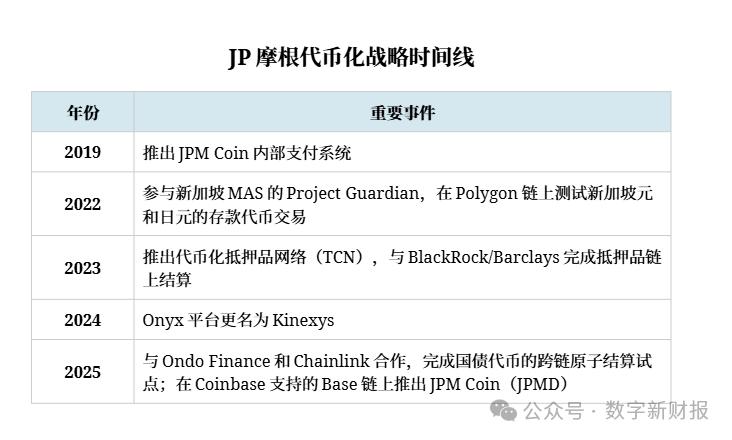
* Note: The above is a schematic timeline chart reflecting the main progress of JP Morgan's tokenization strategy.
Timeline diagram: The timeline of tokenization projects can be shown in the text (such as the internal launch of JPM Coin in 2019, the MAS triangular pilot in 2022, the launch of TCN in 2023, the renaming of Kinexys in 2024, and the cross-chain pilot in 2025, etc.).
Overall, JP Morgan is committed to bringing more financial assets onto the blockchain through the Kinexys platform to achieve real-time, programmable settlement . According to internal reports, tokenized assets offer advantages such as instant settlement and improved liquidity. JP Morgan believes this will help transform traditional markets, for example, by incorporating government bonds and commercial paper into the blockchain clearing system, thereby significantly reducing settlement risks and improving transaction speed and efficiency. Industry observers believe that this technology can save substantial costs in areas such as repurchase agreements and securities lending.
III. JPM Coin and On-Chain Settlement Exploration
JPM Coin (referred to as JPMD under the new naming system) is a US dollar deposit token issued by JP Morgan, used for the rapid transfer of US dollar funds between institutional clients on a blockchain network. In November 2025, the bank officially launched JPM Coin (JPMD) on the Coinbase -supported Base Chain, allowing clients to conduct 24/7 transactions on the public chain and achieve cross-border settlements in seconds. Unlike traditional interbank transfers that can take hours or even business days, JPM Coin can complete asset transfers in seconds.
Furthermore, JPM Coin represents real deposits in commercial banks, backed 1:1 by bank deposit reserves. In contrast, typical stablecoins (such as USDC) are issued by non-bank institutions and are usually backed by assets such as US dollar reserves or government bonds, but crypto platforms may not pass on the interest income from these reserve assets to holders. A JPMorgan executive pointed out that deposit tokens can generate returns for holders (i.e., paid interest), while most stablecoin issuers retain the returns on their assets and do not distribute them to ordinary holders.
The table below compares the main differences between JPM Coin deposit tokens, mainstream stablecoins, and traditional bank transfers in terms of issuing institutions, settlement times, and profit mechanisms :
characteristic | JPM Coin deposit token | Stablecoins (such as USDC/USDT) | Traditional bank transfer |
Issuing institutions | Commercial Bank (JP Morgan) | Commercial companies (e.g., Circle, Tether) | Banking System |
Asset-backed | Bank deposits (1:1 USD reserve) | US dollar reserves or government bonds, etc. (1:1) | Bank account balance |
Settlement Network | Blockchain (Public/Private chains such as Base) | Blockchain (Multi-Public Chain Network) | Traditional payment networks (SWIFT/ACH) |
Transaction timeliness | 24/7 Instant Settlement | 24/7 Instant Settlement | Settlement is usually done on weekdays. |
Reward Mechanism | Interest-bearing (linked to bank deposit interest rates) | Typically, no dividends are distributed; the issuer retains the profits. | Bank accounts may accrue interest. |
Regulatory attributes | Subject to banking system regulation; strict KYC procedures. | Inconsistent regulations; possible anonymity | Fully regulated by banks and regulatory agencies |
Target customers | Institutional banking clients | Crypto exchage and retail users | All bank customers |
interoperability | Exchangeable with bank accounts | Cross-chain exchange is possible | Interbank clearing |
As shown in the table above, the advantage of deposit tokens like JPM Coin lies in their issuers being regulated banks, providing the same security as bank accounts. They also leverage blockchain technology for 24/7 settlement and support the transfer of interest earnings to holders. While stablecoins offer the advantage of global circulation, their non-bank issuers are more susceptible to regulatory and monetary policy influences, and holders generally do not directly receive reserve asset returns. In contrast, JPM Coin is currently only issued to institutional investors, offering customers a solution that balances traditional credit with blockchain efficiency.
IV. Attitudes towards mainstream crypto assets and DeFi
JP Morgan has demonstrated both exploratory support and cautious approach to decentralized finance (DeFi). On one hand, the bank continues to conduct internal research and collaborative pilot programs on DeFi protocols. For example, in November 2022, the Onyx team, in the " Project Guardian " initiated by the Monetary Authority of Singapore (MAS), collaborated with DBS Bank of Singapore and SBI Digital Assets of Japan to trade tokenized Singapore dollar and Japanese yen deposits on the Polygon public blockchain. This pilot also used Aave Arc (a regulatory-compliant version of Aave) and Uniswap tools to verify the feasibility of institutional-grade decentralized lending and trading protocols. Onyx head Ty Lobban pointed out that as long as scalability and privacy solutions are in place, more traditional financial businesses will eventually migrate to public blockchains , indicating JP Morgan's positive expectations for the future role of DeFi technology on public blockchains. On the other hand, the JP Morgan team has also developed an on-chain identity verification framework, allowing DeFi applications to securely access institutional users without repeated KYC checks, providing a compliance approach for the cross-industry use of institutional-grade DeFi.
In May 2025, the Kinexys team partnered with crypto investment firm Ondo Finance and oracle service provider Chainlink to conduct a pilot cross-chain atomic settlement of government bond tokens on the Ondo private chain. This marked Kinexys' first connection between its permissioned blockchain and a public blockchain, utilizing Chainlink as a cross-chain communication layer to achieve synchronous settlement of traditional assets and on-chain assets . Nelli Zaltsman, Head of Settlement at Kinexys, stated that this move expands clients' on-chain settlement options and reflects JP Morgan's efforts to help institutional clients adapt to new payment infrastructures.
JPMorgan Chase holds a more cautious view on mainstream crypto assets such as Bitcoin and Ethereum. While CEO Dimon previously criticized Bitcoin as a "scam," his stance has shifted in recent years, arguing that clients have the right to invest in cryptocurrencies as long as the bank does not assume custody responsibilities. Currently, JPMorgan Chase does not offer cryptocurrency custody services to clients, but related research and trading activities are underway. For example, reports indicate that the bank's markets department is evaluating offering digital currency trading and derivatives services to institutional clients and plans to allow clients to use Bitcoin or Ethereum assets as collateral for loans. These reports primarily come from media coverage and analyst speculation, and there is currently no official confirmation. Overall, JPMorgan Chase maintains an open but cautious attitude towards crypto assets: promoting on-chain settlement solutions while continuously monitoring regulatory developments, striving to introduce innovative financial instruments to clients within the bounds of compliance.
V. Speculated Information and Industry Trends (For Reference Only)
According to media reports and industry rumors, JP Morgan may have more plans in the digital asset space, but these have not been officially confirmed. For example, Bloomberg reported that JP Morgan is "considering offering cryptocurrency trading services to institutional clients"; other reports speculate that the bank may allow clients to use crypto assets such as Bitcoin and Ethereum as collateral for loans. If these reports are true, it would further indicate that traditional financial institutions are showing increasing interest in digital assets. However, it is important to emphasize that such information is currently only industry speculation and does not represent JP Morgan's official position. Overall, JP Morgan is gradually opening up its acceptance of digital assets, but all key decisions will be subject to regulatory approval and market feedback.
References : This article cites official statements from JP Morgan, financial media reports, and industry research, including introductions to the Onyx/Kinexys platform, tokenized projects, JPM Coin, and DeFi pilots (some of which are analytical or speculative, as noted in the text).
" JPMorgan's Blockchain Arm Kinexys Tests Tokenized Carbon Credits With S&P Global" — CoinDesk Report
" Fidelity International Tokenizes Money Market Fund on JPMorgan's Blockchain" — CoinDesk Report
“ Mastercard and JPMorgan Link Up to Bring Cross-Border Payments on the Blockchain” — CoinDesk Report
" JPMorgan Chase Launches Tokenized Money-Market Fund" — Barron's report
" JPMorgan is Jumping Deeper into Crypto with a New Tokenized Money Fund" — Business Insider reports