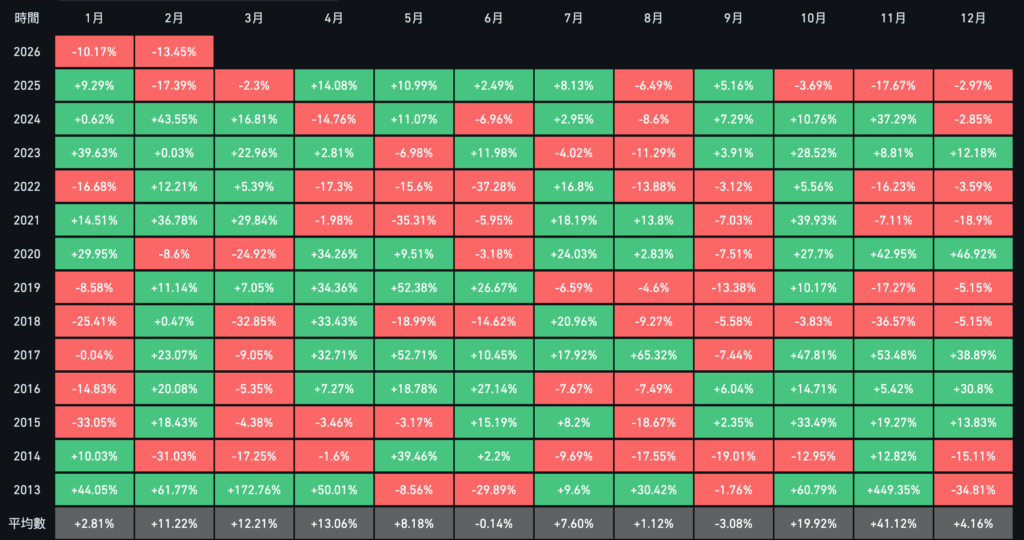
According to analysis by on-chain data platform Checkonchain, Bitcoin fell by 23% in the first 50 trading days of 2026, with a 10% drop in January and a further 15% drop in February, marking the worst start to the year on record.
More noteworthy is the potential for a structural "first": the occurrence of consecutive January and February declines in Bitcoin's history.
As the chart below shows, even during the Crypto Winter of 2018 (January -29%, but February flat) and the start of the bear market in 2022 (January -18%, but February rebound +12%), there was at least one month with positive returns. With less than ten days left in February, even this bottom line may not be held in 2026.
What did the on-chain data reveal?
On February 5th, Bitcoin recorded a realized loss of $3.2 billion (a record high for a single day). The MVRV ratio of short-term holders fell to 0.87, meaning they lost an average of 13%; 35.66% of the circulating supply was in a loss-making state, with an average loss of 18%.
Currently, about half of Bitcoin holders are losing money (about 50% of the circulating supply is at a loss), a situation that has only occurred historically in the bottom areas of 2015, 2019, and 2022.
However, bottoming signals and "having bottomed out" are two different things. On-chain analysts judge $60,000 (optimistic scenario) to $52,000 (pessimistic scenario, MVRV support level) as a possible bottoming range.
Structural problems of ETFs have come to light.
On the other hand, from November 2025 to January 2026, the assets under management of the US spot Bitcoin ETF saw a cumulative net outflow of approximately $7 billion, marking the longest period of continuous outflows since the ETF's inception.
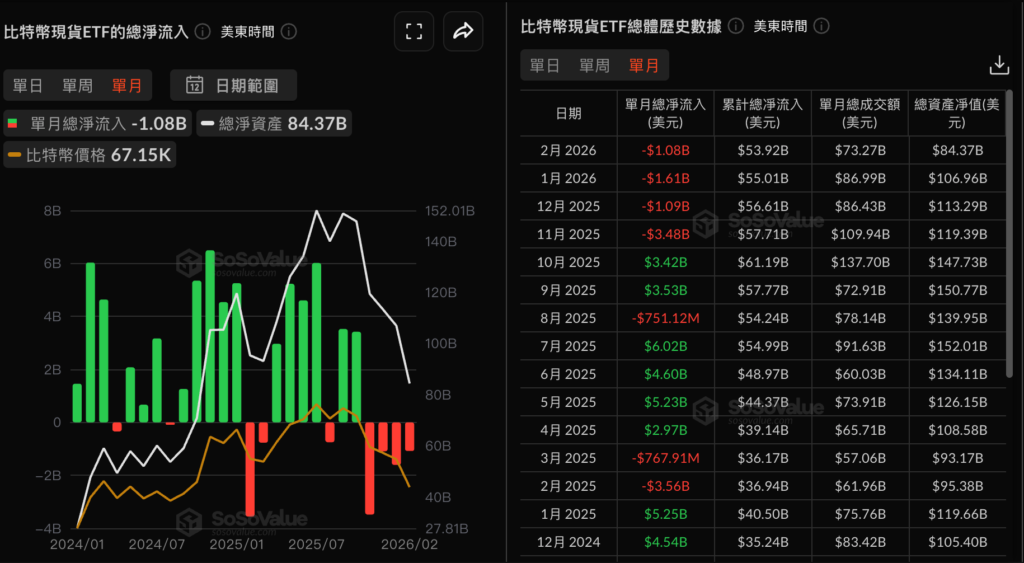
Markus Thielen of 10x Research raised a question: it is estimated that 55% to 75% of BlackRock IBIT holders are market makers and arbitrage funds, rather than genuine "conviction-driven" holders. If this estimate is close to the truth, then the "institutional demand" from ETFs may not be as robust as the surface figures suggest.
Although the overall structure has not broken down, the ETF narrative has shifted from "institutions are pouring in" to "we need to re-examine who is buying and why," which is itself a sign of a change in sentiment.
Why did the script, which had a four-year timeframe, become ineffective?
2025 is the first year after the halving, and historically, it has been one of Bitcoin's strongest years: up 5,507% in 2013, 1,331% in 2017, and 60% in 2021. However, 2025 will see a decline of approximately 6.33% for the entire year, making it the first post-halving year in history to close with a loss.
2026, the second year after the halving, is traditionally a "bear market year," and this label is currently being validated with greater force than expected.
Bitwise CFO Matt Hougan believes the four-year cycle is breaking, but his reasoning is optimistic: diminishing halving effects, ETF-driven institutional demand, and eventual interest rate declines will push new highs. However, these predictions face a straightforward counterargument: if the halving effect has diminished to the point of being unable to drive cyclical increases, then Bitcoin's price drivers will depend entirely on the macroeconomic environment and liquidity conditions.
At a time when the Federal Reserve is maintaining high interest rates, tariffs are pushing up inflation, and technology stocks are weakening, liquidity conditions are actually tightening.
Geoffrey Kendrick, global head of digital asset research at Standard Chartered, has cut his year-end 2026 price target from $150,000 to $100,000 and warned that Bitcoin could first fall to $50,000. His exact words were: "We expect further price capitulation in the coming months."
Peter Brandt offered the most pessimistic prediction: if the parabolic structure breaks down, the lowest point could be $25,000, with the real bottom possibly not appearing until October 2026.
Bitcoin, the most institutionalized cryptocurrency, has had its worst start yet.
This is the deepest contradiction at the beginning of 2026: Bitcoin has never been so "institutionalized": it has spot ETFs, strategic reserves, a friendly regulatory environment, and the backing of mainstream financial institutions, yet its price performance has had the worst start in history.
This contradiction reveals not that institutionalization has failed, but that institutionalization has changed the very nature of Bitcoin. When Bitcoin becomes a macro-asset, it must be subject to macro-economic forces. Federal Reserve interest rate decisions, global trade policies, and tech company earnings season—variables that were previously "unrelated" to Bitcoin—are now its core pricing factors.
The four-year cycle scenario is based on the premise that halvings cause supply shocks, driving up prices. However, when Bitcoin's market capitalization reaches trillions of dollars, the difference between 6.25 and 3.125 coins per block becomes insignificant relative to the overall market size. The price is no longer driven by the mathematics of mining rewards, but by the mathematics of the Federal Reserve's balance sheet.