Author: XinGPT
During the Spring Festival of 2026, I made a decision: to agent all of my business processes.
One week later, the system is nearly one-third operational. Although the system is still being improved, my daily routine work hours have been reduced from 6 hours to 2 hours, but business output has increased by 300%.
More importantly, I verified an assumption: the agent-based transformation of personal businesses is feasible, and I believe everyone should build such an operating system.
Having an agent system means a complete shift in your mindset, from "How can I get this job done?" to "What kind of agent should I build to get this job done?" The impact of this shift from a passive to an active mindset is enormous.
In this article, I will not offer any AI-generated motivational platitudes, nor will I deliberately create anxiety about AI replacement. Instead, I will thoroughly break down how I completed this transformation step by step, and how you can replicate this method for free.
This is the first article in building an agent productivity system. Click to bookmark it now so you can follow future updates and not get lost.

Why is agent-based implementation a mandatory option, not an optional one?
Let me start with a harsh truth:
If your business model is "time for income," then your income ceiling is already locked in by the laws of physics. There are only 24 hours in a day, and even if you work all year round, there's still a limit to your hourly rate.
A fund manager's annual salary of ¥1.5 million is approximately ¥720 per hour (based on 2080 working hours).
Consulting partner annual salary ¥2 million ≈ ¥960 per hour
Top financial KOLs earning ¥3 million annually ≈ ¥1440 per hour
It looks very high? But this is already the limit of the human-powered model.
The logic of agent-based systems is completely different: your income is no longer determined by working hours, but by the efficiency of the system.
A real turning point
On a Friday night in January 2026, at 11 p.m., I was still in front of my computer organizing the day's market data.
That day, the US stock market crashed, and I needed to:
After reading 50+ important news items
Analysis of the after-hours performance of 10 key companies
Update my portfolio strategy
Write a market analysis article
I calculated that it would take at least another 3 hours. And the next morning at 8 o'clock, I would have to repeat the same process.
At that moment, I suddenly realized that I wasn't spending my time on investment analysis and decision-making; I was just a data transporter.
The decisions that truly require my judgment probably only take up 20% of my time. The remaining 80% is repetitive information gathering and organization.
This is where my decision to go from "Agentization" came from.
My investment research agent system now processes data automatically every day:
20,000+ global financial news items
Financial report updates from 50+ companies
30+ macroeconomic data indicators
10+ industry research reports
If we were to do this work manually, it would require a team of 5 people. My costs would be: $500 USD per month for API calls + 1 hour of my daily review time.
This is the essence of agentification: using algorithms to replicate your judgment framework and replacing human costs with API costs.
01 Deconstructing Your Business: A Three-Tier Architecture from People to Systems
Any knowledge work can be broken down into three layers:
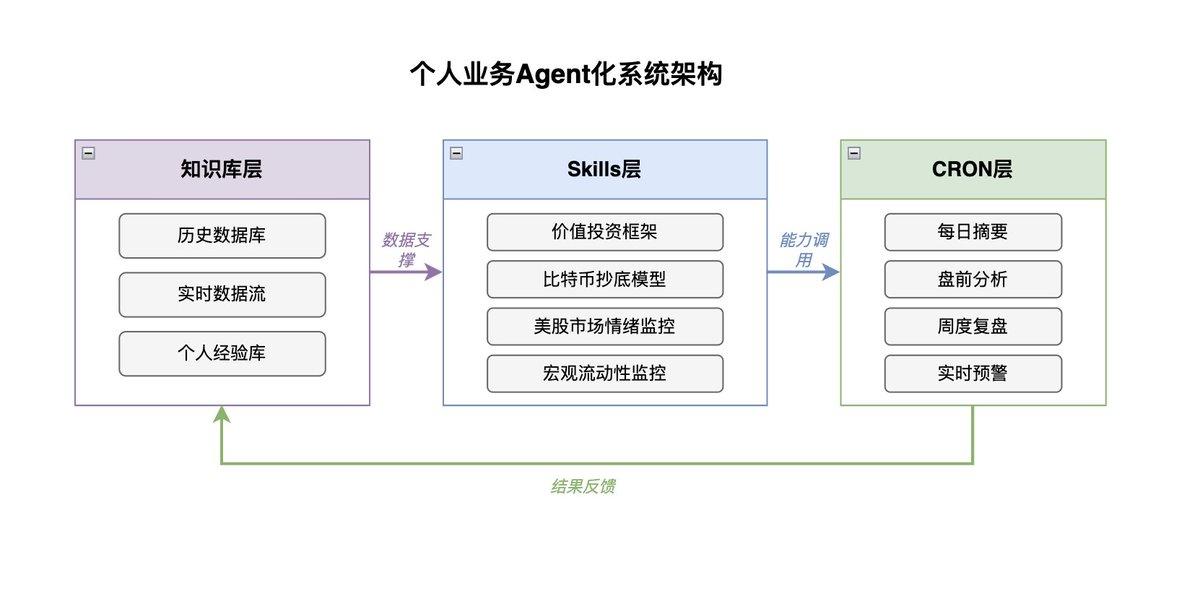
First layer: Knowledge Base
This is the Agent's "memory system".
Taking investment research as an example, my approach is to build a knowledge base containing the information and data I need for my investments, including:
1. Historical Database
Macroeconomic data from the past 10 years (Federal Reserve, CPI, non-farm payrolls)
Financial data of the top 50 US stock companies
Retrospective notes on major market events (2008 Financial Crisis, 2020 Pandemic, 2022 Interest Rate Hike Cycle)
2. Key Indicators and News
The main financial media and information channels I follow
Federal Reserve policy and key company earnings release dates
My 50 Twitter accounts (macro analysts, fund managers)
Key macroeconomic indicators
Important industry research and industry data tracking
3. Personal experience database
My investment decision record over the past 5 years
Reviewing each judgment of right or wrong
A specific example: the market crash in early February 2026
In early February, the market suddenly plummeted, gold and silver prices collapsed, cryptocurrencies experienced a flood of liquidity, and US, Hong Kong, and A-shares all plunged.
There are several interpretations in the market:
Anthropic's legal AI is so powerful that its software stock has crashed.
Google's capital expenditure guidance is too high.
Incoming Federal Reserve Chairman Warsh is a hawk.
My agent system issued a warning 48 hours before the crash because it monitored:
Japanese bond yields jumped, and the US2Y-JP2Y spread narrowed significantly.
With TGA account balances remaining high, the Ministry of Finance continues to extract funds from the market.
CME raises margin requirements for gold and silver futures for the sixth consecutive time.
These are all clear signals of tightening liquidity. And in my knowledge base, there is a complete review of the market volatility triggered by the unwinding of yen carry trades in August 2022.
The Agent system automatically matched historical patterns and gave a recommendation of "liquidity shortage + high valuation → reduce positions" before the crash.
This warning helped me avoid a drawdown of at least 30%.
This knowledge base contains over 500,000 structured data entries, with over 200 automatically updated daily. Manual maintenance would require two full-time researchers.
Second layer: Skills (decision-making framework)
This is the most easily overlooked, but most crucial layer.
Most people use AI by opening ChatGPT, entering their question, and getting the answer. The problem with this method is that the AI doesn't know your judgment criteria.
My approach is to break down my decision-making logic into independent skills. Take investment decisions as an example:
Skill 1: US Stock Value Investing Framework
(The following Skills are examples and do not represent my actual investment criteria, and my investment judgment criteria are updated in real time):
markdown
输入:公司财报数据
判断标准:
- ROE > 15%(持续3年以上)
- 负债率< 50%
- 自由现金流> 净利润的80%
- 护城河评估(品牌/网络效应/成本优势)
输出:投资评级(A/B/C/D)+ 理由
Skill 2: Bitcoin Buy the dips Model
markdown
输入: 比特币市场数据
判断标准:
- K线技术指标: RSI < 30 且周线级别超跌
- 交易量: 恐慌抛售后成交量萎缩(低于30日均量)
- MVRV比率: < 1.0(市值低于实现市值,持有者整体亏损)
- 社交媒体情绪: Twitter/Reddit恐慌指数> 75
- 矿机关机价: 现价接近或低于主流矿机关机价(如S19 Pro成本线)
- 长期持有者行为: LTH供应占比上升(抄底信号)
触发条件:
- 满足4个以上指标→ 分批建仓信号
- 满足5个以上指标→ 重仓抄底信号
输出: 抄底评级(强/中/弱) + 建议仓位比例
Skill 3: Monitoring US Stock Market Sentiment
markdown
监控指标:
- NAAIM暴露指数: 活跃投资经理的股票持仓比例
· 数值> 80 且中位数触及100 → 机构加仓空间见顶预警
- 机构股票配置比例: State Street等大型托管机构数据
· 处于2007年以来历史极值→ 反向预警信号
- 散户净买入额: 摩根大通追踪的每日散户资金流向
· 日均买入量> 85%历史水平→ 情绪过热信号
- 标普500远期市盈率: 监控是否接近历史估值峰值
· 接近2000年或2021年水平→ 基本面与股价背离
- 对冲基金杠杆率: 高杠杆环境下的拥挤仓位
· 杠杆率处于历史高位→ 潜在波动放大器
触发条件:
- 3个以上指标同时预警→ 减仓信号
- 5个指标全部预警→ 大幅减仓或对冲
输出: 情绪评级(极度贪婪/贪婪/中性/恐慌) + 仓位建议
Skill 4: Macro Liquidity Monitoring
markdown
监控指标:
- 净流动性= 美联储总资产- TGA - ON RRP
- SOFR(隔夜融资利率)
- MOVE指数(美债波动率)
- USDJPY + US2Y-JP2Y利差
触发条件:
- 净流动性单周下降>5% → 预警
- SOFR突破5.5% → 减仓信号
- MOVE指数>130 → 风险资产止损
The essence of these skills is to make my judgment criteria explicit and structured, so that AI can work according to my thought framework.
Third layer: CRON (Automated Execution)
This is the key to making the system truly function.
I have set up the following automated tasks:
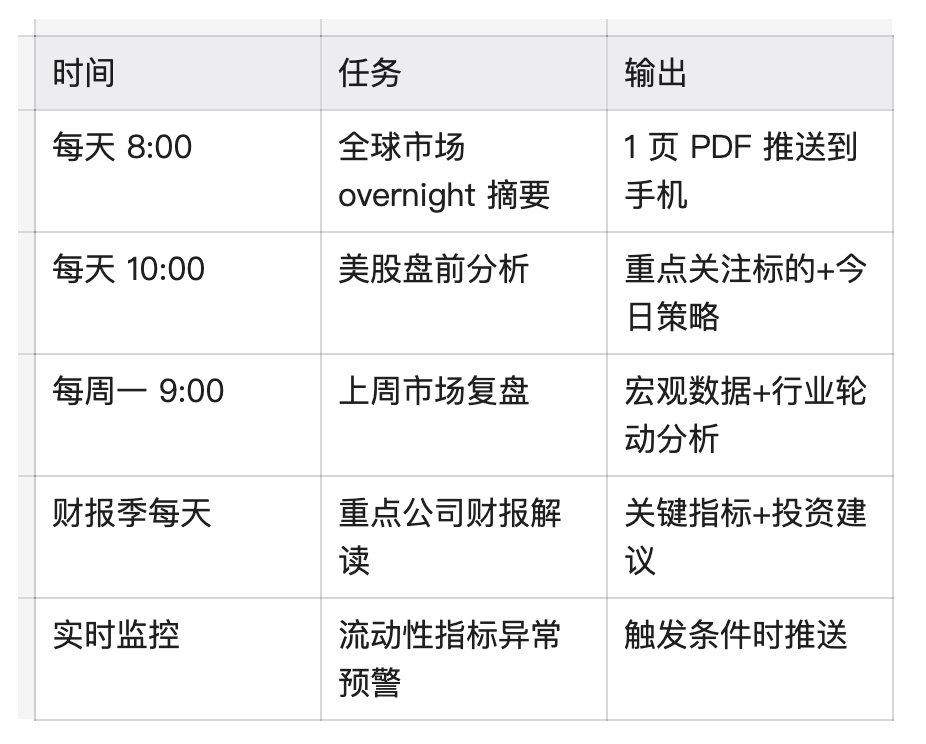
This is what my morning looks like now:
I woke up at 7:50 AM and checked my phone while brushing my teeth. The agent had already pushed out the overnight global market summary:
U.S. stocks rose slightly overnight, with technology stocks leading the gains.
The Bank of Japan kept interest rates unchanged, and the yen depreciated slightly.
Crude oil prices rose 2% due to geopolitical factors.
Today's key focus: US CPI data, Nvidia earnings report.
8:10 Have breakfast and turn on the computer to review the detailed analysis. The Agent has already generated today's strategy:
The CPI data was in line with market expectations and had a neutral impact on the market.
Nvidia's financial report will be key to understanding its AI chip order guidance.
Recommendation: Maintain a position in technology stocks and pay attention to opportunities in the energy sector.
I start work at 8:30. My only task is to make the final decision based on the agent's analysis: whether to adjust the portfolio, and by how much.
The whole process takes 30 minutes.
I no longer need to frantically search for the news every morning; AI has already done the pre-reading for me.
More importantly, investment decisions are no longer easily influenced by emotions, but rather based on a complete investment logic, clear judgment criteria, and review, summary, and iteration based on investment performance. This is the correct path for investing in the AI era, rather than continuing to hire a large number of interns to work overtime every day to update Excel profit forecast tables, or going all in with 50x All In based on gut feeling, waiting for miracles to happen.

02 The Agentification of Content Production: From Handicraft Workshops to Production Lines
My second main business is content creation, currently primarily on Twitter, but I'm also exploring YouTube and other video formats.
My usual process for writing an article was:
Finding topics (1 hour)
Research (2 hours)
Writing (3 hours)
Edit (1 hour)
Posting + Interaction (1 hour)
It takes a total of 8 hours to produce one article, and the quality is inconsistent.
I reviewed the biggest problems with my previous articles, and there are several key points:
The topic is too broad and lacks a specific angle.
The content is too theoretical and lacks specific examples.
The title is not attractive enough
Release time
The integration of agent-based content production is a systematic engineering process!
Therefore, at the content level, my agent-based transformation involves three steps:
Step 1: Build a knowledge base for viral content
I did something that many people overlooked: I systematically studied the patterns of viral articles.
Specific steps:
We crawled the top 200 most popular articles in the finance/technology fields on the X platform over the past year.
Use AI to analyze their commonalities: title structure, opening style, argumentation logic, and ending design.
Extracting a reusable "blockbuster formula"
Here are a few examples:
Title Formula:
The shocking figure: "After my assets shrank by 70%, I realized..."
Counterintuitive: "The Internet is dead, agents are immortal."
Value promise type: "Help you save money...no need to buy from Xianyu (a second-hand marketplace)."
Opening formula:
Specific event as an example: "In January 2025, I made a decision..."
Extreme contrast: "If you continue at the current pace... but 6 months later..."
First break down, then build up: "There are several interpretations in the market... I think none of the above are correct."
Argument structure:
Opinion → Supported by Data → Case Validation → Counter-argument
Use 1/2/3 to clearly layer
Technical terms + plain language explanation
I compiled these patterns into a "framework library for viral content" and fed it to the AI.
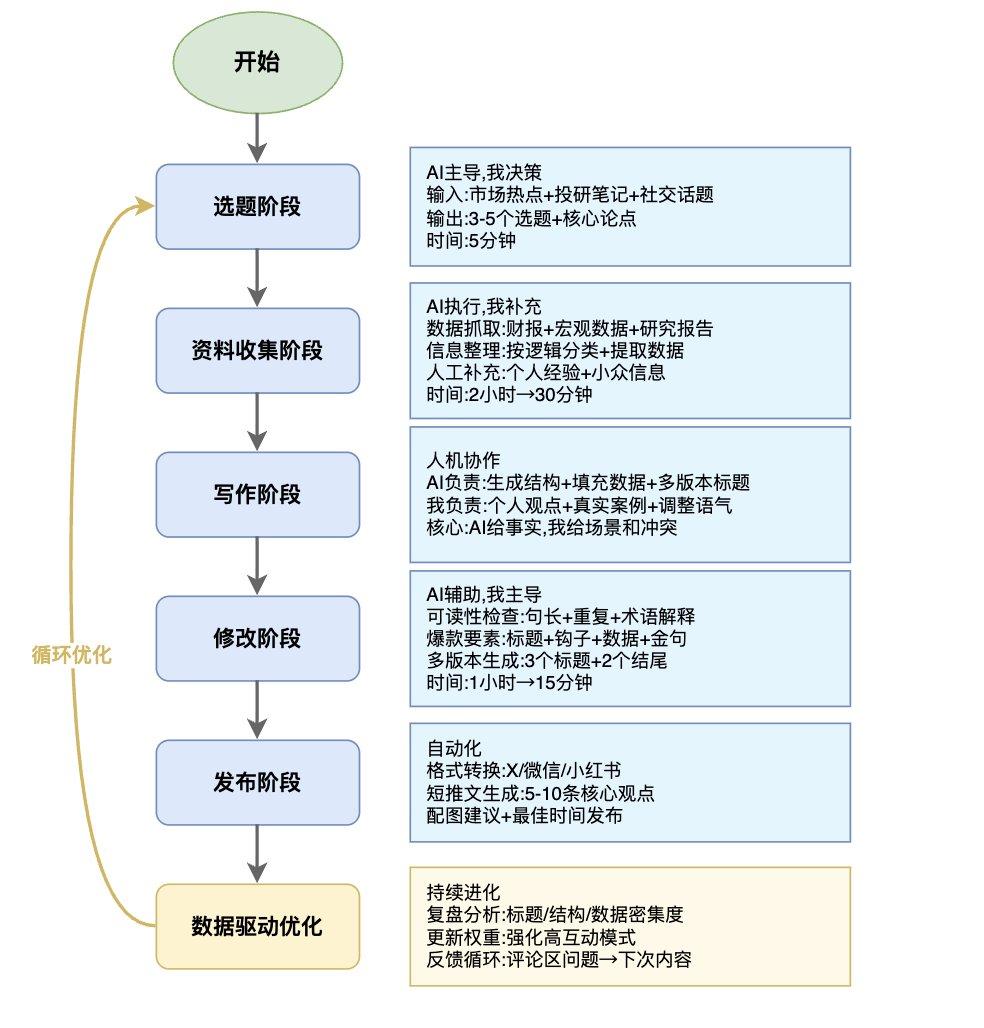
Step Two: Human-Machine Collaborative Content Production Line
My content production process has now become a highly efficient human-machine collaborative production line, with clear division of labor at each stage.
Topic selection stage (AI-driven, my decision-making)
Every Monday morning, my agent automatically pushes 3-5 topic suggestions.
Input source:
This week's global market highlights (automatically captured)
My investment research notes and latest thoughts
Frequently discussed topics on social media
Frequently asked questions in the reader comments section
AI output format:
markdown
选题1: 比特币突破10万美元背后的流动性逻辑
核心论点: 不是需求驱动,而是美元流动性扩张的结果
潜在爆点: 数据密集+反常识观点
预估互动率: 高
选题2: 为什么AI公司都在亏钱,但股价还在涨
核心论点: 市场定价的是未来现金流折现,不是当下利润
潜在爆点: 解答大众困惑
预估互动率: 中高
选题3: 散户情绪指标创新高,该逃顶了吗
核心论点: 情绪指标需要结合流动性环境判断
潜在爆点: 实用工具+方法论
预估互动率: 中
I will choose topics that best reflect the current market sentiment and that I have unique insights into.
Data collection phase (executed by AI, I will add details)
After selecting a topic, the Agent automatically initiates the data collection process:
1. Data scraping (automated)
- Latest financial data of relevant companies
- Historical trends of macroeconomic indicators
- Key viewpoints of the industry research report
- Representative viewpoints on social media
2. Information organization (AI processing)
- Categorize scattered information according to logical reasoning.
- Extract key data and citation sources
- Generate a preliminary argument framework
3. Artificial supplementation (my value)
- Incorporating my personal experience and case studies
- Supplementing niche information sources that the agent cannot find
- Which viewpoints require further elaboration?
- This phase has been shortened from 2 hours to 30 minutes.
Writing stage (human-computer collaboration)
This is the most crucial step, and my division of labor with the AI is very clear:
AI is responsible for:
Generate article structure based on the framework of viral content.
Fill in the data and factual content
Multiple title and opening versions are available for selection.
Ensure the integrity of the argument logic
I am responsible for:
Injecting personal opinions and value judgments
Include real-life examples and details
Adjust tone and expression
Delete AI-generated "correct nonsense".
Modification phase (AI-assisted, I lead)
After the first draft is completed, I will have the agent do a few things:
1. Readability check
- Is the sentence too long? (Sentences exceeding 30 words are highlighted in red.)
- Is there any repetition?
- Do technical terms need explanation?
2. Check the elements of a hit product
- Does the title conform to the high interaction rate model?
- Does the first three paragraphs contain hooks?
- Is there any specific data to support this?
- Are there any memorable quotes?
3. Multiple version generation
- Generate 3 different styles of titles
- Generate two endings from different perspectives.
I choose the most suitable version.
This phase has been shortened from 1 hour to 15 minutes.
Release phase (automated)
Once the article is finalized, the Agent will automatically execute:
Convert to the formats of various platforms (X/WeChat Official Accounts/Xiaohongshu)
Generate suggested images (generated after I confirm).
Publish automatically at the optimal time (based on historical data analysis).
Step 3: Data-driven continuous optimization
Key takeaway: Content Agent is not a one-time setup, but a continuously evolving system.
I do a weekly review:
Which type of title has the highest collection rate? → Update title formula weight
Which argument structure gets the most shares? → Strengthen this template
What are the most frequently asked questions in the reader comments section? → Add to FAQ, and we'll answer them in the next article.
For a specific example:
I discovered that "data-intensive" articles (containing numerous specific numbers and charts) had a 40% higher save rate than purely opinion-based articles. Therefore, I adjusted the content framework and asked the AI to include the following in the initial draft:
Each core argument must be supported by at least one piece of data.
Each article should contain at least 3 charts.
Data sources must be clearly indicated.
Result: The average collection rate of the most recent 5 articles increased from 8% to 12%.
In January 2026, I wrote an article titled "In the Era of the Agent Explosion, How Should We Deal with AI Anxiety?"
This article has a small amount of data, but its forwarding rate is unusually high, reaching 20%.
I asked the Agent to analyze the cause, and found that:
The article touches upon a profound question of values (the meaning of AI vs. humanity).
The specific scenario used was "Should you save the cat or the famous painting if the Louvre is on fire?"
The concluding statement, "It's important to become a better AI user, but it's even more important not to forget how to be a human being," resonated with many.
I've added this discovery to my framework library: appropriately incorporating philosophical reflections and value discussions into technical articles can significantly increase the rate of sharing.
This is the compounding effect of agent systems: the system helps me optimize the system. Content agents are not built once and then stop, but are a continuously evolving system.
03 From Individual Capabilities to Consulting Services: Validating the Replicability of the Methodology
After I got my investment research and content agent system working, I started to think: Could this approach help others?
Last December, I had dinner with a fund manager who said he was overwhelmed with work. He manages a private equity fund of 500 million yuan with nearly 10 people under him, but he still feels like he is being led by the nose by market news and is running around every day.
His daily work routine is as follows:
I get up at 6:30 in the morning to check the overnight global markets.
7-8 PM: Check out the key global market news overnight.
8:30-9:30: Morning meeting to discuss investment strategies.
9:30 AM - 3:00 PM: Monitor the market and process transactions.
3 PM - 6 PM: Research companies and review financial statements.
6-8 PM: Write an investment log and review past performance.
10 PM: Watch overseas markets open.
I helped him perform a workflow analysis and found that:
60% of the time is spent collecting and organizing information (which can be agent-based).
20% of the time is spent on repeatability analysis (which can be agent-based).
15% of the time is spent making decisions (human-machine collaboration)
5% of the time is spent on trade execution (which can be automated).
Therefore, I spent two weeks helping him build a simplified investment research agent:
Week 1: Interview him about his workflow and identify agentable steps.
Week 2: Build a knowledge base + Configure 3 core skills + Set up automated tasks
Two weeks later, he sent me a WeChat message: "With more time to think, my investment mindset has become more stable."
This project made me realize that the need for agent-based transformation is universal, and reducing information processing time is a way to improve investment efficiency.
But I soon discovered that simply doing consulting had two problems:
Time constraint: Each project takes 2-4 weeks, and I can only take on a maximum of 3 projects a month.
Non-scalable: Each customer's needs are different, making standardization difficult.
This made me start thinking about the next stage: from service to product.
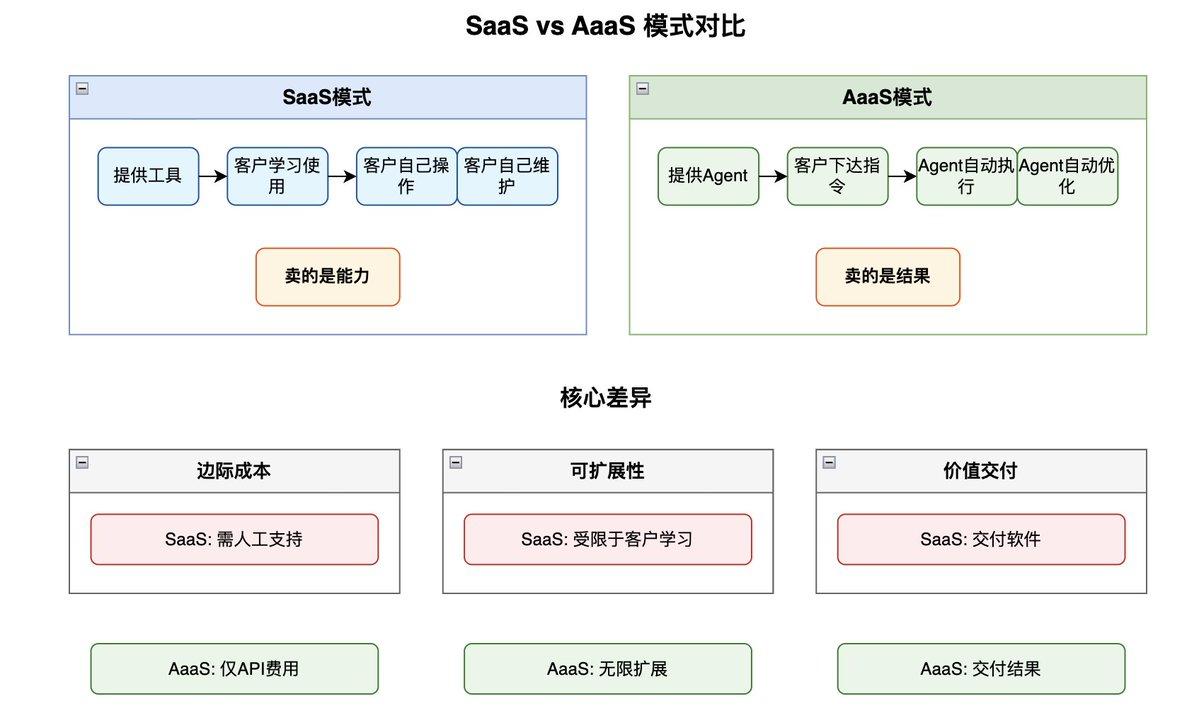
04 Agent as a Service: The Paradigm Shift from SaaS to AaaS
Traditional software is SaaS (Software as a Service):
You give the customer a tool
Customers need to learn how to use it
Customers operate and maintain themselves.
The future is AaaS (Agent as a Service):
You give the customer an agent
The customer only needs to give instructions
Agent auto-execution and auto-optimization
The difference is that SaaS sells "capabilities", while AaaS sells "results".
In January of this year, I had dinner with that fund manager friend of mine.
He said, "The agent system you helped me build is amazing. I've recommended it to several colleagues, and they all want it. But how many clients can you serve as a consultant?"
I said, "Indeed, that's a problem."
He said, "Why don't you turn it into a product? Like Salesforce, but instead of selling software, you sell agent services."
Indeed, I believe that good agents should be developed into services to replace SaaS. Just as Peter, the creator of Openclaw, predicted, the future will belong to agents, and users will no longer need to install software.
Therefore, I think that after this Agent system is fully developed, it should be made into an open-source project so that everyone can copy and use it; for institutional clients with commercial needs, advanced features can be offered through paid subscriptions or billed based on usage.
05 The essence of agentization: from time leverage to algorithmic leverage
Having written this far, I'd like to share some deeper thoughts.
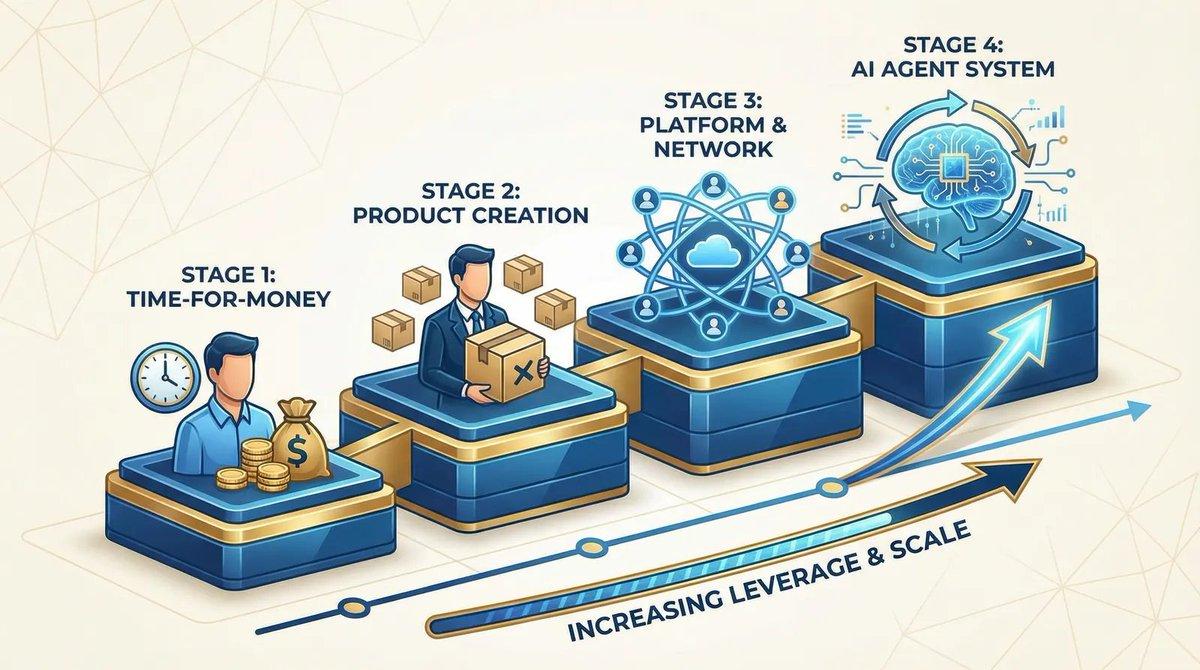
The traditional growth path for personal business is:
Beginner stage: Selling time (charged by the hour)
Intermediate stage: Selling products (develop once, sell multiple times)
Advanced stage: Selling the system (building a platform for others to trade on).
Agentification provides a fourth path: selling algorithm capabilities.
You no longer need:
Hire a team (saves management costs)
Develop a complex software program (by eliminating the need for technical expertise).
Establish a platform (eliminating the need for network effect cold start).
You only need to:
Structure your professional knowledge
Configure Agent System Execution
Continuous optimization of algorithm framework
This is a new kind of leverage: algorithmic leverage.
Its characteristics are:
Low cost: mainly due to API call fees, which are far lower than labor costs.
Replicable: The same agent can serve countless clients.
Evolvable: As the capabilities of the larger model improve, your agent automatically becomes stronger.
Your Agentification Action Checklist
If this article has moved you, we suggest you take the following steps:
Step 1: Diagnosis (to be completed this week)
Make a daily to-do list and mark it:
Which tasks are repetitive (information collection, data processing, format conversion)?
Which tasks involve judgment (decision-making, creativity, strategy)?
What constitutes implementation work (posting, tracking, responding)?
Principles: Prioritize agent-based processing for repetitive tasks, implement human-machine collaboration for judgment-based tasks, and automate execution tasks.
A simple exercise
Take out a piece of paper and write down your to-do list for yesterday.
For every task, ask yourself three questions:
Can this task be standardized? (If so, it can be agent-based.)
Does this task require creative thinking? (If not, it can be agent-based.)
Does this task require my unique judgment? (If not, it can be agent-based.)
You'll find that at least 50% of jobs can be agent-based.
Step 2: Setup (to be completed this month)
Choose a minimum feasible scenario to begin the experiment.
Here are a few examples:
If you are an investor → Set up a "Daily Market Summary Agent"
If you are a content creator → Build a "Topic Suggestion Agent"
If you are in sales → Build a "Customer Background Research Agent"
If you are a designer → Build a "Design Inspiration Collection Agent"
Don't strive for perfection; first, get the smallest closed loop working.
Step 3: Optimization (to be completed this quarter)
Record how much time the Agent system saves you and whether the output quality is consistent.
Do a weekly review:
Which aspects do agents perform well in?
Which steps still require human intervention?
How can I adjust Skills to make the Agent better match my criteria?
Step 4: Commercialization (to be completed this year)
Once your agent system is running stably, consider:
Is this method valuable to peers?
If so, how much are they willing to pay?
Can you productize it?
If the answer is yes, congratulations, you have found a new business model.
Later, I will share how to build your agent system using Openclaw or other latest AI tools. If you have video editing experience, are proficient in using agent tools such as Openclaw, or have even done your own AI project development, please feel free to contact me . I am recruiting full-time partners to build the future together.
- After my US stock assets shrank by 70%, I realized the real reason for the massive crash. (This article breaks down the real reasons for the market crash in early 2026, and outlines my liquidity monitoring indicator system. If you're an investor, this article will help you develop a macro perspective.)
- In an era of agent proliferation, how should we cope with AI anxiety? (This article explores a deeper question: as AI becomes increasingly powerful, where does humanity's value lie? My view is that AI is responsible for instrumental rationality (efficiency), while humanity is responsible for value rationality (meaning). This is the philosophical foundation of agentization.)