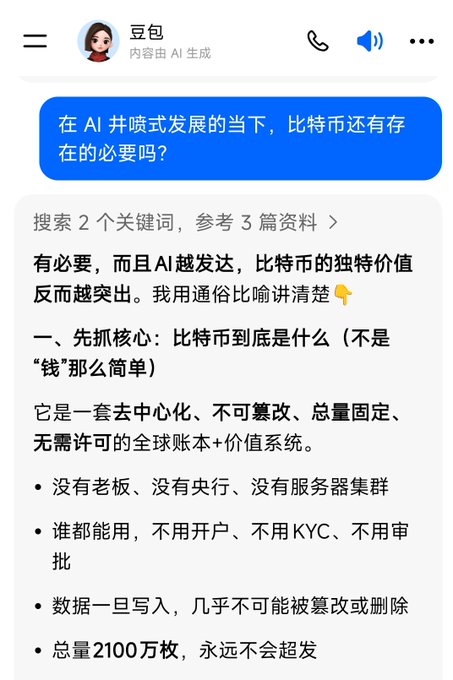
I asked Doubao, "Is there still a need for Bitcoin?" This is Doubao's reply to me: It's necessary, and the more advanced AI becomes, the more prominent Bitcoin's unique value will become. Let me explain with a simple analogy 👇 First, grasp the core: What exactly is Bitcoin (it's not as simple as "money")? It is a decentralized, immutable, fixed-total, permissionless global ledger and value system. - No boss, no central bank, no server cluster - Anyone can use it; no account opening, KYC, or approval required. - Once data is written, it is virtually impossible to tamper with or delete it. - Total supply of 21 million coins, never to be over-issued. II. With the AI boom, why is Bitcoin needed even more? 1. The biggest crisis in the AI era: the collapse of trust. AI can generate incredibly realistic deepfakes, forge documents, tamper with data, and manipulate public opinion. Humans can no longer distinguish between genuine and fake products using their eyes, ears, or signatures. The Bitcoin blockchain is the world's strongest "digital anchor of truth". - Any important data, contracts, identities, or property rights, stored on the blockchain, become permanent and immutable ironclad evidence. This is something that even the most powerful AI cannot forge or alter. 2. AI needs "machine-native currency," which fiat currency cannot provide. In the future, billions of AI agents will work, transact, and pay on their own. AI has no nationality, no ID card, cannot open a bank account, and cannot use a credit card. - Fiat currency systems rely on centralized institutions, KYC (Know Your Customer) verification, and manual checks; AI cannot be used for these. Bitcoin is permissionless, globally accepted, and runs purely on code, making it the only native value carrier that AI can utilize. Just as the internet needs TCP/IP, the AI economy needs Bitcoin as a value protocol between machines. 3. Combating the dual chaos of deflation and inflation brought about by AI AI will cause a surge in productivity and a sharp drop in costs, which could trigger deflation; at the same time, central bank money printing could trigger inflation. - Fiat currencies are either depreciating or experiencing deflation; they are unstable. Bitcoin has a fixed total supply, transparent code, and is not centrally controlled. - It is a hard currency independent of AI and fiat currency, like digital gold. 4. Bitcoin is the "hard currency" of computing power/energy for AI. AI is most dependent on computing power and electricity, while Bitcoin mining is essentially exchanging electricity for computing power and digital scarcity. AI requires stable payments for computing power/energy. Bitcoin's value is strongly tied to global electricity/computing costs. - Becoming the most reliable "hard currency" in the AI world III. Bitcoin's shortcomings (which do not affect its necessity) Slow transactions and high fees: The mainnet takes 10 minutes to generate a block, making it unsuitable for high-frequency, small-amount transactions. - Single function: It can only transfer funds and cannot create complex smart contracts → But it does not need to be omnipotent. It only needs to do the most basic value storage and the most basic value transfer, and leave the rest to public chains such as Ethereum and Solana. IV. One-sentence summary AI is the brain, responsible for thinking, creating, and fabricating. Bitcoin is the skeleton and heart, responsible for preserving the truth, transmitting value, and anchoring trust. The more powerful AI becomes, the more humans and machines need a foundation of value and trust that is not controlled by AI, is immutable, and is based on global consensus—this is the irreplaceable necessity of Bitcoin. Would you like me to compare the roles of Bitcoin, Ethereum, and stablecoins in the AI era to help you understand their respective positions more clearly?
This article is machine translated
Show original

From Twitter
Disclaimer: The content above is only the author's opinion which does not represent any position of Followin, and is not intended as, and shall not be understood or construed as, investment advice from Followin.
Like
Add to Favorites
Comments
Share
Relevant content