Author: CryptoSlate/Oluwapelumi Adejumo
Compiled by: TechFlow TechFlow
TechFlow Dive: Bitcoin recently rebounded to $70,000, and a conspiracy theory linking Jane Street to "market manipulation at the opening of the US stock market" has been circulating wildly in the crypto community. This article dissects this claim from three dimensions: on-chain data, ETF structure, and option positions. The conclusion is that the real problem is not Jane Street, but the price discovery black box of the ETF era—the lack of transparency in institutional hedging is making it increasingly difficult for ordinary investors to understand the market.
The full text is as follows:
Bitcoin has rebounded in the past 24 hours, approaching $70,000, reigniting a familiar debate in the crypto market: Do Wall Street institutions operating within the spot ETF ecosystem have too much influence over price discovery?
The target this time is Jane Street, a quantitative trading firm that is both a major ETF intermediary and a defendant in a new lawsuit related to the 2022 Terraform Labs collapse.
On social media, traders have linked Bitcoin’s recent rally to a claim that a pattern of sharp intraday drops that occurred near the opening of the US stock market suddenly disappeared after the lawsuit was made public.
This theory spread rapidly because it combined two already resonant ideas: distrust of large trading institutions and unease about the Bitcoin market increasingly operating through traditional financial channels.
However, the evidence supporting the "coordinated suppression of Bitcoin" plan remains weak.
This event reveals more clearly that the structure of spot Bitcoin ETFs has made it increasingly difficult for many investors to distinguish between genuine spot demand and market-making, hedging, and arbitrage activities.
In this sense, the Jane Street controversy transcends accusations against a single institution. At its core, it concerns how Bitcoin's new institutional infrastructure will shape price discovery, and whether the market will become more efficient or increasingly opaque.
The Origins of the Jane Street Bitcoin Rumors
The rumor took shape after Bitcoin rebounded sharply for two consecutive trading days. Users on X began claiming that the so-called "10 a.m. sell-off" had disappeared.
It's worth noting that the X account Negentropic, run by Glassnode co-founders Jan Happel and Yann Allemann, was a key driver in spreading this theory. They claimed, "With the Jane Street lawsuit made public, the Bitcoin crash at 10 o'clock miraculously disappeared."
This claim quickly gained attention because Jane Street is no unknown entity. It is one of the world's largest trading firms and a prominent player in the Bitcoin ETF market, serving as an authorized participant in IBIT (BlackRock Spot Bitcoin ETF).
In practice, this makes it tightly embedded in the core mechanism that keeps ETF share prices aligned with the value of the underlying holdings.
Meanwhile, legal disputes involving the company have further fueled the controversy.
The liquidation administrators of Terraform Labs have filed a lawsuit in Manhattan alleging that Jane Street and other entities profited from materially non-public information related to Terraform liquidity operations during the TerraUSD crash in May 2022.
The complaint alleges that Terraform withdrew $150 million of TerraUSD liquidity from Curve's 3pool, while wallets associated with Jane Street withdrew approximately $85 million within minutes of the news being made public.
Jane Street denies any wrongdoing and calls the case a desperate attempt to shift responsibility for losses caused by Terraform's own actions onto others.
This lawsuit proves nothing about current Bitcoin transactions.
But it explains why traders quickly linked Jane Street to an observable market pattern. In the crypto world, trust is often fragile, and an institution accused in one market event often becomes a suspect in the next.
Industry insiders refute rumors
Against this backdrop, some Bitcoin traders believe that the top cryptocurrency has been mechanically sold off around the opening of US stock markets for months, liquidating long positions and creating a liquidity vacuum in a thin order book.
If this sell-off subsides after Jane Street faces new legal pressures, it may indicate that the company has been putting pressure on the market all along.
Furthermore, the company's early association with FTX founder Sam Bankman-Fried has cast a shadow over its image. Bankman-Fried worked at the trading firm before founding FTX.
This narrative is emotionally convincing, but it is far easier to assert than to prove.
James Check, an on-chain analyst at Checkonchain, directly refuted this argument, writing that Jane Street did not suppress Bitcoin; rather, the price movement was better explained by long-term holders selling their holdings to the market.
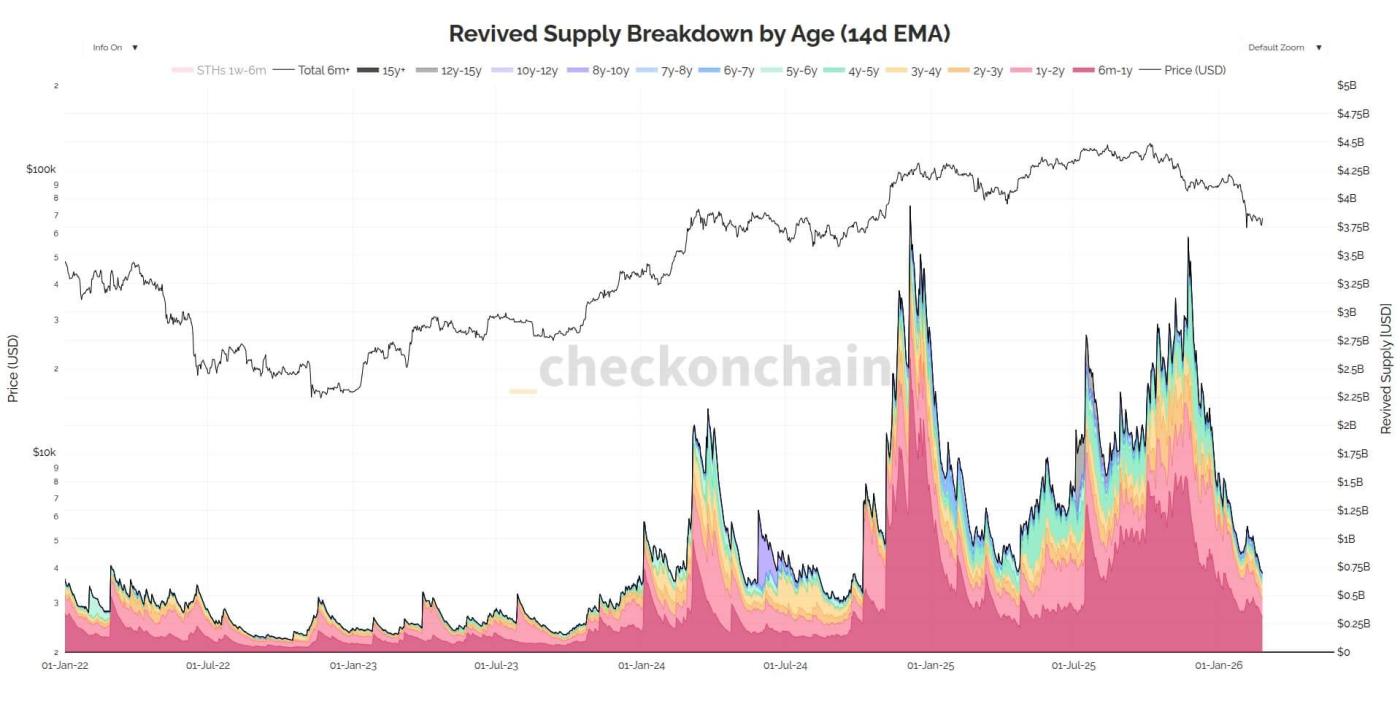
Julio Moreno, head of research at CryptoQuant, holds a similar view, arguing that this theory overlooks a more obvious driving factor: spot demand for Bitcoin has shrunk dramatically since early October 2025.
He added that the operating mechanism attributed to Jane Street is similar to the delta-neutral position management approach commonly used by many trading firms.
The value of these rebuttals lies in their direct address to the core weakness of the claim: Bitcoin is already under pressure from broader macroeconomic repricing before 2026.
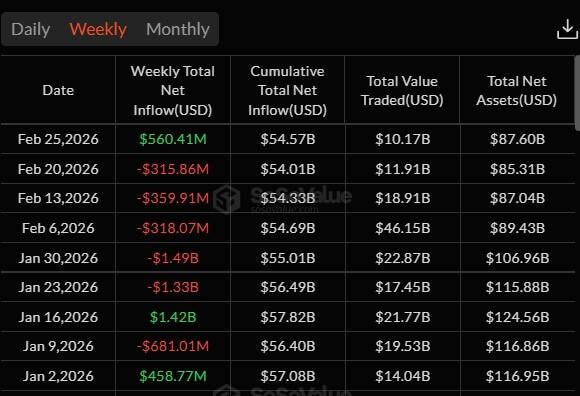
According to SoSo Value data, institutional investors have reduced their exposure to Bitcoin ETFs for five consecutive weeks, with total outflows from spot Bitcoin ETFs reaching approximately $4.5 billion.
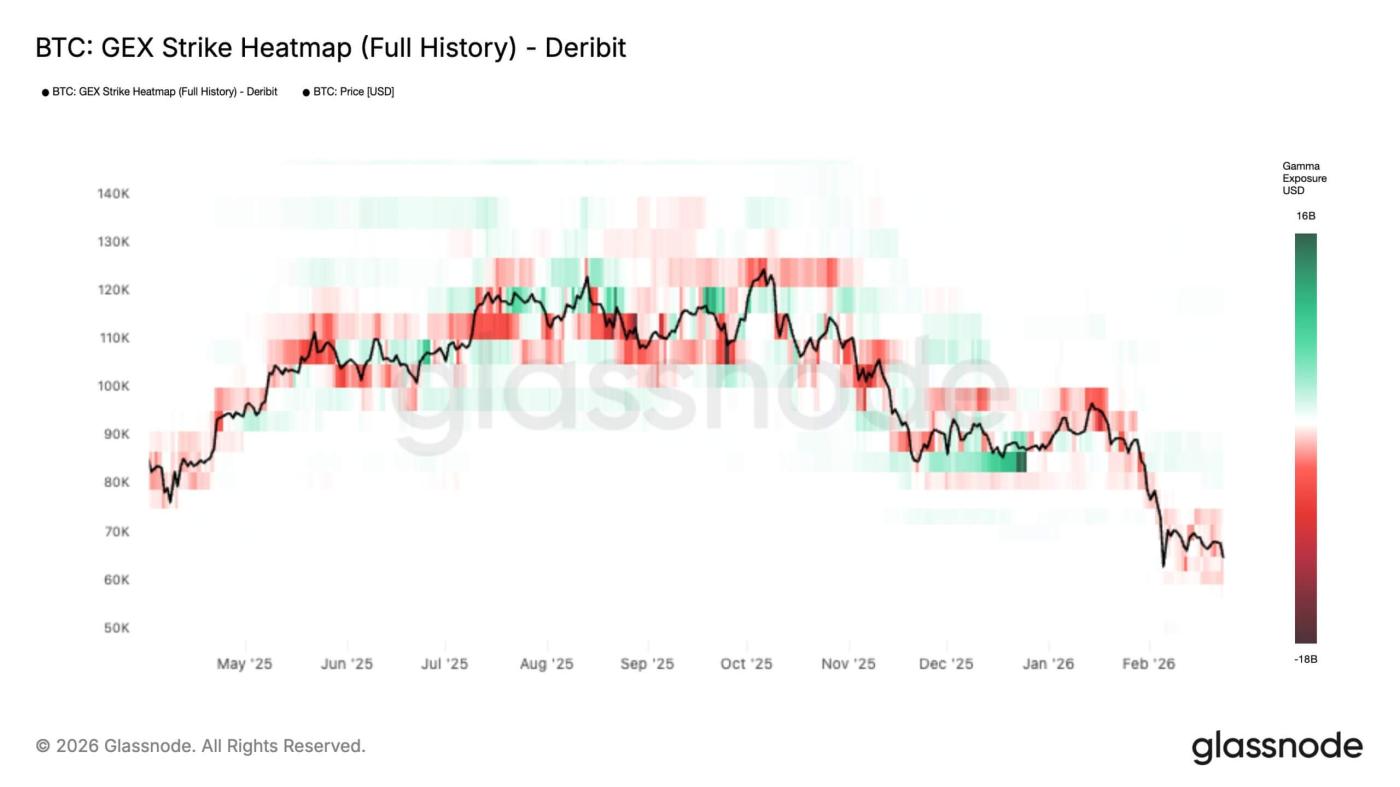
Meanwhile, Glassnode data shows that the recurring market pressures at the beginning of the month have triggered a structural shift in the Bitcoin options market, leading to a more unstable landscape.
The agency points out that the all-historical gamma exposure (GEX) heatmap shows that negative gamma is expanding at and below the current price, while the positive gamma "resistance wall" above the spot price is receding.
In layman's terms: those option positions that usually act as shock absorbers are fading out, and the market is increasingly in a range where hedging flows are no longer buffering the decline, but rather amplifying it.
This dynamic is important: when prices are in the short-gamma range, market makers' delta hedging tends to follow the trend rather than selling when prices fall and buying when prices rise.
The result is that the market can go faster and further with relatively small catalysts—greater intraday volatility and a higher risk of cascading moves across key levels—until Bitcoin hits the next thick "gamma wall," at which point hedging switches back to buffer mode.
In other words, traders are in an environment where "intention" is easily visible everywhere. With low liquidity and high leverage, almost any sharp fluctuation can appear to be organized behavior.
ETF channels are more difficult to understand than they appear.
The deeper issues raised by the Jane Street controversy are structural, rather than targeting any particular institution.
As Jeff Park, chief investment officer of ProCap Financial, argues, the real issue is not whether any one company is "monopolizing" Bitcoin, but whether the ETF market structure grants authorized participants a degree of discretion that is difficult for the public to discern.
This is important because investors often interpret ETF disclosures as clean directional signals—but that's not the case. A Form 13F can show a large long ETF position, but SEC guidance explicitly states that short positions are not included, and short options are not offset against net long positions.
In practice, the market may see the inventory, but not the futures, options or other hedging instruments that surround it.
This lack of transparency is further exacerbated by the way the trust is built. BlackRock's documentation on IBIT shows that the trust can handle the creation and redemption of shares through authorized participants, and can also transact with designated Bitcoin counterparties.
As of this filing, these counterparties include JSCT, LLC, an affiliate of Jane Street Capital, and Virtu Financial Singapore, an affiliate of Virtu Americas.
The document also shows that the list of authorized participants has expanded to include institutions such as JPMorgan Chase, Citadel Securities, Citigroup, Goldman Sachs, UBS, and Macquarie, with more and more companies gaining access to ETFs to create redemption mechanisms.
Park argues that this structure distorts outsiders' interpretation of ETF fund flows.
Under the old cash model, creating ETF shares required the fund to purchase physical Bitcoin. However, after the SEC approved the physical creation and redemption of crypto ETPs in July 2025, authorized participants gained greater flexibility in acquiring and settling the underlying assets.
The SEC stated that this change will reduce product costs and improve efficiency. However, it also means that authorized participants' exposure can be managed through a wider range of tools and counterparties, making it more difficult to determine when ETF activity reflects genuine spot demand and when it reflects inventory management, basis trading, or hedging construction.
These are not evidence of abuse of power, and Park's argument does not rely on proving that Jane Street or any other firm has abused its power. His sharper point is that the Bitcoin ETF era has inserted a black box between publicly available holdings data and the underlying price discovery process.
The transaction begins and ends like a typical market-making activity. What's difficult to observe is the intermediate stage: whether hedging is done through spot, futures, swaps, or some combination of the three, and whether the natural arbitrage mechanism truly transmits real spot demand to Bitcoin.
This is precisely why the Jane Street rumor resonated so strongly. Rather than an accusation against a particular player, it signaled just how limited the market's understanding of its own operating channels is.
Why does the US stock market open like a selling pressure zone?
The "10-point theory" sounds reasonable because even without deliberate manipulation, the opening of the US stock market is a genuine window of fluctuation.
This period is characterized by cross-asset rebalancing, equity-related risk adjustments, and derivatives hedging operations.
In markets where ETF intermediaries can use futures or other instruments to hedge inventory, futures may drive spot prices rather than simply follow them.
When order books are thin, these moves can appear larger and more insidious than they actually are. Bloomberg reported earlier this month that Bitcoin market depth is still more than 35% lower than October levels, highlighting how fragile liquidity has become.
Meanwhile, macro analyst Alex Kruger said that existing data does not support the claim of a "systemic sell-off at 10 a.m. every day".
He wrote that since January 1, IBIT has had a cumulative return of 0.9% in the 10:00 to 10:30 ET window, while it has fallen by 1% in the 10:00 to 10:15 ET window.
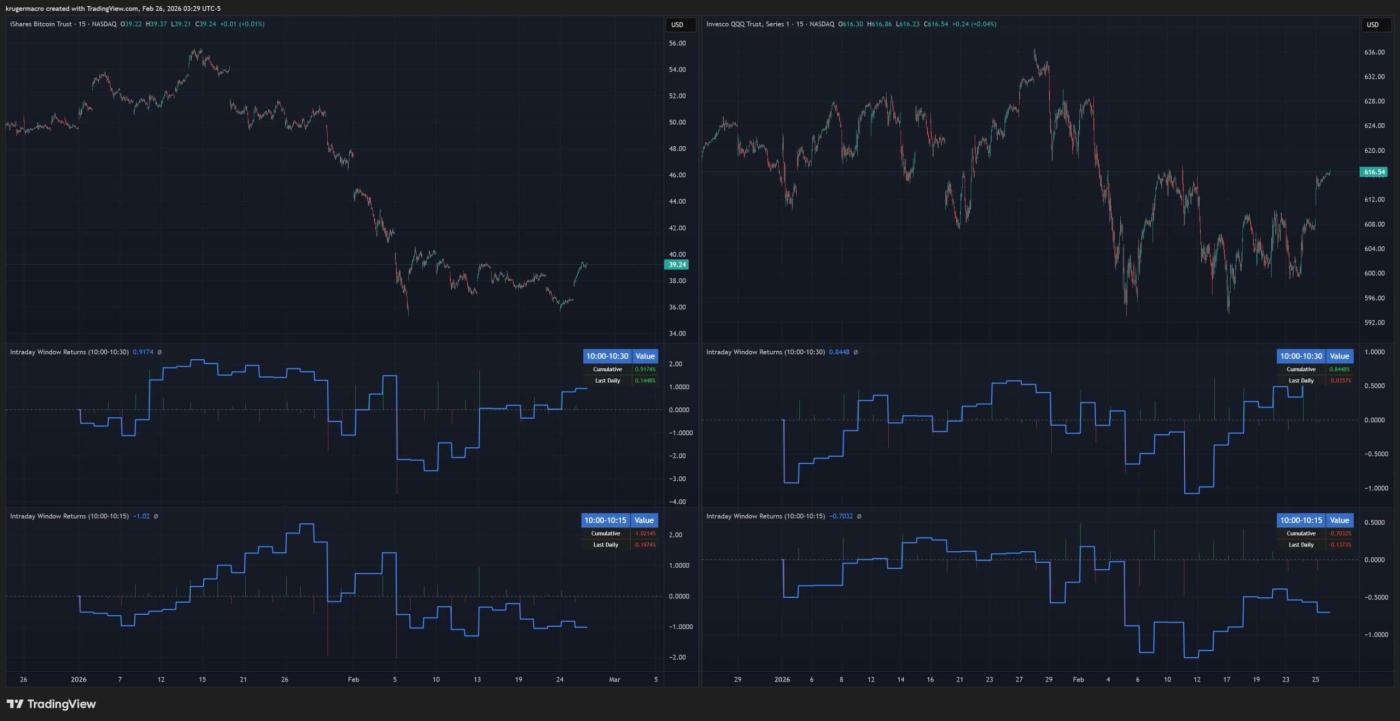
In his view, this was noise, not evidence of a repeatable suppression procedure.
More importantly, he said, the performance patterns of these two windows closely match those of Nasdaq, indicating that this is a repricing of risk assets as a whole, rather than a Bitcoin-specific operation.
This interpretation fits a broader market context than the story of viral spread.
If Bitcoin is increasingly packaged in ETFs and traded as a macro risk asset, then it should not be surprising that opening pressure on U.S. stocks—especially in illiquid markets—repeatedly weakens Bitcoin within the same intraday window.
On-chain scarcity is clear, but price discovery is not.
Bitcoin's supply is fixed by a protocol. No change in the ETF market structure can alter this. What has changed is the increasingly larger proportion of demand—and skepticism—that now flows through the channels.
The Jane Street controversy reveals the gap between these two realities. On-chain scarcity is transparent, but the institutional systems superimposed on it are not.
Investors can see the circulating shares of an ETF and some of the disclosed holdings, but they cannot see every hedging transaction, every internal net exposure, or every cross-market position that may exist behind the market maker's ledger.
This gap creates space for misunderstanding and distrust.
Jane Street has also faced scrutiny in other markets, which has done little to improve the situation. In July 2025, the Indian Securities and Exchange Commission (SEBI) issued a provisional order regarding an index manipulation case involving Jane Street entities, and Reuters subsequently reported that the SEBI had banned the company from the Indian securities market during the investigation. Jane Street similarly denied any wrongdoing there.
The Indian case has nothing to do with Bitcoin, but it explains why crypto traders are ready to imagine the worst when Jane Street's name reappears in the headlines.
However, the existing facts do not prove that Jane Street carried out a deliberate Bitcoin suppression plan.
They prove something else: the post-ETF era Bitcoin market has become more accessible, more deeply integrated with institutions, and more difficult for ordinary investors to understand.