Source: Wintermute
Author: Jasper De Maere
Compiled and edited by: BitpushNews
Bitpush Note:
As a leading market maker in the crypto industry, Wintermute processes hundreds of billions of dollars in transaction volume daily. Compared to ordinary researchers, they can see through the fog and discern the true flow of retail investor funds. In its latest report, Wintermute raises a thought that should alarm the crypto: the "retail investor faith" that once supported the crypto market is faltering. In the past, cryptocurrencies and stocks typically rose and fell in tandem, but since the end of 2024, this relationship has completely reversed—retail investors have begun to face a "choose one" dilemma between the two.
The following is the main text:
Retail activity drives the cryptocurrency market. Through speculation, reflexive buying on dips, and agile capital rotation within the token world, retail investors define every major market cycle. However, new data suggests that the relationship between retail investors and cryptocurrencies is shifting. For some time, we've observed the stock market attracting retail attention at the expense of Altcoin. New data from JP Morgan's strategy division, combined with our proprietary liquidity data, now indicates that stocks and cryptocurrencies are increasingly becoming complementary risk assets.
Key points
A reversal phenomenon: Retail investor activity in cryptocurrencies and stocks used to move in the same direction. But since the end of 2024, the two have shown an inverse relationship: when retail investors buy stocks, they are quiet in the cryptocurrency market, and vice versa.
Volatility premium compressed: The volatility premium of cryptocurrencies relative to stocks used to be their biggest attraction for retail investors, but it is now being structurally compressed, and volatility is no longer a product feature that makes cryptocurrency investment more diversified.
Technological drivers: Several underappreciated technological factors have accelerated this shift, such as easier access to cryptocurrencies breaking down the “closed audience” effect; meanwhile, Large Language Model (LLM)-driven analytics are narrowing the cognitive advantage gap in the stock market, a phenomenon that has not yet occurred in the cryptocurrency space.
Traditional indicators are failing: Traditional leading indicators of crypto risk appetite (such as M2 money supply) are becoming ineffective. Investors should increasingly view cryptocurrencies from a multi-asset portfolio perspective, similar to how they are viewed with other established asset classes.
Reversal phenomenon
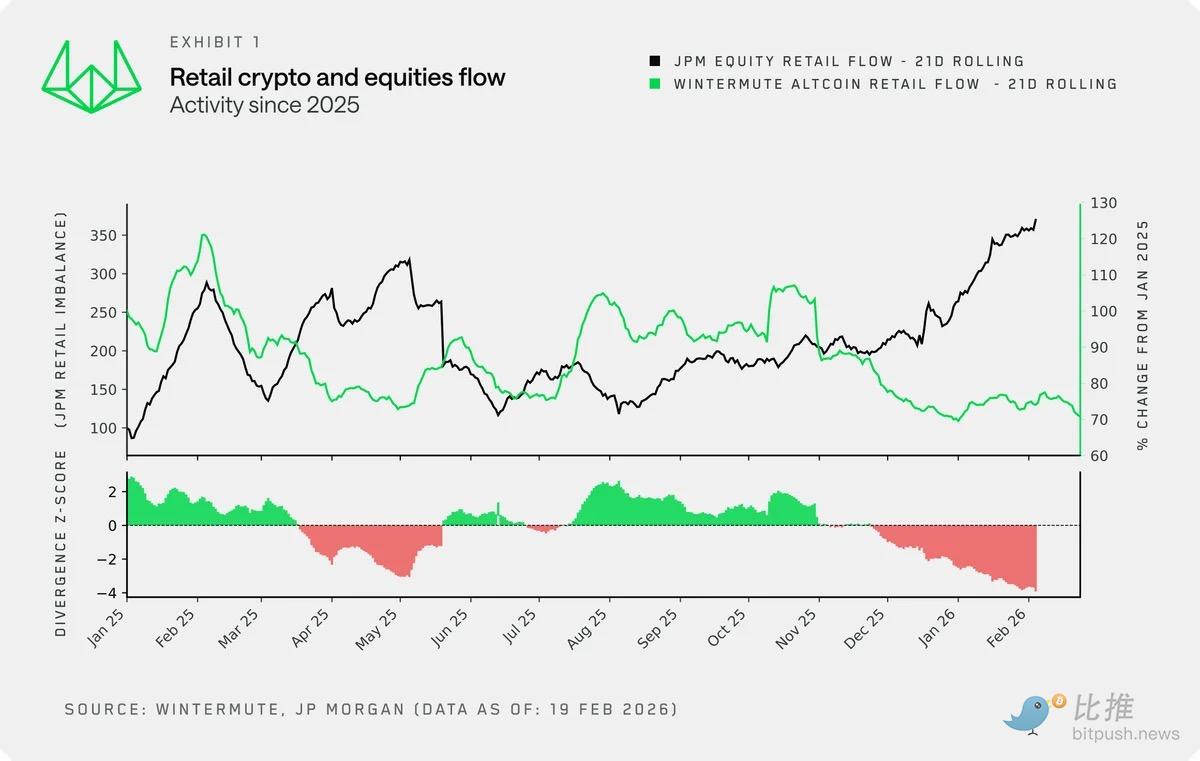
By overlaying Wintermute's proprietary crypto retail flow data with JPMorgan's retail equity inflow data, we gained a new perspective on the relationship between retail stock trading and crypto activity.
Historically, the two had moved in tandem until the end of 2024. At that time, high risk appetite drove buying in both sectors, as they both served to some extent as outlets for excess capital (see M2) and risk appetite.
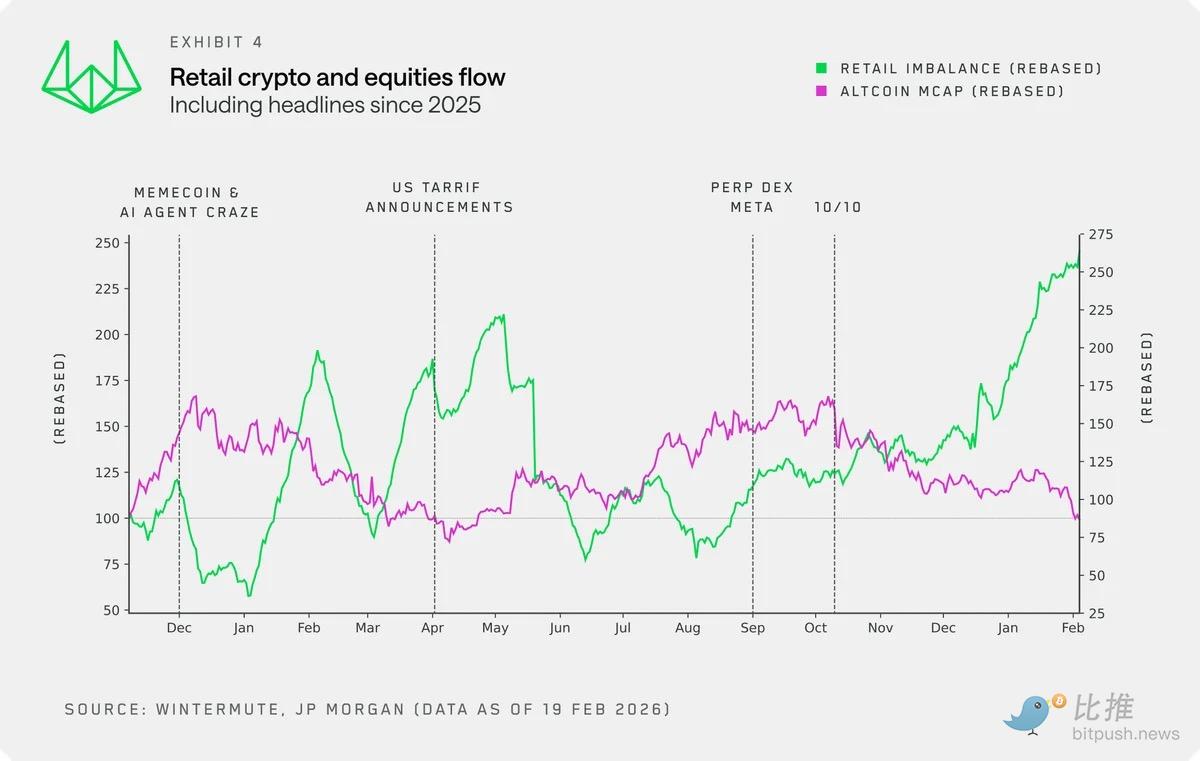
However, this relationship has broken down since the end of 2024: as retail investors have poured into the stock market at an unprecedented rate but remained inactive in cryptocurrencies, the divergence between the two has now reached an all-time high.
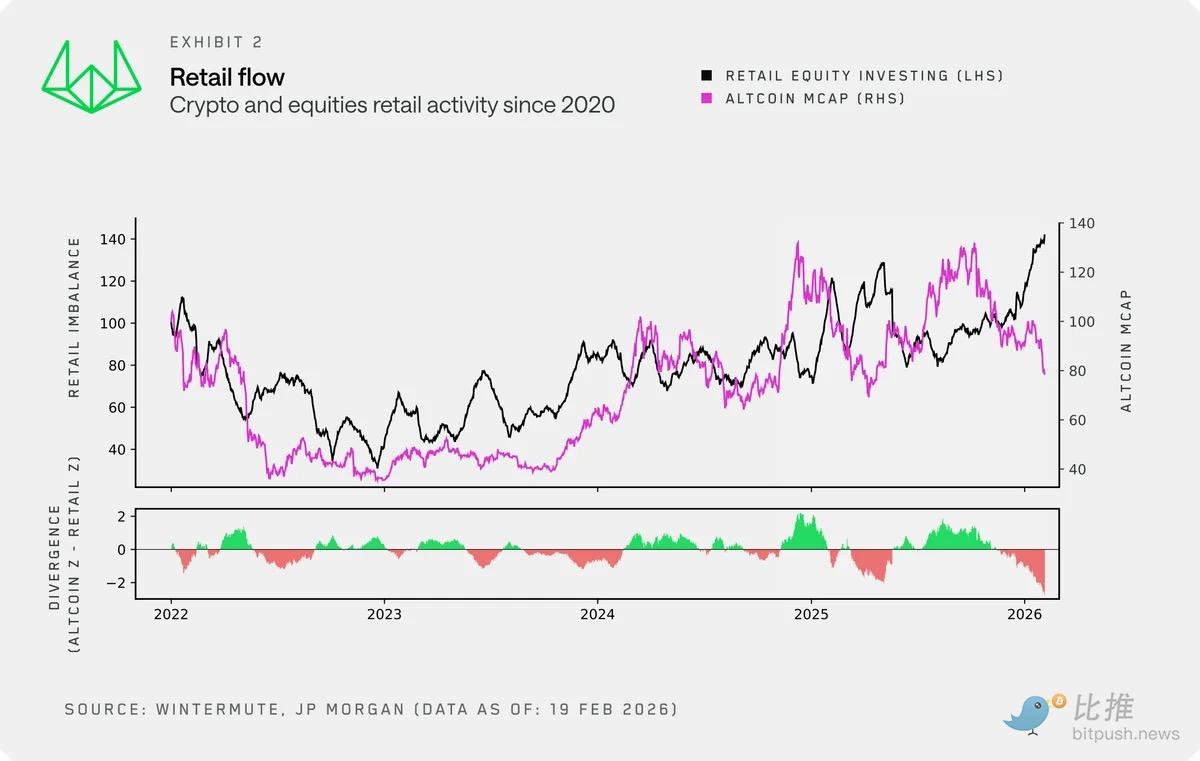
Zooming out, we use Altcoin capitalization as a long-term proxy for retail crypto activity.
It closely aligns with our retail investor activity data and boasts a more impartial and longer historical record. Between 2022 and the end of 2024, cryptocurrencies and stocks moved in roughly tandem, both considered high-risk portfolios by retail investors. The decoupling at the end of 2024 was particularly pronounced, reflecting retail activity becoming more short-term driven, volatile, and somewhat lacking in structure.
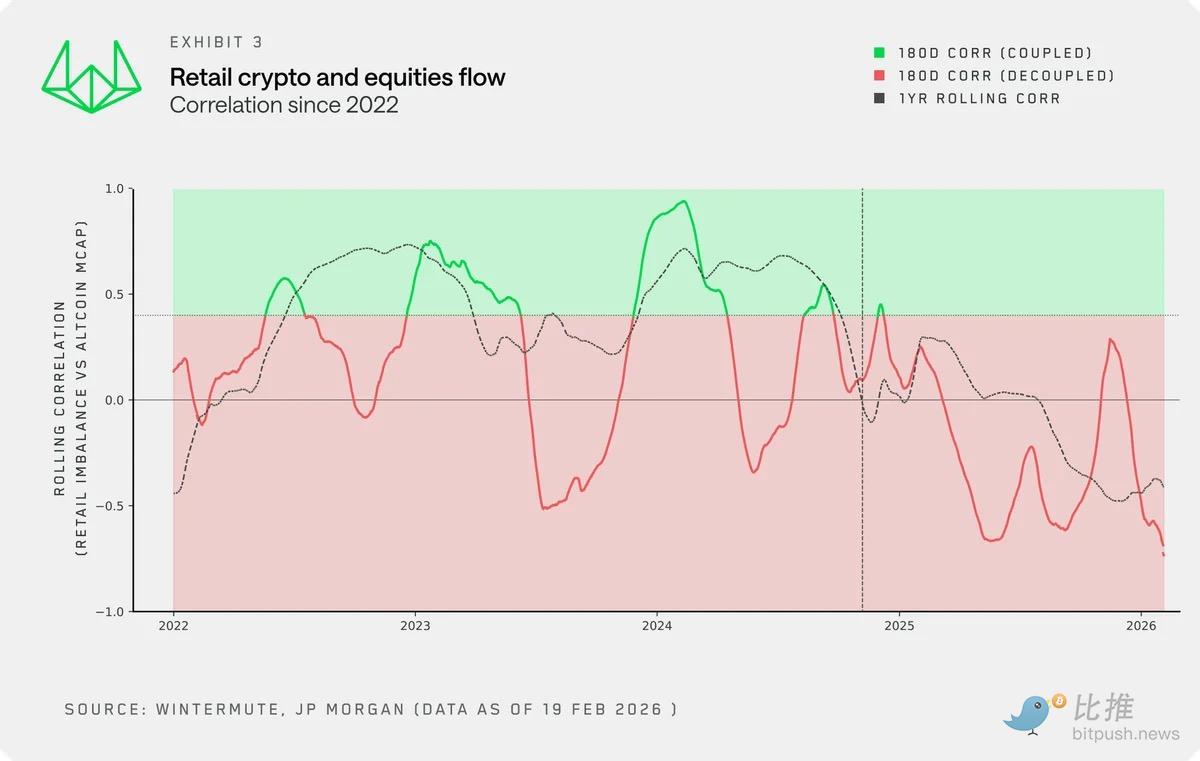
The rolling correlation between retail activity and Altcoin market capitalization confirms this shift. The previously volatile but generally positive relationship has turned negative. Retail investors are now allocating between the two, rather than injecting funds into both simultaneously.
With a focus on 2025 and the addition of key catalysts, this dynamic becomes even clearer. Several points are worth noting:
Memecoins and AI agents have had a moment of glory when stock market activity stalled, and retail investors have found speculative outlets elsewhere.
Retail investors continue to aggressively buy on dips in the stock market, both during the announcement of tariff policies in April 2025 and during recent market volatility.
After October 10, the market almost completely shifted to the stock market, and this trend is still continuing.
causation
The rolling correlation between retail investor activity and Altcoin market capitalization confirms this shift. The previously fluctuating but generally positive relationship has now turned negative. Retail investors are now choosing between the two, rather than investing in both simultaneously.
This new data confirms that. Retail investor activity in the stock market has become a new variable that cryptocurrency investors should closely monitor in order to identify opportunities where retail funds may continue to flow into cryptocurrencies.
Volatility = Product itself
One reason retail investors are drawn to and remain active in cryptocurrencies is the asset's volatility. Volatility is the product. It was the initial driving force that drew retail investors into the crypto space.
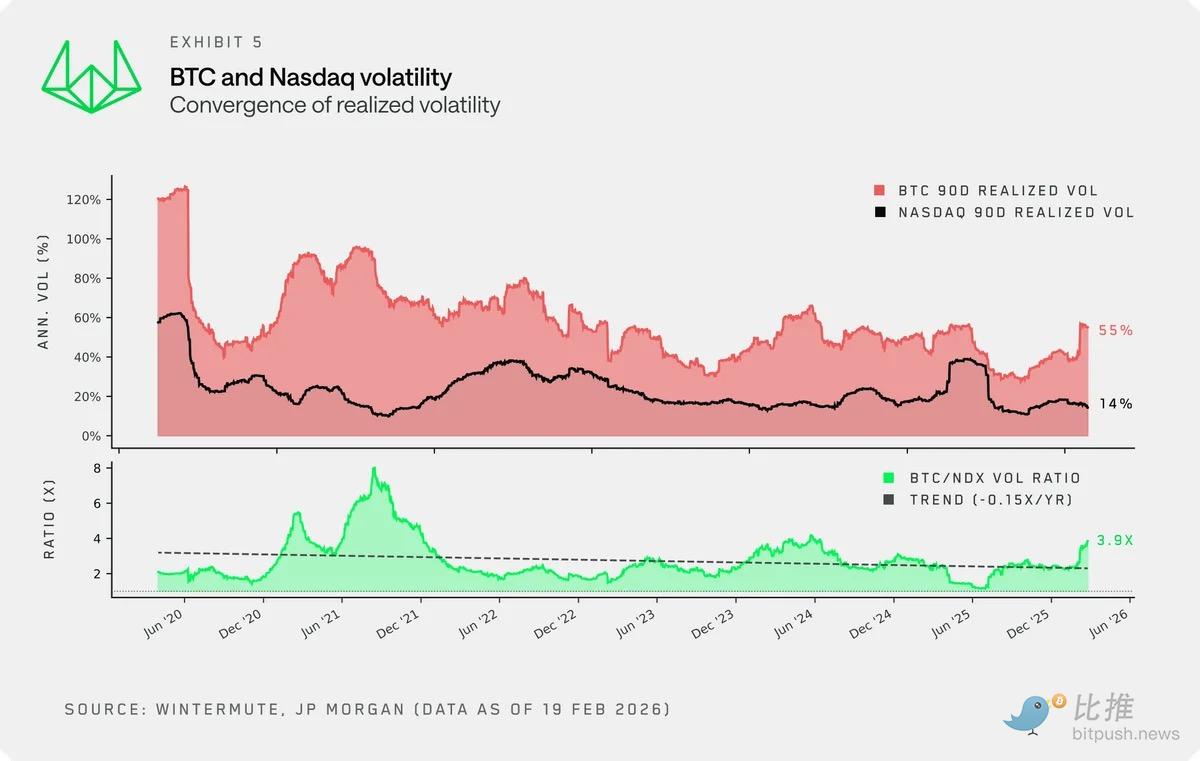
However, although the actual volatility of cryptocurrencies still far exceeds that of the stock market, a structural contraction trend has already formed, and this trend is unlikely to reverse in the short term. The volatility ratio of BTC to the Nasdaq (NDX) index has continued to decline, even compressing to below 2x at one point in the first half of 2025.
Thoughts on key drivers:
Market maturation: With the increasing number of sophisticated investors and new liquidity instruments such as ETFs and DATs, the peaks of reflective volatility defined in earlier cycles have been smoothed out.
Market size: At a market capitalization of $2.3 trillion (even at 40% below its all-time high), the mobile market requires far more capital inflows than it did five years ago.
As volatility compresses, the core selling point of cryptocurrencies for retail investors is being eroded. The "excess volatility" that defined the 21-22 year cycle and attracted a generation of retail investors is gone. For retail investors seeking volatility, stocks are becoming increasingly attractive.
Technical factors
In addition to structural changes within the crypto market itself, several technological factors are accelerating this shift, a point that is rarely mentioned.
The facilitation of crypto entry points—fintech companies and traditional brokerage platforms integrating crypto trading (or crypto-native platforms introducing stock trading) has indeed lowered the barrier to entry, but its more profound impact lies in the exit process. In the past, cumbersome deposit processes meant that once funds were invested in the crypto market, they were easily "locked" in, naturally circulating among various tokens. Now, these smooth deposit and withdrawal channels mean that funds can flow freely between the stock and crypto markets without facing significant obstacles.
Gaining an informational advantage – Retail investors seem increasingly drawn to the stock market, partly because they have gained an unprecedented “analytical advantage” through artificial intelligence (AI). Large Language Models (LLMs) have greatly enhanced the analytical capabilities of retail investors, giving them the feeling that they can compete on a level playing field with institutions .
This feeling simply doesn't exist in the crypto market . While it's possible to analyze cryptocurrencies based on data, the crypto market lacks a consensus-based valuation framework, the value capture mechanism for tokens is unclear, and the number of investable assets continues to expand, all of which make it difficult for retail investors to gain that sense of "having an advantage."
in conclusion
Retail investors, once the most reliable source of self-reinforcing demand in the crypto market, are increasingly satisfying their risk appetite elsewhere.
The stock market not only offers increasingly competitive volatility but also provides a growing analytical advantage, and allows for a seamless transition from encrypted to stock trading through existing applications on retail investors' mobile phones.
Cryptocurrencies still hold a place in retail investors' portfolios, but they are now just one of many options, no longer the main battleground for speculation.
This shift should also reshape how investors view the market . Some proven traditional indicators have become ineffective. For crypto investors, simply finding leading indicators of risk appetite and combining them with a crypto-native framework is no longer enough to succeed. Investors need to increasingly examine cryptocurrencies from a cross-asset portfolio perspective , just as is standard practice in the equities and fixed income sectors.
Twitter: https://twitter.com/BitpushNewsCN
BitPush Telegram Community Group: https://t.me/BitPushCommunity
Subscribe to Bitpush Telegram: https://t.me/bitpush