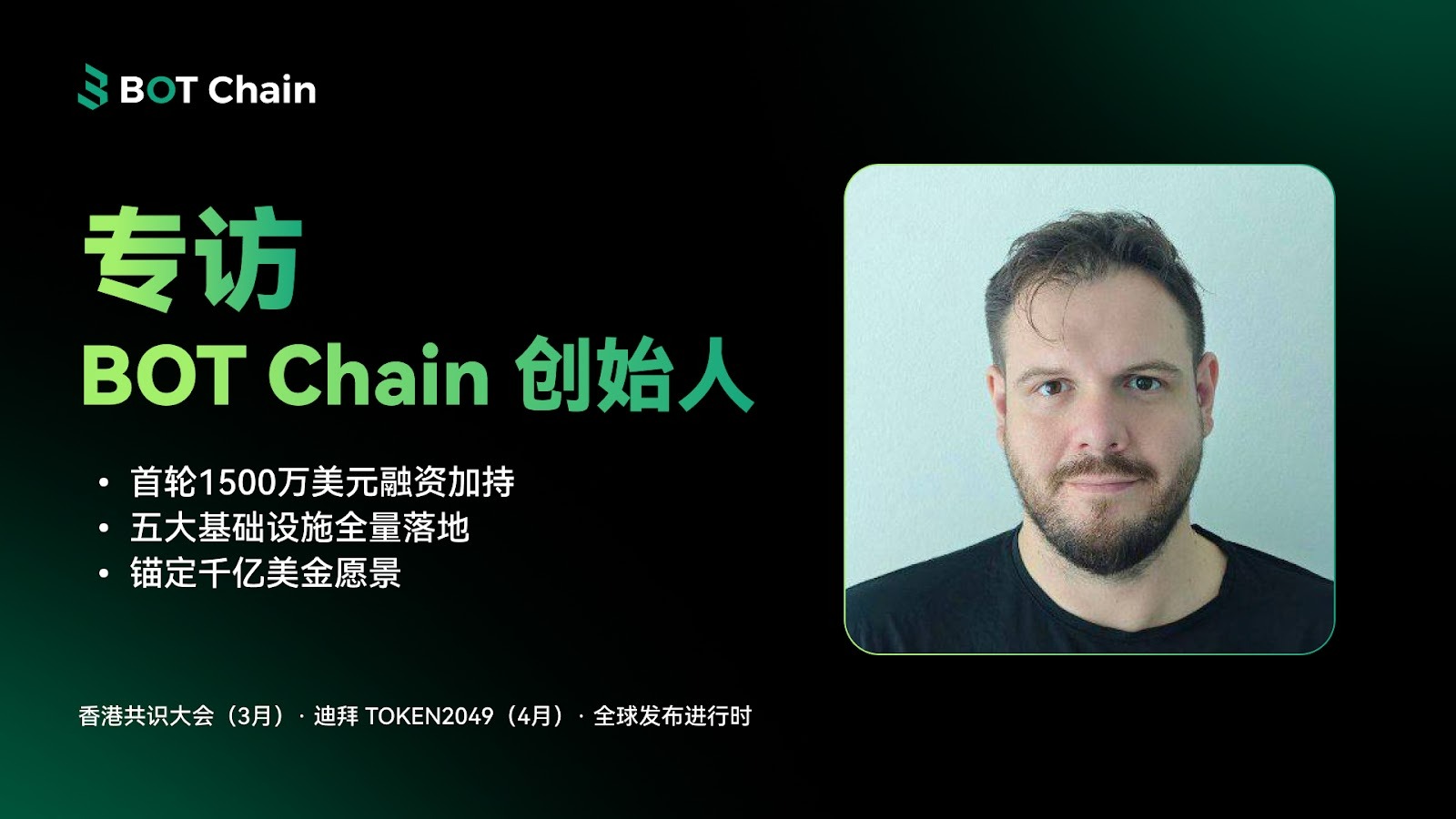
On February 25, 2026, the BOT Chain mainnet officially launched. In the current crowded public blockchain market, with numerous Layer 2 solutions emerging, this new player focusing on a "modular algorithm network" has quickly become the focus of the market, thanks to its initial $15 million funding round and the simultaneous implementation of five core infrastructure projects. What are its strategic intentions? What are its technological strengths? Alexander Ververis, co-founder and CTO of BOT Chain, recently gave an exclusive interview to the media, detailing the underlying logic of modular public blockchains and the future vision of computing power assetization.
Q: The mainnet launch is BOT Chain's first milestone. In your opinion, what is currently the biggest deficiency in the public blockchain sector?
Alexander: I think the biggest deficiency is "adaptability." Current public blockchains, whether Ethereum or Solana, are like fixed-size shipping containers—developers have to cram their applications into these containers, regardless of whether their application is a heavy truck or a bicycle. This "one-size-fits-all" model might have been sufficient during the DeFi summer, but in the AI era, when applications have vastly different needs for computing power, latency, and storage, it completely fails.
BOT Chain's modular architecture essentially does one thing: turn shipping containers into Lego bricks. You can freely combine consensus, execution, and storage modules, and even upgrade a single module without affecting the others. This means that a high-frequency trading DEX can choose the fastest execution module, an AI training protocol can choose a dedicated computing power module, and a storage application can choose the cheapest storage module. Developers are no longer tied to the chain; instead, the chain serves the developers.
Q: The concept of modules isn't new; Polkadot and Cosmos are doing similar things. What differentiates BOT Chain?
Alexander: The key is that we've implemented a "protocol-layer module." BOT Chain is a modular algorithm public chain whose underlying protocol consists of pluggable algorithm modules. When developers use BOT Chain to build applications, they can flexibly select and combine algorithm modules based on business scenarios, data availability, execution environment, etc., without having to start an independent chain or rely on an external coordination chain like other modular solutions. This design retains the efficient interoperability of a single chain while giving applications customized algorithmic flexibility.
Q: The simultaneous launch of five major infrastructure components (main chain, browser, BDEX, cross-chain bridge, and BO Wallet) is extremely rare in the industry. Why such a "heavy" approach?
Alexander: Because we're not building a chain, we're building an "ecosystem." Anyone can make a standalone browser or wallet, but the real challenge is seamlessly integrating them to create a complete user experience loop.
The main chain is responsible for transaction settlement and consensus security; BDEX enables the discovery and pricing of protocol assets; the cross-chain bridge connects to the liquidity entry point of the mainstream ecosystem; the on-chain browser provides full-process auditable transparency; and the BO wallet serves as a unified user interface. These five modules each perform their respective functions, forming a complete closed loop: from protocol development/access, computing power scheduling, task execution to final settlement, all links are seamlessly connected.
What we aim to do is lower the barrier to entry for Web3. Developers don't need to worry about which underlying node is running; they only need to see two things: lower costs than centralized cloud services and a simpler experience than traditional blockchains. Only when the infrastructure is sufficiently adaptable and easy to use can decentralized computing power truly serve the needs of the AI era.
Q: What major events will BOT Chain be making at the Hong Kong conference in March and Dubai 2049 in April?
Alexander: These two events represent a crucial leap for BOT Chain from infrastructure development to the full launch of its ecosystem. We're moving quickly because the window of opportunity is closing.
The Hong Kong Global Consensus Conference at the end of March was the launch ceremony for our "core nodes" and the first global appearance of BOT Chain since its mainnet launch. Hong Kong, as a super hub connecting traditional finance and the Asian crypto market, will be the venue for our initial deployment of core nodes. These nodes consist of top global verification institutions, mining pools, and communities, and they will be deeply involved in ecosystem governance and regional market expansion. At this conference with thousands of attendees, we want to send a clear message: BOT Chain's node network is a globally deployed network. On-site, we will publicly demonstrate real trading data from BDEX, as well as the real-time interaction between the cross-chain bridge and the Ethereum and Solana ecosystems—making the operational status of the modular public chain perceptible and verifiable, letting everyone see: this chain is already running.
At the end of April, TOKEN2049 in Dubai will be our "Ecosystem Launch Ceremony" for global developers. Dubai is an innovation hub for Web3 in the Middle East and even globally, and a forefront of the integration of AI and blockchain. There, we will officially announce the launch of a $50 million ecosystem support program, and announce the specific application channels and review criteria for the fund. The funds will focus on three major tracks: AI, DePIN, and protocols, supporting the technical development, node integration, and market launch of early-stage projects. The significance of Dubai lies in its initiation—initiating a continuous process of development, and opening a channel for deep connection with global developers. Our goal is clear: through the continuous operation of the fund, to attract tens of thousands of projects to join the ecosystem, select hundreds of high-quality projects from the vast amount of innovation for key support, and ultimately help a group of these projects grow into leading applications with widespread influence.
From Hong Kong to Dubai, from laying the foundation to launching construction— BOT Chain is telling the market at its own pace: We are ready, and we will move very fast.
Q: Regarding the economic model of BOT Chain, how does the dual-track mechanism of burning and staking support long-term value?
Alexander: We designed a dual engine of "deflation + equity." First, the transaction fees generated by each transaction in the network (including trading, cross-chain transfers, etc.) will be distributed according to a clear ratio: 50% will be directly burned, creating continuous deflationary pressure; 30% will be injected into the ecosystem fund to support developer incentives and ecosystem construction; and 20% will be rewarded to nodes to ensure the stable operation of the network. Second, nodes, projects, and developers need to stake BOT to participate in the network, which locks up a large amount of circulating supply. More importantly, in the future, transaction fees on BDEX will be distributed proportionally to stakers, which is equivalent to allowing all token holders to share in the growth dividends of the BOT Chain economy.
Our goal is clear: to make the BOT token the value anchor of the AI computing power economy. By the end of 2026, if the BOT Chain can support 10,000 protocol instances, then BOT's valuation model will no longer be simply that of a public chain token, but rather the "digital oil" of the global computing power market.
Q: Finally, is there anything you'd like to say to the market?
Alexander: I want to say that the next decade of Web3 doesn't belong to any one chain, but to an underlying network that can truly serve the real economy and lower the barriers to innovation. BOT Chain is just getting started, but we believe that the combination of modules and computing power is the right path to that future. We welcome all developers, miners, and users to join this computing power revolution.
About BOT Chain
BOT Chain is a modular public blockchain designed for large-scale Web3 applications. Its unique three-layer architecture—a structural core ensuring consensus security, a verifiable execution layer powered by a self-developed VPC parallel engine achieving tens of thousands of TPS, and a modular protocol layer encapsulating core functionalities such as DeFi, NFTs, and AI Agents into standard components—allows developers to quickly deploy applications without writing contracts from scratch. Five key infrastructure components (main chain, BDEX exchange, cross-chain bridge, browser, and BO wallet) launched simultaneously with the mainnet launch form a complete public blockchain network loop. The project has completed a $15 million funding round led by the NIX Foundation and Alpha Capital, and has passed a CertiK security audit. The mainnet launched in the first quarter of 2026, aiming to become a "manufacturing factory" for Web3 protocols and a underlying computing power scheduling system for the AI era.