I. Execution Summary
In January 2026, Andreessen Horowitz (known in the industry as a16z), a top Silicon Valley venture capital firm, officially announced the completion of a new fund raising of over $15 billion. This was the largest fundraising in the company's sixteen-year history and is widely regarded as the highest single-round fundraising record in Silicon Valley venture capital history (Horowitz, "Why Did We Raise $15B?"; Metinko, "A16z Raises $15B").
The funds were allocated to six strategic directions: the Growth Fund ($6.75 billion), the Apps Fund ($1.7 billion), the Infrastructure Fund ($1.7 billion), the American Dynamism Fund ($1.176 billion), the Bio + Health Fund ($700 million), and other venture capital strategies ($3 billion) (Horowitz; Loizos, "The Venture Firm That Ate Silicon Valley").
According to a16z's own calculations, this single funding round accounts for more than 18% of the total venture capital funding raised in the United States in 2025. If this figure is accurate, then a16z's role is far beyond that of an ordinary market participant—it is becoming a structural force reshaping the flow of capital in the US technology sector (Horowitz).
This figure is particularly striking because it is closely related to the broader context. According to preliminary data from PitchBook and NVCA, the total amount of new funds raised by US venture capital firms in 2025 will only be $66.1 billion, a significant drop from $101.3 billion in 2024, marking the lowest level since 2017 (Primack, "Andreessen Horowitz Raises $15 Billion"). At the same time, the number of new funds established in 2025 will also fall to its lowest level in nearly a decade (Sophia and Hu, "Andreessen Horowitz Raises 15 Billion").
In other words, against the backdrop of a sharp contraction in the entire venture capital fundraising market, a16z has instead captured a disproportionate share of this shrinking pool. This phenomenon reflects the accelerating polarization within the industry: on one hand, there are super platforms capable of attracting large amounts of institutional capital, and on the other hand, there are small and medium-sized and emerging managers who are finding it increasingly difficult to raise funds.
In a side-by-side comparison, a16z's $15 billion even surpasses the combined fundraising of its two closest competitors in 2025—Lightspeed Venture Partners ($9 billion) and Founders Fund ($5.6 billion) (McCormick, "a16z: The Power Brokers"). Looking at the entire history of venture capital, only SoftBank's Vision Fund a decade ago surpassed a16z's fundraising round in terms of size (Newcomer, "Andreessen Horowitz's Fresh $15 Billion").
Following this fundraising, a16z's total assets under management (AUM) surpassed $90 billion, placing it among the world's largest investment firms, far exceeding its recent venture capital peers—Sequoia Capital (approximately $56 billion) and General Catalyst (approximately $43 billion) (Martin, Forbes via Techmeme; Loizos). The fact that a venture capital firm that started with a $300 million initial fund in 2009 can now manage assets comparable to the world's top alternative asset management companies demonstrates a fundamental shift in the underlying architecture of fintech—and a16z is both a beneficiary and a driver of this transformation.
This capital was actively deployed in 2025. According to Crunchbase data, a16z participated in at least 165 post-seed round startup funding deals throughout the year, becoming the second most active late-stage venture capital firm globally, second only to Y Combinator (Metinko, "A16z Raises $15B"; Metinko, "Large American VCs"). Notable investments included: Anysphere, the parent company of AI programming tool Cursor; legal tech unicorn Harvey; prediction market platform Kalshi; AI security lab Safe Superintelligence; speech synthesis leader ElevenLabs; and enterprise data giant Databricks (Metinko, "A16z Raises $15B").
Between May and September 2025 alone, a16z participated in funding rounds for seven companies that subsequently reached unicorn valuations—five of which were in the field of artificial intelligence (CDP Center, "VC Digest: Andreessen Horowitz").
The backdrop to these investment activities is a historic surge in global AI venture capital investment. In 2025, AI startups raised approximately $270 billion globally, accounting for 52.7% of total global venture capital investment—marking the first time AI has surpassed half of global VC funding (Goldberg, BestBrokers via Open Data Science). North American startups alone raised $280 billion, a 46% year-on-year increase, with the majority of the funds flowing into the AI sector (Metinko, "A16z Raises $15B"). Crunchbase refers to a16z as a "major driving force" of this investment wave (Metinko).
As of September 2025, a16z had invested in 32 projects categorized as AI or AI Agents, with healthcare and enterprise software being its two core sectors (CDP Center).
However, the deeper significance of a16z's 2025 positioning goes far beyond the number of deals and the size of funding. Co-founder Ben Horowitz articulated the company's mission in clear geopolitical language, declaring, "Our mission is to ensure that the United States wins the technological competition of the next hundred years," starting with "winning the key architectures of the future—AI and Crypto," and extending to areas such as "biotechnology, healthcare, defense, public safety, education, and entertainment" (Horowitz, "Why Did We Raise $15B?").
This narrative positioning—portraying venture capital as a tool of national strategy rather than simply pursuing financial returns—is not a rhetorical embellishment, but rather the core organizing principle of the company's entire investment activity. The $1.176 billion American Dynamism fund, the $1.7 billion infrastructure focused on AI's underlying computing power, and the increasingly close ties between a16z and the US defense system all reflect the same core argument: technological hegemony, economic competitiveness, and geopolitical power are inseparable (Loizos; Sophia and Hu).
This report systematically reviews a16z's AI-related investment portfolio throughout 2025, covering foundational model labs, infrastructure and computing power, enterprise-level vertical applications, consumer and creative AI, healthcare, fintech, defense and national security, and the emerging Crypto-AI convergence sector. The report integrates disclosed financing data, a16z's publicly published research and investment statements, and independent analyses and reports from technology and financial media, aiming to present not only where a16z invested its money, but also why—and the resulting investment portfolio, revealing the institution's profound judgment on how artificial intelligence will reshape the industrial landscape, the labor market, and even the global power balance.
In addition, this report will also examine the emerging inherent tensions in a16z's strategy, including: the risk of capital being highly concentrated in a few mega-rounds, the ideological friction between the "American Dynamism" narrative and some of the investment targets, and the structural risks of managing a $90 billion mega-platform in a sector where there is still a huge gap between valuation and revenue.
II. a16z's Top-Level Investment Strategy - Winning the Next Century
Most venture capital firms use a set of cold, precise financial language when discussing their mission—IRR, MOIC, fund-level DPI. Andreessen Horowitz is different. It chooses a much grander narrative: the language of the future of civilization.
In January 2026, co-founder Ben Horowitz wrote in a blog post announcing the $15 billion funding round: "Our mission is to ensure America wins the technological competition of the next century. This means first securing the key architectures of the future—AI and Crypto—and then injecting these technologies into areas that truly matter to human well-being: biotechnology, healthcare, defense, public safety, education, and entertainment" (Horowitz, "Why Did We Raise $15B?"). This statement, along with the substantial capital allocation behind it, reveals a clear ambition of a16z—it is not content to be merely a financier for startups; it wants to be the chief architect bridging private capital and national interests.
But what truly elevates this narrative beyond mere "pretty talk" is not its rhetorical grandeur, but rather its structural dominance over the flow of funds.
At first glance, a16z's fund portfolio might lead you to believe that AI is merely one of many sectors, neatly tucked into its $1.7 billion Infrastructure fund—officially described as focusing on "AI computing power, data, and model infrastructure" (Metinko, "A16z Raises $15B"). But if you think that way, you're sorely mistaken. AI isn't just a piece of the puzzle in a16z's investment landscape; it's the thread that connects all the pieces.
The $1.7 billion Apps fund is betting on AI-native enterprise and consumer applications. The $1.176 billion American Dynamism fund is channeling funds to autonomous military systems, AI-driven defense platforms, and robotics. The $700 million Bio + Health fund targets AI's role in reshaping drug discovery and clinical automation. The $6.75 billion Growth fund is responsible for guiding late-stage AI companies all the way to their IPOs. Even the $3 billion allocated to "other venture capital strategies" covers a16z's cryptocurrency portfolio—in their view, decentralized data layers and machine-to-machine payments are deeply intersecting with AI (Horowitz; AInvest, "Strategic Allocation").
In other words, this $15 billion is not six parallel tracks, but a spider web radiating outwards in six directions with AI at its center. As one external analysis put it, a16z's fund "is more than just a financial instrument—it is a strategic weapon for the United States to counter China's technological rise" (AInvest).
This ubiquitous AI architecture is not accidental, but rather traceable. a16z's annual "Big Ideas in Tech" report serves as a panoramic view of the firm's investment worldview. In the 2025 edition, fifty partners collaborated to depict their vision of the annual innovation landscape: nuclear energy renaissance, AI-driven medical "superhumans," battlefield AI, AI disrupting search engines, leaps in inference models, the proliferation of edge computing… (a16z, "Big Ideas in Tech for 2025"). While the topics seem diverse, beneath the surface lies a highly unified underlying logic: AI is not a track that can be confined to a specific industry; it is an infrastructure-level enabling layer, rewriting the cost structure, human resource models, and competitive rules of every field it touches.
One partner's prediction was particularly insightful: AI will transform humans from "executors" to "reviewers" through "participatory systems" (a16z, "Big Ideas in Tech for 2025"). This statement encapsulates the essence of a16z's entire argument—AI is a workforce multiplier, not just a software category.
AI as a Geopolitical Issue: The US-China Dimension
However, interpreting this investment narrative solely from a business perspective will only reveal half the story. a16z consciously embeds its capital narrative within a grander framework—the US-China technology rivalry. And since the beginning of 2025, the sense of urgency surrounding this framework has not diminished, but rather intensified dramatically.
Horowitz's wording was unambiguous: "If the United States loses technologically, it will suffer a complete defeat economically, militarily, geopolitically, and culturally. And the entire world will pay the price" (Horowitz, "Why Did We Raise $15B?"). Such rhetoric is not uncommon in Washington policy circles and Pentagon strategic documents, but coming from the founder of a venture capital firm carries entirely different weight—it's worth noting that venture capital has historically maintained a deliberate distance from national security discourse.
The catalyst that abruptly accelerated this geopolitical narrative of a16z was the bombshell dropped by DeepSeek in January 2025.
DeepSeek released its R1 inference model. Marc Andreessen's assessment was brief but impactful: "This is the Sputnik moment for AI" (SCBC Law, "DeepSeek's Influence on AI Startups and Venture Capital"). DeepSeek demonstrated something to the world that made Silicon Valley uneasy: a Chinese startup, despite US export controls cutting off the supply of the most advanced chips, could still train a product capable of rivaling OpenAI's cutting-edge models at an astonishingly low cost—reportedly less than $6 million to train the V3 pre-model (Fortune, "After Pouring Billions into AI").
The market reaction was immediate and dramatic: Nvidia lost nearly $600 billion in market capitalization in a single trading day (Guinness Global Investors, "How Has DeepSeek Affected the AI Market"). But the deeper shock lay in the fact that a long-held axiom—that the US could maintain its technological lead by spending money—was torn open.
The impact of DeepSeek exposes a key structural asymmetry in the US-China AI race.
On paper, the US holds a significant advantage. Analysis from the Federal Reserve shows that the US controls approximately 74% of the world's high-end AI computing power, while China accounts for only 14% (Federal Reserve, "The State of AI Competition in Advanced Economies"). However, China has found another path: bridging the hardware gap with engineering efficiency, achieving breakthroughs through the open-source ecosystem, and concentrating efforts through national-level coordination. Jensen Huang acknowledged this in a public speech in December 2025. He likened the AI competition to a "five-layer cake"—energy, chips, infrastructure, models, and applications—and warned that while the US still leads in cutting-edge models, China has "taken the lead" in the open-source field (Global Times, "Nvidia CEO's US-China AI Competition Remarks").
Goldman Sachs' research outlines a similarly nuanced competitive landscape: the US has an advantage in cutting-edge research and platform capabilities, while China leads in large-scale deployment and downstream applications (Outlook Business, "US vs China Tech Race 2025").
Understanding this background reveals the true strategic nature of a16z's $1.7 billion Infrastructure Fund. Led by partner Jennifer Li, the fund is anchored to three pillars: computing power innovation, data infrastructure, and basic model development (Bitcoin World, "A16z AI Infrastructure Fund"). Crucially, a16z's infrastructure investment logic is not a brutal hardware arms race. The company explicitly states that it avoids undifferentiated GPU hosting and asset-heavy data center projects—which it views as "infrastructure finance," not venture capital opportunities (StartupNews.fyi, "What a16z Is Funding and Skipping in the AI Infrastructure Boom").
What a16z is truly betting on is what it calls the "decision-making layer"—orchestration software, search infrastructure for AI agents, developer tools, and model optimization frameworks. The logic behind this is clear: when AI systems scale, it is these control nodes, not the underlying hardware, that truly capture excess value. This mirrors the pattern of the previous computing cycle—in the cloud computing era, the most sustainable returns were not generated by physical servers, but by the orchestration layer (StartupNews.fyi; Bitcoin World).
This assessment is directly related to the competitive landscape in China. If DeepSeek has proven that raw computing power can be replaced to some extent by engineering ingenuity—as one venture capitalist put it, "scarcity breeds great innovation" (SiliconANGLE, "Venture Investors See DeepSeek Accelerating AI Market Growth")—then a16z's bet isn't about who owns the most GPUs, but about who controls the software layer that orchestrates, optimizes, and massively schedules AI workloads. From this perspective, this $1.7 billion is less a defensive response to China's progress and more an offensive bet—a bet on the final position in the value chain.
American Dynamism: Technology Access to the State Mechanism
Within a16z's entire investment discourse, the most geopolitically charged segment is its American Dynamism practice. This line of work was initially incubated in 2022 by partner Katherine Boyle, stemming from a simple yet incisive observation: "The seemingly unsolvable problems in our societies—from national security and public safety to housing and education—require builders to answer" (Boyle, "Building American Dynamism"). Today, this practice holds $1.176 billion in dedicated funding, investing across aerospace, defense, public safety, manufacturing, education, and critical infrastructure (a16z, "Investing in American Dynamism").
It has long since transcended the theme of defense technology investment. The "American Dynamism 50" 2025 list published by a16z fully illustrates this point: the companies on the list cover autonomous anti-drone systems, robotic aerospace manufacturing, nuclear microreactors designed for forward military bases, defense-grade cybersecurity, as well as civilian supply chain optimization, housing and public safety, and other areas (a16z, "American Dynamism 50").
In a companion article, a16z partner David Ulevitch wrote a representative passage: "The global battle for AI leadership is no longer just a contest between companies—it's a contest between nations. AI is not merely computing infrastructure; it's also cultural infrastructure, economic strategy, and national security" (a16z, "American Dynamism"). a16z goes further, calling on large institutional investors—pension funds, sovereign wealth funds, and insurance companies—to adopt a "capital-driven national security" mindset. In this discourse, American Dynamism is not venture capital philanthropy, but rather a "financially rational" reinvestment in the nation's industrial base (Ulevitch, "Investing Capital to Defend the Nation").
The intersection of a16z's AI discourse and its national security positioning creates a flywheel effect worthy of examination.
The computing power provided by the infrastructure fund underpins the operations of companies within the defense portfolio. Commercial AI platforms supported by the Apps and Growth funds, with their dual-use capabilities in areas such as surveillance, autonomous systems, and cybersecurity, are increasingly coming into the Pentagon's procurement purview. Meanwhile, the American Dynamism practice itself acts as a bridge—connecting Silicon Valley founders to the Pentagon's procurement ecosystem, an ecosystem that has for decades been the domain of traditional defense giants like Lockheed Martin and Raytheon (Capitaly, "How Andreessen Horowitz Is Transforming US Defense Tech").
In this model, the $15 billion in funding is not six separate funds operating independently. It is a coordinated deployment of the same narrative—AI-driven American technological hegemony—through six complementary platforms.
Whether this argument will ultimately be validated by market returns, or collapse under the weight of its own geopolitical ambitions, will be one of the most worthwhile questions for the venture capital industry to explore in the next decade.
III. Basic Model Lab and Cutting-Edge AI Research
In the traditional syntax of venture capital, the seed round validates a product hypothesis, the Series A round validates the product-product fit (PMF), and the Series B round focuses on large-scale distribution.
The foundational model labs that Andreessen Horowitz bet on in 2025 completely overturned this grammar. They weren't betting on products, market segments, or even business models—they were betting on people and paradigms. Within a single calendar year, a16z led or participated in a series of seed and early-stage funding rounds for companies with no revenue, no customers, and some without even a product, yet their valuations would have been equivalent to those of a mid-sized publicly traded company in any other era.
By 2025, a16z's total funding across cutting-edge modeling labs and research-stage AI projects—spanning Thinking Machines Lab, Safe Superintelligence, xAI, Mistral AI, and Periodic Labs, plus its continued holdings in OpenAI—constitutes the most concentrated gamble ever made by a single venture capital firm on fundamental AI research.
This chapter examines these investments as a separate asset class. Later chapters of this report will discuss a16z's infrastructure investments, enterprise application investments, and large growth-stage funding rounds separately, but the Frontier Labs portfolio deserves separate analysis for a simple reason: its risk profile, return cycle, and strategic logic are fundamentally different from developer tools or vertical SaaS. Essentially, these investments represent a prepayment for a belief—that the landscape of foundational model layers is still evolving, and that the researchers who spearheaded the creation of the first generation of cutting-edge models at OpenAI, Google DeepMind, and Meta are now among the most valuable assets in the entire tech industry.
As TechCrunch observed in January 2026, a16z "has already placed its pieces at every level of the AI technology stack"—from "base models (holding stakes in Mistral AI, OpenAI, and xAI)" to infrastructure and applications (Conger et al., "The Venture Firm That Ate Silicon Valley").
3.1 OpenAI's Discrete Wave: a16z's Systematic Bet on Cutting-Edge Talent
The pattern is so clear it cannot be ignored. Throughout 2024 and 2025, a16z positioned itself as the preferred financial backer of OpenAI's most important departures.
According to statistics, companies founded by former OpenAI employees have attracted over $42 billion in venture capital, with industry reports attributing this to investors' extraordinary confidence in their "technical capabilities and market insights" (TechFundingNews, "Ex-OpenAI Execs Raise $200M"). a16z sits at the very center of this talent arbitrage: it has led or participated in investments in at least four labs founded by former OpenAI key figures—Thinking Machines Lab (Mira Murati, former CTO), Safe Superintelligence (Ilya Sutskever, former Chief Scientist), Periodic Labs (Liam Fedus, former VP of Research), and the relatively undisclosed Stem AI (Emmett Shear, former interim CEO) (TechCrunch, "The OpenAI Mafia"; TechCrunch, "Periodic Labs"). Combined with its existing holdings in OpenAI itself, xAI, and Mistral AI, a meticulously crafted panoramic view of its frontier model holdings emerges.
The underlying logic of this strategy is debatable, but it is internally consistent: the market for basic models has not yet entered a winner-takes-all phase. By simultaneously betting on multiple lab-level competitors—including those explicitly aiming to replace OpenAI—a16z hedges its exposure to cutting-edge AI while maximizing the probability of at least one portfolio company achieving a paradigm-breaking breakthrough.
To evaluate this assertion, every significant investment deserves careful analysis.
3.2 Thinking Machines Lab: Landmark Transactions—and Their Lessons
Of all the investments in a16z’s portfolio in 2025, none more vividly illustrates the immense potential and immense risk of investing in cutting-edge laboratories than Thinking Machines Lab.
Founded in February 2025 by former OpenAI CTO Mira Murati, the company completed a $2 billion seed funding round in July of the same year, led by a16z—one of the largest seed rounds in Silicon Valley history (Zeff, "Mira Murati's Thinking Machines Lab"). The lineup of investors was star-studded, including Nvidia, AMD, Accel, Cisco, ServiceNow, and Jane Street, but the company had neither product nor revenue. According to TechCrunch, the round valued the company at $12 billion; Bloomberg previously reported an initial valuation of approximately $10 billion, indicating the price was significantly inflated in the final weeks of negotiations (Zeff; Crunchbase, "Biggest Seed Round"). Crunchbase confirmed that this was "the largest seed round to date" in its database (Crunchbase).
The founding team is a dream team. Murati assembled John Schulman, Barret Zoph, Lilian Weng, Andrew Tulloch, and Luke Metz as co-founders—these researchers are key figures behind ChatGPT, DALL-E, and OpenAI's reinforcement learning infrastructure (Maginative, "Mira Murati's Thinking Machines Lab Raises $2B"). Murati's vision, which she calls "collaborative general intelligence," positions the company as a builder of multimodal AI systems—not just another chatbot competitor, but AI that works collaboratively with humans.
The Tech Portal reports that the company's goal is to "develop advanced multimodal AI systems—not only capable of understanding and generating text, but also processing images, audio, and other forms of input" (The Tech Portal, "Mira Murati's Thinking Machines Lab"). In terms of governance structure, the company grants Murati a majority of votes in all board decisions, and founding shareholders have 100 times the voting power of ordinary shareholders—a direct response to the OpenAI governance turmoil of 2023 (The Tech Portal).
The company's first product, Tinker, was launched in private beta on October 1, 2025. Essentially a Python-based API for distributed fine-tuning of open-source weighted language models. Instead of training cutting-edge models from scratch, Tinker provides researchers with underlying primitives—forward_backward, sample, and optim_step—allowing users to directly control the training pipeline without worrying about the complexities of multi-GPU orchestration (VentureBeat, "Thinking Machines' First Official Product"). Former OpenAI co-founder Andrej Karpathy highly praised Tinker, stating that it allows users to "retain approximately 90% of algorithmic control while eliminating approximately 90% of infrastructure pain points" (VentureBeat). Early academic users from Princeton, Stanford, and UC Berkeley delivered impressive results: Goedel's team at Princeton, through LoRA fine-tuning, matched the performance of the fully parameterized model with only 20% of the data, achieving an 88.1% pass@32 on the MiniF2F benchmark (VentureBeat).
However, by early 2026, Thinking Machines Lab had quickly gone from a Silicon Valley darling to a cautionary tale about how fragile a talent-centric bet can be.
On January 14, 2026, Murati announced on X that the company was parting ways with co-founder and CTO Barret Zoph, with PyTorch co-creator Soumith Chintala taking over his position (TechCrunch, "Mira Murati's Startup… Losing Two Co-Founders"). Just 58 minutes later, Fidji Simo, CEO of OpenAI's Applications division, announced that Zoph, co-founder Luke Metz, and researcher Sam Schoenholz would all return to OpenAI, stating that this had been "planned for several weeks" (TechCrunch; TechBuzz, "Thinking Machines Lab Loses 2 Co-Founders").
According to Wired, the breakup was far from amicable: Murati's team accused Zoph of "gross misconduct," a claim publicly refuted by OpenAI (Beebe, "Thinking Machines Lab: Timeline"). Earlier, co-founder Andrew Tulloch moved to Meta in October 2025, meaning that only John Schulman remains of the original five co-founders (TechCrunch).
This personnel upheaval exposed the structural fragility of the "founder brand premium" model. eWeek points out that these departures force investors who "bet billions on Murati's vision" to face the reality that the core talent of that vision has left (eWeek, "Mira Murati's Thinking Machines Lab Loses Key Leaders"). TechBuzz puts it more bluntly: "Even a valuation of billions of dollars cannot guarantee stability—when the founders hear the call from their old lab" (TechBuzz).
For a16z, which led the largest seed round in venture capital history with a resume of a team of 30 people, the experience of Thinking Machines raises a structural question that goes beyond individual cases: what happens when investment arguments are valued almost entirely in human capital and that capital decides to walk out that door?
3.3 Safe Superintelligence: The Purest Bet on Research
If Thinking Machines Lab tests the limits of "investment without a product stage", Safe Superintelligence (SSI) takes that line even further.
SSI was founded in June 2024 by Ilya Sutskever, former chief scientist at OpenAI, with Daniel Gross (former head of AI at Apple) and researcher Daniel Levy as co-founders. On its one-page website, the company describes its sole objective with unusual candor: "We created the world's first SSI lab with a single, direct goal and one product: secure superintelligence" (SSI, company website).
In September 2024, a16z participated in SSI's first round of $1 billion funding, valuing the company at $5 billion. Other investors in the round included Sequoia Capital, DST Global, and SV Angel (SiliconANGLE, "Safe Superintelligence Reportedly Raising").
In April 2025, according to the Financial Times, SSI completed another $2 billion funding round, surging its valuation to $32 billion. The round was led by Greenoaks Capital with a $500 million investment, with a16z participating again. Other participants included Lightspeed Venture Partners, DST Global, and reportedly Alphabet and Nvidia (TechCrunch, "SSI Reportedly Valued at $32B"; CTech, "SSI Raises $2B at $32B"). In less than seven months, its valuation had increased sixfold—and the company had only about twenty employees, no product, and no revenue (CTech; Crunchbase, "Biggest Rounds of April").
The fundamental difference between SSI and all other cutting-edge labs is that it explicitly rejects product cycles. According to SiliconANGLE, Sutskever stated that the company's first product "is secure superintelligence, and we won't do anything else before that," deliberately isolating the company from "external pressures—not having to deal with a huge, complex product line, not getting bogged down in the competitive grind" (SiliconANGLE). In a podcast, Sutskever admitted that if the timeline to superintelligence takes longer than expected, SSI might eventually release a product—but he emphasized that it would be to demonstrate the power of strong AI to the public and advocate for safety standards, not for commercial needs (Inc., "OpenAI's Ilya Sutskever Raised Billions"). SSI has also taken a unique path in its infrastructure choices: according to CTech, it uses Google's TPUs instead of Nvidia's GPUs, making it "one of the few companies to have the backing of two major chip giants" (CTech), given that Nvidia is also an investor in SSI.
For a16z, the most appropriate way to understand SSI investment is as a call option betting on a paradigm shift. Sutskever has publicly stated that his team is exploring a research path different from the mainstream scaling paradigm in current cutting-edge laboratories—he explicitly stated at the NeurIPS 2024 conference that pre-training based on internet data has reached its ceiling (SiliconANGLE, "SSI Reportedly Raising at $20B+").
If SSI's alternative path succeeds, a16z's investment will be one of the most defining venture capital cases of our time. If it fails, this funding will be a modest allocation within a16z's $15 billion capital pool—this asymmetric risk structure explains why several top investment firms are willing to invest in a company that commits only to a single research mission and nothing else.
3.4 xAI, OpenAI, and Mistral: A Combination of Cutting-Edge Models in the Growth Stage
Beyond its early lab bets, a16z maintained and expanded its positions in three of the world’s most valuable cutting-edge modeling companies in 2025, each with a different strategic logic.
3.4.1: xAI
In December 2024, a16z participated in xAI's $6 billion Series C funding round, with fellow investors including BlackRock, Fidelity, Sequoia, and sovereign wealth investors such as the Qatar Investment Authority and Saudi Kingdom Holding Company (Sacra, "xAI Revenue, Valuation & Funding"). In March 2025, xAI acquired X (formerly Twitter) in an all-stock transaction. According to Fortune, the deal valued X at $33 billion—or $45 billion including $12 billion in debt—and xAI at $80 billion, bringing the combined entity's total value to $113 billion (Fortune, "Musk Says xAI Bought X"). Musk summarized the deal's logic with a statement reminiscent of infrastructure thinking: "Today, we officially bring together data, models, computing power, distribution, and talent" (CNBC, "Elon Musk Says xAI Acquired X").
This acquisition gave xAI access to hundreds of millions of users as distribution channels and massive amounts of real-time social data as training assets—which Acquinox Capital describes as a "closed-loop ecosystem" that provides both "technology and financial leverage" (Acquinox Capital, "xAI: Investor Insights"). By September 2025, xAI had raised another $10 billion, reportedly reaching a valuation of $200 billion. Sacra estimates its annualized consolidated revenue at approximately $3.8 billion, but it is still burning through about $1 billion in cash each month (Sacra).
However, the xAI investment warrants scrutiny for a different reason than SSI and Thinking Machines: the problem lies in the valuation logic within Musk's ecosystem. TechCrunch points out that the merger of xAI and X raises the question of whether the valuations of Musk's companies reflect fundamentals or are driven by a "narrative-driven investment" based on the founder's political and business aura (TechCrunch, "The xAI–X Merger"). A professor at Columbia Business School believes the biggest near-term risk is the SEC lawsuit accusing Musk of misleading investors during the initial acquisition of Twitter (TechCrunch). For a16z, which entered the market in December 2024 at a valuation of $50 billion, the paper returns are already extremely substantial; however, whether these returns can be realized depends on an exit market that remains highly uncertain.
3.4.2: Mistral AI
In September 2025, a16z participated in Mistral AI's €1.7 billion (approximately $2 billion) Series C funding round, led by Dutch semiconductor equipment giant ASML, valuing the Paris-based open-source big-model company at €11.7 billion (approximately $13.8 billion) (CNBC, "AI Firm Mistral Valued at $14 Billion"; Latham & Watkins, "Mistral AI Funding Round"). Previously, a16z led Mistral's €385 million Series A funding round at the end of 2023 at a valuation of $2 billion, and has been a key institutional investor since its inception (Sifted, "A16z's Anjney Midha on Backing Mistral"; AI Funding Tracker, "How Mistral AI Became Europe's Fastest AI Unicorn"). Anjney Midha, a venture partner at a16z and a board member of Mistral, set the tone for the investment with clear geopolitical language, calling on Western countries to pursue "infrastructure independence" relative to the Chinese model and positioning Mistral as the strongest European competitor in this direction (TechCrunch, "Mistral Board Member Anjney Midha").
Mistral's position complements a16z's US-centric investments strategically: it provides exposure to open-source model paradigms, the European regulatory environment, and sovereign AI needs—a growing number of governments globally seeking alternatives to the US and Chinese models. Crunchbase reports that this Series C round is "the largest venture funding round ever for a European AI company"—no previous European AI funding round has come close (Crunchbase, "Mistral's $2B Series C"). CEO Arthur Mensch revealed that the company's revenue has grown 25-fold in the past year and it has signed "hundreds of millions of dollars in contracts," contrasting Mistral sharply with other zero-revenue frontier labs in the a16z portfolio (AI Funding Tracker).
3.4.3: OpenAI
a16z holds a position in OpenAI through its later-stage venture capital fund. TechCrunch confirmed that the company includes OpenAI alongside Mistral AI and xAI in its foundational model portfolio (Conger et al.). OpenAI is reportedly seeking to raise up to $100 billion at a valuation of $830 billion by the end of 2025 (TechCrunch, "OpenAI Reportedly Trying to Raise $100B"). Specific financial details of a16z's holdings were not disclosed, but the company's simultaneous investments in OpenAI and several companies explicitly seeking to disrupt OpenAI—Thinking Machines, SSI, Mistral, and xAI—constitute an unusual multilateral bet, suggesting that a16z views the foundational model market as a structural oligopoly rather than a single dominant player.
3.5 Periodic Labs: The Frontiers of AI Beyond Language
The final noteworthy frontier bet is Periodic Labs. In September 2025, the company emerged from stealth mode and disclosed a $300 million seed round led by a16z, with participation from DST, NVIDIA, Accel, Elad Gil, Jeff Dean, Eric Schmidt, and Jeff Bezos (TechCrunch, "Periodic Labs"). Founder Liam Fedus was formerly VP of Research at OpenAI and was one of the key architects at ChatGPT, while co-founder Ekin Dogus Cubuk came from Google DeepMind. Periodic Labs is building what it calls "AI scientists"—in autonomous labs, robots perform physical experiments, collect data, and iterate in closed loops to generate proprietary experimental data at scale (TechCrunch; a16z, "Investing in Periodic Labs").
In its investment announcement, a16z articulated its argument as follows: "The internet has been saturated—the best models have been trained on approximately 10 trillion tokens of text. But training alone is not enough" (a16z, "Investing in Periodic Labs"). The company's initial research focus is on inventing new superconductors, with grander ambitions pointing to advanced manufacturing, semiconductors, and aerospace (TechCrunch).
One intriguing detail is that, according to TechFundingNews, the founders of Periodic Labs initially planned for OpenAI to lead this round, but ultimately "believed that a16z could offer broader strategic support and resources" (TechFundingNews). This choice reveals the competitive advantage of a16z's platform services (including the Oxygen GPU program) in vying for high-quality projects—even against the most prestigious alternative lead investors.
While Periodic Labs is not a language modeling company, its inclusion in this chapter is deliberate. It represents a core judgment of a16z: the frontier of AI research is expanding from text and multimodal interaction into the physical sciences—in which the competitive advantage is determined not by the scale of pre-training, but by proprietary experimental data.
3.6 Comprehensive Analysis: The Portfolio Logic of Frontier Betting
Looking at a16z’s frontier lab investments in 2025, several structural beliefs emerge that deserve critical examination.
First, a16z is pricing founder reputation as the primary variable in early-stage, cutting-edge AI investments. The table below visually illustrates the scale of this phenomenon: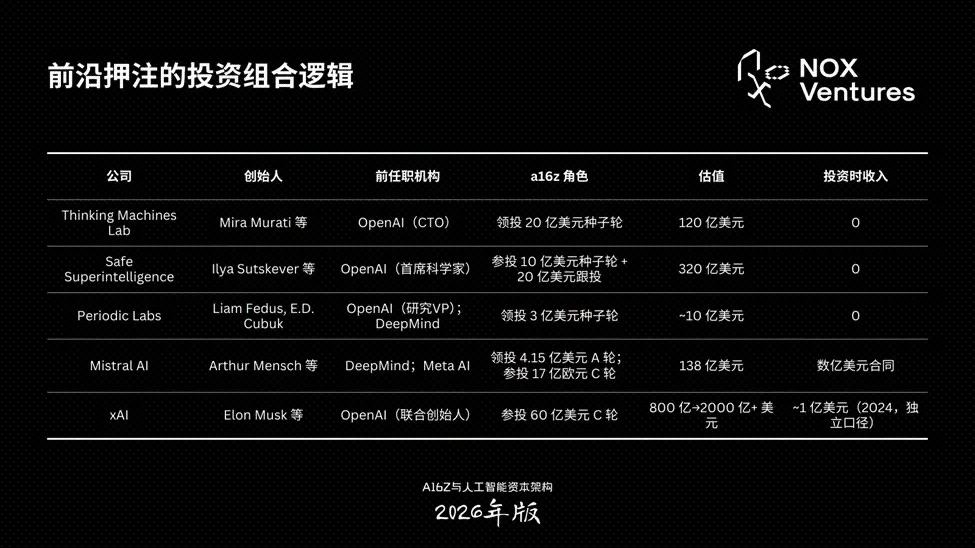
Sources: TechCrunch; CNBC; CTech; Sacra; AI Funding Tracker; a16z Announcement
Second, the turmoil at Thinking Machines Lab exposed the structural weaknesses of this model. When a $2 billion investment is built on the resumes of a team of thirty, the departure of each co-founder constitutes a substantial detriment to the investment argument. Three of the five co-founders left within six months of the seed round closing—two of whom returned to the organizations they left—demonstrating that the talent moat surrounding these companies is far shallower than their valuations suggest. TechCrunch reported that "the departure of co-founders less than a year after the company's founding is particularly noteworthy" and "could be seen as a particularly significant setback" (TechCrunch, "Losing Two Co-Founders"). The comparison to SSI is illuminating: Sutskever's lab maintained a small and stable team precisely because it refused aggressive hiring and the organizational complexity that led to Thinking Machines' collapse.
Third, the core of the portfolio logic is deliberate redundancy. By simultaneously holding positions in OpenAI, xAI, Mistral, SSI, Thinking Machines, and Periodic Labs, a16z effectively constructs a cutting-edge model index fund—diversifying its exposure to the assumption that "basic AI research will generate excess returns," regardless of which specific lab ultimately achieves the next breakthrough. Anjney Midha, a venture partner at a16z, perfectly exemplifies this interconnected strategy: he personally serves on the boards of Mistral AI, Periodic Labs, and several infrastructure companies serving the broader model ecosystem (including OpenRouter and LMARaena) (a16z, "Investing in OpenRouter"). This network of cross-held board seats enables cross-portfolio coordination—driving collaborations, sharing proprietary intelligence on model performance trends, and guiding computing power allocation—something difficult for any investor investing in a single company to replicate.
Fourth, the boundary between "cutting-edge labs" and "infrastructure companies" is collapsing. Thinking Machines Lab's first product, Tinker, is not a cutting-edge model but rather a fine-tuned API—strictly speaking, an infrastructure product. Periodic Labs' value proposition similarly relies on its robotics lab hardware, on par with AI inference capabilities. Mistral is simultaneously a model builder, API provider, and (with the launch of Mistral Compute) an infrastructure company. This blurring suggests that traditional venture capital classifications—"model layer," "infrastructure layer," and "application layer"—may be less analytically valuable than a classification based on research ambition and competitive barriers. a16z clearly recognizes this: the investments discussed in this chapter span multiple internal team managements; Midha straddles both infrastructure and cutting-edge model lines; Jennifer Li's infrastructure team invests in both basic model companies and tool projects; and the Growth Fund supports the massive funding rounds of OpenAI and xAI, which defy simple categorization.
Whether this combination is visionary or wasteful will depend on a question that remains truly unresolved as of early 2026: can a new lab, no matter how talented its founders, train results that rival those produced by institutions that spend hundreds of billions of dollars annually on computing power?
Sutskever believes the answer lies in new research paradigms beyond scaling. Murati bets on post-training efficiency and open-source fine-tuning as the key. Mistral is betting on open weight models and European sovereignty. Periodic Labs hypothesizes that the forefront of AI progress now requires not more internet text, but real-world experimental data.
a16z's approach remains consistent—betting simultaneously in all directions.
IV. AI Infrastructure, Computing Power, and Developer Tools
4.1 The "Shovel and Pickaxe" of the Intelligent Revolution
Every technological paradigm shift has spurred a gold rush in infrastructure, and the AI era is no exception. In the 19th century, hardware stores, rail freight, and explosives factories were just as profitable as miners themselves; by the 2020s, the equivalent "shovels and picks" have become new chip architectures, inference routing layers, model evaluation platforms, and generative media engines.
Andreessen Horowitz put this belief into practice with a structured funding commitment unmatched by its peers: the company allocated $1.7 billion from its recently raised $15 billion—one of the largest venture capital pools ever—specifically to its infrastructure team, targeting the underlying foundation driving the AI revolution (Bort, "What a16z Is Actually Funding"; "A16z AI Infrastructure Fund"). This is not a minor adjustment to the previous funding cycle—when the company raised $7.2 billion in 2024, the infrastructure team's $1.25 billion already exceeded that of any other vertical team (Bort). The 2025 allocation represents an actual increase of 36%, sending a clear signal: a16z believes the infrastructure gap is widening, not narrowing.
The team responsible for deploying this funding is co-led by two complementary leaders. Martin Casado, the general partner overseeing the entire infrastructure business line, is described by Bloomberg as "some kind of successor to Horowitz—the latter being the firm's original infrastructure experts" (Verhage and Bergen). His partner, general partner Jennifer Li, manages a strong portfolio spanning early and growth stages, including industry leaders such as OpenAI, ElevenLabs, Ideogram, Cursor, Black Forest Labs, and Fal (Bort, "What a16z Is Actually Funding").
Li's investment philosophy provides a useful lens for understanding these deals: her team primarily seeks out startups that address fundamental bottlenecks in AI development and deployment—companies that revolutionize computing efficiency, platforms that manage massive datasets, and teams building the next wave of foundational models (CXO DigitalPulse). She identifies two structural forces shaping near-term opportunities that deserve particular attention: first, the growing shortage of experienced AI talent, which is already constraining the growth of AI-native startups; and second, the rising importance of search infrastructure—a field she believes remains undervalued despite its central role in AI systems' large-scale retrieval, organization, and reasoning of information (CXO DigitalPulse; "Revealing a16z's $1.7 Billion AI Infrastructure Strategy").
These two bottlenecks—human capital and data retrieval—act like a red thread running through the entire portfolio in 2025, connecting seemingly unrelated projects.
Crucially, a16z has a similarly clear stance on "what not to invest in." Despite the massive global construction of AI data centers, a16z has consistently refrained from directly betting on the trillion-dollar data center infrastructure boom—though not without its regrets. Casado admits to missing out on the new wave of cloud computing, frankly stating regarding CoreWeave, "We foolishly convinced ourselves not to invest" (Verhage and Bergen). Instead, the company chooses to invest relatively small but highly confident stakes in companies that address the bottlenecks of the software layer above bare metal—a strategy that has yielded astonishing returns, measured by the book value of early bets like Cursor.
The infrastructure investments confirmed for 2025 span four sub-layers of the AI technology stack: silicon and computing power, developer tools, inference routing and model evaluation, and generative media infrastructure. Together, they constitute a16z's most coherent full-stack infrastructure discourse to date—deliberately covering every link in the chain, from transistor physics to the API call initiated by a product engineer in a production environment.
4.2 Unconventional AI: A New Chip Architecture
The most noteworthy infrastructure deal of 2025—and perhaps the most noteworthy deal in the entire seed round market—was Unconventional AI’s $475 million seed round.
Founded by Naveen Rao, former AI head at Databricks, the company has completed a funding round at a $4.5 billion valuation, co-led by Andreessen Horowitz and Lightspeed Venture Partners, with participation from Lux Capital, DCVC, Databricks, and Amazon founder Jeff Bezos (Wiggers, "Unconventional AI Confirms"; Tech Funding News). This round is reportedly just the first tranche in a planned total fundraising of up to $1 billion (Wiggers). Even more surprisingly, the company went from inception to closing the funding round in just two months (Data Center Dynamics).
The investment argument builds on a fundamental insight that a16z articulated in a public statement: "Unconventional's core observation is that AI models are probabilistic, but the chips used to train and run them are not" (Andreessen Horowitz, "Investing in Unconventional"). Specifically, the company is designing new chips specifically for probabilistic workloads, employing analog and mixed-signal designs to store precise probability distributions directly in the underlying physical matrix, rather than using numerical approximations—theoretically, such chips could consume O(1,000×) less power than digital computers (Andreessen Horowitz, "Investing in Unconventional").
This ambition is radical: to replace the deterministic numerical paradigm that has dominated computation since the 1950s with a natively probabilistic computational matrix.
The premise for this bet is a series of converging pressures. As a16z points out, training cutting-edge models typically requires hundreds of thousands of GPUs; inference clusters are often quite large or even larger, with no clear upper limit to growth; and the construction of new data centers exceeding 1 gigawatt, once considered impossible, is now commonplace (Andreessen Horowitz, "Investing in Unconventional"). Rao's resume somewhat mitigates the inherent execution risks of hardware moonsailing projects: he previously sold Nervana Systems to Intel for approximately $350 million in 2016 and MosaicML to Databricks (Data Center Dynamics) for $1.3 billion in 2023. a16z also acknowledges that analog computers have historically faced scalability challenges, but the team has "multiple theoretically sound directions, including oscillators, thermodynamics, and spiking neurons," and the company believes that "now is the right time to seriously try, as AI is creating new markets and driving changes across the entire computing stack" (Andreessen Horowitz, "Investing in Unconventional").
It's essential to understand the magnitude of this bet. $475 million invested in a company without a product represents one of the largest seed-stage capital deployments in venture capital history for Unconventional AI. The underlying belief is that the energy consumption bottlenecks of GPU-centric AI infrastructure have become severe enough to support a paradigm-shifting gamble—and the window for such a bet is narrowing before existing architectures become more rigid.
4.2 Anysphere (Cursor): Developer Tools and Code Automation
If Unconventional AI represents the boldest bet on the future of computing power, then a16z's investment in developer tools represents a far more directly validated assertion: the tools used to write and deploy software are themselves being rewritten by AI, and companies that capture this transformation will achieve compound growth at an unprecedented rate in history.
Anysphere (Cursor) may be the most extraordinary growth story in SaaS history. The most intuitive way to understand the company's trajectory by 2025 is to look at the speed at which it raises funds.
In June 2025, Anysphere raised $900 million at a $9.9 billion valuation, led by Thrive Capital, with participation from Andreessen Horowitz, Accel, and DST Global (Temkin, "Cursor's Anysphere Nabs $9.9B"). Just five months later, in November, Cursor announced the completion of a $2.3 billion Series D round at a post-money valuation of $29.3 billion—almost three times the June figure—confirming that it would deepen its partnerships with existing investors Accel, Thrive, and Andreessen Horowitz while bringing in new partners such as Coatue, Nvidia, and Google (Cursor, "Series D"; Rooney, CNBC). By the time the Series D round closed, Anysphere reported annualized revenue exceeding $1 billion, compared to just $100 million in ARR in January 2025 (Contrary Research; Rooney).
From $100 million to over $1 billion in ARR in just one calendar year—nothing unprecedented in the enterprise software industry. Multiple media outlets, including Bloomberg, have called Anysphere "the fastest-growing startup ever" (Summit Ventures). As of December 2025, the company has raised approximately $3.4 billion in total funding, completed in seven rounds (Contrary Research).
Of particular note is that Anysphere achieved this growth with zero marketing investment—a rarity in Silicon Valley—and its users include top AI labs like OpenAI, mainstream companies like Uber, Spotify, and Instacart, and even unexpected users like Major League Baseball (Tech Funding News, "Anysphere Soars").
For a16z, Cursor is a textbook example of an infrastructure investment: an AI-native Visual Studio Code fork that has become an integral part of the development workflow, integrating models from companies like Anthropic and OpenAI into a comprehensive platform for writing, reviewing, and understanding code. Matt Bornstein, recently promoted to general partner on a16z's infrastructure team, was the driving force behind the initial Cursor investment—when the company was valued at only $400 million (Verhage and Bergen; Andreessen Horowitz, "Matt Bornstein"). By November 2025, this investment had grown more than 70 times—a vivid illustration of the asymmetric returns that infrastructure investments can generate when product-market fit grows at an "AI speed" compounded.
4.3 OpenRouter and LMARaena: Inference Routing and Model Evaluation
The second, and more structurally novel, aspect of a16z's infrastructure argument targets the emerging middleware layer—the layer that bridges the gap between AI model providers and the developers who use them. Two investments in 2025 clearly outline this category: OpenRouter and LMARaena.
OpenRouter has completed a total of $40 million in seed and Series A funding rounds, co-led by Andreessen Horowitz and Menlo Ventures, with participation from Sequoia, valuing the company at approximately $500 million (GlobeNewsWire; Sacra, "OpenRouter"). Founded in 2023 by OpenSea co-founders Alex Atallah and Louis Vichy, the company provides a unified API that allows developers to access over 400 large language models from more than 60 providers through a single endpoint (Sacra, "OpenRouter").
The growth momentum is incredibly strong: annualized inference spending surged from $10 million in October 2024 to over $100 million in May 2025, with over 1 million developers using the API (GlobeNewsWire). By the end of 2025, OpenRouter will process over 1 trillion tokens daily, serving over 5 million developers (Andreessen Horowitz, "State of AI"). Anjney Midha, General Partner at a16z, stated their investment rationale: "The AI technology stack is fragmenting. OpenRouter is unifying them with a single API, a single contract, and industry-leading availability—this is the kind of infrastructure investment that defines a new category" (GlobeNewsWire).
LMArena secured $100 million in seed funding led by a16z and UC Investments, with participation from Lightspeed, Felicis, Kleiner Perkins, and The House Fund (PR Newswire, "LMArena Secures $100M"). Founded by UC Berkeley professors Ion Stoica and Wei-Lin Chiang, the platform runs an open, community-driven infrastructure layer for evaluating the real-world performance of AI models—it has completed over 400 model evaluations, collected over 3 million votes, and influenced various proprietary and open-source models, including those from Google, OpenAI, Meta, and xAI (PR Newswire).
In January 2026, LMARaena completed a $150 million Series A funding round at a valuation of $1.7 billion—almost three times its seed round valuation—led by Felicis and UC Investments, with continued investment from a16z (PR Newswire, "LMArena Raises $150 Million"). The company's annualized consumer runs exceeded $30 million in December 2025, less than four months after the launch of its first commercial product (PR Newswire, "LMArena Raises $150 Million").
Midha succinctly summarized the company's belief: "We invested in LMArena because the future of AI depends on reliability" (Andreessen Horowitz, "Investing in LMArena"). a16z's description of the platform "Polaris" is also quite insightful: "Companies that make AI 'boring' will create the greatest value. Not 'boring' to the point of being unimpressive, but 'boring' to the point of being reliable, predictable, and trustworthy" (Andreessen Horowitz, "Investing in LMArena").
Taken together, OpenRouter and LMARaena reflect a16z's assessment: when the AI technology stack is fragmented among dozens of model providers, the integration, routing, and evaluation layers will become critical chokepoints—and neutral platforms trusted by developers will capture a disproportionate share of the value.
4.4 Black Forest Labs and Fal: Generative Media Infrastructure
The infrastructure team's portfolio extends far beyond text-centric AI, encompassing a rapidly growing generative media technology stack. These two investments anchor a16z's position in the field of visual intelligence infrastructure.
Black Forest Labs, a Freiburg-based startup founded by the original co-creators of Stable Diffusion, raised $300 million in Series B funding in December 2025 at a valuation of $3.25 billion. The round was co-led by Salesforce Ventures and Anjney Midha's AMP fund, with participation from a16z, NVIDIA, General Catalyst, Temasek, and others (TechCrunch, "Black Forest Labs Raises $300M"). a16z has been an investor since the company's seed round in August 2024, and Midha serves on the board (Andreessen Horowitz, "Investing in Black Forest Labs"). The company's FLUX series of models has become one of the most widely used image generation systems globally, powering production workloads at Adobe, Canva, Meta, Picsart, ElevenLabs, and Vercel (Dakota). Total funding has exceeded $450 million (Tech Funding News, "Black Forest Labs").
Fal, a real-time generative media platform, completed three funding rounds in 2025 alone—a pace reflecting a surge in demand driven by usage rather than simply a need for capital expenditure (BusinessWire, "Fal Raises $140M"). These included a $49 million Series B round in February co-led by Notable and a16z, a $125 million Series C round in July led by Meritech, and a $140 million Series D round in December led by Sequoia at a valuation of $4.5 billion, with continued participation from Andreessen Horowitz (Sacra, "Fal.ai"; BusinessWire). Sacra estimates that Fal will reach $200 million in annualized revenue by October 2025, compared to approximately $25 million at the end of 2024 (Sacra, "Fal.ai"). a16z invested in Fal.ai from its $9 million seed round, making it one of the company’s earliest bets on generative media infrastructure (Sacra, "Fal.ai").
Ideogram, an AI image generation company co-founded by former Google Brain researchers, marked the end of an era for generative media portfolios. a16z co-led a $16.5 million seed round for Ideogram in 2023 with Index Ventures, followed by an $80 million Series A round in February 2024 (Andreessen Horowitz, "Investing in Ideogram"; VentureBeat). As of early 2026, both Ideogram and Fal remained active portfolio companies on the infrastructure team (Bort, "What a16z Is Actually Funding").
4.5 Groq's Acquisition of Nvidia: Inference Chips
Beyond its direct investments, a16z's infrastructure argument also intersects with the broader inference chip market—a market poised for a dramatic turnaround in 2025.
Groq, a Mountain View-based AI chip startup, develops a proprietary language processing unit (LPU) for ultra-low latency inference. In September 2025, the company completed a $750 million Series E funding round at a $6.9 billion valuation, led by Disruptive, with significant participation from BlackRock, Neuberger Berman, Samsung, and Cisco (Groq, "Raises $750 Million"). Earlier in February, Groq also secured a $1.5 billion commitment from Saudi Arabia to expand its LPU-based inference infrastructure in the Middle East (Sacra, "Groq"). Portfolio tracking agencies list Groq as part of a16z's broader AI investment stack (FeedtheAI), but it's worth noting t