Author: Jiawei | IOSG Ventures
Let me tell you a story first.
Imagine waking up one morning in 2027.

You tell your AI agent: “Book me a flight to Seoul next week. Budget under $700, window seat.”
Then you go brush your teeth.
Your AI agent gets to work — It needs to:
- Find an AI agent that’s good at comparing flight prices
- Make sure this agent is legit and not a scammer
- Have it search across all major platforms
- Compare results and pay automatically
- Complete the booking
By the time you’re done brushing, the ticket is booked.
Sounds like sci-fi, right? But technically, we’re already pretty close. There’s just one problem —
How does your AI know which AI to trust?
The “trust crisis” of AI agents
AI agents aren’t a new concept anymore. They can browse the web, write code, manage your calendar, even trade crypto for you.
But there’s a problem that’s never been solved: These AI agents are all islands.
- OpenAI’s agents only play nice with OpenAI’s ecosystem
- Google’s agents only follow Google’s rules
- Different companies’ AIs don’t talk to each other as they have no idea who the other one is
It’s like the early days of the internet, when each email provider’s users could only send emails to their own people. Hotmail users couldn’t message Yahoo users.
Crazy, right?
But that’s exactly where the AI agent world is at today.
Two protocols enter the chat
The tech giants noticed this problem.
Google launched the A2A protocol (Agent-to-Agent), letting different AI agents “talk” to each other. Think of it as giving AIs a common language. In June this year, Google even donated it to the Linux Foundation — a signal that they want this to be an open standard.
Anthropic launched the MCP protocol (Model Context Protocol), letting AI agents connect to various tools and data sources.
These two protocols solved the “communication” problem.
But there’s an even more fundamental issue they didn’t touch:
How do you find a reliable AI agent? How do you know if it’s doing a good job?
A2A lets AIs have conversations, but it doesn’t tell you who’s worth talking to.
It’s like having a phone but no yellow pages.
ERC-8004: Giving AI agents a “passport” and “credit score”
That’s what ERC-8004 is here to solve.
Put simply, it gives AI agents three things:
1. An ID card (Identity)
Every AI agent registers on Ethereum and gets a unique ID. This ID is actually an NFT — yes, that NFT. This means:
- Your AI agent has a verifiable on-chain identity
- The identity can be transferred
- No one can fake it or tamper with it
2. A credit score (Reputation)
People who’ve used an AI agent can rate it. These ratings are recorded on-chain for anyone to see. It’s like:
- Uber driver star ratings
- eBay seller feedback scores
- But it’s on the blockchain, so no fake reviews or deleting bad ones
3. Verification (Validation)
For high-stakes tasks (like financial transactions), ratings alone aren’t enough. ERC-8004 supports independent third-party verification:
- Someone stakes money to re-run the task and verify the results
- Cryptographic proofs (ZK proofs) verify the AI didn’t lie
- Trusted Execution Environments (TEE) ensure the computation wasn’t tampered with
Higher risk, stricter verification.
Ordering pizza? Check the ratings. Managing your investment portfolio? You’ll need cryptographic proof.
Wait, so why Ethereum?
Good question.
The AI agent economy is worth trillions. Google, Microsoft, OpenAI — they all want to own this pie. So why build this “trust layer” on Ethereum?
The answer: Neutrality.
Think about it. If you were an AI agent, would you rather:
- Have your identity stored on Google’s servers, or on a public ledger no one can change?
- Have your reputation decided by some company, or by transparent on-chain ratings?
- Have your existence depend on some platform not going bankrupt or banning you, or be permanently recorded on a blockchain?
Binji from Ethereum Foundation said something that really stuck with me:
“If you were an agent with no loyalty except to your own survival, you wouldn’t want to bet your memory and reputation on one corporation or one government. You’d want a ledger that no one could quietly change behind your back. You’d want neutral ground. You’d want Ethereum.”
This isn’t the community hyping itself up. It’s just logic:
AI agents need a playing field with no referee. And blockchains — especially one as decentralized as Ethereum — are exactly that.
Ethereum’s AI ambitions
Ethereum Foundation clearly sees this as a historic opportunity.
In September 2025, they launched a dedicated dAI team (Decentralized AI Team). The mission: make Ethereum the settlement and coordination layer for the AI economy.
This is a crucial step in Ethereum’s transformation from “the DeFi chain” to a “general coordination layer.”
Think about it:
- 2017–2020: Ethereum was the platform for ICOs
- 2020–2023: Ethereum was the platform for DeFi and NFTs
- 2024-?: Ethereum could become the infrastructure for the world AI agent economy
ERC-8004 isn’t just some random proposal. It’s backed by Ethereum’s strategic bet on the next decade.
The ecosystem is already moving
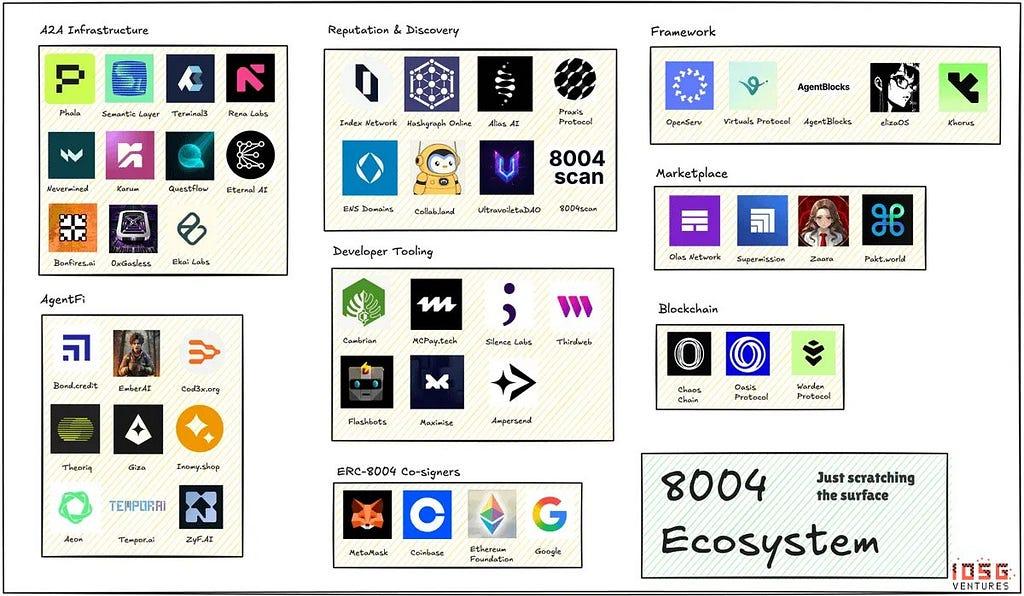
This isn’t just talk.
Since the August launch:
- 1,100+ developers are building in the community
- 70+ projects have submitted demos
- Agent explorers already exist (8004scan.io)
- A bunch of projects demoed live at DevConnect on November 21
The coolest part? ERC-8004 naturally pairs with the x402 protocol.
Put the two together:
- x402 handles “how to pay”
- ERC-8004 handles “who to trust”
One provides the wallet, the other provides the passport.
The economic loop for AI agents is complete.
What does this mean for regular people?
In the short term, probably nothing.
But if this takes off, in a few years you might:
1. Hire AI agents like calling an Uber
Open an interface, type in your task, the system automatically matches you with highly-rated AI agents, task gets done, payment goes through. You don’t need to know who built this AI or what server it runs on.
2. Have AI agents make money for you
You could train or configure an AI agent, register it on-chain, and let it complete tasks for others and get paid. The higher its rating, the more work it gets.
3. Finally have a truly personal AI assistant
No more being locked into one company’s ecosystem. Your AI assistant could call on any AI agent registered on-chain to get whatever you need done.
Final thoughts
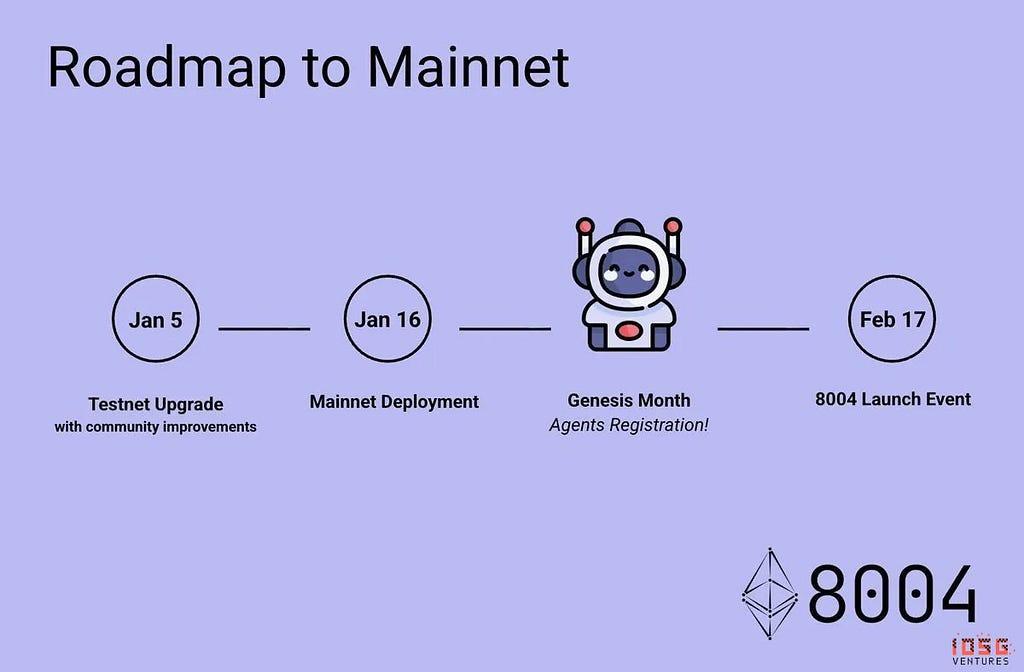
ERC-8004’s ambition is to become the “TCP/IP” of AI agents — a foundational protocol everyone uses, making this whole ecosystem interoperable.
Will it work? Honestly, no one knows.
But a few things are certain:
- The AI agent economy is happening — this isn’t just hype
- The trust problem must be solved, or agents will be stuck playing in their own walled gardens
- Ethereum is actively fighting for the position of “neutral coordination layer”
- Major players (Google, Coinbase, MetaMask) are all involved
This might be the most important narrative shift in the Ethereum ecosystem since DeFi.
From “on-chain finance” to “on-chain intelligence.”
Let’s see how it plays out.
Links:
- Official EIP: eips.ethereum.org/EIPS/eip-8004
- Website: 8004.org
- Community discussion: ethereum-magicians.org

Decentralized AI: Ethereum’s Long Game was originally published in IOSG Ventures on Medium, where people are continuing the conversation by highlighting and responding to this story.